Home / Low Strength / 77 Melon Mint Nicotine Pouches
77 · 5.2mg
Read the full guide
77 Melon Mint Nicotine Pouches
£39.90
✔ In stock — ready to ship
100% tobacco-free
Free over £20
Same-day dispatch
Secure checkout
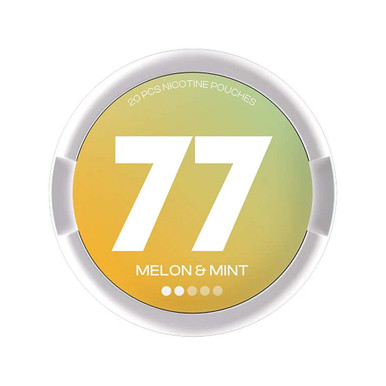
This page is for 77 Melon Mint Nicotine Pouches. The price is £39.90. There is one declared strength on the listing, 5.2mg, and the flavour record we hold gives two entries: mint and watermelon. We list it as in stock at the time of writing. That is the complete set of facts we have about this product, and everything below is either a description of the object, a comparison against other cans on our shelves, or a plain statement that we do not hold a particular piece of information.
We have written this page the way the counter conversation usually goes. Somebody already knows what a pouch can is, already buys them, and wants to know three things: what this one tastes of, how it compares with the other cans sitting next to it, and what the number on the lid means as a number. Those are answerable questions. Some of the other questions people ask are not answerable without inventing something, and where that is the case we say so instead of filling in the gap.
The full guide to 77 Melon Mint Nicotine Pouches
5,687 words on how it eats, who it suits, how to serve it and what to put beside it.
What this listing covers
Two housekeeping notes before anything else. First, this is an adult nicotine product. It is sold only to people aged 18 or over who already use nicotine, and the full compliance wording sits in its own section at the foot of this page. Second, the can in your hand is always a better source than a website. Manufacturers change printing, pack contents and presentation without telling retailers. Where the printed can and this page disagree, believe the can.
The last thing worth saying in an opening paragraph is what this product is not. It is not a multi-flavour assortment, it is not sold here in more than one strength, and it is not a variable listing where the price moves depending on which option you pick. One product, one flavour description, one figure, one price. The simplicity of that is the main reason this page can afford to spend its length on comparison rather than on explaining a complicated product structure.
Melon and mint, taken as a taste
The flavour record we hold gives mint and watermelon, and the name printed on the can is Melon Mint. Those two things point at the same thing from different directions, and it is worth separating them, because a melon-and-mint pouch is not a mint pouch with fruit added, nor a fruit pouch with a bit of mint thrown over the top. It is a pairing where both halves are meant to be audible at once.
Taking the melon side first: watermelon as a flavouring reads as light, watery-sweet and slightly green at the edge. It is one of the mildest of the fruit characters on a pouch shelf — there is no acid bite in it the way there is in citrus, and no jammy depth the way there is in a dark berry. Watermelon flavouring tends to sit in the front of the mouth and stay there, sweet without being heavy, and it is easy to lose underneath anything more assertive. That is the flavour's main weakness and also the reason it is so often put with mint: the mint gives it a spine.
Taking the mint side: mint here is the partner, not the headline. Mint flavourings cover a wide territory — the sharper, greener spearmint character at one end, the colder peppermint and menthol-leaning characters at the other — and a melon-mint pairing generally leans towards the cooler end, because cool is what makes a watery fruit read as refreshing rather than flat. What you should expect as aroma, when the lid comes off, is the mint arriving a fraction before the melon. That is usual with this kind of pairing; the cooler note is simply more volatile.
Put together, the taste is a sweet, light fruit character with a cool green line running through it. Neither half is doing anything complicated. There is no spice, no cream, no dark or roasted note, and no citrus edge, because nothing of that sort appears in our flavour record for this can. If you want to hear the fruit on its own, without the mint underneath it, that is a different product, and we point at a couple of them further down the page.
One honest limitation on all of the above: flavour writing describes a family, not a specific formulation. We hold the flavour tags, not the recipe, and we are not going to pretend otherwise. Two cans tagged mint and watermelon by two different manufacturers can be noticeably different in the mouth. The only way to know where a specific can lands is to have one.
The pouch, the lip and the clock
The format is the same across every product on this site, whatever the brand or the flavour. A pouch is a small sealed sachet. It is placed in the mouth, between the lip and the gum, usually at the front and most often under the top lip, and it stays there. It is not chewed, it is not sucked like a sweet, and it is not swallowed. When the person is finished with it, it comes out in one piece.
The physical routine is short: lid off, one pouch out, lid back on. The pouch goes in, the lip holds it, and it stays where it was put unless it is moved. Most people settle on a side and a position within a few uses and then stop thinking about it. It can be shifted from one side of the mouth to the other if the spot it is in becomes uncomfortable, and if it is uncomfortable in every position, the sensible response is to take it out. Comfort is not something to push through.
How long people keep one in varies widely, and we would rather give the honest range than a made-up number. Across the pouch category, the usual span people describe is somewhere between roughly twenty minutes and around an hour, with plenty of people at both ends of that. The flavour is the part that changes first and most obviously: it is at its clearest early and fades from there, which is why a good number of people take a pouch out when the taste has gone rather than watching a clock. That is a description of what people do, not an instruction, and we are not telling anyone how long to keep anything anywhere.
Disposal is the part most often left out of product pages, so: the used pouch goes in a bin. Pouch cans of this general type usually have a shallow compartment built into the underside of the lid, intended to hold used pouches until you reach one. We do not hold a specification sheet for this particular can, so we are not going to promise you the compartment is there — open the can and look. If it is, it is for carrying rubbish, not for storage, and it is worth emptying regularly for obvious reasons. Used pouches do not go down a drain or a toilet.
5.2mg, read as a figure on a lid
The number on this can is 5.2mg. Read it as a declared figure per pouch, printed by the manufacturer, and treat it as a label rather than as a description of an experience. It is a unit of measurement the industry uses so that one product can be placed next to another on a shelf. That is genuinely all it is on this page.
What the figure is useful for is ordering. It lets us file cans in ascending order and lets you find the part of the range you already buy from. Because of that figure, this listing sits on our low-strength shelf, which holds fifteen cans in total. That is a small shelf by our standards, and it is worth knowing that it is small, because it means the choice at this end of the range is narrower than it is further up.
What the figure is not useful for is prediction. Two cans printed with the same number are not guaranteed to be the same in use, and we will not tell you they are. Pouch size, moisture, flavour intensity and how a particular manufacturer builds a pouch all vary, and none of those things appear in a milligram figure. We hold the declared number and nothing behind it.
We also want to be unambiguous about what this section is not doing. It is not advice. We cannot tell you whether 5.2mg is the right figure for you, we do not know anything about you, and choosing a strength is your decision and not ours. Everything written here and in the section below is comparison between products on a shelf. If you are looking for a recommendation, we do not give them.
5.2mg against the rest of what we stock
This is the part of the page worth the most, because it is the part that cannot be got from the can itself. A can tells you what it is. It does not tell you where it sits among the two hundred-odd other cans in the room. Below is that placement, set out as information.
Where it falls on our strength shelves
Our shelves are split by declared figure, and 5.2mg puts this can at the bottom of that split, on the fifteen-can low shelf. Above it sits the medium shelf, which runs to a hundred and thirty-five cans and is by a distance the busiest part of our catalogue. Above that again are the strong shelf and the extra-strong shelf, each holding products with higher declared figures on the lid.
The shape of that distribution is worth noticing as a plain fact about the market: the shelves are not evenly filled. There are nine times as many cans on the medium shelf as on the low one. If you buy at the bottom of the range, you are shopping from a much smaller pool, and you will exhaust it faster. That is the practical consequence of the figure on this can, and it is a stocking fact rather than a statement about anything else.
Same figure, different can: what else we list near this number
Within the low-strength part of our range, the useful comparison is not brand against brand but flavour against flavour, because the declared numbers cluster tightly. Sticking with the fruit-and-mint construction, Fumi Watermelon Mint at £27.90 is the closest neighbour by description — the same two flavour families in the same order, from a different maker and at a different price. ZYN Watermelon Mint, listed at £19.99, is the third can we hold with that same pairing in the name, which makes three cans that read almost identically on paper and are unlikely to be identical in the mouth.
If the melon is the part you are after and the mint is the part you could do without, Nordic Spirit Melon Fresh at £4.49 is the obvious can to put alongside this one, and its price is the lowest of any product mentioned on this page. Going the other way — keeping the fruit, moving the cold up — Velo Watermelon Ice at £4.19 and 77 Watermelon Ice at £39.90 both put watermelon against an iced presentation rather than a plain mint one. All four of those sit on the watermelon shelf, which holds twenty-three cans in total.
Reading across the price column
The prices quoted in the paragraphs above range from £4.19 to £39.90, which looks like an enormous spread until you notice what it usually reflects: some of our listings are priced as a single can, and some are priced as a larger quantity. We do not publish a can count for this listing, so we are not going to tell you how many cans £39.90 buys here — the basket page and the printed outer are where that gets settled. What we can say plainly is that you should never read two prices on this site as a like-for-like comparison without checking what each one covers. A £4.19 listing and a £39.90 listing are not four-and-a-half pounds apart in any meaningful sense.
Within the £39.90 group specifically, this can has a lot of company. Clew Cool Mint, Denssi Cold Mint, XQS The Spearmint and Cuba Black Apple Juice are all listed at the same £39.90 as this can, which makes them the natural set to look at if price is the thing you are holding constant. Three of those four are mint-family cans and the fourth is a straight fruit; between them they cover most of what a mint shelf and a fruit shelf are for. UBBS Spicy Cherry at £19.95 sits between the two price groups and is the only can we mention here with a spiced description.
The mint shelf as a whole
Mint is the largest flavour category we run: the mint shelf holds a hundred and forty-eight cans. That number is the single most useful piece of context for this product, because it explains why "mint" tells you almost nothing on its own. Within those hundred and forty-eight there are plain mints, doubled mints, spearmints, frost-and-ice presentations, and — like this one — cans where mint is the second name rather than the first. Melon Mint is in the last of those groups. It appears on the mint shelf because mint is genuinely in it, not because mint is the point of it.
The can itself, as an object you handle
The second thing worth a long section is the physical can, because it is the part of the purchase you interact with several times a day and the part that product pages usually skip in a sentence.
Shape, lid and closure
Pouch cans of this type are shallow round tins — a cylinder considerably wider than it is tall, sized to be closed inside a hand. The lid lifts off and presses back on. There is no screw thread, no hinge and no catch to release; it is friction, and a well-made can has enough of it that the lid stays on in a pocket and little enough that it comes off without a fight. The fit is the single most important piece of engineering in the object, and it is the thing most worth checking on the first can of any new purchase.
The top face of the lid is where the information lives: brand, flavour name, and the strength figure. That matters more than it sounds. If you keep more than one can in the house — and most people who buy at this end of the range keep two or three — the lid is the only surface you actually look at. Cans of different flavours from the same maker are often near-identical apart from colour, so getting into the habit of reading rather than recognising saves a certain amount of annoyance.
Inside: the ring, and the count we do not publish
Open it and the pouches are laid flat in a ring around the inside of the base, backs up, which is what lets you lift one out with a fingertip rather than digging. As the can empties the ring thins out and the remaining pouches tend to shift; that is normal and not a sign of anything.
We do not publish a pouch count for this product. Our record simply does not carry one, and rather than guess a number that sounds plausible we will say plainly: we do not hold it. The printed can carries that figure, and that is where to read it. The same applies to the can's weight, its diameter, the material it is made of, and anything else stamped on the packaging by the manufacturer. If it is not in the facts we hold, it is not going on this page, and an invented number on a product listing is worse than a blank.
The catch compartment
Most modern pouch cans include a second, shallower compartment beneath the lid, separated from the pouches by an inner disc. It exists so that a used pouch has somewhere to go when there is no bin within reach. Whether this particular can has one is something we cannot confirm from our record, so check the can. If it does, treat it as temporary storage for rubbish: it fills quicker than people expect, it is the part of the can that gets unpleasant if it is ignored, and emptying it when you open a fresh can is a reasonable habit.
Pocket, bag, drawer
In practical terms the can is a puck. It goes flat in a jacket pocket without a bulge, it sits awkwardly in a tight trouser pocket because of its diameter rather than its depth, and it disappears entirely into any bag with a small internal pocket. Kept loose in a bag it will end up under everything else, and the lid, being friction-fitted, is the part that suffers when it is knocked around at the bottom of a rucksack for a week. A can that has been squashed out of round will never seal as well again — that is the main way people damage them.
At home, the thing people underestimate is how many cans accumulate. A part-used can from a flavour someone went off, two spares from the last order and the one currently in use is four cans in a drawer, all of them nearly identical from above. Keeping them in one place, lids up, is about the whole of the storage discipline required.
Melon Mint's position in the 77 line
We list twenty-nine products under this brand, and you can see the whole set on the 77 brand page. It is one of the broader ranges we carry, and the spread of it is worth describing because it tells you what kind of maker you are buying from: 77 covers fruit, mint, fruit-and-mint pairings, cola presentations, teas, a few dessert-leaning names and a sub-line of smaller-format cans.
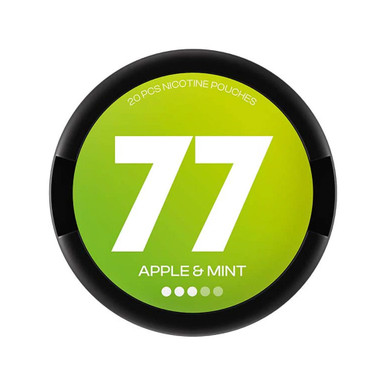
Against that spread, Melon Mint is one of the brand's fruit-and-mint entries, and one of its lower declared figures. If you want to hear what else the brand does in that construction, 77 Apple Mint at £39.90 is the closest structural sibling on our shelves — the same two-word fruit-plus-mint format, with apple where the melon is. Moving away from mint entirely, 77 Forest Fruits is the brand's mixed dark-fruit entry at the same £39.90, and a much deeper, jammier flavour family than anything on this page.
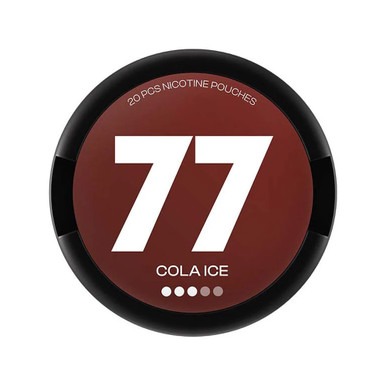
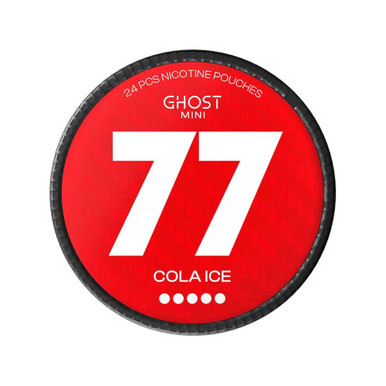
The brand also runs two cola variants on our shelves, 77 Cola Ice and 77 Cola Vanilla, both at £39.90 and both a long way from a melon-mint description — the first pairs the cola character with an iced presentation, the second with a sweet vanilla one. And there is a small-can sub-line: 77 Ghost Mini Mango and 77 Ghost Original Mini, also £39.90 each, which are worth knowing about purely as a format, since a mini can is a different object in a pocket from the standard one described above.
What people keep beside it
Almost nobody who buys pouches regularly keeps only one flavour in the house. The reason is straightforward and has nothing to do with claims of any kind: a single flavour gets monotonous, and a second can that tastes clearly different from the first is the cheapest fix for that. What follows is how a second can is usually chosen, with our reasons stated.
The commonest approach is one similar can and one deliberately unlike can. On the similar side, the three watermelon-and-mint listings already mentioned do the job: the Fumi at £27.90, the ZYN at £19.99, and the iced treatments in the 77 Watermelon Ice can and the £4.19 Velo. Any of those keeps you in the same flavour family while changing the balance.
On the deliberately unlike side, the useful move is to pick something with no fruit in it at all, so that the two cans never blur. XQS The Spearmint at £39.90 is a straight mint with the sharper green character rather than the cool one. Clew Cool Mint, also £39.90, and Denssi Cold Mint at the same price are both cans where cold is the entire description. Further out again, Cuba Black Apple Juice is a fruit with no mint behind it, and UBBS Spicy Cherry at £19.95 is the only spiced description in this group, which makes it the most complete contrast to a light melon can of anything we have mentioned.
If you would rather browse than take a shortlist, the two shelves that matter here are the twenty-three-can watermelon shelf and the mint shelf with its hundred and forty-eight entries. Between them they contain every can on this site that shares a flavour tag with this one.
Keeping a can in decent condition
Storage advice for pouches is short, and most of it is common sense about a sealed tin that has been opened.
Keep it closed. The lid is the only thing standing between the contents and the air, and a can left open on a worktop overnight will not be the same the next morning — pouches dry, and dried pouches are less pleasant to use and taste of less. Press the lid down until it sits flush rather than balancing it on top.
Keep it cool and out of direct sun. A windowsill in summer, a car's dashboard, a radiator shelf: those are the three places cans most often die. Heat is harder on flavour than anything else you can do to a can short of leaving it open. A drawer, a cupboard or any shaded shelf is fine, and nothing about this product requires a fridge. Some people keep cans refrigerated by preference; we neither recommend it nor warn against it, and it is not necessary.
Keep it upright, and keep it away from children and animals. That second point is not a formality. A pouch can is small, brightly printed and easy to open, which is precisely the combination that makes it something to store somewhere a child cannot reach. This is an adult product and it should be stored like one — high up, or in a drawer that shuts properly.
Finally, check the printed date on the base and use older cans before newer ones. If you buy more than one at a time, putting the newest at the back of the drawer takes two seconds and saves finding a two-year-old can behind the tea.
One figure, one price: what there is to decide here
Some of our listings carry several strengths on the same page and require a decision at the point of adding to basket. This one does not. There is a single variant — 5.2mg at £39.90 — and there is nothing to select. That makes the ordering side of this product about as simple as it gets.
The only real decision, then, is quantity, and that is a question about how you buy rather than about what you buy. Two cans of one flavour is the standard cautious order for someone who already knows they like it. One can plus one can of something different is the standard order for someone who does not yet know. Both are reasonable and we have no interest in pushing either.
If the figure on this listing is not the part of the range you buy from, the answer is not to buy this can in a different number — there isn't one — but to shop from a different shelf. The medium shelf is where the bulk of our catalogue sits, and the strong shelf and the extra-strong shelf hold the listings with higher declared figures. We are not suggesting you should move; we are telling you where the other shelves are.
Ordering, delivery and the check at the door
The buying process is unremarkable, which is how it should be. Add the can to your basket, add anything else you want from the full catalogue, and check out. Flavours, brands and strengths mix freely in one basket; there is no rule here that says a mint can and a fruit can have to travel separately.
We sell only to adults aged 18 or over. Age verification is part of the order process, and it is not optional and not something that can be waived by asking. Photographic ID may be requested on delivery, and the courier is within their rights to refuse to hand over a parcel to anyone who cannot produce it or who appears to be under 18. If that happens, the parcel goes back. The simplest way to avoid the whole situation is to have ID to hand if you are expecting a delivery, and not to arrange for a parcel of this kind to be accepted by anyone who is not an adult.
On stock: we list this product as available at the time of writing, but stock moves and a product page is a snapshot. The basket is the authority on what can actually be bought right now. If something has gone out between this page being written and you reading it, the listing will say so.
On delivery times and carriers, our shipping pages carry the current position, and we would rather point you at them than print a figure here that ages badly. The one thing worth saying is the general one: order everything you want in a single basket rather than in three separate ones, because a single parcel is simpler for everybody, including the person who has to be in when it arrives.
Finding this page again
If you want to come back to this can without going through a search box, there are four routes, and all of them are shelves this product sits on. It appears on the 77 range page among the brand's twenty-nine listings; on the low-strength shelf among its fifteen; on the mint shelf, which is the largest flavour category we run; and on the watermelon shelf, which is one of the smallest and therefore the fastest to scan.
If you are browsing rather than looking for something specific, the brand pages are usually the better way in, because a range tends to be internally consistent in a way a flavour category is not. The Pablo range and the Cuba range are two of the larger ones we carry besides this one, and both are worth a look if you are trying to get a sense of what a maker does across a whole line rather than in a single can. And the full shop listing holds everything at once, if you would rather start from the top.
Questions we are actually asked about this can
How many pouches are in the can?
We do not hold that figure for this product. Our record carries the price, the strength, the flavour tags and the stock position, and it does not carry a pouch count. Rather than print a number that looks right and might not be, we would rather say plainly that we do not know it. The printed can carries the count, so it can be read as soon as you have one in hand. This is not us being evasive — it is a gap in our data, and we would rather show the gap than paper over it.
How many cans does £39.90 buy?
Our record does not carry a can count for this listing either, so we cannot answer that from this page. Some listings on this site are priced as a single can and some as a larger quantity, and the listing page and basket are where that gets confirmed at the point of purchase. If the answer matters to you before you order — and it reasonably might, at this price — the basket will show what you are actually getting before you pay for anything.
Is the mint or the melon the dominant flavour?
Our flavour record gives both, and the name on the can puts melon first. Beyond that we are describing a flavour family rather than a measured formulation, and the honest answer is that balance is the thing that varies most between cans that look identical on paper. What we can say is that in pairings of this kind the cooler note is usually the one you notice first on opening the can, and the fruit is usually the one that reads as sweeter once the pouch is in. We do not hold a ratio and will not invent one.
Which strength should I buy?
We do not answer that. Choosing a strength is a personal decision, we know nothing about the person asking, and a recommendation from a shop would be worth nothing and would be inappropriate besides. What we will do is tell you what is on the shelves: this listing is 5.2mg, our low-strength shelf holds fifteen cans, the medium shelf a hundred and thirty-five, and there are strong and extra-strong shelves above those. That is information. The decision is yours.
Does it taste the same as the other watermelon cans you stock?
Almost certainly not, and we would be careful of any shop that told you otherwise. Three of the cans mentioned on this page carry the same two flavour words in their names, made by three different manufacturers, and shared flavour tags do not mean shared formulations. The tags tell you which shelf a can belongs on. They do not tell you how two cans compare in the mouth. The only reliable way to answer that question is to have both.
Is this in stock?
We list it as in stock at the time this page was written. Stock changes, though, and no product description can keep up with it in real time. The basket is the live answer: if you can add it and check out, it is there. If it has gone, the listing will say so rather than letting you order something we cannot send. We would rather you found out on the page than three days later in an email.
Can I order this alongside other flavours and brands?
Yes. There is no restriction on mixing flavours, brands or strengths within one basket, and the great majority of orders do exactly that. Practically, one basket is better than three — it is one parcel, one delivery and one occasion on which somebody has to be at the door with ID. If you are building a mixed order, the 77 range page is a quick way to add several cans from the same maker without hunting for each one.
How long should I keep a pouch in?
We do not give instructions on that, and we would be wary of a retailer who did. What we can offer is a description of the range people report across the category, which is roughly twenty minutes to about an hour, with plenty of people outside it in both directions. The flavour fades well before the end of that span for most people, which is why taste rather than time is what usually decides it. Take it out whenever you want to; there is nothing to finish.
Do you publish the ingredients or technical details?
No. We do not publish ingredient lists, composition, manufacturing detail or technical specification for this or any other product on the site, and we are not going to summarise or paraphrase what is printed on the packaging. The can and the manufacturer's own materials are the correct source for all of that. Our product pages deal with price, strength figure, flavour category, format, availability and comparison against other things we stock, and they stop there deliberately.
Where is it made, and by whom?
We do not hold that information and will not guess at it. Country of origin, manufacturing site and corporate ownership are not in the facts we keep for this listing, and inventing any of them would be worse than leaving the question unanswered. If the printed can carries that detail, the can is the place to read it.
Will I definitely be asked for ID?
You should expect to be. Age verification forms part of the order process, and photographic ID may also be requested at the door on delivery. Whether the courier asks on any given occasion is their judgement, but the safe assumption is that they will, and the parcel can be refused if ID cannot be produced. We sell to adults aged 18 or over who already use nicotine, and the checks exist to keep that true. There is no way to opt out of them.
What if I order it and do not get on with the flavour?
Flavour is subjective and we cannot predict it for anybody. Our returns position for opened consumable products is set out in our terms rather than on a product page, and the terms are the authority. The practical advice, which costs nothing, is that if you are trying a flavour for the first time and are not sure about it, order the smaller amount rather than the larger one, and put something you already know alongside it so the order is not a total loss if the new can is not for you.
Legal and compliance
This product is for adults aged 18 and over only. We sell it exclusively to adults who already use nicotine.
Nicotine is an addictive substance.
This product is not a licensed stop-smoking medicine, and it is not intended for non-smokers, for anyone who does not already use nicotine, for anyone under the age of 18, or for anyone who is pregnant or breastfeeding. Nothing on this page should be read as a health claim, a medical claim, or advice of any kind about your own use. If you have questions about nicotine and your health, those are questions for a healthcare professional, not for a retailer.
Age verification is carried out as part of the order process, and photographic ID may be requested on delivery. Couriers may refuse to hand over an order to anyone who cannot produce acceptable identification or who appears to be under 18. Keep this and every product of this kind stored securely, out of the reach of children and animals.
To close
77 Melon Mint is a single-strength listing at 5.2mg and £39.90, tagged mint and watermelon, sitting on our low-strength shelf alongside fourteen other cans. It is one of twenty-nine products we list under this brand. The flavour pairing is a light, sweet fruit with a cool line through it, and the useful comparisons are the other watermelon-and-mint cans on the shelf, which share the description without sharing the recipe.
Where we hold a fact — price, strength, flavour category, stock — this page has printed it. Where we do not — pouch count, can count, origin, composition — it has said so instead of inventing something. That is the whole approach, and it applies to every listing we write.
More from 77
More low strength pouches

More mint pouches
Where this sits
77 Melon Mint Nicotine Pouches appears in these categories. Browse them, or jump to something close.
You might also like