Home / Medium Strength / 77 Forest Fruits Nicotine Pouches
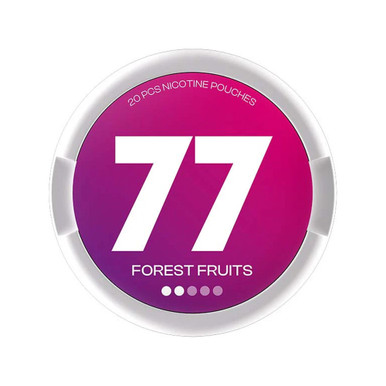
77 · 5.2mg–10.4mg · 10-can pack
Read the full guide
77 Forest Fruits Nicotine Pouches
£39.90
✔ In stock — ready to ship
100% tobacco-free
Free over £20
Same-day dispatch
Secure checkout
77 Forest Fruits Nicotine Pouches are listed at £39.90, in two declared strengths — 5.2mg and 10.4mg — at the same price for either. The listing is showing as available as this is written. The detail that sets it apart from most of what we carry is quieter than any of those: our record holds a cans-per-pack value for this product, and that value is 10.
That matters because it is the exception rather than the rule here. For the majority of listings on this site we hold no pack quantity at all, which means we cannot tell you whether a price covers one tin or several, and we say so on those pages rather than guessing. On this one we can. Ten cans are recorded against the £39.90, which works out at a little under £4 a tin, and that changes what kind of purchase this is — it is a stocking-up buy rather than a try-one buy, and the rest of this page is written with that in mind.
The full guide to 77 Forest Fruits Nicotine Pouches
4,904 words on how it eats, who it suits, how to serve it and what to put beside it.
The Forest Fruits listing, and the one number that makes it unusual
The second thing worth flagging at the top is a gap. Our flavour record for this product is empty. Not sparse — empty. Most listings here carry one or two flavour entries that determine which flavour shelves they appear on; this one carries none, which is why you will not find it filed under a flavour category anywhere on the site and why it reaches you through the 77 brand page or the medium-strength band and nowhere else. The name on the lid is the manufacturer's. It is not, on this site, a filing.
Everything else follows the usual shape: a round tin per can, a lid that lifts and presses back, a catch compartment under that lid, and pouches laid flat inside. We publish no pouch count, no tin weight, no dimensions and no date marking, because none of those are in our record. This is an age-restricted product for adults aged 18 or over who already use nicotine, and the compliance section at the foot sets that out properly.
Ten tins, and what that does to the decision
Before anything about taste, it is worth working through the practical consequence of the pack figure, because it is the part of this listing that will decide it for most people.
A ten-can pack is a commitment to one flavour in a way that a single tin is not. If you already know this product and get on with it, that is straightforwardly convenient — you buy once and stop thinking about reordering for a while. If you have never had it, you are buying ten cans of something you have not tasted, and our flavour record cannot help you narrow that risk because it is empty. Those are genuinely different positions and we would rather set them out than pretend the decision is simple.
There is also a storage consequence, which the section further down goes into. Ten tins is more than most people keep about the house at once, and pouches do not improve with keeping. The relevant habit is to leave nine of them sealed and work through one at a time, rather than opening several because they happen to have arrived together. A sealed tin in a cool drawer changes very slowly; an open one does not.
And there is a comparison worth making with the rest of the brand. Every 77 listing on this site is priced at £39.90 — the Cola Ice can, Apple Mint, Ice Mint, all of them. But we hold a pack quantity for this one and not for those. The honest reading of that is narrow: it means our record is more complete here, not that the others are single tins. We do not know what the others contain, we have said so on their pages, and the difference in our data should not be mistaken for a difference in the products.
The format, briefly, since it does not vary
A pouch is a small sealed sachet placed between the lip and the gum and left there. It is not chewed, not swallowed and not sucked in any deliberate way. Every product on this site works this way, so there is little here that is specific to this one and no reason to spend a page on it.
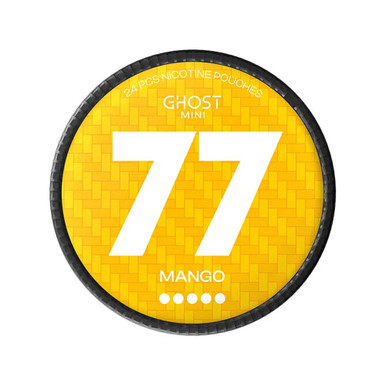
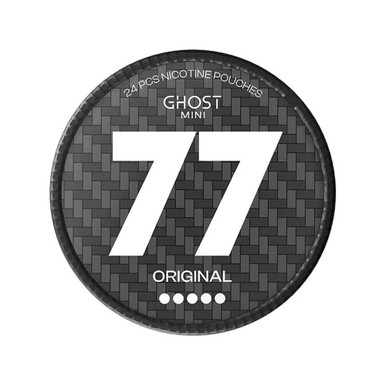
These are standard-format pouches rather than mini ones. 77 keeps its smaller pouches in a separate sub-line under the Ghost name — the Ghost Original Mini can and Ghost Mini Mango are the two we carry, both also £39.90 — and the difference between the two formats is visible the moment you have one of each in front of you. If the standard pouch has never sat comfortably for you, that sub-line is where to look rather than here.
Placement is under the top lip for most people, held there by the lip itself. It can be shifted side to side with the tongue. How long anyone keeps one in is personal habit and not something we will put a number on, since that would be advice about use rather than a description of a product. Used pouches go in the lid compartment and from there into household waste; nothing goes down a drain or a lavatory, ever.
A tasting note built from axes rather than adjectives
This is the section where a page like this usually reaches for flowery language, and this is precisely the listing where it cannot, because our flavour record is empty. So instead of describing a taste we have no record of, here is something more useful and more honest: an explanation of the four axes a pouch flavour actually moves along, what each one means, and exactly which parts of that we can and cannot fill in for this can.
Cool
Cooling is a sensation rather than a flavour, and it is the axis that varies most dramatically across our shelves. At one end sit cans with no cooling at all, where the flavour arrives and nothing else happens. At the other end are products built around the sensation, where the cold is the point and the flavour is a carrier for it — XQS Arctic Freeze at £39.90 is the clearest example we stock of that end of the scale. Between them is everything else.
For this listing, our record carries no mint entry and no ice word in the name. That is an absence of evidence rather than evidence of absence: it means we have not been given anything indicating a cooling note, and so we will not tell you there is one, and we will not tell you there is not. If cooling is the thing that matters most to you in a can, that is an argument for buying a listing whose record is explicit about it rather than one whose record is silent.
Sweet
Sweetness in a pouch is a flavouring decision and it varies widely by brand rather than by flavour family. A berry-named can from one manufacturer can read as confectionery-sweet and the equivalent from another can read as restrained. Nothing in our record quantifies it for any product, here or elsewhere, and no brand we carry publishes a sweetness figure, so there is no scale to put this can on. What can be said generally is that a dark-fruit name in this category conventionally sits somewhere in the sweeter half — but that is a statement about naming conventions, not about this tin.
Sharp
Sharpness is the acidic edge that makes you aware of the sides of your tongue. Fruit-named cans carry it far more often than mints do; berry and citrus names carry it more often than orchard-fruit names. Fumi Blackcurrant at £27.90 and Pablo Silver Edition Blue Raspberry at £39.90 are the two cans on our shelves most obviously in the sharp-fruit territory, and they are useful reference points if you already know one of them. Again, our record does not place this listing on that axis, and we are not going to place it there on the strength of its name alone.
Bitter
The fourth axis is the least discussed and the most real. Roasted and herbal flavours carry bitterness openly; fruit flavours usually carry a little, held under the sweetness, and its presence is what stops a sweet flavour reading as flat. Whether this can carries any is not something our record tells us. It is also the axis that changes most as a pouch is kept in — the sweeter top notes tend to go first and what remains is whatever sat underneath them.
What the four axes are actually for
Not for describing this can, as it turns out. They are for describing what you already like, which is the more useful direction of travel. If you know that what you enjoy in a can is mostly the cold, the fruit name is nearly irrelevant and you should be shopping the cooling end. If it is sharpness you want, the berry and citrus names are the place to look. If you want a sweet, round flavour with no cold in it, a great many cans on this site will disappoint you and the ones that will not are identifiable from their records. We would rather hand you that framework than write four paragraphs of invented tasting notes about a product whose flavour we have not been told.
Why a name is not a tasting note
It is worth spelling out why we treat the words on a lid and the entries in a record as different classes of thing, because the distinction governs most of this page. A product name is a piece of the manufacturer's own presentation. It is chosen for recognition, it is not standardised across the industry, and two cans carrying near-identical names from different brands can be built quite differently. A flavour entry in our catalogue is a filing decision made against a defined set of categories, which is what makes it usable for sorting a shop.
Neither is a measurement. Even a full flavour record, of the kind most listings here carry, tells you which families are involved and nothing about proportion, sequence or intensity. So the difference between a page like this one and a page for a can with two flavour entries is smaller than it appears: there, we could tell you the families; here, we cannot even do that. In both cases the specific character of the thing is something only the tin and your own palate can settle, and every page on this site that suggests otherwise is overreaching.
5.2mg and 10.4mg, as declared
Two figures are declared for this listing and both carry the £39.90 price. They are the manufacturer's own declarations per pouch, published here exactly as given, without rounding or conversion. The odd-looking decimals are the brand's convention and not an artefact of ours.
A milligram figure is a narrow piece of information. It does not describe how a pouch will feel, it does not allow a clean comparison across brands, and it says nothing whatever about the person reading it. Pouch size, moisture and the balance of the flavouring all sit outside the number and none of them are things we hold data on. We will not tell you which of these two figures suits you — not from reticence, but because a shop describing a product and a shop advising on its use are two different things, and only one of them is what this page is.
What the figure is good for is navigation. Both variants are filed in the medium band, which holds 135 listings and is the largest of our three. Above it sit the strong shelf, with 132, and the extra strong shelf. Those bands are applied by us, consistently, across every brand in the catalogue, which makes them a far better tool for finding your way around than the printed numbers, which are applied by whoever made each can.
With a ten-can pack there is one further practical note. You are choosing a strength once, for ten tins, rather than once for one. That is not a reason to pick differently — we are not going to suggest a figure either way — but it is a reason to pick deliberately, and if you are not certain which figure you get on with, a single can of something else from the brand is a cheaper place to establish that than this listing is.
What to keep alongside it, and why
This is the part of the page that earns its keep. Ten tins of one thing is a lot of one thing, and the people who buy in that quantity almost always keep something else in rotation beside it. What follows is not a set of recommendations — it is a map of what we stock, organised by the kind of contrast each can provides, with the fact that makes it relevant.
The opposite-direction pairing: mint
The standard counterweight to a fruit-named can is a mint one, and the reason is simply that they share no ground at all. Within the brand, 77 Ice Mint is the direct option at the same £39.90. Outside it, White Fox Double Mint at £34.90 leads with the mint itself rather than the cold, while Klint Arctic Mint at £36.90 does the reverse. At the cheaper end, Edge Spearmint at £14.95 and Velo Bright Spearmint at £4.19 are the two least expensive ways to keep a spearmint in the drawer, and spearmint is the most distinct of the mints from anything fruit-flavoured.
The adjacent pairing: other fruit, differently cut
If you want variety without leaving the fruit family, the useful move is to change the cut rather than the fruit. SYX Apple Kiwi at £29.90 pairs an orchard fruit with something green and tart, which is a different construction from a dark-berry name. UBBS Cherry at £19.95 is a single stone fruit run on its own at half the price of this listing. Nordic Spirit Blueberry at £4.49 is the cheapest berry can we carry by a wide margin, which makes it an inexpensive way to find out whether a berry note is what you actually want before committing further.
The sharp pairing
For contrast by edge rather than by family, the Fumi blackcurrant can at £27.90 and the Pablo blue raspberry listing at £39.90 both sit in sharper territory than most berry-named products. Keeping one of those beside a rounder can is the pairing people describe most often when they talk about rotating flavours, because sharpness is the quality that stops being noticeable fastest when it is all you have.
The cold pairing
If what you want is a change of sensation rather than a change of flavour, the XQS freeze listing at £39.90 is the most direct option on our shelves — it is built around the cooling rather than around a flavour, which makes it about as unlike a fruit-named can as anything we stock. It matches this listing's price, though without a pack quantity in our record for it.
How many to run at once
Two is the arrangement most people settle on, and there is a plain practical reason for it rather than anything to do with taste. One can in use and one alternative open means both are ageing, and that is manageable; four or five open tins means four or five are drying in parallel and only one of them is being used at any given time. With a ten-can pack already in the house, the arithmetic gets worse rather than better, because the stock you are holding is larger than the stock you are consuming.
The arrangement that works, if variety matters to you, is one tin of this open and one tin of something else open, with everything else sealed. Which something else depends entirely on what kind of contrast you are after, and the four groupings above are the honest map of what we stock. None of them is a recommendation; they are categories with cans in them and prices attached.
The in-brand pairings
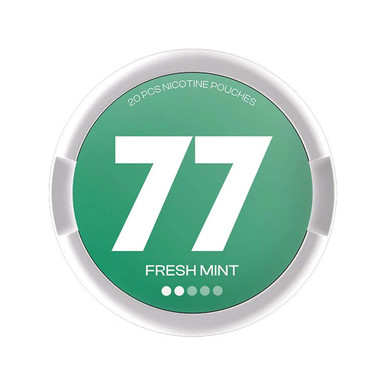
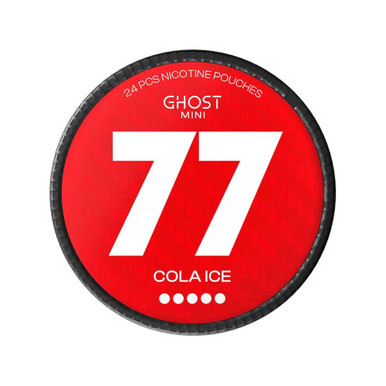
Staying within 77, the three obvious companions are Cola Vanilla, which is filed under cola and coffee and is the darkest-reading can in the brand's range; the Apple Mint listing, which puts a sharp orchard fruit over a cool base; and Cola Ice, which is a soft-drink flavour with a cold note across it. All three are £39.90. None of them overlaps much with a dark-fruit name, which is the point.
The brand's range, and where this falls in it
There are 29 77 listings on this site, gathered on the brand's own page, and the range is broad rather than specialised: mints, fruits, teas, confectionery-leaning flavours, the Ghost mini line and a set of special editions. Pricing is uniform at £39.90 throughout, so nothing in the range is positioned above anything else by cost, and the only variables between listings are flavour, declared strength and — where we hold it — pack quantity.
Forest Fruits sits in the fruit part of that range, and specifically in the part of it that carries no mint entry. Several 77 fruit listings pair their fruit with a cool base; this one, on our record, does not pair with anything at all. Whether that makes it the plainest fruit can in the range or simply the one we have the least data about is a question we genuinely cannot answer, and it would be easy and wrong to present the gap as a virtue.
Keeping ten tins in good condition
Storage matters more here than on a single-can listing, purely because there is more to store and it will be in the house for longer.
The first rule is one open tin at a time. Pouches lose moisture and cannot take it back, so an open can is on a clock and a sealed one is very nearly not. Nine sealed tins in a drawer will be much the same in a month; nine open ones will not. There is no benefit to opening several, and the only reason people do it is that the cans arrived together.
The second is temperature. A vehicle in summer is the classic way to ruin a tin, and a dashboard is worse than a glovebox. Radiators, sunny windowsills and the shelf above a cooker are the slower domestic versions of the same thing. Anywhere that stays at the temperature of the room — a drawer, a cupboard, a shelf in a cool part of the house — is all that is needed, and a fridge is not required.
The third is the lid. It is the whole of the storage system: a tin whose lid no longer seats flush, because it has been dropped or stood on, will dry out whatever else you do. If one of the ten arrives or becomes damaged, use that one first rather than keeping it back.
We publish no shelf life, no best-before and no after-opening window for this product, and we will not estimate any of them. Where the manufacturer applies a date marking it is printed on the packaging, and the tin in your hand is the authority for it.
Deciding between the two variants
The decision on this listing is narrower than it looks. Flavour is fixed — there is one flavour, whatever our record does or does not say about it. Format is fixed. Price is fixed at £39.90 either way. Pack quantity is the same ten cans. The only thing that changes between the two options is the declared figure, 5.2mg or 10.4mg.
Because the price is identical, cost gives you nothing to go on, and because the figures are the manufacturer's own, a number you recognise from a different brand is a weak guide. The strongest comparison available is another can from 77 itself, since at least the declaration convention will be consistent within one brand. If you have used one and know which figure worked, that is your answer; if you have not, then a purchase of ten tins is an expensive place to find out, and there are single-can listings across the site that are a cheaper experiment.
Ordering, delivery and the age check
An age check runs at checkout and must be cleared for an order to proceed; it is not decorative. On delivery, the courier may ask for ID, and where it is asked for and no adult present can produce it, the parcel is not released and the delivery fails. Having something to hand on the day is the simplest way to avoid a second attempt.
Stock here moves in whole deliveries rather than gradually, so availability can change quickly in both directions. This listing is showing as in stock at the time of writing, but the basket is the live position and a page is only a snapshot. Prices across the site range widely — from £4.19 to £39.90 among the cans named on this page alone — and that spread reflects brand, format and pack contents rather than any ranking on our part. Read the line on the listing before paying, particularly on a listing where a pack quantity is involved.
How to get back to this page
Because our flavour record for this product is empty, it appears on fewer shelves than most: the 77 listing page and the medium band are the two routes to it, and there is no flavour filter that will surface it. That is worth knowing, because a flavour-first browse will skip this can entirely.
For wider browsing, the whole catalogue is the top of the tree. Of the larger brand pages, the Pablo range and the Cuba range are the two most worth going through in full, since both carry enough listings to reward a proper look rather than a filtered one.
Questions we get about this one
Does the £39.90 really cover ten cans?
Our record holds a cans-per-pack value of 10 for this listing, and that is the basis for everything this page says about it. The basket and the listing page are the live statement of what an order contains at the price shown, and those are the lines to check before paying. If what you see there disagrees with what our record says, the basket is correct and we would want to know about the discrepancy.
What flavour is it, exactly?
We hold no flavour entries for this product. The name on the can is Forest Fruits and that name is the manufacturer's; our catalogue record, which is what places products on flavour shelves here, is empty for this one. We are not going to describe a taste we have not been given, and we are not going to reason backwards from the name and present the result as fact. The can and the manufacturer's own labelling are the authority.
Why is it not on any flavour shelf?
For the same reason. Flavour shelves are built from the flavour entries in our records, and an empty record puts a product on none of them. It is a gap in our data rather than a statement about the product, and it is the reason this page reaches you through the brand page or the strength band instead. If a flavour filing is added later the listing will appear on the relevant shelf.
Is there any cooling in it?
We do not know and will not say. There is no mint entry on the record and no cooling word in the name, which tells you what we have not been given rather than what is in the tin. If a cooling note is important to you, buying a listing whose record explicitly carries mint is the way to be certain of getting one, and there are plenty of those across the catalogue.
Is the ten-can price better value than the other 77 cans?
We cannot make that comparison honestly, because we hold a pack quantity for this listing and not for the others. Every 77 product here is £39.90; what that figure covers on the other listings is not recorded in our data, and inferring that they are single tins would be a guess presented as arithmetic. The individual listing pages state what each one includes, and that is where the comparison has to be made.
Can I buy a single can to try first?
Not of this product, as far as our record goes — the pack quantity we hold for it is ten. If a smaller purchase is what you want before committing, the sensible approach is a single can of a different listing at a lower price. The Nordic Spirit berry can at £4.49 and the UBBS cherry listing at £19.95 are both considerably cheaper entry points into fruit-named pouches, though neither is this product and neither will tell you how this one tastes.
How many pouches are in each tin?
We do not hold that. The pack figure we have is a count of cans, not of pouches, and the two are different things. Pouch counts are printed on the packaging by the manufacturer and the can is the place to read one. Where a product page on this site states a pouch quantity it is because our record carries it; the silence here means it does not.
Will ten tins go off before I finish them?
We publish no shelf life and will not estimate one, so the truthful answer is that we cannot tell you. What is describable is the behaviour: a sealed tin kept cool changes very slowly, and an opened one left in a warm place changes quickly. Opening one at a time and keeping the rest sealed and cool is the practical response to holding a larger quantity, and the date markings on the packaging are the manufacturer's own to state.
Are the two strengths the same flavour?
Yes — the flavour is constant across both declared figures and so is the price, at £39.90 either way. The only difference between the two options on this listing is the milligram number the manufacturer prints. Which of them to take is not a question we will answer for you, and nothing on this page should be read as pointing at one.
Do you know who makes it, or where?
No. We hold the brand, the product name, the price, the two declared strengths, the pack quantity and the stock position — that is the complete list, and the flavour field within it is empty. There are no origin claims, founding stories or manufacturing details here because we have none. The packaging is the next place to look, and if it is silent too, asking us will get you an honest "we do not know" rather than a confident guess.
What if ten cans of it turn out not to suit me?
That is the real risk on a listing like this and it would be dishonest to talk around it. Our standard returns policy applies here as everywhere on the site, and its terms are on the policy page rather than on this one. Beyond that, the catalogue is built for moving sideways — the other 28 cans in this brand and the rest of the shop are both a click away, and a flavour you have not met is always a gamble on a quantity purchase.
Is it a mini pouch?
No. This is a standard-format listing. The brand's smaller pouches are kept in its separate Ghost sub-line, of which we carry the original mini can and the mango version, both at £39.90. Format is one of the few things about a pouch that is immediately obvious in the hand, and the two are not easily confused once you have had one of each. There is no mini edition of this flavour in our catalogue.
Will the ten cans all be the same strength?
Yes. The declared figure is chosen once, at the point of ordering, and applies to the whole pack — there is no mixed option on this listing. If you want both figures in the house you would be ordering twice, which at £39.90 each is a substantial outlay for a comparison. The basket line states which variant an order covers, and that is the place to check it before paying rather than after.
The legal position, in full
Nicotine is an addictive substance.
We sell this product only to adults aged 18 or over who already use nicotine, and to nobody else. Age verification is part of the checkout process, and ID may be requested on delivery; where it is requested and an adult cannot produce it, the courier will not hand the parcel over.
77 Forest Fruits Nicotine Pouches are not a licensed stop-smoking medicine and carry no authorisation of that kind. The product is not intended for non-smokers, for people who do not already use nicotine, for under-18s, or for anyone who is pregnant or breastfeeding. Nothing on this page is medical advice. Nothing on it should be read as encouragement to anyone to begin using nicotine, or as a recommendation of either declared strength for any particular person.
Keep the product away from children and animals. Every factual statement above — brand, product name, price, declared strengths, pack quantity, stock position — is taken from our catalogue record for this listing. Where that record is empty, as it is for the flavour field, this page says so plainly rather than filling the gap. The manufacturer's own labelling on the can governs everything printed on the packaging.
Last word
Forest Fruits is a £39.90 listing from 77 in 5.2mg and 10.4mg, and the two facts that distinguish it are a recorded pack quantity of ten cans and a flavour field with nothing in it. The first makes it a stocking-up purchase; the second means we cannot tell you what it tastes of, and we have not pretended otherwise anywhere on this page.
If you know the product, the pack quantity is the argument. If you do not, a cheaper single can from elsewhere in the catalogue is the more sensible first move, and the rest of the brand is the closest place to start looking.
More from 77
More medium strength pouches
More 77 pouches
Where this sits
77 Forest Fruits Nicotine Pouches appears in these categories. Browse them, or jump to something close.
You might also like