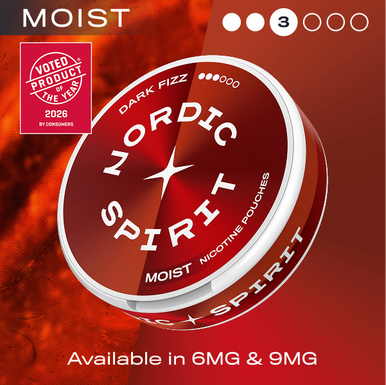
Home / Medium Strength / Nordic Spirit Blueberry Nicotine Pouches
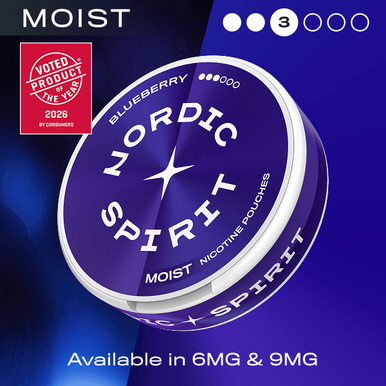
Nordic Spirit · 6mg–9mg
Read the full guide
Nordic Spirit Blueberry Nicotine Pouches
£4.49
✔ In stock — ready to ship
100% tobacco-free
Free over £20
Same-day dispatch
Secure checkout
This page covers Nordic Spirit Blueberry Nicotine Pouches. The brand is Nordic Spirit, the product name on our record is Blueberry, and the price is £4.49. Two declared strengths are held against it, 6mg and 9mg, and both variants are listed at that same £4.49. The listing showed in stock at the time of writing, and we hold one product image for it.
This is a nicotine pouch: a small pouch supplied in a round can, used the way the rest of this category is used. Our flavour record for it is the single tag berry, which is broader than the product name — the name says blueberry and the classification says berry, and we have not narrowed the tag on our own initiative because we only publish what we hold. The practical effect of that tag is that the listing sits on our berry shelf alongside 76 other listings, which covers everything from strawberry through blackcurrant to blends.
The full guide to Nordic Spirit Blueberry Nicotine Pouches
4,969 words on how it eats, who it suits, how to serve it and what to put beside it.
What is on this listing
One gap to declare at the outset: we hold no pouch count for this listing and no cans-per-pack figure. That matters more here than on most pages, for reasons the price comparison section goes into, and it is a genuine absence in our data rather than something withheld. Whatever number the packaging carries is the correct one.
Sold to adults aged 18 or over who already use nicotine. Nicotine is an addictive substance. The full compliance wording closes this page.
The format, in as much practical detail as we can give
This page is written mainly around the format itself, because it is the part of the product that a description usually skips and the part that a first-time buyer of this brand most needs. None of what follows is specific to the flavour; all of it is specific to how the thing works.
The can
The container is a round, shallow tin with a lift-off lid — the standard shape across almost everything we stock. It sits inside a closed palm, it is flat enough to go in a pocket without making a shape in the fabric, and it opens with one hand. The brand, the product name and the declared figure are printed on the lid face, which is the only surface you see once a can is sitting in a drawer.
Inside, unused pouches sit in a ring around the base. Above them, under the lid, there is a second shallower compartment separated from the ring below. That is the catch compartment, and it exists for one purpose: somewhere to put a used pouch when there is no bin within reach.
The pouch, and what "portion" means
A pouch is a small, soft, sealed portion. It is used whole and it is not opened, split or divided. There is one size per product as we list it — our record holds no separate portion-size specification for this listing, so if the packaging describes the format in particular terms, the packaging is the place that will tell you.
What is worth understanding is that pouch size is one of the real variables between brands even though it is rarely the one people compare on. Some ranges are built around a noticeably smaller portion, some around a larger one, and the difference is immediately obvious in the hand. We cannot tell you which end of that range this listing sits at, because we do not hold the figure, and we are not going to estimate it from the brand's reputation or from anything else. That is an honest limitation of a catalogue record.
How it sits, and for how long
A pouch is placed, left in position, and then removed and thrown away. It does not need holding, adjusting or attending to, and there is nothing to do with it while it is in place. People do report that a pouch settles after the first minute or so and then stays where it is put, and that moving it around is more disruptive than leaving it alone — that is a comment about the physical object rather than a claim about anything else.
How long anyone keeps one in varies from person to person, and we do not publish a figure for this listing because our record does not hold one. Manufacturers generally print guidance on the packaging, and that is what to read. What is consistent is the shape of the thing: one pouch, used once, for a period, then removed. There is no partial use, no saving one for later, and nothing to refill.
Disposal, which is the part people get wrong
A used pouch goes in a bin. Not down a sink, not into a drain, not out of a car window and not onto the pavement. The catch compartment is for the interval between finishing with one and finding a bin, which might be minutes or might be an hour. It is not for storing them.
That is worth stating firmly because it is the single most common cause of a can becoming unpleasant. The compartment is small and unsealed, and it sits directly above the unused pouches. Four used ones left in there over a weekend will affect the whole can. Empty it when you empty your pockets.
What genuinely varies between one brand's format and another's
Since the mechanics are shared, it is worth naming the handful of things that actually do differ, because those are what people notice when they change brand and then struggle to describe.
Portion size is the first, as covered above. The second is how the pouch is finished — how soft or firm it feels, how it behaves once in place — which varies between manufacturers and is the thing most often described afterwards as a can feeling "different" without the person being able to say why. The third is the can itself: lid tension differs, the depth of the catch compartment differs, and how positively a lid seats after fifty openings differs a great deal.
We hold none of those specifications for any listing on this site, including this one. That is a real limitation of what a catalogue record contains, and it is why this section describes the format in general rather than claiming to describe this product in particular. Where the packaging says something specific, the packaging is the source.
What the format does not involve
No device, no battery, no charging, no refilling, no cleaning, no accessories and no compatibility to check. There is nothing to break and nothing to replace. That is the whole reason moving between brands in this category is frictionless: a can from one manufacturer and a can from another are the same object with different printing, and the only things you carry across are your own preferences about flavour, figure and price.
Blueberry, described as a taste
Our record classifies this listing as berry and the product name says blueberry, so the sensible thing is to describe what a blueberry note conventionally is, while being clear that the tag we hold is the broader one. This is a description of a flavour family, not a specification, and it says nothing about what is inside the pouch — we do not publish composition for any product on this site.
A blueberry note is the mildest of the common berry flavours and the one with the least acidity. Where raspberry is perfumed and tart and blackcurrant is sharp and almost medicinal in its intensity, blueberry is rounded, evenly sweet and quiet. It has a soft skin-like character behind the sweetness — a very faint dryness at the finish that stops it reading as plain sugar — and a gentle floral edge that is easy to miss unless you are looking for it.
The shape of it over time is even rather than arced. It does not arrive sharply and it does not fall away quickly; it presents at a steady level. Compared with a strawberry note, which tends to be jammier and heavier at the front, blueberry is lighter and more consistent. Compared with a mixed-berry blend, it is simpler and easier to identify, because there is only one thing going on.
There is no cooling register implied by the name. This is not an iced or frosted flavour on our record, and nothing in the name suggests a menthol-type sensation over the top. That is a real distinction on our shelves, because a good number of berry-named cans elsewhere in the catalogue are built with a cold element, and cold does not sit politely beside a soft fruit — it pushes the sweetness back and takes over the finish. If you have used a frosted berry can and found it read as a cold can with fruit behind it, that is why.
One more thing about blueberry as a flavour idea, which is less about taste than about expectation. It is a fruit whose flavour most people know better from processed forms than from the fruit itself, and the two are not the same reference. The fruit is mild to the point of being faint; the processed version is sweeter, rounder and more obviously aromatic. Almost every blueberry-named product in any category is working from the second reference rather than the first, and a can that tasted like the fruit would strike most people as tasting of very little at all.
That matters when you are comparing cans, because it means "does it taste like real blueberry" is not a useful question to ask of any of them. The more useful question is where a given can sits between mild and emphatic, and how much sweetness has been used to get there. We cannot answer that for this listing — we hold a one-word tag — but it is the right axis to be thinking along when you compare it with the other blueberry-named cans further down this page.
The honest caveat, as always: our record holds the general tag rather than a specific one, taste varies enormously between people, and everything above is our own account of a flavour family written as description. The can itself is the authority on what the manufacturer says it is.
6mg and 9mg on one listing
| Variant | Declared strength | Price |
|---|---|---|
| Lower | 6mg | £4.49 |
| Higher | 9mg | £4.49 |
Both figures come from our product record and both are published because both are declared. We do not hold the basis on which either is expressed, and we are not going to infer it — the can is where that is properly read. The two variants carry the same price, so nothing about the choice between them is financial.
What the figures do on this site is decide filing. Both of them place this listing in the medium band, which currently holds 135 listings, and that is the widest of our three bands by some distance. The others are the strong shelf and the extra strong shelf, which exist for the higher end of the catalogue.
That is the full extent of what the number means here: a sorting key on a website. We do not attach advice to it. We do not describe either figure as suitable for any person or any situation, we do not present the higher of the two as a step up from the lower, and we cannot tell you which one suits you. That is not a judgement a shop is in a position to make, and no page on this site will attempt it.
How this sits against the other cans on the same shelves
The second thread of this page is comparison, and it needs a note on method before the comparisons themselves, because a shop that compares without explaining its basis is usually hiding something.
What the neighbour list is, and what it is not
The cans named below are drawn from our own record of listings that share a shelf with this one — the berry shelf, the medium band, or both. For each of them our pack entry gives us a title and a price and nothing further. It does not give us their declared figures, their pouch counts or their flavour detail. So the comparisons that follow are made on the two things we actually hold, which are the name and the price, and nothing is asserted about how any of these cans compares with this one on strength.
That is a narrower basis than a comparison table usually implies, and we would rather set it out than let a list of products imply a depth of knowledge we do not have.
The price spread, which is the striking thing
This listing is £4.49. Among its neighbours, Velo Strawberry Ice at £4.19 is the only one in the same region, thirty pence below. After that the figures climb steeply: Edge Strawberry at £14.95, then ZYN Blackcurrant Forest at £19.99 and Rush Berry Ice Pro, also £19.99, then Fumi Blackcurrant at £27.90 and SYX Blueberry at £29.90.
Higher again: Klint Blueberry at £36.90, and then a cluster at £39.90 comprising 77 Strawberry, Pablo Silver Edition Blue Raspberry and XQS Berrynana Twist. That is a range from £4.19 to £39.90 across listings that share a shelf.
Why we will not explain that gap
Because we cannot. The field that would account for most of it — how many cans a listing represents — is empty in our record for every single product named above, including this one. A price of £39.90 against a price of £4.49 might reflect quantity, might reflect the product, might reflect how a manufacturer prices, or might be some combination we cannot see from a catalogue entry.
We are not going to pick the most flattering explanation and print it. What we will say is that comparing two listings on price alone, without a quantity figure, is comparing two numbers rather than two products — and that the packaging is where a quantity is properly read. If you are price-comparing across this shelf, that is the thing to check before drawing any conclusion.
Comparing on the one thing we do hold: the name
Within the berry family the names do at least tell you something about direction. SYX Blueberry and Klint Blueberry name the same single fruit as this listing, so they are the nearest comparisons by flavour idea if not by price. 77 Strawberry and Edge Strawberry name a jammier, heavier-fronted fruit. Fumi Blackcurrant and ZYN Blackcurrant Forest name the sharpest and most intense end of the berry family, which is a long way from a blueberry note in character.
Pablo Silver Edition Blue Raspberry names a hybrid idea rather than a fruit, and XQS Berrynana Twist names a blend crossing the berry family with something softer. Rush Berry Ice Pro and Velo Strawberry Ice both carry a cold element in the name, which as noted above changes the character of a berry flavour considerably rather than simply adding to it.
What a shared shelf does and does not imply
A final point on method, because people reasonably read a neighbour list as a recommendation engine. It is not one. These listings appear here because they share a category with this product in our catalogue, which is a structural fact about how the site is organised rather than a judgement that they are similar in use, comparable in specification or interchangeable in any way.
Two cans on the same shelf may have been placed there by quite different routes — one by flavour, one by band, one by both — and nothing about co-location on a website implies equivalence. We name them because they are the honest set of near listings our record produces, and we describe them on the two fields we hold. Anything beyond that would be a shop inventing depth it does not have.
The Nordic Spirit range as we list it
The Nordic Spirit shelf holds 14 listings, of which this is one. Six of them are held against this product as siblings in our record, and all six carry the same £4.49 price as this can, which makes moving between them a flavour decision with no cost attached.
Forest Berries at £4.49 is the closest neighbour by family — a mixed-berry name rather than a single fruit, so darker and more layered than a plain blueberry, with more going on and less that is immediately identifiable. Frosty Berry, also £4.49, takes the berry family and builds a cold register over it, which as discussed is a structural change rather than an addition. Max Foresty Berry is a third berry-named listing on the same shelf at the same price.
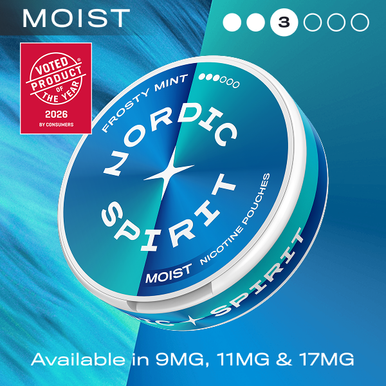
Away from berries, Frosty Mint at £4.49 is the range's plain cold-and-mint direction, and Max Frosty Mint is its companion at the same price. Dark Fizz, £4.49, is the one name in the six that does not point at fruit or mint at all — a coined name suggesting something darker and sweeter, though our record gives us no classification to confirm that, so treat the name as a name.
The useful thing about this brand shelf is its flatness on price. Every sibling is £4.49, so nothing about the choice between them involves money, and the comparison is purely about which flavour name you want. That is not true across the site generally, which is why the price section above reads the way it does.
Keeping more than one can going
Most people who use this format regularly run two or three at a time, and the reason usually given is straightforward: a single flavour with nothing to contrast it against stops registering after a while. A blueberry note, being even and quiet rather than sharp, is more susceptible to that than most.
The productive pairing is something structurally different rather than a close relative. Within this brand, the frosty mint listing is the obvious counterweight, since a cold mint register has almost nothing in common with a soft fruit. Outside it, a sharp berry rather than a mild one does a similar job — the Fumi blackcurrant can at £27.90 or the ZYN blackcurrant listing at £19.99 sit at the intense end of the same family.
What is less useful is pairing this with another blueberry. The SYX version at £29.90 and the Klint one at £36.90 are both worth knowing about if you want to see how different manufacturers handle the same fruit, but as companions to each other they will blur, which rather defeats the purpose of running two.
Storage and keeping a can in condition
Heat is the thing that matters and everything else is a footnote. A can left in a parked car on a warm day, on a sunny windowsill, or on top of something that produces heat will not be in the condition it was when it arrived. The change is gradual and invisible, which is why it usually gets blamed on the product rather than on the shelf.
Cool, dry and out of direct light covers it. A drawer works. A cupboard away from the cooker works. A bathroom does not, because steam is not what a can wants, and neither is a wet coat pocket in winter. A fridge offers nothing worth having: cold is less damaging than heat, but a can moving repeatedly between cold and room temperature will collect condensation under the lid, and moisture arriving from outside is not useful.
The lid does the rest. Press it fully home each time rather than resting it on top — this is the most commonly skipped step and the one that makes the most difference. A can that has been sat on or crushed may no longer seat its lid flat, and once that has happened there is no fixing it; use that can rather than saving it. Keep the catch compartment empty between uses, and if you buy several at once, work through them in the order they arrived.
None of that requires equipment or effort. There is no storage accessory that improves on a dark drawer and a lid that has been properly closed, and the habits that matter are small enough to become automatic within a week: a fixed place at home for the spares, one can carried rather than three, the lid pressed rather than rested, and the catch compartment emptied when you empty your pockets rather than when it fills up.
And the non-negotiable one: cans belong where children and animals cannot reach them. The packaging is small, round, brightly printed and easy to open, and this is an adult nicotine product.
Choosing between what is on offer here
There are two choices on this listing. One is the flavour, and the brand shelf above sets out the alternatives at the same £4.49, so that decision costs nothing whichever way it goes.
The other is between the 6mg variant and the 9mg variant, and our position on that is the same as on every other page of this site. We publish both figures because both are declared. We will not tell you which to choose, we will not describe either as suitable for any person or situation, and we do not present the higher figure as a progression from the lower one. We are a shop; that decision is not ours and we are not qualified to make it. Both variants cost £4.49, so there is no money in it either way.
What we can usefully say about the flavour decision is that it is a low-stakes one here in a way it is not everywhere on the site. At £4.49 a can, with six siblings at exactly the same price, trying a second name alongside this one is a small commitment, and nothing about buying from this manufacturer ties you to them afterwards. There is no device to buy into and no compatibility to worry about. A can that turns out not to suit you is one can.
On pack sizes, we have nothing to offer, because our record holds no cans-per-pack figure for this listing. If a multi-can option exists, the packaging and the listing itself are where it would appear, not in a paragraph written from a catalogue entry that does not contain it.
Ordering, delivery and proof of age
This is an 18+ purchase. Age verification is part of checkout, we may ask for proof of age at the point of sale, and the courier may ask for ID on delivery. Neither check is skipped because an order looks routine, and an order that cannot be verified is not completed.
The price quoted here — £4.49 for either variant — is what our record held at the time of writing, and the stock statement is dated the same way. Where this text and the live listing disagree, the listing is right. Payment, delivery options and returns are set out in the site's policy pages, which is where they belong.
Where to go next from here
Three routes out. By flavour: the berry shelf holds 76 listings and is the widest way to see what else is in this family. By brand: the Nordic Spirit page holds all 14 of that manufacturer's listings, while the Pablo shelf and the Cuba shelf are two of the larger brand pages we keep and cover a much wider spread of prices. By number: the three bands, with this can in the medium one.
Or, if none of that appeals, the entire catalogue sits on one page and can be narrowed from there.
Questions we are asked about this one
Why is the flavour listed as "berry" rather than "blueberry"?
Because that is the tag our record holds. Blueberry is a berry, so the tag is not wrong, just broader than the product name, and we have not narrowed it ourselves because we publish the classification we have rather than one we would prefer. The practical effect is that the listing appears on the general berry shelf with 76 others rather than on any narrower one.
How many pouches are in a can?
We do not hold that figure, and we hold no cans-per-pack number either, so we cannot answer. We will not estimate from what is typical in the category, because an estimate published on a product page gets read as a fact. The packaging carries the declared number. This gap is the reason the price comparison section on this page is hedged as heavily as it is.
Why is this so much cheaper than other berry cans on the same shelf?
We genuinely do not know, and that is the honest answer rather than a deflection. The listings on that shelf run from £4.19 to £39.90, and since we hold no quantity figure for any of them, we cannot tell you whether the difference reflects how many cans a listing represents, the product itself, or the manufacturer's pricing. Check the packaging for quantity before treating a price difference as a like-for-like comparison.
What is the difference between 6mg and 9mg?
Three milligrams as printed, and nothing else that we hold. Both figures are declared on the product and we publish both. We do not know the basis on which either is expressed, we cannot compare them with figures from other manufacturers, and we do not describe the higher one as a step up. Both variants are £4.49.
Which strength should I get?
We cannot tell you. We do not give strength advice to anybody, on any listing, and we do not describe any figure as suitable for a person, an experience level or a circumstance. The numbers are label information about a product. If you already use nicotine you will have your own reference point; a shop's product page is not a substitute for one.
Is this a cold or iced flavour?
Nothing in the name or in our record indicates a cooling element, so as far as we can tell it is a plain berry flavour rather than a frosted one. If you want a cold register with a berry flavour, the brand shelf has listings whose names say so explicitly. Where the packaging describes the product differently from this page, the packaging is correct.
How long does a pouch last?
It varies between people and we do not publish a figure for this listing, because our record does not hold one. The manufacturer generally prints guidance on the packaging and that is the place to read it. What is consistent about the format is that a pouch is used once, for a period, and then removed and put in a bin — there is no partial use and nothing to save for later.
What do I do with used pouches when I am out?
The catch compartment under the lid is there for exactly that, and it will hold a used pouch until you reach a bin. It is a temporary holding space rather than storage: leaving pouches in it for days will make the can unpleasant and does the unused ones underneath no favours. Empty it into a bin regularly. Nothing goes down a drain or on the ground.
Is the can resealable?
The lid lifts off and presses back down. It is not a screw fitting and it is not airtight, so a can that has been crushed or whose lid has been bent will not seat properly, and there is no repair for that. Pressing the lid fully home each time and keeping the can away from heat does more for the condition of what is inside than anything else available to you.
Is it in stock at the moment?
Both variants showed as available at the time of writing, and the live listing is the authoritative answer — this text does not change when a shelf empties. The two variants can also move independently, so the availability shown against the one you have selected is what governs. The brand page will show you the state of all 14 Nordic Spirit listings at once.
Can I use this at work, indoors, or while travelling?
That is set by whoever runs the place, not by us. Employers, venues, transport operators and airlines each write their own policies, those policies differ from one another and change over time, and we have no standing to interpret any of them. Ask the organisation concerned. If you are crossing a border, rules on carrying nicotine products vary by country and by carrier, and we do not track them — check before you travel rather than after.
Is this the same product as the Max version on the brand shelf?
They are separate listings in our catalogue with their own pages, and beyond the names we hold no specification that would let us explain how they differ. Both sit on the same brand shelf at £4.49. If you want to know what distinguishes them, the packaging and the manufacturer are the sources; we are not going to construct an explanation from a difference in naming.
Do you publish ratings or reviews?
No. We do not carry ratings, review scores or customer comments on product pages, so there is nothing of that kind for this can. Everything factual on this page comes from our own catalogue record, and where that record is empty — the pouch count, the portion specification — the page says so rather than filling the space with something plausible.
Compliance
This product is sold only to adults aged 18 or over who already use nicotine. We do not sell to under-18s. ID may be requested at the point of purchase and may be requested again by the courier on delivery.
Nicotine is an addictive substance.
This is not a licensed stop-smoking medicine and it is not intended for non-smokers, for anyone who does not already use nicotine, for under-18s, or for anyone who is pregnant or breastfeeding. Nothing on this page is medical advice, and nothing on it is a recommendation about what strength any individual should use. We make no claim about what this product does.
Keep out of reach of children and animals. Used pouches go in a bin.
To finish
Nordic Spirit Blueberry is a nicotine pouch listed at £4.49, with two declared figures against it, 6mg and 9mg, at the same price either way. Our flavour record holds the broad tag berry rather than the narrower blueberry, and we have said so rather than tidying it. We hold no pouch count, which is why this page will not compare its price with a £39.90 listing and pretend the comparison means something. The rest of the brand's shelf, the berry category and the wider catalogue are all linked above.
More from Nordic Spirit
More medium strength pouches
More berry pouches
Where this sits
Nordic Spirit Blueberry Nicotine Pouches appears in these categories. Browse them, or jump to something close.
You might also like