Home / Medium Strength / 77 VB Edition Arctic Berry Nicotine Pouches
77 · 5.2mg–10.4mg · 10-can pack
Read the full guide
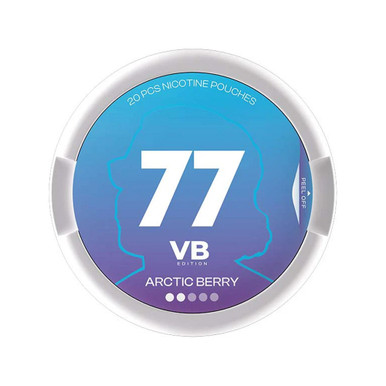
77 VB Edition Arctic Berry Nicotine Pouches
£39.90
✔ In stock — ready to ship
100% tobacco-free
Free over £20
Same-day dispatch
Secure checkout
77 VB Edition Arctic Berry Nicotine Pouches are listed here at £39.90 for a pack of 10 cans, and unusually for this brand the listing carries two strengths — 5.2mg and 10.4mg — at the same price. It was showing as in stock when this page was written, though the live marker on the listing is the one to go by rather than this sentence.
The two-strength arrangement is the first thing that separates this from most of our 77 listings, which run a single figure. Here you choose between two numbers and the money does not move, so whatever decision you make is purely about the figure and never about the cost. That is a cleaner choice than the shop usually offers and there is a section further down on what the numbers do and do not mean.
The full guide to 77 VB Edition Arctic Berry Nicotine Pouches
5,130 words on how it eats, who it suits, how to serve it and what to put beside it.
What the VB Edition Arctic Berry tin is
The second distinguishing thing is that this is a two-part flavour. Our catalogue files it on both the Mint shelf, which runs to one hundred and forty-eight listings, and the Berry shelf at seventy-six. Very few cans earn a place on two flavour shelves, and it happens here because the can genuinely does two things rather than one. How those two things are built to sit together is the most interesting technical thing about it and gets a long section of its own.
Beyond that: it is a 77 product, so it sits on the 77 brand listing with the other twenty-eight cans we carry from them, and both strengths fall inside our Medium Strength band of one hundred and thirty-five listings. We publish no composition or technical detail for any product we sell; the manufacturer's packaging carries that and it is the right place for it.
The name, and the bit of it we cannot explain
There are three parts to the name and we can account for two of them honestly.
Arctic is a cooling descriptor. Across this catalogue, words like arctic, ice, freeze and frost signal that a cooling element has been built into the flavour, and they are reasonably reliable signals rather than decoration. They do not tell you precisely how cold a can is, because there is no standard scale and every maker uses the words to its own taste, but they do tell you that cold is present and intended as a feature. On this can it is.
Berry is the taste half. It is a general fruit descriptor rather than a named single fruit, which in this format usually indicates a blended dark-fruit profile rather than one identifiable berry. That is what you get here.
VB Edition is the part we cannot explain. It is the manufacturer's own sub-line name, it appears on the packaging, and we reproduce it because that is what the product is called. We do not hold an explanation of what the letters stand for and we are not going to invent one, which would be easy to do and completely useless to you. If the meaning matters, the manufacturer is the only reliable source. What we can say factually is that it denotes a sub-line within the brand rather than a one-off can, and that more than one flavour appears under it — the 77 shelf shows everything from the brand that we carry, VB Edition listings included.
One small navigational note while we are on names: the web address for this page retains an older spelling of the word arctic. It is the same product, the address still works, and we have not changed it because changing addresses breaks links people have saved.
Dark fruit over cold: the flavour as a taste
Opening the tin gives you the cold first, which is characteristic of this kind of can — a sharp, clean, slightly medicinal top note in the aroma before any fruit registers. Behind it there is a darker, jammier smell, more blackcurrant and blueberry than strawberry or raspberry. The two are distinguishable in the aroma rather than blended into a single smell.
In the mouth the sequence runs cold-first as well, and quite decisively. The first fifteen or twenty seconds are dominated by the cooling element, which arrives fast and is genuinely sharp rather than gentle. This is a proper cold can and not a fruit flavour with a token chill on it. If you have used arctic or freeze cans before you will recognise the intensity immediately; if your reference point is a mild mint, this is a significant step up in that respect.
The fruit arrives second, coming up underneath the cold once the initial rush has settled. It reads as a dark berry blend: deep rather than bright, jammy rather than fresh, with a modest tartness that keeps it from being flat. It is noticeably less sweet than a dedicated fruit can, partly because it is less sweet and partly because cold suppresses the perception of sweetness, which is a real effect and one worth knowing about when comparing iced and non-iced versions of the same fruit.
Over the length of a pouch the balance shifts. The cold is at its most aggressive early and settles into a steady cool background within a few minutes, at which point the fruit becomes the more prominent of the two. The last stretch is mostly a quiet dark-fruit note with a residual coolness underneath it. So the can you have at minute two and the can you have at minute twenty-five are meaningfully different experiences, which is part of why people keep these in a while.
Aroma afterwards is cool and faint, closer to what a mint leaves than what a fruit leaves. The tin, left open, will scent a drawer faintly of cold sweets.
How two flavours get built into one dry pouch
This is the technically interesting part of the can, and it explains why some combination flavours work and others turn to mush. None of what follows describes what the product does to anybody — it is about flavour engineering in a dry format and nothing else.
Two channels, not two flavours
The key thing to understand is that cold and fruit are not competing for the same space. Taste is one channel. Cooling is a physical sensation rather than a taste, operating on a separate channel. That separation is the whole reason mint-and-fruit combinations are common and successful in this format, while fruit-and-fruit combinations so often blur.
Put two fruits together and they fight, because they are both trying to occupy the taste channel at once, and unless one is clearly pushed forward you get a vague sweetness that could be anything. Put a fruit and a cooling element together and each has its own lane. You can perceive both simultaneously and keep them distinct, which is exactly what happens on this can — the cold and the berry stay identifiable as separate things rather than merging into a single impression.
Why the cold arrives first, every time
The ordering is not an accident of this particular can; it is a property of the format. A cooling sensation registers almost immediately and needs very little to trigger it. A taste has to come off a dry pouch as it takes on moisture, which is a slower process by its nature. So in essentially every iced can in this shop, the cold leads and the flavour follows a beat behind.
That fixed ordering has a design consequence. A fruit note placed under a strong cooling element has to be robust enough to still register once the cold has already grabbed your attention. Delicate, bright, high-toned fruit gets flattened. Deep, jammy, dark fruit survives. This is why arctic and freeze cans across the whole catalogue tend to be paired with blackcurrant, blueberry, dark berry blends and similar, and rarely with something light and floral. The pairing on this can is the conventional and sensible choice rather than an adventurous one.
What cold does to sweetness
Cooling suppresses perceived sweetness. The same fruit flavour, placed under a strong cooling element, will read as noticeably drier and sharper than it would on its own. That is worth knowing because it explains a comparison people make constantly and find confusing: an iced version of a fruit does not taste like the plain version plus cold, it tastes like a drier, sharper relative of it.
You can test that directly on our shelves if you want to. SYX Blueberry at £29.90 is a blueberry without a cooling element. XQS Blueberry Mint at £39.90 and ZYN Blueberry Mint at £19.99 are the same fruit idea with mint over it. The difference between them is larger than the descriptions suggest, and it is mostly this effect.
What gets lost, honestly
The trade is real and worth stating rather than glossing. A strong cooling element buys you clarity and a long, steady background, and it costs you fruit detail. A dedicated berry can without cold will give you more nuance in the fruit — more distinction between the individual berries in a blend, more of the tart edges. Under an arctic-level cooling element, that detail flattens into a single dark-fruit impression.
Neither version is better. They are different products for different preferences, and anyone who tells you the iced version is an improvement is expressing a taste rather than reporting a fact. If fruit detail is what you value, Fumi Blackcurrant at £27.90 does dark fruit without burying it. If you want the cold to lead, this can does that properly.
The pouch and the tin, day to day
Physically it is the standard slim white pouch — a soft rounded rectangle, dry out of the can, softening within a minute or so. Slim format rather than the fat traditional portion, so it sits without an obvious bulge.
Placement is a matter of individual habit that nobody needs explained to them. Under the top lip, off-centre, flattened along the gum line with the tongue is how most people do it, and a folded pouch is worth straightening rather than persevering with.
Duration tends to run longer on cans like this than on plain fruit cans, for the structural reason set out above: the cooling element keeps going after the fruit has quietened, so there is still something present at minute thirty. Twenty to forty minutes covers most habits and plenty of people run past that. We are not putting a number on it as guidance because there is no correct one and a shop inventing one would be overstepping.
The tin is a two-chamber design: the main well holds the fresh pouches, the lid has a shallow catch compartment for used ones. Three or four used pouches fit comfortably; beyond that the lid stops closing flush and tells you clearly that it is full. Emptying it routinely keeps the can pleasant, and on a cold can there is a specific reason to bother — used pouches in a warm lid produce a stale smell that clashes badly with the clean cold of a fresh one.
Disposal: general waste, not sinks, not the ground. The empty tin is a small plastic pot for whatever plastics your council takes.
5.2mg and 10.4mg on one listing
This listing carries two figures: 5.2mg and 10.4mg, both at £39.90. Since the milligram number is the main sorting tool in a catalogue this size, here is what it actually is.
It is a content figure, measured and printed by the manufacturer, describing what is in the product. Makers state it per pouch or per gram according to their own house convention, and those conventions are not standardised across the industry. Two cans from different companies showing the same number are therefore not necessarily equivalent, and cross-brand comparison by that figure alone is rougher than people assume. It is packaging information, not a rating.
Both figures here fall within the band we call medium, which is why the listing appears once on the medium-strength shelf rather than in two places. The bands above are Strong and Extra Strong. Those bands are how we organise one hundred and thirty-five listings into something browsable; they are not a ladder and no progression through them is implied or suggested.
We will not tell you which of the two numbers to choose. We know nothing about you, a retailer is not an appropriate source for that judgement, and a product page that starts making it has stopped describing a product. Both figures come from the manufacturer's own packaging and both are published here exactly as given.
Where a tin actually goes: the practical questions about carrying one
This is the part of a pouch listing that gets asked about most and answered least usefully, because most of the honest answers are about rules rather than about the product. Here is what we can say factually, and where we genuinely cannot help.
What the format requires, which is not much
The practical facts of the format are simple enough. There is no device. Nothing is charged, nothing has a battery, nothing needs cleaning, refilling or replacing, and there is no second object to lose. The whole of what you carry is a tin the size of a large bottle cap. It makes no noise and needs no hands once a pouch is in. That is the entire operational description of the thing, and it is why people who carry one tend to find it a low-maintenance object to have in a pocket.
The can being self-contained also means the used-pouch problem travels with you, which is the one genuinely practical consideration. A bin is not always to hand, and the catch compartment in the lid exists precisely for that gap. It holds three or four, which covers a train journey or an afternoon, and it is not a substitute for actually disposing of them.
The rules are set by the place, not by us
Here is the important part, and it is the part where an honest shop has to decline to be useful. Whether these products may be used in any particular place is decided by whoever runs that place, not by us and not by the product.
Employers set their own workplace policies. Building managers, landlords and site operators set their own site rules. Train and coach operators set their own conditions of carriage. Airlines set their own cabin policies, and airports and destination countries set their own rules on top of those. Hotels, venues, hospitals and schools all set their own. These policies vary enormously, they change, and several of them are specific enough that a general answer would be worthless.
We do not hold that information for any venue, operator or employer, and we are not going to guess at it. If it matters to you, the organisation itself is the only source that can actually answer, and asking them before rather than after is obviously the better order. That is an unsatisfying answer and it is the only honest one available to a retailer.
Travelling with a ten-can pack
Two separate issues arise when travelling, and they are worth keeping apart.
The first is the carrier's own rules about what may be carried and where — hand luggage against hold, quantities, and whether use on board is permitted at all. That is a question for the airline or operator, and the answer differs between them.
The second is the law at the destination. Rules on these products vary widely between countries and some prohibit them outright, with real consequences for arriving with them. Quantity limits at customs also become a live concern when you are carrying a ten-can pack rather than a single tin, since what passes as personal use in one jurisdiction will not in another. We hold no country-by-country information, cannot advise on any specific destination, and would be doing you a disservice by pretending otherwise. Checking before you travel is genuinely your own responsibility.
Long stretches without a bin
The most common practical complaint about carrying a tin has nothing to do with rules and everything to do with disposal. A long journey, a long shift somewhere without accessible bins, an all-day event — these are the situations where the catch compartment runs out of room, and it runs out sooner than people plan for. Four used pouches and the lid is at capacity.
The workaround people settle on is straightforward and worth stating because it saves a certain amount of irritation: take a second empty tin. An emptied can is a sealed, rigid, pocket-sized container that costs nothing, and it turns a four-pouch limit into whatever you need. Wrapping used pouches in tissue and pocketing them is the other approach and it is considerably less pleasant by the end of a day. Neither is sophisticated; both beat the alternative of a lid that will not shut.
The one piece of practical advice we will give
Keep the bulk of a ten-pack at home and carry one tin. That is a storage point as much as anything else, and it is covered again below, but it applies here too: a single can in a pocket is a small object that goes everywhere easily, while ten cans is a package the size of a mug that has no business being in a bag.
The other berry-and-cold cans on our shelves
Mint-over-berry is a well-populated corner of this catalogue, so it is worth being specific about who else is doing it and how they differ.
The closest comparisons on approach are the XQS Blueberry Mint can and the ZYN Blueberry Mint tin, both of which name the fruit specifically rather than using a general berry descriptor — worth knowing if you want a defined single fruit under the cold rather than a blend. Pablo Silver Edition Blueberry Peach Ice at £39.90 adds a third element, putting two fruits under the cooling, which is a more complicated proposition and a good test of the two-channel argument made above.
At the cheaper end, Nordic Spirit Frosty Berry at £4.49 is the single-tin way to see whether iced berry suits you at all before committing to ten cans, and Velo Strawberry Ice at £4.19 does the same job with a lighter fruit underneath. Those two are the sensible reconnaissance purchases if you are unsure.
For the cold without the fruit, Klint Arctic Mint at £36.90 is the comparable arctic-level mint can, and Edge Spearmint at £14.95 is the gentler, cheaper mint option. For fruit without the cold, the SYX Blueberry tin at £29.90 is the reference. And for something in neither family, UBBS Cola Ice at £19.95 is the cola-plus-cooling version of the same structural idea.
Its place in the 77 line-up
Across our twenty-nine 77 listings the range covers mints, fruits, colas, teas, a small dessert group and a couple of sub-lines. This can belongs to the VB Edition sub-line, and it is one of the few 77 listings we carry that offers a strength choice at all.
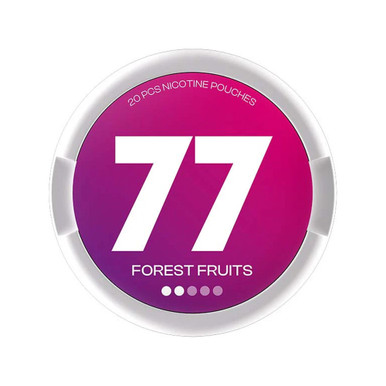
Within the brand, the nearest thing in structure is 77 Apple Mint, which uses the same fruit-plus-cooling architecture with a lighter fruit and a gentler cooling element — a useful comparison if arctic-level cold is more than you want. 77 Forest Fruits is the dark berry blend without any cooling at all, which makes it the direct test of what the cold is contributing here.
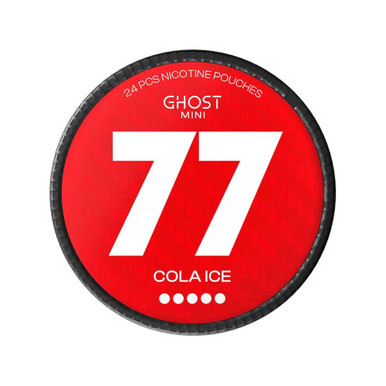
Elsewhere in the range, 77 Cola Ice applies the same cold-over-sweet structure to a soft-drink flavour, while 77 Cola Vanilla drops the cooling entirely. The reduced-pouch sub-line runs through 77 Ghost Original Mini and the Ghost Mini Mango can if pouch size matters more to you than flavour. Every 77 listing we stock is £39.90, so price never enters the comparison within this brand.
Storage, and what heat does to a cold can
These are dry pouches rather than the moist chilled kind, so they need no refrigeration and keep perfectly well in a cupboard, drawer or bag pocket. The requirements are: lid shut, out of direct heat, and worked through in order.
Heat is the one variable that measurably changes a can, and on this particular flavour it has a specific effect worth knowing. The cooling element is the more robust of the two components; the fruit notes are the volatile ones. So a tin that has spent a summer in a car does not lose its cold — it loses its berry, and what you are left with is an increasingly one-dimensional cold can. That is a more noticeable degradation than on a plain mint, where there is less to lose.
A fridge is unnecessary and introduces a condensation risk when a cold tin is opened in a warm room, which dampens dry pouches early and shortens them. If you do keep cans cold, let one warm up before opening it. A cupboard does the same job without the complication.
With ten cans the useful discipline is dull: finish an open tin before starting the next, keep the unopened ones somewhere stable rather than carrying them all around, and work to the date the manufacturer prints on the packaging rather than to anything written here.
Choosing between the two figures
This listing is one of the more straightforward in the shop to decide on, because the only variable is the number. Both 5.2mg and 10.4mg cost £39.90, both come as ten cans, and the flavour is identical between them. There is no price penalty attached to either choice and no format difference.
What we can tell you is what the figures are: manufacturer-stated content figures, both inside our medium band, published exactly as printed. What we will not tell you is which to pick. That decision depends entirely on things about the person buying that a shop has no access to and no business speculating about, and any retailer offering you a recommendation on that point is doing something it should not.
The one genuinely useful observation is structural rather than personal: because the price is identical, there is no financial reason to treat either option as the default. On listings where strengths differ in price, people sometimes drift toward a figure for the wrong reason. That cannot happen here.
Ordering, delivery and proving your age
Ordering is standard. Add it to the basket, mix it with anything else in the shop, and it ships as one parcel. Brands, strengths, pack sizes and flavour families can all be combined without restriction or surcharge.
This is an 18+ product, sold to over-18s only. Age verification forms part of checkout, and the courier may ask to see identification when handing the parcel over. Somebody aged eighteen or over has to be present to receive it; with no one to show ID, the parcel is not left. This applies to every nicotine product on the site and is not something anyone here can set aside.
Delivery costs, cut-off times and current dispatch estimates live on the checkout and delivery pages, not on product descriptions. That is deliberate — a delivery promise written into a product page will eventually be out of date, and a stale promise is worse than a pointer to the live figures.
Routes back to this listing
Four ways lead here. The 77 brand page gathers all twenty-nine of our listings from the brand. The medium-strength band collects every can we file at this level across every brand. Both flavour shelves carry it: the mint shelf with its one hundred and forty-eight listings and the berry shelf with seventy-six. Appearing on both is unusual and is a consequence of the can genuinely doing two things.
If you browse differently, the full catalogue lists everything in one place, the stronger bands are Strong and Extra Strong, and the two longest brand ranges we carry are Pablo and Cuba.
Common questions about this can
What does VB Edition mean?
We do not know, and we would rather say so than make something up. It is the manufacturer's own name for a sub-line within the 77 range, it appears on the packaging, and we reproduce it because it is part of the product name. What the letters stand for is not information we hold. The manufacturer is the only source that can answer it reliably, and an invented explanation on a shop page would be worse than none.
How cold is it, really?
Properly cold. The word arctic in this catalogue signals a serious cooling element rather than a hint of one, and this can delivers that — the first twenty seconds are dominated by it. If your reference point is a mild mint, this is a considerable step up in intensity. If you have used freeze or arctic cans before, it will land where you expect. There is no standard scale for this, so that comparison is the best we can honestly offer.
Which berry is it?
It is a blend rather than a single named fruit, which is what the general berry descriptor usually indicates in this format. It reads dark rather than bright — closer to blackcurrant and blueberry than to strawberry or raspberry. If you want a specifically named single fruit under a cooling element, the blueberry-mint listings from other brands on our shelves name theirs, and that is the better route than trying to pick a blend apart.
Why does the web address spell arctic differently?
The address was created with an older spelling and we have left it alone, because changing an address breaks every saved link and bookmark pointing at it. The product title is the corrected spelling. It is the same can either way and nothing about the product is affected by it.
Do the two strengths cost different amounts?
No. Both 5.2mg and 10.4mg are £39.90 for ten cans. That is not true across the whole shop, but it is true here, so the choice between the two is purely about the figure and not about the money. The flavour is the same in both, and the pack configuration is the same in both.
Which strength should I choose?
We will not answer that, and we would be wary of any shop that did. Both figures come from the manufacturer's packaging and both are published here as given. Choosing between them depends on things about the individual buying that a retailer cannot know and should not speculate about. The numbers are in front of you; the decision is yours.
Is £39.90 the price of one can?
No. It buys ten cans, which is worth knowing before ordering because the figure reads very differently once you do. This is a bulk listing rather than a single tin, so it suits somebody who already knows they like iced berry flavours. For a first look at whether this flavour family works for you, the cheaper single tins on the same shelves are the far more sensible outlay.
Am I allowed to use these at work or on a plane?
That is not ours to answer. Employers, building operators, transport companies, airlines and venues each set their own rules, those rules differ widely and change, and we hold none of that information. The organisation concerned is the only reliable source. On international travel there is a second question — the law at the destination — and some countries prohibit these products outright, so checking before you go matters.
How many pouches come in each can?
We hold the pack size, which is ten cans, but not the count per can, and we will not estimate a figure that people would end up budgeting against. The manufacturer prints the count on the can. It is worth reading rather than assuming, because counts differ between brands and between formats within a brand, so a number remembered from another product will often not carry across.
Does the cold fade before the fruit does?
The other way round, generally. The cooling element settles from its sharp opening into a steady background and persists, while the fruit notes quieten sooner. That means the tail end of a pouch is cooler in character than fruity, and it is one reason people keep cans like this in longer than they might a plain fruit can — there is still something present when a fruit-only pouch would have gone flat.
Is it in stock?
It was at the time of writing, which is not the case for all our 77 listings. Stock changes though, so the indicator on the listing itself is the accurate source rather than this paragraph. If it has gone, the other iced berry cans across our mint and berry shelves cover comparable ground at a range of prices and pack sizes.
Is this the same flavour in both tins of a ten-pack?
Yes. A ten-can pack is ten cans of the identical product at the identical stated figure; it is not a mixed selection and there is no variety option on this listing. If you want more than one flavour, that is done by ordering more than one listing, which combines freely in a single basket. People buying at this volume very commonly add a contrasting single tin from elsewhere in the shop for exactly that reason.
Why is it filed under two different flavour shelves?
Because it genuinely does two things that sit in different flavour families, and filing it under only one would hide it from half the people looking for it. Most cans belong on a single shelf. This one has a cooling element substantial enough to count as a mint listing and a fruit element substantial enough to count as a berry listing, so it appears on both. It is one product with one listing, not two separate items.
Do you publish what is in it?
No. We do not publish composition, ingredient or technical information for any product on this site. The packaging that arrives with the cans carries the manufacturer's own information and that is the correct place to read it. Questions beyond what is printed there are for the manufacturer rather than for a retailer repeating something second-hand.
Compliance and legal information
This product contains nicotine, and nicotine is an addictive substance.
It is sold only to adults aged 18 or over who already use nicotine products. We do not sell to under-18s. Age verification is part of our checkout process, and the courier may request identification when the parcel is delivered.
It is not a licensed stop-smoking medicine and is not intended for non-smokers, for anyone who does not already use nicotine, for under-18s, or for anyone who is pregnant or breastfeeding. Nothing written on this page constitutes a health, medical or therapeutic claim of any kind, and nothing here should be read as one. If you have questions about nicotine in relation to your own circumstances, ask a healthcare professional rather than a shop.
Closing note
77 VB Edition Arctic Berry is a ten-can pack at £39.90, available in 5.2mg and 10.4mg at the same price, in stock as this was written. The flavour is a genuinely cold arctic-level cooling element with a dark, jammy berry blend underneath it, arriving in that order and shifting in balance as a pouch runs on.
It earns a place on two flavour shelves because it does two separable things, and the cold is the dominant of the two. If that is what you want, this is a well-built example of it. If it is fruit detail you are after, the berry shelf has seventy-six listings and plenty of them leave the cold out entirely.
More from 77
More medium strength pouches
More mint pouches
Where this sits
77 VB Edition Arctic Berry Nicotine Pouches appears in these categories. Browse them, or jump to something close.
You might also like