Home / Medium Strength / 77 Blackcurrant Ice Nicotine Pouches
77 · 10.4mg
Read the full guide
77 Blackcurrant Ice Nicotine Pouches
£39.90
✔ In stock — ready to ship
100% tobacco-free
Free over £20
Same-day dispatch
Secure checkout
This page covers 77 Blackcurrant Ice Nicotine Pouches. Our record prices it at £39.90, declares one strength of 10.4mg, carries two flavour tags against it — berry and mint — and currently marks it as out of stock. Four shelves hold it: one for strength, one for the brand, and one for each of those flavour tags.
That is the complete set. Anything on this page that is not one of those facts is either a description of the object, a comparison against other listings in our own catalogue, or a statement that we do not know something. We have written this in the belief that a page which admits its gaps is more useful than one which quietly fills them, and on an age-restricted product it is also the only defensible way to write.
The full guide to 77 Blackcurrant Ice Nicotine Pouches
4,931 words on how it eats, who it suits, how to serve it and what to put beside it.
Blackcurrant Ice: the facts we hold on this listing
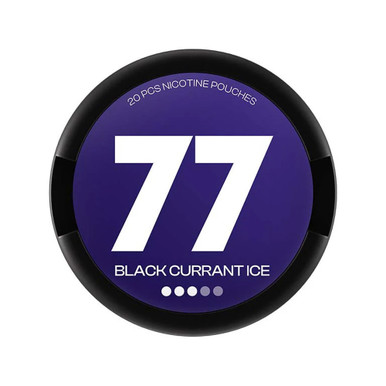
The packaging is the usual disc-shaped tin, printed on the cap with the brand, the flavour name and the milligram figure, and holding its pouches flat in a ring inside. Moulded into the cap is a shallow compartment for used pouches. None of that is remarkable — it is the standard arrangement across most of the brands we carry — but it is worth setting down because the compartment in particular changes how the format works away from home, and we return to it further down.
One thing to note early, because it governs how you should read everything after it: this is an age-restricted nicotine product, listed for adults aged 18 or over who already use nicotine. The complete compliance wording has its own section near the end.
Blackcurrant, and the cold sitting over it
Blackcurrant is one of the few fruit flavours where British readers have an unusually precise shared reference, and that makes it easier to describe than most. It is the darkest of the common berry flavours. Where a strawberry note is bright and a raspberry note is light and slightly floral, blackcurrant is deep, thick and unmistakably tart, with a quality that sits somewhere between a fruit and a preserve. There is an earthy, leafy edge to it as well — the green, almost stalky note that real blackcurrant carries and that most other berries do not.
That tartness is the defining feature. A blackcurrant flavour that has had the acid taken out of it stops being blackcurrant and turns into a generic dark fruit, so the sharpness is not a flaw in the flavour but the substance of it. The sweetness that comes with it is dense rather than light, the sort that coats rather than sparkles.
The second word on the lid changes the shape of all that. "Ice" signals a cooling layer laid over the fruit, and the effect on a flavour this dark is different from the effect on a pale one. On a light fruit, cold tends to sharpen and thin it. On blackcurrant, the cold works more like a lid: it sits across the top of the density and gives the tartness somewhere to go, so the flavour reads as cleaner at the front and just as dark underneath. The aroma off an opened tin follows the fruit first, with the cool arriving as an impression rather than a smell.
Both those elements are reflected in how we file the product: the berry tag is for the fruit, the mint tag is for the cooling layer, and the can appears on both shelves as a result. That is a description of our own filing, which we can stand behind, rather than a claim about what is in the pouch, which we do not make. Flavour itself remains subjective. Blackcurrant divides people less than a savoury flavour does but more than a plain mint, and the tartness is usually the deciding factor either way.
The 10.4mg on the cap
One declared strength, 10.4mg per pouch, given by the manufacturer and printed on the can. There is no second version of this listing in our data and no price attached to a choice, because there is no choice to make.
The figure has a particular usefulness within this brand that it does not have generally, and it is worth drawing out. Because almost everything we carry from this manufacturer declares the same figure, the number stops being a variable across the brand's own shelf. It cannot be the thing that distinguishes one 77 can from another, which means that when you are comparing inside the range you are comparing flavour and only flavour. That is unusual. On most brand shelves the strength column is the first thing people sort by; here it is flat, and the sorting has to happen somewhere else.
Across the site as a whole, 10.4mg places this can on our medium strength shelf, which runs to 135 listings and is the largest of the three bands we use. The bands are our own filing convention, drawn by us to make the catalogue searchable, and they are not a manufacturer's grading or an industry standard. The strong shelf and the extra strong shelf sit above it for the same purpose.
What a milligram figure does not do is describe an experience. Two cans printing identical numbers can strike a person entirely differently depending on pouch size, flavour weight and how long the pouch is kept in place, and none of those variables live inside the figure. We publish the number because it is on the lid. We do not interpret it for individuals, we do not know what anybody currently uses, and we are not qualified to advise on the question — which is why this page will not tell you what to buy.
A dark berry on a shelf of 76: where this one actually sits
Our berry flavour shelf holds 76 listings, which makes it one of the larger flavour groupings on the site and, for anyone browsing it, one of the harder ones to read. "Berry" is not a flavour so much as a drawer with four or five different flavours in it. This section is about how that drawer divides and where a blackcurrant can falls inside it, because that is a more useful comparison than anything we could say about this can in isolation.
The dark end
The dark berries — blackcurrant, blackberry, black cherry, and the darker mixed-fruit blends — are the group this can belongs to. They share tartness, depth and a preserve-like quality. The closest direct comparison we stock is Fumi Blackcurrant at £27.90, which takes the same fruit without a cooling word in the name, so the difference between the two listings is precisely the layer this one adds and the £12 between the prices. If you want to know what blackcurrant does on its own and what the cold is contributing, those two cans are the comparison.
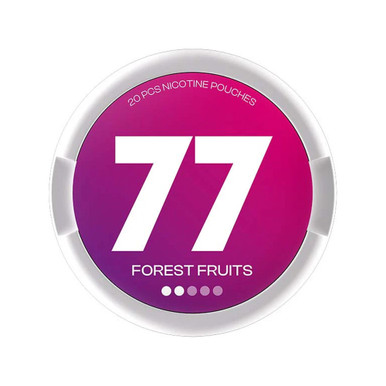
Mixed dark fruit is the other part of this end of the shelf. 77 Forest Fruits, at £39.90 like everything else from the brand, blends rather than isolates, so no single berry is identifiable and the overall reading is rounder and less sharp than a single-fruit can. The 77 VB Edition Arctic Berry can — also £39.90, and a listing from this same brand that reaches this page through the berry shelf rather than through the brand's main range — puts a heavier cooling word in front of a berry blend, which makes it the coldest reading of the same broad idea that the brand offers here.
The blue end
Blueberry is the berry most often confused with blackcurrant on a shelf, and they are not close. Blueberry is rounder, muskier and considerably less acidic; blackcurrant is sharper, darker and more assertive. Anyone who buys one expecting the other is usually disappointed, and the confusion is common enough that it is worth the paragraph. We stock the blue side several times over: SYX Blueberry at £29.90 without a cooling element in the name, XQS Blueberry Mint at £39.90 and ZYN Blueberry Mint at £19.99 with the mint stated outright, and Pablo Silver Edition Blueberry Peach Ice at £39.90, which stacks a second fruit on top before cooling the result.
That last one is a good illustration of how much room there is inside a single flavour tag. Four cans, all filed under berry, all built on blueberry, ranging from £19.99 to £39.90, and no two of them constructed the same way.
The red and mixed end
Red berries are the lightest part of the shelf. Velo Strawberry Ice at £4.19 is the cheapest berry-and-cold listing we hold, and it is about as far from a blackcurrant as the drawer allows: pale, sweet-leaning and light where this one is dark and tart. Nordic Spirit Frosty Berry at £4.49 is a mixed-berry reading with a cooling word, again at a fraction of this listing's price. Both are worth naming for scale as much as for flavour — the berry shelf spans from £4.19 to £39.90, and where our record does not state what a given price covers, we cannot account for that gap and will not try.
A single fruit against a blend
The division that matters most on this shelf is not which berry but whether there is one of them or several, and it is the division people pay least attention to when ordering. A single-fruit can is trying to be identifiable. The whole point of naming a pouch after one berry is that you should be able to recognise it, so the flavour tends to be built with edges on it — the tartness kept in, the specific character of that fruit left exposed. This listing and the Fumi blackcurrant can are both doing that, as are the SYX blueberry listing and the Velo strawberry one.
A blend is doing the opposite. Forest Fruits and Frosty Berry are not trying to make any one fruit identifiable; they are aiming at a general impression of dark or mixed fruit, and the individual edges are rounded off in the process. Blends are consequently less sharp, harder to get tired of, and much harder to describe — which is why the descriptions of blended cans across this site are shorter than the descriptions of single-fruit ones, and why there is less to say about them honestly.
Neither construction is better. What is worth knowing is that people who find a single-fruit can wearing after a fortnight often get on better with a blend, and people who find blends vague often prefer a single fruit. If you already know which of those two descriptions fits you, it narrows a 76-listing shelf faster than any other filter we could offer. And a third category sits between them — the Pablo blueberry and peach listing pairs exactly two fruits rather than blending several, which keeps both identifiable while giving neither the whole can.
The cans filed on two shelves at once
One structural point that helps when browsing. This can carries both a berry tag and a mint tag, so it appears on the berry shelf and on the mint shelf, which is our largest flavour grouping at 148 listings. Any can with a cooling word in its name is likely to be double-filed in the same way. The practical consequence is that the mint shelf is not a shelf of mint flavours — it is a shelf of cans with a mint element somewhere in them, most of which are fruits with cold on top. If you are browsing there looking for plain mint, filter further; Klint Arctic Mint at £36.90 and Edge Spearmint at £14.95 are the kind of listing you would actually be after.
The limits of all this are worth stating. We are comparing our own listings using our own data — names, prices, tags and bands. We do not hold declared strengths for neighbouring products in the data behind this page, so no strength comparison is being made here, and we are not ranking any of these cans against one another beyond describing what kind of flavour each is doing. Which is best is not a factual question and we are not going to answer it as though it were.
Portion, position and the shape of the time
The format is the thing people ask about before flavour, so it deserves proper description. A pouch is a slim white pad, dry to handle, with the corners taken off so that nothing has a sharp edge. It is light enough to be easy to drop and small enough to be hard to find again if you do.
Size and fit. The portion is designed to sit in the space between the upper lip and the jaw, and it is sized for that space rather than for a mouth generally. Out of the tin it feels slightly thicker than it will after a minute or two in place, as it softens and takes on the shape of where it is. Most people find that the initial awareness of it fades quickly and that thereafter it needs no attention at all — no holding, no adjusting, nothing to pick up or put down.
What the cooling does to the timing. On a can with a cold layer, the arc of the flavour is more pronounced than on one without. The cool element is at its most noticeable early and drops away before the fruit does, so a pouch that has been in place for a while tends to read as progressively less cold and more purely fruit. That is a characteristic of the construction rather than a fault, and it is the reason people describe cooled cans as having a "front end" in a way that a plain fruit can does not.
Eating, drinking and talking. A seated pouch does not stop anybody holding a conversation, and it does not change how a voice carries on a phone call, which is the question we are asked more than any other about the format. Drinking with one in is ordinary, though a hot drink will cut through a cooled flavour more noticeably than a cold one will, and on a can like this the cool front end is the part that gets flattened. Whether to eat with one in place is entirely a matter of preference; some people do, some take it out first, and we have no view on it worth publishing.
How long. There is no standard and we will not invent one. In practice the range runs from a handful of minutes to most of an hour, it differs from person to person, and it differs for the same person between a quiet morning and a busy afternoon. Fading flavour is what most people treat as the signal to change. That is an observation about how the format gets used and not an instruction from us, and we are not going to present it as one.
Finishing with it. Removal takes a fingertip. The used pouch goes into the compartment in the cap, which takes several before it needs emptying — and that compartment is what makes the whole format practical on a train, in a passenger seat, or anywhere without a bin within reach. Empty the compartment into general waste. Not into a sink, not into soil, not out of a car window. A used pouch is small, pale and easy to overlook on a surface, and that is the main argument for putting it back in the tin rather than down. The other, more important one, is that the tin should be closed and kept away from children and animals whether it is full or nearly empty.
Blackcurrant Ice inside the 77 range
We list 29 products from this brand on the 77 shelf, and as noted above the entire shelf is priced at £39.90. That flatness is the most useful single thing to know about the range, because it removes cost from any comparison within it.
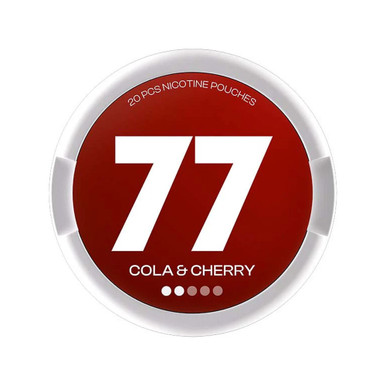
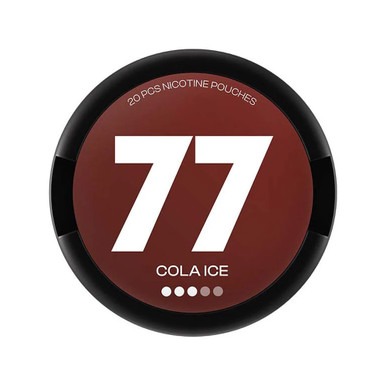
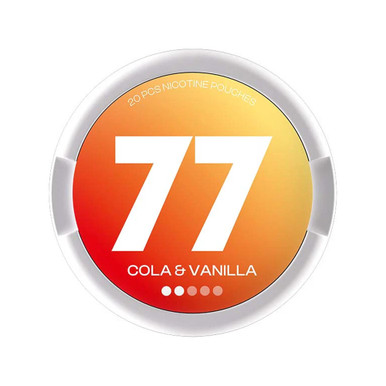
Inside those 29, the brand's fruit output is where this can lives, and it is the darker, sharper corner of it. The Apple Mint can is the light end of the same idea — orchard fruit, green and crisp, with a cool layer that works the same way this one's does over completely different material. Forest Fruits is the blended version of this can's own territory. Away from fruit entirely, 77 Cola Ice and the Cola Vanilla listing are where the brand does its soft-drink flavours, one cold and one rounded off.
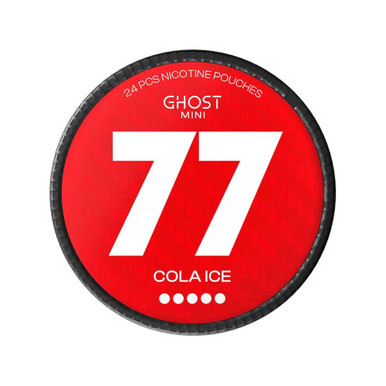
There is also a mini sub-line, listed as Ghost. Ghost Mini Mango and 77 Ghost Original Mini both sit at the same £39.90. If the size of the portion rather than the flavour is what you would change about this product, that sub-line is the brand's own answer to the question, and pointing at it is more honest than implying this listing has a format option it does not have.
What people keep going alongside it
A rotation of two or three cans is the normal pattern, and the logic behind a second can is usually either variation or contrast. With a dark, tart, cooled fruit, the two common choices split neatly.
For variation — a different berry rather than a different idea — the £29.90 SYX blueberry listing is the obvious counterpart, because it moves along the shelf without leaving it, and the difference between a round blueberry and a sharp blackcurrant is large enough to be interesting while both remain recognisably berry. ZYN Blueberry Mint at £19.99 does the same job with the cooling element retained, for about half of what this listing costs.
For contrast, the usual move is away from fruit altogether. A straight mint is the most common second can in the catalogue as a whole — the £14.95 Edge spearmint at the lighter end, the £36.90 Klint can at the colder — and a cola flavour from inside this brand is the other direction people go. If the second can is chosen on price rather than on flavour, Velo Strawberry Ice at £4.19 and Nordic Spirit Frosty Berry at £4.49 are the two cheapest berry-and-cold listings we carry, and the difference between those and this listing is large enough that people commonly keep one of each rather than two of either.
Looking after the tin
These are not delicate objects, but an open tin is exposed to the air every time it is used, and flavour is the first casualty of carelessness. Four habits cover it.
- Seat the cap fully. Half-closed in a coat pocket for an afternoon is the commonest reason a can reads flatter than it did.
- Keep it out of direct heat. Dashboards, windowsills and the top of a radiator are where cans get forgotten and where they do worst; a drawer or a bag pocket is entirely adequate.
- Empty the cap compartment before it fills. Used pouches left in the top of a tin for a week make the next opening unpleasant.
- Keep the tin shut and out of reach of children and pets, at home and in the car.
On whether a can belongs in a fridge: our record carries no storage instruction for this listing, so we are not going to issue one. If the packaging says anything about how to keep it, the packaging is the authority and it outranks this page. What can be said without inventing anything is that a closed tin kept cool, dry and out of the sun is how the format is ordinarily stored and that nothing about it asks for more.
One variant, one price, and one number we do not have
There is nothing to choose inside this listing. A single declared strength of 10.4mg, a single price of £39.90, one variant in the record — no ladder, no saving, no trade-off.
The missing piece is quantity. Our data does not record how many cans £39.90 covers for this product. Some listings on the site do hold a can count in their record; this one does not. That is a gap in our data and not a statement about what is in the box, and we are not going to produce a per-can figure by dividing the price by an assumption, because a made-up unit price is more misleading than an admitted blank. If the number matters to your decision, ask us rather than infer it from this page.
Ordering, the age check, and the door
The direct answer is that this one cannot be ordered at present. Our record marks it unavailable, and an out-of-stock listing cannot be added to a basket no matter how fully it is described here. We do not operate a waiting list, we do not take back-orders on individual lines, and we cannot give a restock date that nobody has given us. The listing page carries the live position.
Where a nicotine product is available, two checks sit around the ordinary business of buying it. The first is at checkout: everything on this site is sold to adults aged 18 or over, and an order that does not pass the age check is not dispatched. The second is at the address, because ID may be requested on delivery — and where it is requested and no adult present can produce it, the parcel goes back rather than through the door. That is the condition on which age-restricted goods can be sent at all, not a courier's preference, and it is worth deciding in advance where a parcel should go, because this is not a product to leave unattended on a doorstep.
A basket holding several brands, flavours and strengths is ordinary and changes nothing: one order, one age check, one parcel. Our standard returns terms apply as they do site-wide, subject to the obvious point that a can opened to taste it cannot be resold.
The four routes to this page
This listing is filed four ways. By strength it sits on the 135-listing medium band. By brand it sits on the 29-product 77 page. By flavour it appears on both the berry shelf, which holds 76 cans, and the mint shelf, which holds 148, because of its two tags.
If you browse by flavour, the berry shelf is the sensible entry point for anything in this family; the mint shelf will surface it too but alongside a great many cans that have little in common with it. If you browse by brand, the Pablo page and the Cuba page are the next two brand shelves of comparable size, and the full catalogue index lists everything we sell in one place.
Questions that come up about this can
What is the difference between this and a blueberry can?
Quite a lot. Blackcurrant is sharp, dark and tart with a leafy edge; blueberry is rounder, softer and much less acidic. They look similar on a shelf and read very differently in the mouth, and the mistake of treating them as interchangeable is the commonest one in this part of the catalogue. If a round, mild berry is what you want, the blueberry listings are where to look; if the tartness is the appeal, this side of the shelf is.
What does "Ice" mean on the lid?
It signals a cooling element in the flavour, laid over the fruit. It is a flavour word, not a strength word — the milligram figure is printed separately for exactly that reason, and no cooling word on any lid tells you anything about the number. How cold a given can reads is not something we can quantify for you, and we would be inventing a scale if we tried.
Is it in stock?
No. Our record shows it as unavailable at the time of writing, and the listing page is the live answer if that changes. We have no return date, we do not keep notification lists for individual cans, and we would rather say all of that than leave you with the impression that something is imminent.
How many pouches are in the tin?
We do not hold that figure. It is printed on the packaging by the manufacturer and that is where to read it. We are not going to publish an estimate that might be wrong for the batch in front of you.
How many cans does the £39.90 buy?
Our record does not say for this listing. Other products on the site do carry a can count and this one has none, which is a hole in our data rather than a fact about the product. We would rather tell you the field is empty than divide a price by a guess.
Is there a milder or stronger version?
Not in our catalogue. This listing holds one variant at 10.4mg and nothing else. Other products on the site do come in more than one declared strength, but this is not one of them, and we hold no information about versions we do not stock.
Which strength should I choose?
We cannot tell you that, and a shop that would is doing something it should not. We know nothing about what you use, we are not qualified to advise, and recommending a nicotine strength to an individual is outside a retailer's role. The strength bands exist so that someone who already knows their bracket can filter to it; that is the whole of what we offer on the question.
How long is a pouch normally kept in?
There is no standard figure and we are not going to print one. The honest range is broad — several minutes at one end, most of an hour at the other — and it varies between people and across a single day. Most people change when the flavour thins out. That describes what happens rather than telling you what to do.
Do you publish what is inside the pouch?
No. We do not publish ingredient, composition or technical information for any nicotine product on this site. We describe flavour as taste and aroma, we publish the facts our record holds, and the manufacturer's own labelling is the authoritative source for everything else.
Can I use it on a plane or at work?
That is a question for the airline and for your employer, and not one we can answer. Carriers, workplaces, venues and transport operators each set their own rules, some of which mention pouches and some of which do not. The fact that the format is not visible does not make it permitted anywhere. Rules for bringing nicotine products into another country also vary widely and some countries restrict them; we do not hold a list and will not improvise one.
Why does a berry can appear on the mint shelf?
Because our flavour shelves are built from tags, and this can carries two of them. The mint tag records the cooling element in the flavour, the berry tag records the fruit, and a product with both appears on both shelves. It is not an error and it does not mean the can is half a mint. It does mean the mint shelf is broader than its name suggests, since most cooled fruit cans are filed there alongside the plain mints.
Is the cooling the same as a menthol mint?
They are not the same thing to taste. A cooled fruit can puts a cold character at the front of a flavour that is otherwise fruit all the way through, whereas a mint can is mint from beginning to end. If what you want is mint, a cooled berry will not satisfy it; if what you want is fruit with an edge on it, a plain mint will not either. We cannot give you a numerical measure of how cold any particular can reads, because no such figure exists in our data and we are not going to construct a scale of our own.
What if I do not like it?
There is no way to find out except by opening a can, which is exactly the difficulty. Our standard returns policy applies, but an opened tin is not resaleable. Blackcurrant is a fairly polarising flavour because of the tartness, so if you are unsure about the family rather than about this particular can, a cheaper listing is a less expensive place to test the question.
Legal and compliance wording
Nicotine is an addictive substance.
77 Blackcurrant Ice Nicotine Pouches are sold only to adults aged 18 or over who already use nicotine. We run an age check at checkout, we do not supply anyone under 18, and ID may be requested on delivery — where it is requested and no adult at the address can produce it, the parcel will not be handed over.
This product is not a licensed stop-smoking medicine and holds no authorisation of that kind. It is not intended for non-smokers, for people who do not already use nicotine, for anyone under 18, or for anyone who is pregnant or breastfeeding. Nothing on this page is medical advice, and nothing on it should be read as a suggestion that any person begin using nicotine or select any particular strength.
Keep the tin closed and out of reach of children and pets, and dispose of used pouches in general waste. Every product fact above — name, brand, price, declared strength, flavour tags, shelf placement and stock position — comes from our own record for this listing. Where the record holds nothing, this page has said so instead of estimating, and the manufacturer's labelling on the can governs anything printed on the packaging.
In summary
77 Blackcurrant Ice is the dark, tart end of the berry shelf with a cooling layer over it, listed at £39.90 in a single 10.4mg strength and out of stock as this was written. It is double-filed on berry and mint, sits in the medium band, and shares its price with every other can on the 77 shelf. The nearest thing we stock to it is the £27.90 Fumi blackcurrant can, which takes the same fruit without the cold; the furthest thing from it in the same flavour drawer is a £4.19 strawberry listing. Everything we know about this product is above, and every gap in what we know has been written down as a gap.
More from 77
More medium strength pouches
More mint pouches
Where this sits
77 Blackcurrant Ice Nicotine Pouches appears in these categories. Browse them, or jump to something close.
You might also like