Home / Medium Strength / Klint Blueberry Nicotine Pouches
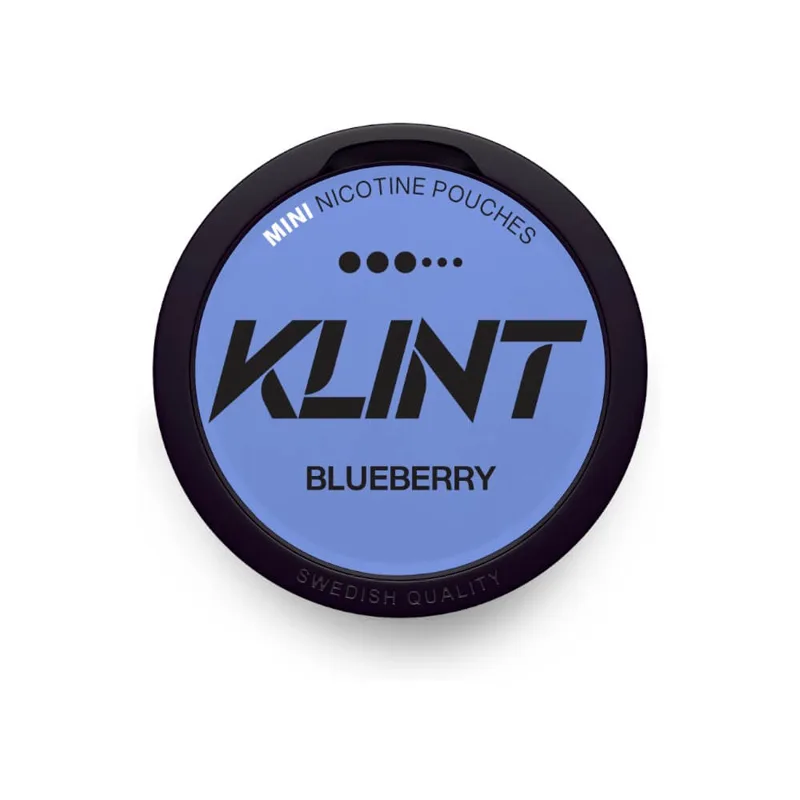
Klint · 6.4mg · 10-can pack
Read the full guide
Klint Blueberry Nicotine Pouches
£36.90
✔ In stock — ready to ship
100% tobacco-free
Free over £20
Same-day dispatch
Secure checkout
This listing is out of stock. That goes at the top because it is the fact most likely to change what you do next, and burying it under a page of description would be a waste of your time. You can read on and get an accurate picture of the can, but you cannot buy it today. If it is the flavour you came for, the sections on substituting across our shelves are the useful part of this page; if it is the brand, the position there is thin too, and we set it out plainly further down.
The listing itself: Klint Blueberry Nicotine Pouches, a ten-can pack at £36.90. Our record holds one declared figure, 6.4mg, and one flavour heading, berry. It is filed on the Medium Strength shelf among a hundred and thirty-five listings, and there is a single photograph attached to it.
The full guide to Klint Blueberry Nicotine Pouches
5,359 words on how it eats, who it suits, how to serve it and what to put beside it.
Klint Blueberry: unavailable at present, and what the can is
Everything below is drawn from that record or from general information about the format that applies to every can we stock. Where our data has a gap, this page leaves the gap visible and says what it is. Two of them matter — the pouch format and the pouch count — and neither is filled in with a plausible-looking number further down.
Blueberry as a taste, and a tag broader than the name
The product name is Blueberry. The flavour tag in our catalogue is berry. Those are not in conflict, but they are not the same thing either, and it is worth being clear about which is which so that nobody browsing a category page ends up surprised.
The berry shelf collects seventy-six listings and it is a parent category. It holds blueberry, blackcurrant, raspberry, strawberry and mixed-berry products together, because filing each fruit separately would produce a menu nobody could use. So the tag on this listing tells you which shelf it lives on and not which fruit it is named for. The product name is the specific statement, and the can's own front panel is the authority over both.
Blueberry as a flavouring tends to read as a rounder, softer, darker fruit than the sharp end of the berry family. Where a raspberry or a blackcurrant carries obvious acidity and a bright, sharp edge, blueberry is usually the sweeter and gentler of the group, with less tartness at the front and a slightly jammy, deeper character. It is a low-contrast fruit in the way that coffee is a low-contrast flavour: it does not shout, and it sits comfortably next to other things rather than competing with them.
Two honest qualifications on that. First, it is a description of how blueberry flavourings behave generally across this category, not a tasting note for this specific can, which we have not published and are not going to invent. Second, this listing carries no cold word in its name and no mint tag, so on the evidence of the naming it is a plain fruit rather than a fruit-and-mint pairing — but that is inference from a name, and the packaging is what settles it.
Substituting across our shelves when the line is not there
Since you cannot buy this one today, the practical question is how to find something else without ending up with a can you did not want. This is a genuine skill and most of it comes down to knowing what a category page is actually promising.
Start with what you are matching. There are three separate things people try to match when a line is unavailable, and they pull in different directions. You can match the flavour, you can match the declared figure, or you can match the unit and the price. It is unusual to get all three, and deciding which one you care about before you start browsing saves a great deal of circling.
If you are matching the flavour, the berry shelf is the tool, but it is a wide one — seventy-six listings covering a family of fruits rather than a single one. Narrowing by the word in the product name is more precise than the tag. Among the cans near this listing, SYX Blueberry at £29.90 and Nordic Spirit Blueberry at £4.49 both name the same fruit outright. Pablo Silver Edition Blue Raspberry at £39.90 and XQS Berrynana Twist at £39.90 pair a blue fruit with something else. 77 Strawberry at £39.90, Fumi Blackcurrant at £27.90 and ZYN Blackcurrant Forest at £19.99 are berries of a different character — sharper and more acidic than blueberry usually is.
Worth flagging before you go looking: two of the berry cans nearest this one are also unavailable at the time of writing. Edge Strawberry at £14.95 and Rush Berry Ice Pro at £19.99 are both out of stock. We would rather tell you that here than have you click through to two more pages that cannot sell you anything. Velo Strawberry Ice at £4.19 is available and is the cheapest headline price among the berry cans near this listing, subject to everything said below about units.
If you are matching the declared figure instead, the band page is the starting point rather than the answer, for reasons set out in the strength section below. And if you are matching the unit — ten cans in a box — then very few of the listings above will match, because most of the shop is priced per can. That is the substitution that catches people out most often, and it is worth doing the arithmetic before rather than after.
What transfers between cans, and what does not
Moving from one can to another is a smaller step than a category page makes it look, and it helps to separate the things that genuinely change from the things that do not.
What changes is short. The flavour changes, obviously. The declared figure changes, and it does not mean the same thing between manufacturers — a number on one house's lid and a number on another's are two separate declarations rather than two readings from a single shared instrument, and we have no basis for telling you they are interchangeable. The naming conventions change, sometimes dramatically: words like ice, freeze, max, pro and edition are range branding rather than descriptions of a can, and reading them as specifications will mislead you. And the unit changes, which is the one that costs money.
What does not change is the reassuring half, and it is longer. The handling is identical: a pouch from any brand goes in the same way, sits in the same place, comes out the same way and is disposed of the same way. The can construction is near-universal across everything we stock — a well underneath for fresh pouches, a shallow catch tray under the lid for used ones, and a lid that clicks rather than screws. The storage considerations are the same for every can in the shop. The age restriction, the checkout confirmation and the check at the door are the same on every order regardless of what is in it.
So switching brands is not learning a new object. It is changing a taste and a printed number while the physical routine stays exactly where it was. People who understand that tend to shop the whole catalogue by flavour and figure; people who do not tend to stay with one brand and accept a narrower choice. Neither approach is better, but they fail differently, and a six-listing range with four gaps in it — which is what this brand currently is — is precisely how brand loyalty fails.
Three houses, one word: reading a flavour shelf
There is a trap in flavour shelves worth naming, because it affects every substitution you might make from this page.
Three manufacturers can each produce something called blueberry and produce three noticeably different things. The word on the label describes the fruit they were aiming at; it does not describe how sweet the result is, how sharp, how deep, or whether anything else has been put alongside it. Our record holds product names and not formulations, so when this page lists several cans that name the same fruit, it is telling you where to look rather than promising you a match.
The same applies in reverse. A can named for the broad family rather than a specific fruit may be closer to what you wanted than one that names the exact fruit, and there is no way to tell from a category page. The only reliable method anybody has is to buy a small quantity of something and find out — which is easier where a listing sells single cans, and harder where it sells boxes of ten, as this one does.
We are not going to pretend to knowledge we do not have here. We have not tasted our way across the berry shelf and published a ranking, there are no comparisons on this site that would let you shortcut the question, and a description claiming that one can is "closest to" another would be making it up. What we can do is be accurate about names, prices, figures and availability, and tell you honestly where the limits of that are.
The pouch, and the can it arrives in
A pouch is taken from the well between finger and thumb and placed between the upper lip and the gum, usually towards one side rather than centred. Once it is in, it should stay put; one that will not settle is generally sitting too far forward, and easing it back against the gum resolves it. It is not chewed and it is not swallowed.
How long anyone keeps one in varies from person to person. People across the format describe anything from around twenty minutes to about an hour, and many sit outside that in both directions. We are not going to tell you how long to keep one in, how many to have, or how to space them out. Those are matters of individual habit, we have no way of knowing anything about yours, and it would be an overstep for a shop to issue instructions on them. If you want guidance rather than description, a pharmacist or a doctor is the place for it.
Two things about this listing we do not hold. We do not know the pouch format — whether these are slimmer and longer portions, shorter and broader ones, or a smaller mini size — and that difference is obvious the moment you handle one. And we do not hold the pouch count per can; our record carries the pack figure of ten cans and nothing about what is inside each. Neither field exists in our data, so neither appears here as a number. The can's labelling states both, and we will check a physical unit if you ask before ordering.
Disposal is where description stops and instruction starts. Used pouches go into the catch tray if there is no bin, and out of it into general waste at the first opportunity. Never down a sink or a drain, never into a recycling stream, and never left on a surface. Used pouches, unused pouches and the can itself stay out of reach of children and animals without exception.
6.4mg, and a band wider than any single number
This listing declares 6.4mg. The figure is printed by the manufacturer and it appears here so that one can can be distinguished from another and found again later. That is all it does. It is not a rating and not a score, and a can printing a larger number is not better, more serious or more worth buying than one printing a smaller one.
It is worth noting what that means for the filing, because people find it counter-intuitive. This can declares one of the lower figures we carry and it is filed on the Medium Strength shelf rather than anywhere lower, because our bands are ranges rather than points. The hundred and thirty-five listings on that shelf declare a spread of numbers that all fall inside the boundaries we drew for it. Two cans filed together can print noticeably different figures. So the band page narrows a long catalogue to a short list, and then you read the individual listings for the actual numbers. Above it in our menus sit the Strong and Extra Strong bands, and that ordering is a sorting order for navigation rather than a ladder anyone is expected to climb.
We cannot advise you on which strength suits you. Not from your order history, not from anything you could describe to us, and not from any rule of thumb. We do not hold that expertise, and a retailer claiming it would be doing something it has no business doing. We report the printed figure accurately on every listing and file it consistently so that you can find what you already buy. Anything beyond that belongs with somebody medically qualified.
Dry pouches, moist pouches, and what changes in an open can
Condition is the part of owning a can that nobody explains and that accounts for most of the disappointment people report, so it gets proper space here.
Products in this category do not all arrive in the same physical condition. Some are noticeably drier to the touch and some are more moist, and that varies by manufacturer and by product line rather than following any rule you could apply across a shelf. Our record does not state which this one is, so we are not going to tell you — but the distinction matters because it sets what "normal" looks like for a given can, and a pouch that seems dry compared with the last brand you bought is not necessarily a pouch in poor condition.
What does change over time is straightforward: an open can loses moisture. A can that has been open for weeks will not be in the condition it was in on the day the lid first came off, and the practical signs are the ones you would expect — the pouches feel firmer and less pliable, they are slightly less comfortable to place, and the flavour reads fainter and shorter than it did at the start. None of that is a fault and none of it makes a can unusable; it is the ordinary behaviour of anything that was sealed and then was not.
The mechanism is entirely mundane. A lid that does not close fully leaves a can effectively open, and the commonest cause of a lid not closing fully is a used pouch left in the catch tray holding it proud. The second commonest is debris on the rim. Pressing the lid down properly and wiping the rim occasionally is most of what condition management consists of, and it costs nothing.
One thing we will not do is tell you a can has gone off, or put a use-by interpretation on anything. Our record holds no manufacturer guidance on that for this listing, and the packaging carries whatever dates the maker prints. If there is a date on the can, that date is the authority and nothing on this page competes with it.
Heat, light, and where a can should not be left
Heat is the main thing that dries a can out, and the places people leave cans are depressingly predictable. A windowsill in summer. A car dashboard. The shelf above a radiator. A bag left in a warm boot. A coat pocket hung over a heater. Each of those will age an open can faster than a drawer will, and none of them is necessary — a cupboard, a drawer or any cool interior space is enough, and nothing more elaborate is required.
Direct sunlight is worth avoiding for the same reason, and a sealed box left in the sun is no better protected than an open can in terms of the temperature it reaches. Cool, dark and dry is the whole of the advice and it is not complicated.
On refrigeration: some customers keep cans in a fridge and some do not. Our record carries no manufacturer storage instruction for this listing, so we are not issuing one of our own, and we are not going to claim a fridge does or does not help. If Klint print a storage instruction on the packaging, that instruction outranks anything written here. What is not optional, wherever you store it, is keeping the box and every can in it out of reach of children and animals, and not leaving an open can on a kitchen surface, a coffee table or a bedside table.
Ten cans, and opening them one at a time
A box of ten makes condition a live question in a way a single can does not, because most of what you have bought will be sitting unopened for a considerable time.
The habit that matters is opening one can at a time. An unopened can keeps better than an opened one, so opening three at once starts all three drying together while you work through the first. Treat the box as the store and the single open can as the one in circulation. It costs nothing and it is the one storage practice that genuinely changes the outcome for people buying in quantity.
The corollary is that a large box is a commitment to a flavour as well as to a quantity. Ten cans of something you turn out not to like is a worse outcome than one can of it, and this listing does not offer a single-can option to test with. That is a real argument for buying a single can of something from a listing that sells them, before committing to a box of anything — a point about how to spend money sensibly, not a suggestion about how much anyone should use.
Because we do not hold the pouch count, we cannot tell you how long a box lasts. Nobody can from a description: it depends on individual habit, which is not something we comment on. People work it out by buying once, noting what it lasted, and planning subsequent orders against their own figure.
The Klint shelf, and what is actually on it today
The brand's shelf here holds six listings and this page is one of them. The other five are Klint Arctic Mint, Klint Avalanche Mint, Klint Apple Mint, Klint Cola Lime and Klint Freeze Mint. All six carry the same £36.90, so inside this brand price does not distinguish anything.
Availability does, and bluntly. Arctic Mint and Avalanche Mint are in stock at the time of writing. This can, Apple Mint, Cola Lime and Freeze Mint are not. Four out of six unavailable is a thin shelf, and since the two that remain are both mints, the entire fruit and drinks side of this range — including the can you are reading about — cannot currently be bought. If you came here for a fruit from this particular house, the honest answer is that there is not one available, and the berry listings from other brands above are the realistic route.
By name, the range divides three and three: three mints, and three that pair mint with a fruit or leave it out altogether. This listing is the only one of the six named for a single fruit on its own, which makes it the plainest fruit in the range and, at present, the least obtainable.
Our record on this page carries the siblings' names, prices and stock positions, and not their declared figures. We are not going to print a milligram number for a can whose own listing we are not writing, so if you are matching a figure across the brand, open each sibling page and read it there. A flat price across a range is no indication that the printed numbers are flat with it.
£36.90 across a range, and prices that are not comparable
Ten cans at £36.90 is £3.69 a can, and that division is available because our record carries the pack figure. Doing it is the first step in any comparison with the rest of the shop, because our category pages sit box prices next to single-can prices with nothing to tell them apart.
Look at the berry cans near this one and the spread runs from £4.19 to £39.90. That is nearly a tenfold difference on a single shelf, and it is overwhelmingly a difference in what the listing ships rather than in what the cans are. Our record for this page does not state what each of those other lines contains, so we are not going to convert them for you. The method is always the same: find what the line actually includes, divide, compare per can. Done properly, a £4.19 listing and a £36.90 listing can land close together, and a headline price that looked like a bargain can turn out not to be one.
Within a single brand the problem vanishes, because a house normally prices its whole range uniformly. Every Klint listing is £36.90, so comparing them needs no arithmetic at all — only a look at what is in stock. It is cross-brand comparison that requires the work, and the Pablo shelf and the Cuba shelf, two of the widest ranges we carry, are good places to practise it.
What there is to decide, and the matter of waiting
Our record holds one variant for this listing: 6.4mg at £36.90 for ten cans. No second figure, no smaller pack, no single-can option and no bundle. So the decision, when it is available, is whether you want a plain blueberry rather than a pairing, whether 6.4mg is the figure you already buy, and whether a box of ten of one flavour is a commitment you want to make in one go.
Today there is a fourth question, and it is the operative one: whether to wait or to substitute. We cannot tell you when it will return. Restocks depend on supply into us rather than on anything we control, and we have deliberately not put a date on this page because a guessed date is worse than no date — people plan around dates. The live listing is the accurate signal, and the add-to-basket control reappearing is what "back in stock" looks like. If you would rather be told, contact us and ask about this specific line rather than watching the page.
If you are not waiting, the substitution sections above are the practical part, and the single most useful thing in them is the advice to decide first whether you are matching the fruit, the figure or the unit. Trying to match all three across a catalogue of this size usually ends in not buying anything.
Ordering, and the person at the door
When a line is available, ordering is the same here as anywhere on the site: add it to the basket from the product page, and the basket states the exact quantity, the exact price and any delivery charge before you commit. The checkout is the authoritative statement of what you are buying, not a description and not a category listing. While this line is out of stock, the add-to-basket control is unavailable, and that is the reliable signal — we do not take orders for stock we do not hold.
Age verification applies to every order without exception. Sales are to adults aged 18 or over only. You confirm your age at checkout, orders may be verified before dispatch, and the courier may ask for photographic identification at handover. If no adult is present who can produce it, the parcel is not left and the delivery fails. Choosing an address where somebody is reliably in is the simplest way to avoid that, and it is worth deciding before you order rather than on the day.
On delivery timescales, carriers and charges, our record for this page holds nothing, so this page states nothing. The site's own delivery information carries those details and is kept current in a way a product description cannot be.
Where this page sits
Three routes lead back here. By brand, the Klint shelf holds all six listings in one place and at six items is short enough to read in full, which also makes it the fastest way to see what is currently obtainable. By flavour, the berry category is where this page is filed, alongside seventy-five others covering the whole fruit family rather than this one fruit. By figure, the Medium Strength band is the filing, with the other two bands either side of it in the menus.
Crossing two routes narrows fastest — brand plus flavour, or flavour plus band, will take a long catalogue down to something readable. For an unavailable line, the brand shelf is the most useful of the three, because it shows at a glance what else from the same house can actually be bought. If none of those is how you remember the can, the shop index carries everything on one page and the search box will take a brand name or a fruit.
Questions about this one
When is it coming back?
We do not know and we are not going to print a date we cannot stand behind. Restocks depend on supply reaching us rather than on anything within our control, and a guessed date is worse than none because people plan around it. The live listing is the accurate signal: when the add-to-basket control returns, the line is available again. If you would rather be told than keep checking, contact us and ask about this specific listing.
Why is it tagged berry when it is called Blueberry?
Because the tag is the shelf and the name is the product. The berry category is a parent heading holding seventy-six listings across blueberry, blackcurrant, raspberry, strawberry and mixed-fruit products, since filing every fruit separately would produce an unusable menu. The tag tells you where the page lives, and the product name tells you which fruit it is named for. Where the two seem to disagree, the product name and the can's own front panel are the reliable statements.
What is the closest thing you stock to this?
We are not going to name one, because we would be guessing. Several listings name the same fruit — two of them are linked above at £29.90 and £4.49 — but three manufacturers producing something called blueberry will produce three different results, and our record holds names rather than formulations. We have not tasted across the shelf and published a ranking, so a claim that one can is "closest" would be invention. Names tell you where to look; they do not promise a match.
Is 6.4mg low?
It is one of the lower figures we carry, and it is filed on the Medium Strength shelf because our bands are ranges rather than single values. Beyond that arithmetic we are not going to characterise it, and we certainly cannot tell you whether it suits you — that is not a judgement a shop is competent or permitted to make. We report printed figures accurately and file them consistently. If you want a view rather than a number, that belongs with a pharmacist or a doctor.
How many pouches are in a can?
Not a figure we hold. Our record carries the pack count of ten cans and says nothing about what is inside each one, and we are not willing to print a number typical of the category and let it be mistaken for this product's specification. The can's own labelling states it. This is also why we cannot tell you how long a box lasts: without a count, and with no business commenting on how much anyone uses, there is no honest sum available.
Are these slim pouches or the broader kind?
We do not hold the format for this listing. Pouches in this category come slimmer and longer, shorter and broader, and in smaller mini sizes, and the difference is obvious in the hand — but that field is not in our record and we will not guess it. The packaging states it, and the single photograph on the listing shows the outside of the can rather than the contents. Ask before ordering if it matters and we will check a physical unit.
My last can felt dry. Was it faulty?
Probably not. Products in this category arrive in different conditions — some drier to the touch, some more moist — and that varies by maker and by line, so a can that feels dry against the last brand you bought is not necessarily in poor condition. An open can also loses moisture over time, which firms the pouches and shortens the flavour. The usual culprits are a lid not closing fully, often because a used pouch is sitting in the catch tray, and storage somewhere warm.
Should I open all ten cans to check them?
No. An unopened can keeps better than an opened one, so opening the box starts every can ageing at once while you work through the first. Take one out, use it, then take the next. Keep the box somewhere cool, dry and dark — not a windowsill, a dashboard, a radiator shelf or a warm car — and keep the whole lot out of reach of children and animals. Press the lid fully shut each time and keep the catch tray empty.
Can I buy one can instead of ten?
Not from this listing. Our record holds a single variant, the ten-can pack at £36.90, with no smaller option and no bundle. Other listings on the site are sold as single cans, and the very wide price spread across our category pages is mostly explained by that difference in unit rather than by anything about the cans themselves. We cannot split this pack, and saying so is better than leaving you searching for an option that does not exist.
Do any of the other Klint flavours work as a substitute?
Not really, on availability grounds. Four of the brand's six listings are out of stock, this one included, and the two that remain are both mints rather than fruits. So within this house there is currently no fruit at all to move to. The berry listings from other brands linked earlier in this page are the realistic route, with the caveat that two of the berry cans nearest this one are also unavailable at the time of writing.
Do you publish reviews or ratings?
No, not on this page or any other listing here. There are no star scores, no aggregate figures and no quoted customer opinions, and their absence is deliberate rather than an oversight. What this page holds is the record we actually have — name, brand, price, pack figure, declared strength, flavour heading and stock position — plus general information about the format, with every gap in that record marked rather than filled.
Compliance and the age restriction
This product is sold only to adults aged 18 or over who already use nicotine, and we will not sell it to anyone else. Age confirmation is required at checkout, orders may be verified before dispatch, and photographic ID may be requested by the courier on delivery. If nobody at the address can produce identification, the parcel is not handed over.
Nicotine is an addictive substance. That is set out here plainly and in full view, because a description of an age-restricted nicotine product should never bury it or soften it.
This is not a licensed stop-smoking medicine and it is not offered, described or intended as one. It is not for non-smokers, not for anyone who does not already use nicotine, not for under-18s, and not for anyone who is pregnant or breastfeeding. We make no health, medical or safety claim about this product in any direction, and nothing above should be read as one. Questions about nicotine and your own circumstances belong with a pharmacist or a doctor rather than with a retailer. Keep the box and every can out of reach of children and animals.
Closing note
Klint Blueberry is a ten-can pack at £36.90 — £3.69 a can — declaring 6.4mg, filed under the broad berry heading and on the Medium Strength shelf, and it is out of stock at the time of writing. It is the only can in a six-listing brand range named for a single fruit on its own, and it is one of four in that range you cannot currently buy. Its berry tag is the parent shelf rather than a statement about the fruit. We do not hold the pouch format or the pouch count, and we have marked both as gaps instead of filling them with numbers borrowed from elsewhere. The packaging in front of you, and Klint's own printing on it, is the authority over everything written above.
More from Klint
More medium strength pouches
More berry pouches
Where this sits
Klint Blueberry Nicotine Pouches appears in these categories. Browse them, or jump to something close.
You might also like