Home / Medium Strength / 77 Raspberry Ice Nicotine Pouches
77 · 5.2mg–10.4mg
Read the full guide
77 Raspberry Ice Nicotine Pouches
£39.90
✔ In stock — ready to ship
100% tobacco-free
Free over £20
Same-day dispatch
Secure checkout
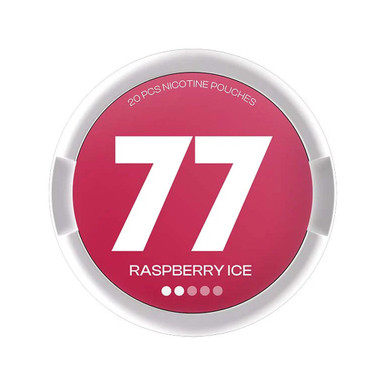
This page is for 77 Raspberry Ice Nicotine Pouches. It is one of the few listings we run that carries more than one declared strength: both 5.2mg and 10.4mg appear on it, and both are priced at £39.90. Our flavour record gives two categories, mint and berry. And the fact that matters most before you read any further — we currently list this product as out of stock, in both figures.
A product page written against an empty shelf has to be honest about what it is for. You cannot buy this today. What the page can still do is tell you precisely what it is, so that you know whether it is worth waiting for; place it against the cans that are available now, so that you have somewhere else to go if it is not; and be specific about the two-figure structure, which is the unusual part of the listing and the part people ask about.
The full guide to 77 Raspberry Ice Nicotine Pouches
5,092 words on how it eats, who it suits, how to serve it and what to put beside it.
Two figures on one listing, and an empty shelf
Everything factual here comes from our own product record. Where the record is silent, and it is silent on several things, this page says so rather than filling in a plausible answer. A shop that invents small details is a shop whose large details you cannot rely on either.
The standing note, before the detail: this is an adult nicotine product, sold only to people aged 18 and over who already use nicotine. The full compliance wording has its own section at the foot of the page.
Raspberry under a cold treatment, described as taste
Our flavour filing gives mint and berry; the name on the can gives raspberry and ice. Between the two you get a reasonably clear picture of the construction, and it is a different construction from a plain fruit-and-mint pairing, which is worth spelling out.
Raspberry, as a flavouring, sits towards the sharper end of the berry family. It is sweet, but it is not a round or nectar-like sweetness — there is an acidity in it and a faintly seedy, slightly tart edge that distinguishes it from a strawberry or a blueberry. It reads as bright rather than deep. Against the darker berries, which tend towards jam, raspberry stays on the fresher side of the family.
"Ice" in a product name signals a cold treatment rather than a specific mint variety, and that is the difference between this construction and a fruit-plus-mint one. In a fruit-and-mint can you usually get two identifiable flavours side by side. In an iced can, the cold tends to sit over the fruit as a layer rather than beside it as a partner — it arrives first, it stays longest, and the fruit reads through it. That is why our filing tags this as mint and berry while the can calls it ice: the cold belongs to the mint family in our categories, but its role in the flavour is different from the role mint plays in something named as a mint.
Taken together, expect a bright, slightly tart berry read through a cold layer. The aroma on opening will be the cold note first, because cool notes are the more volatile, with the berry behind it. Nothing in our record suggests anything creamy, spiced, herbal or dark has been put alongside it.
The honest limit, as on every one of our pages: we hold flavour categories, not formulations. Describing raspberry as a flavour family is fair. Claiming to know how sharp this particular maker has made it, or how far forward the cold sits, would not be. Two cans with the same two tags can be noticeably different in the mouth.
What the two numbers on this page are
The figures printed on these cans, 5.2mg and 10.4mg, are declared amounts per pouch published by the manufacturer. They exist to allow products to be sorted and compared, and they are labels rather than forecasts of anything.
Their function on this site is filing, and there is a wrinkle worth naming here. A listing sits on one strength shelf, not two, and this listing sits on our medium-strength shelf among its hundred and thirty-five cans. That is our categorisation doing something slightly blunt with a product that carries two figures, and rather than pretend the filing is more precise than it is, we would rather point it out: the shelf tells you where the listing lives in our navigation, and the variant you select at the point of purchase tells you which figure you are actually buying.
Above that shelf sit the strong shelf and the extra-strong shelf, holding listings with higher declared figures. That is the arrangement, and it is the whole of what the numbers do here.
What they do not do is guarantee that two cans printed with the same figure behave alike. Pouch size, moisture, flavour intensity and the way a maker builds a pouch all vary between products and none of it appears in a milligram figure. And nothing in this section is advice. We do not know anything about you, we do not recommend strengths, and the choice is yours rather than ours.
How a can like this actually gets bought
The most useful thing a shop can describe, and the thing manufacturers never cover, is the rhythm of buying — how a product moves from a first order to a standing habit, what people hold in reserve, and what happens when the supply breaks. This listing is a good one to describe it against, because the out-of-stock position makes the mechanics visible.
One can, several cans, or a standing habit
Pouch buying tends to fall into three patterns. The first is the trial: one can of something unfamiliar, bought to find out whether the flavour suits, usually alongside something already known so the order is not wasted if it does not. The second is the restock: a repeat of something established, bought in whatever quantity the listing offers, with no decision involved beyond quantity. The third is the browse, where somebody orders three or four different things at once and sorts out afterwards which of them they will buy again.
Which of those you are doing changes what a listing like this is worth to you. For a trial, the two-figure structure is genuinely useful, because the decision about the figure can be made on the same page as the decision about the flavour. For a restock, the same structure is neutral — you already know which figure you buy. For a browse, a can with an unambiguous name like this one is an easy thing to add, because you know roughly what you are getting before it arrives.
The spare, and why regular buyers keep one
Anybody who buys pouches regularly works out fairly quickly that running out is annoying, and the standard response is to keep a spare sealed can somewhere. It is not a complicated habit. One unopened can behind the one in use, replaced whenever it gets promoted, is enough to cover the gap between noticing you are low and a parcel arriving.
The variation people settle on is whether the spare is the same flavour or a different one. The same flavour makes for continuity. A different one means that when you do run out, you get variety rather than an exact repeat. Neither is better and it is purely a matter of how you like to buy. What both have in common is that the spare is kept sealed until needed — an opened can degrades from the moment the lid first comes off, so a spare that has been opened "just to try" is no longer really a spare.
Reordering without having to think about it
The practical mechanics of reordering are worth a paragraph because they are where money and hassle are actually saved. Ordering everything in one basket rather than three is one parcel, one delivery and one occasion on which somebody has to be at the door with identification. Ordering when you are low rather than when you are out means the timing of the parcel does not matter. And ordering the same set each time — one known can, one spare, one thing being tried — means the basket takes thirty seconds to rebuild rather than half an hour of browsing.
If you buy mainly from one maker, the 77 range page is the fastest way to reassemble an order, because all twenty-nine of the maker's listings are on a single page and you do not have to search for each one. If you buy across makers, the full catalogue is the broader starting point.
What an empty shelf does to the rhythm
This is the part that applies specifically today. When a product you buy regularly goes out of stock, the buying rhythm breaks in a predictable way: you discover it at the moment you were about to reorder, which is by definition the moment you are low. The spare, if you keep one, is what turns that from a problem into a mild inconvenience.
Beyond that, there are two sensible responses and one poor one. The first sensible response is to wait, if you have enough to wait with. The second is to buy the nearest available equivalent, which is what the whole of the next section of this page is for. The poor response is to buy nothing and then have to make an emergency decision later, because emergency decisions in this category tend to produce cans that sit in a drawer unloved. None of that is advice about consumption; it is advice about shopping, and it costs nothing to follow or ignore.
What a basket usually looks like
It is worth describing the shape of a typical pouch order, because new customers often assume there is a right way to do it and there is not. Most orders we see are mixed rather than single-line: two or three different cans, frequently from two or three different makers, occasionally at two different declared figures. Very few are one line of one thing, and very few are enormous.
The reason is the one set out in the pairing section further down this page. A single flavour, bought on its own and used exclusively, becomes monotonous faster than people expect, and the cheapest correction is a second can that reads clearly differently. So the standard basket ends up being one established can plus one deliberate contrast, and the contrast is the line that changes between orders while the established one stays put.
There is no minimum, no requirement to buy a set, and no advantage to ordering a single line rather than a mixed one. The only practical consideration is the one mentioned above: put everything in one basket rather than spreading it across several, because each separate order is another parcel and another delivery somebody has to be present for.
Buying two figures at once
One thing worth noting about a multi-figure listing, purely as a mechanical point: because both variants live on the same page at the same price, ordering one of each is as simple as ordering two of one. Some people who buy across two figures do exactly that and keep both in the house. Whether that suits you is your business entirely, and we make no suggestion about it — but the structure of the listing makes it trivially easy, and it is the kind of thing that is worth knowing exists rather than discovering by accident.
The pouch in practice
The format is identical across everything we sell. A pouch is a small sealed sachet placed in the mouth between the lip and the gum, most often at the front under the top lip, and left there. It is not chewed, not sucked and not swallowed, and it comes out in one piece.
Handling it is three movements: lid off, one out, lid on. The lip holds the pouch in place and it stays where it is put unless it is moved. It can be shifted from one side to the other if the position becomes uncomfortable, and if it is uncomfortable in every position the sensible thing is to take it out rather than persevere.
Duration varies widely and we will not pretend to a number. Across the category, people describe something between roughly twenty minutes and about an hour, with plenty outside that range in both directions. Flavour is usually what decides it — clearest early, fading from there — rather than a clock. That is a description of behaviour and not an instruction; nothing about a pouch needs finishing.
Used pouches go in a bin. Cans of this type usually have a shallow catch compartment beneath the lid for holding them until a bin appears, but we do not hold a specification for this can and will not promise you it is there — open one and look. If it is, it is temporary storage for rubbish rather than permanent, and emptying it when you open a fresh can is about the right rhythm.
Substitutes while it is unavailable, and companions when it is not
Because this listing is currently empty, the question of what goes alongside it and the question of what stands in for it are the same question, and we can answer both from our own shelves with reasons attached. Everything below is a can we actually list, with its price and the reason it is being mentioned.
Nearest by description
The closest thing on our shelves to a berry-with-cold construction from the same maker is 77 VB Edition Arctic Berry at £39.90 — the same berry-and-cold shape, from the same range, at the same price. If you want to stay as close as possible to what this listing offers while it is out, that is the first can to look at.
Beyond the maker, XQS Blueberry Mint at £39.90 and ZYN Blueberry Mint at £19.99 are the two cans that share both this listing's flavour tags — berry and mint — most directly, though both name a blueberry rather than a raspberry, which is a shift from the sharper end of the berry family towards a rounder one. SYX Blueberry at £29.90 gives you the berry without the mint at all, which is a different construction rather than a different fruit.
Berry under a cold treatment
If the cold layer is the part you want to preserve, rather than the specific fruit, the shelf has several options at different prices. Nordic Spirit Frosty Berry at £4.49 is a berry under a frost treatment and the cheapest can named anywhere on this page. Velo Strawberry Ice at £4.19 is cheaper still and swaps the raspberry for a strawberry, which is softer and less tart. Pablo Silver Edition Blueberry Peach Ice at £39.90 is the most complicated of the group — two fruits under an iced treatment rather than one — and sits on the same price line as this listing.
All of those are on the berry shelf, which holds seventy-six cans in total. That is a substantial shelf, and it is the most efficient place to browse if berry is the quality you are holding constant while this listing is unavailable.
Leaving berry behind entirely
The third approach, and the one that produces the most contrast, is to pick something that shares only the cold and not the fruit. Klint Arctic Mint at £36.90 is an arctic presentation with no fruit behind it at all. Edge Spearmint at £14.95 takes the sharper, greener spearmint direction rather than the cold one, and is the most economical mint-led can mentioned here. Both sit on the mint shelf, which at a hundred and forty-eight cans is the largest flavour category we run and by far the widest choice on the site.
For a fruit with no cold on it whatsoever, Fumi Blackcurrant at £27.90 is the clearest example we stock — a dark, deep berry, which is about as far from a bright iced raspberry as the berry family goes while remaining a berry. If you keep two cans on the go at once, a pairing that differs on both the fruit and the temperature is the one least likely to blur into a single taste.
Where this sits in the 77 line
We list twenty-nine products from this maker, gathered on the 77 brand page. It is one of the broader ranges we carry, spanning fruit cans, mint cans, fruit-and-mint pairings, iced treatments, cola presentations, teas, dessert-leaning names and a sub-line built around a smaller can.
Within that, Raspberry Ice is one of the maker's iced fruit entries, and it has a direct relative in the range already mentioned — the VB Edition Arctic Berry can — which takes the same berry-plus-cold idea under a different name. For a different construction from the same maker, 77 Forest Fruits at £39.90 is the mixed dark-berry entry with no cold layer over it, and 77 Apple Mint, also £39.90, is the fruit-and-mint pairing rather than the fruit-and-ice one — a genuinely different shape, as described further up this page.
Outside fruit, the maker runs two cola variants on our shelves, 77 Cola Ice and 77 Cola Vanilla, both £39.90, the first of which applies the same iced treatment to an entirely different base. And there is the smaller-format sub-line — 77 Ghost Mini Mango and 77 Ghost Original Mini, each at £39.90 — which is a difference of object rather than of flavour, and worth knowing about if the size of the can matters to how you carry one.
Keeping cans in usable condition
Storage for pouches is short, and on this listing there is one extra reason to take it seriously: if you keep a spare against an out-of-stock period, that spare needs to still be good when you get to it.
The can in use wants its lid on and pressed flush. The lid is the only thing between the contents and the air, and a can left open overnight will be drier and duller in the morning. This is the most common way people spoil something they have already paid for.
The cans not in use want to stay sealed, somewhere cool, dark and dry. Heat is harder on flavour than anything else you can do to a can short of leaving it open, and the three places cans reliably suffer are a sunny windowsill, the inside of a parked car in summer and a shelf above a radiator. A drawer or a cupboard is entirely adequate. No refrigeration is needed; some people use a fridge by preference and we neither suggest it nor warn against it.
Check the printed date on the base and work through older stock first. A spare kept for a long stock outage is exactly the can that gets forgotten behind newer purchases, so putting new cans at the back of the drawer is worth the two seconds.
Keep every can out of reach of children and animals. A pouch can is small, brightly printed and easy to open, which is precisely why a low drawer is the wrong place for it. This is an adult product and it should be stored accordingly.
Choosing between the two figures on this page
This is one of the few listings where there is a genuine selection to make before adding to a basket, so it is worth being clear about what the selection does and does not change.
What it changes is the declared figure printed on the can: 5.2mg or 10.4mg. What it does not change is the price, which is £39.90 either way, or the flavour, which is the same product under both figures. There is no premium for the higher number and no saving on the lower one, so price is not a factor in the decision at all.
What we will not do is tell you which to pick. We know nothing about the person reading this, choosing a strength is a personal matter, and a recommendation from a shop would be worth nothing and inappropriate besides. If somebody asks us at the counter, the honest answer is the same one printed here: we can tell you what is on the shelves and we cannot tell you what to buy.
What we can do is note the mechanical points. Both variants are on the same page, so moving from one to the other on a future order takes a single click rather than a search. Both are at the same price, so a mixed order of the two is arithmetically identical to two of either. And because the listing is filed on the medium shelf, browsing by strength will only ever show you one of its two faces — another reason to come at this can through the maker's own page rather than through the strength ladder.
Buying it when it returns, and what happens on the doorstep
The first honest sentence is that you cannot order this at the moment, in either figure. The listing stays published because stock positions change, because people want to know what a product is before deciding whether to wait, and because removing pages whenever a shelf empties makes a catalogue impossible to navigate.
When it returns, buying it is unremarkable. It goes into a basket with anything else from everything we list; brands, flavours and strengths mix freely, and there is no rule requiring separate orders for different kinds of can. One basket is one parcel and one delivery to be in for.
We sell only to adults aged 18 and over. Age verification forms part of the order process and is not optional. Photographic ID may be requested on delivery, and a courier may refuse to hand over a parcel to anyone who cannot produce acceptable identification or who appears to be under 18. A refused parcel goes back. Having ID to hand, and not arranging for someone under 18 to take the delivery, avoids the whole thing.
Our shipping pages carry the current position on timings and carriers, and they are a better source than a paragraph here that ages badly. The one durable point is to consolidate an order rather than split it across several baskets.
Routes back to this page
This listing appears in four places in our navigation. It is on the 77 range page among the maker's twenty-nine products; on the medium-strength shelf among a hundred and thirty-five; on the mint shelf, our largest flavour category at a hundred and forty-eight; and on the berry shelf, which holds seventy-six.
Of those, the berry shelf is the most efficient route back, simply because seventy-six entries can be scanned and a hundred and forty-eight is a longer job. The brand page is the better route if you are shopping rather than hunting, because a maker's range has an internal consistency that a flavour category does not.
If you are browsing more widely, the Pablo range and the Cuba range are two of the other larger maker pages we run, and the strong shelf and the extra-strong shelf are the two strength categories above the one this listing sits on.
Questions we are asked about this one
When will it be back?
We do not know and we are not going to guess. Restock timing depends on supply, and a date published on a product page that then slips is worse than no date at all. The listing itself is the live record: when it can be added to a basket, it is available. If waiting is not practical, the substitutes set out further up this page are the nearest things we actually stock, with prices attached.
Are both strengths out of stock, or just one?
Our record shows the listing as out of stock, and it does not break that position down by variant. If it did, we would print it. The listing page itself is where the live position by variant shows up, so that is the place to check rather than this description. We would rather tell you the limit of what our record holds than imply a level of detail we do not have.
Why does the price not change between 5.2mg and 10.4mg?
Because it does not. Both variants on this listing are £39.90, and the declared figure is not something we price differently. That is simply how the product is listed to us, and it means the choice between the two figures is not a financial decision in either direction.
Which of the two should I buy?
We do not answer that. Choosing a strength is a personal decision, we know nothing about the person asking, and a shop is the wrong place to look for that kind of recommendation. What we will tell you is what is on the page: two declared figures, 5.2mg and 10.4mg, at the same price, for the same flavour. The information is yours and so is the decision.
What is the pouch count per can?
We do not hold that figure. Our record carries price, the two strength figures, flavour categories and stock position, and no pouch count. Rather than publish a number that looks right and might not be, we will say plainly that we do not know it. The printed can carries the count, along with weight, dimensions and anything else the manufacturer stamps on the packaging.
Is £39.90 the price of a single can?
Our record does not carry a can count for this listing, so we cannot answer it from this page. Some of our listings are priced as a single can and some as a larger quantity, which is why comparing two prices on this site without checking what each covers is a good way to be surprised. The basket shows what you are getting before you pay for anything.
Is this the same as the Arctic Berry can from the same maker?
No — they are separate listings with separate names, and we hold no information suggesting they share a formulation. What we can say is that both come from the same maker, both are priced at £39.90, and both are built on a berry-plus-cold idea, which is why the Arctic Berry listing is the first substitute named on this page. Beyond that shared shape, we do not hold anything that would let us compare them in the mouth.
Why is it on the medium shelf when one variant is 5.2mg?
Because a listing is filed on one strength shelf rather than two, and ours puts this one on the medium shelf. It is a limitation of how the navigation is built rather than a claim about either variant, and we would rather explain it than let you conclude the 5.2mg option is something other than what the page says it is. The figure you buy is the one you select on the listing.
How long does one pouch last?
We do not give instructions on that, and would be wary of a retailer that did. The range people describe across the category runs from roughly twenty minutes to about an hour, with plenty of people either side of it. Flavour is generally what decides it rather than a clock, because it is clearest early and fades from there. There is nothing about a pouch that needs finishing.
Can I order it with other brands when it returns?
Yes. There is no restriction on mixing brands, flavours or strengths in one basket, and most orders are mixed. In practice a single basket is better than several: one parcel, one delivery, one occasion on which somebody has to be at the door with ID. If you are rebuilding a regular order, the maker's range page is the quickest way to add several of its cans at once.
Is there an ingredients list anywhere on the site?
No. We do not publish ingredient lists, composition, manufacturing detail or technical specification for this or any other listing, and we do not paraphrase what is on the packaging either. The can and the manufacturer's own materials are the correct source. Our pages deal with price, strength figures, flavour categories, format, availability and comparison with the rest of our stock, and stop there deliberately.
Do you know the country of origin?
We do not hold that information and will not guess at it. Country of origin, manufacturing site and corporate ownership are not part of our record for this product. If the printed can carries that detail, the can is where to read it. Inventing it to round out a product page would be worse than leaving the question open.
What if I buy it and do not get on with the flavour?
Flavour is subjective and nobody can predict it for you, least of all a shop writing from a two-word category tag. Our position on returns for opened consumable products is set out in our terms rather than on a product page, and the terms are the authority. The advice that costs nothing is to treat an unfamiliar flavour as a trial rather than a restock: buy the smaller amount, put something you already know alongside it, and the order is not wasted either way.
Will I be asked for identification?
Expect to be. Age verification is built into the order process, and photographic ID may also be requested at the door on delivery. Whether a particular courier asks on a particular day is their judgement, but a parcel can be refused if ID cannot be produced or if the person accepting it appears to be under 18. We sell only to adults aged 18 and over who already use nicotine, and these checks are what keep that true.
Compliance and legal information
This product is for adults aged 18 and over only, and we sell it only to adults who already use nicotine.
Nicotine is an addictive substance.
It is not a licensed stop-smoking medicine, and it is not intended for non-smokers, for anyone who does not already use nicotine, for anyone under the age of 18, or for anyone who is pregnant or breastfeeding. Nothing on this page is a health claim, a medical claim or advice about your own use. Questions about nicotine and your own health belong with a healthcare professional rather than with a retailer.
Age verification is carried out as part of the order process, and photographic ID may be requested on delivery. Couriers may refuse to release an order to anyone who cannot produce acceptable identification or who appears to be under 18. Store this and every product of its kind securely, well out of the reach of children and animals.
Summing up
77 Raspberry Ice is a two-figure listing — 5.2mg and 10.4mg, both at £39.90 — tagged mint and berry, filed on our medium-strength shelf, and currently out of stock in both. The construction is a bright, slightly tart berry read through a cold layer rather than a fruit sitting beside a mint, which is a different shape from most of the maker's other pairings.
Where we hold a fact, this page has printed it, including the unhelpful one about availability and the awkward one about how a two-figure listing gets filed. Where we do not — pouch count, can count, origin, restock date, the stock position of each variant separately — it has said so plainly instead.
More from 77
More medium strength pouches
More mint pouches
Where this sits
77 Raspberry Ice Nicotine Pouches appears in these categories. Browse them, or jump to something close.
You might also like