Home / Medium Strength / 77 Raspberry Vanilla Nicotine Pouches
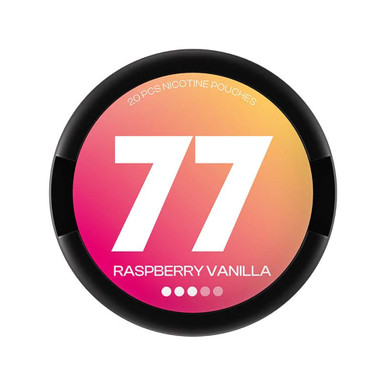
77 · 10.4mg
Read the full guide
77 Raspberry Vanilla Nicotine Pouches
£39.90
✔ In stock — ready to ship
100% tobacco-free
Free over £20
Same-day dispatch
Secure checkout
This page describes 77 Raspberry Vanilla Nicotine Pouches. There is one declared strength on the listing, 10.4mg, and one price, £39.90. Our flavour record gives two categories for it, berry and coffee, which is a pairing worth explaining and which gets its own section below. And the fact that belongs at the top rather than the bottom: we currently list this product as out of stock.
That shapes what this page is for. It cannot help you buy something today. What it can do is describe the product accurately enough for you to judge whether it is worth waiting for, place it against the cans we do have on the shelf, and be specific about the parts of the listing people query — which, on this one, means the flavour filing and the fact that a single figure is all that is offered.
The full guide to 77 Raspberry Vanilla Nicotine Pouches
5,013 words on how it eats, who it suits, how to serve it and what to put beside it.
The listing, the tags, and where the shelf stands
Every fact above comes from our own product record. Where the record is thin, this page says so instead of writing round the gap. That is not modesty; it is the only way a catalogue this size stays trustworthy, because a shop that invents a pouch count will invent other things too.
Standing note: this is an adult nicotine product, sold only to people aged 18 and over who already use nicotine. Full compliance wording sits in its own section at the foot of the page.
Two tags, one name, and an honest note about the second
The name printed on the can is Raspberry Vanilla. The flavour categories in our record are berry and coffee. The first of those is straightforward — raspberry is a berry, and the listing appears on our seventy-six-can berry shelf accordingly. The second is not straightforward at all, and we would rather address it directly than hope nobody notices.
Because the record carries a coffee tag, this listing also appears on the coffee shelf, which is one of the smallest flavour categories we run at nine cans. We do not hold anything that explains that filing, and we are not going to construct an explanation to make it look tidy. What we can say is what the tag does and does not mean: it determines which of our shelves the can appears on, and it is not a description of the contents. The name on the lid says raspberry and vanilla. If the tag and the name read oddly against each other, the printed can is the authority and our categorisation is a navigation aid that has been stretched.
The practical upshot is worth stating for anyone browsing by flavour. If you found this listing on the coffee shelf and were expecting a roasted or coffee-led can, this is not that, and nothing in our record suggests it is. If you found it on the berry shelf, you are in the right place.
Raspberry and vanilla, described as taste and aroma
This is a two-part construction where both parts are sweet, which makes it a different shape from most of the pairings in this maker's range — the fruit-and-mint cans set a sweet note against a cool one, and this does not.
Raspberry sits at the brighter, sharper end of the berry family. It is sweet, but with an acidity behind it and a faintly seedy, slightly tart edge that separates it from the rounder berries. It reads as fresh rather than deep, and against the dark jammy characters — blackcurrant, mixed forest fruit — it is the lighter and more angular of the options.
Vanilla is the opposite kind of flavour and that is presumably why it is there. It is a soft, creamy, rounded note with no acidity in it at all, and its usual role in a flavour pairing is to take the edge off something sharp and give it body. Where mint puts a cool line under a fruit, vanilla puts a cushion under it. The result reads as sweeter and fuller than the fruit alone, and noticeably less bright.
On the aroma, a pairing of this shape usually presents the opposite way round to a fruit-and-mint can. There is no volatile cool note to arrive first, so what you tend to get on opening is the fruit, with the vanilla underneath it as a warmer, softer background. Nothing in our record suggests any cold treatment, spice, herb or citrus has been put alongside either element.
The honest limit, as on all our pages: we hold flavour categories, not formulations. It is fair to describe what raspberry and vanilla do as flavour families. It would not be fair to claim we know how far forward the vanilla sits in this particular maker's version, and two cans with the same description can be quite different in the mouth. The only way to settle that is to have one.
Handling a pouch: the whole of the routine
The format is the same across everything we sell. A pouch is a small sealed sachet placed in the mouth between the lip and the gum, usually at the front under the top lip, and left there. It is not chewed, not sucked and not swallowed, and it comes out in one piece when the person is finished.
The handling is three movements: lid off, one pouch out, lid on. Once in place the lip holds it and it stays put unless moved. It can be shifted from one side of the mouth to the other if the position it is in becomes uncomfortable, and if no position is comfortable, take it out. There is nothing to be gained from persevering with something that does not sit well.
How long people keep one in varies a great deal, and the honest answer is a range rather than a number. Across the category, people describe something between roughly twenty minutes and about an hour, with plenty outside that in both directions. Flavour is usually what decides it rather than a clock — it is clearest early and fades from there — and there is nothing about a pouch that needs finishing.
Used pouches go in a bin. Cans of this general type usually have a shallow compartment beneath the lid for holding used pouches until a bin appears; we hold no specification for this can and will not promise you it is there, so look when you open one. If it is, treat it as somewhere to carry rubbish rather than somewhere to store it.
The figure on the lid, read as a figure
10.4mg is a declared amount per pouch, published by the manufacturer and printed on the can. It exists so that products can be sorted into an order and compared against one another. It is a label, not a forecast.
Its function on this site is filing. Because of it, this listing sits on the medium-strength shelf, which holds a hundred and thirty-five cans and is our largest strength category by a distance. The strong shelf and the extra-strong shelf hold the listings with higher declared figures above it. That is the ladder in full.
What the figure does not do is promise that two cans carrying the same number are interchangeable. Pouch size, moisture, flavour intensity and the way a maker constructs a pouch all vary from product to product, and none of that is captured by a milligram figure. We hold the declared number and nothing behind it.
And nothing in this section is advice. We do not know anything about the person reading it, we do not recommend strengths to anybody, and the choice is yours. What we offer is the shelf layout so that you can find the part of the range you already buy from.
Settings, rules, and the practical business of carrying a can
The questions we get about pouches away from home are almost always practical ones — what a can is like to travel with, what happens to a used pouch when there is no bin, whose rules apply where. This section answers the practical part and is completely straight about the part we cannot answer.
The rules are other people's, and we do not hold them
Start with the important thing. Where nicotine products may and may not be used is decided by venues, employers, transport operators, airlines and national law — not by a retailer, and not by us. We do not hold those rules for any particular office, train operator, airline, venue or country, we have no way of keeping such a list current, and we are not going to publish guesses about them.
So the honest answer to "can I use this at work / on that flight / in that country" is: we do not know, and the organisation concerned is the one to ask. Employers publish their own policies. Transport operators publish conditions of carriage. Countries publish import and possession rules, and those vary considerably and change. Check before you travel rather than after you arrive, and treat any rule you find as binding. Nothing in this section is an invitation to work around a rule, and we are not encouraging anyone to use anything anywhere they should not.
Travelling with a can, as a matter of luggage
What we can describe is the object as baggage, which is a genuinely useful thing to know and involves no claims at all. A pouch can is a small, shallow tin. It is not a liquid, a gel or an aerosol, so it does not interact with the cabin-baggage liquid rules that govern so much else in a wash bag. There is no device, no battery and no charging cable associated with it — the can is the entire kit, which is one fewer thing to find a socket for.
The limits on that: airlines, airports and destination countries set their own rules on carrying and importing nicotine products, including quantity limits, and those are the rules that decide the matter rather than anything about the shape of the tin. We hold none of them. Look them up for your specific route and destination, and if you are unsure, ask the airline and the destination's customs authority rather than a shop.
Long journeys, and disposal when there is no bin
The genuinely awkward practicality of pouches away from home is not carrying them, it is disposing of them. A used pouch has to go somewhere, and on a train, a plane or a site there is not always a bin within reach at the moment you want one.
This is what the compartment under the lid exists for, where a can has one: it holds used pouches until you get to a bin. As noted above, we cannot confirm from our record whether this particular can includes one, so check the can itself. If it does, empty it when you open a fresh can — it is shallow, it fills faster than people expect, and it is the part of the can that becomes unpleasant if ignored. Used pouches do not go down a drain, a toilet, or out of a window, and leaving one on a table or a seat is the sort of thing that gets products banned from places.
Workplaces and sites
Employer policies on nicotine products are set by employers, and they vary widely between organisations and between sites run by the same organisation. Some address pouches specifically, some address nicotine generally, some are silent and leave it to line management. We do not hold any of them and cannot tell you what yours says.
What we would say is the obvious thing: the policy is the answer, not a product page, and the safe assumption in any regulated environment — construction, food handling, laboratories, clinical settings, transport — is that there are rules and that they are there for reasons unrelated to us. Read the policy.
Discretion as a practical fact, not a selling point
People do ask about how noticeable a pouch is, and the answer is a physical description rather than a recommendation. It is a small object held under the lip. There is nothing to operate, nothing that lights up, nothing to charge and nothing to put down. The can is a tin the size of a stack of coins.
We are deliberately not turning that into a proposition. The fact that something is unobtrusive is not a reason to use it where it is not permitted, and a product page is not the place to hint otherwise. The rules above stand regardless of how small the object is, and if the rule in a given place is no, the answer is no.
Pairing a doubly sweet can with something else
Regular buyers rarely keep one flavour and nothing else, and a construction like this one — sweet fruit over a soft vanilla note, with no cool line anywhere in it — makes the question of a second can more pressing than usual. A flavour with no contrast built into it tends to want contrast from the drawer instead. Here is how that is usually done, from our own shelves, with reasons and prices attached.
Berry without the softness
The most direct move is to keep a berry can that has none of the vanilla cushioning, so the two read as clearly different despite sharing a shelf. Fumi Blackcurrant at £27.90 is the deepest and darkest of the berry options named here — jammy rather than bright — and about as far from a soft vanilla treatment as a berry gets. ZYN Blackcurrant Forest at £19.99 takes the same dark direction with a mixed forest character behind it. SYX Blueberry at £29.90 is the plainest of them, a single berry with nothing added to it at all.
Lighter, cheaper options in the same family are Nordic Spirit Blueberry at £4.49 and Clew Blueberry at £39.90, and Cuba Black Blueberry, also £39.90, which gives you a third reading of the same fruit at the same price point. All of them live on the berry shelf, which at seventy-six cans is large enough to browse properly and small enough to get through.
Berry with an edge or a chill on it
The second move keeps the fruit family but changes what is done to it. Velo Strawberry Ice at £4.19 puts a soft berry under a cold treatment, which is the opposite treatment to a vanilla one applied to a comparable fruit — a useful contrast precisely because the fruit is not the variable. Pablo Silver Edition Blue Raspberry at £39.90 keeps the raspberry but takes it in a sharper, more confected direction rather than a creamy one.
For something more unusual within the fruit family, XQS Berrynana Twist at £39.90 pairs a berry with a soft round fruit rather than with a dairy-leaning note, which is a near neighbour of this construction in shape while being a different thing in the mouth.
A complete break
The third move is to keep something in the house that shares nothing with this at all, so that the two never blur. From the maker's own range, the cola and tea-leaning entries do that job, and they are covered in the next section. From elsewhere in our catalogue, Denssi Berry Beast Energy Pouches at £39.90 is a berry-named can from an entirely different part of what we stock, and it is worth reading its own listing rather than assuming it is a like-for-like substitute for anything described on this page.
If you would rather browse than take a shortlist, the Cuba range and the Pablo range are two of the larger maker pages we run, and the full catalogue holds everything at once.
Where it falls in the 77 line-up
We list twenty-nine products from this maker, gathered on the 77 brand page. The range covers fruit cans, mint cans, fruit-and-mint pairings, iced treatments, cola presentations, teas and a sub-line built on a smaller can, which makes it one of the broader ranges we carry.
Raspberry Vanilla is one of the maker's dessert-leaning entries rather than one of its fruit-and-mint ones, and it has a clear relative in 77 Cola Vanilla at £39.90 — the same vanilla treatment applied to a completely different base. If the vanilla note is the part of this can you are interested in, that is the obvious second listing to look at, and it is the only other vanilla-named product in the maker's range on our shelves.
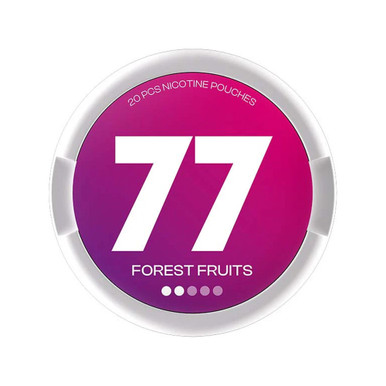
For the berry side without the vanilla, 77 Forest Fruits at £39.90 is the maker's mixed dark-fruit entry and a deeper, less bright reading of the family. For a different shape entirely, 77 Apple Mint, also £39.90, is the fruit-and-mint construction described further up this page — a sweet note against a cool one rather than a sweet note against a soft one — and 77 Cola Ice at the same price applies a cold treatment to a cola base.
The maker also runs a smaller-format sub-line, which is a difference of object rather than of flavour: 77 Ghost Mini Mango and 77 Ghost Original Mini, both £39.90. A mini can is a noticeably different thing to carry, which is worth knowing given how much of this page is about carrying one.
Keeping a can in condition
Storage is short and mostly consists of treating an opened tin sensibly, but it matters more than usual on a sweet, fruit-led flavour, because flavour is the first thing to suffer in a badly kept can.
Keep the lid on and pressed down flush rather than balanced on top. The lid is the only thing between the contents and the air, and a can left open overnight will be drier and duller by morning. This is the most common way people spoil something they have already paid for.
Keep it cool, dark and dry. Heat is harder on flavour than anything else you can do short of leaving the lid off, and the three reliable killers are a sunny windowsill, a parked car in summer and a shelf above a radiator. A drawer or a cupboard is fine. No refrigeration is needed; some people keep cans in a fridge by preference and we neither recommend it nor warn against it.
Check the printed date on the base and use older cans before newer ones. If you keep more than one or two at a time, putting new stock at the back of a drawer takes two seconds and saves finding a forgotten can behind everything else a year later.
Store every can well out of the reach of children and animals. A pouch can is small, brightly printed and easy to open, which is exactly why a low drawer is the wrong place for it. This is an adult product and it should be kept like one, and that applies just as much to a can carried in a bag as to one in a kitchen.
One variant on the page: what is and is not a decision
This listing carries a single variant — 10.4mg at £39.90 — so there is no strength to select and no price that moves depending on which option you pick. Unlike some of our listings, there is nothing on this page to choose between.
Quantity is the remaining question, and it is complicated slightly by the fact that our record does not carry a can count for this product. We cannot tell you from this page whether £39.90 covers one can or a larger quantity; the basket is where that becomes explicit before you pay. On any listing where that figure is not published, it is worth checking rather than assuming, because the size of the commitment depends on it entirely.
If the declared figure rather than the flavour is the part that does not suit, the remedy is a different shelf rather than a different option here. The medium shelf holds a hundred and thirty-five cans in this region, and the strong and extra-strong shelves hold the listings above it. We are saying where they are, not suggesting you go.
Ordering while the shelf is empty, and the check at the door
The honest first sentence is that you cannot order this at the moment. We list it as out of stock, and the listing remains published because stock positions change, because people want to know what a product is before deciding whether to wait, and because pulling pages down whenever a shelf empties makes a catalogue unusable.
When it returns, the process is unremarkable. It goes into a basket with anything else from everything we list. Brands, flavours and strengths mix freely within one order, and there is no rule requiring separate baskets for different kinds of can. One basket means one parcel and one delivery for somebody to be in for.
We sell only to adults aged 18 and over. Age verification forms part of the order process and cannot be waived. Photographic ID may be requested on delivery, and a courier may refuse to hand over a parcel to anyone who cannot produce acceptable identification or who appears to be under 18. A refused parcel goes back to us. Having ID to hand on the day, and not arranging for someone under 18 to take a delivery in, avoids the situation entirely.
Our shipping pages carry the current position on timings and carriers and are a better source than a paragraph here that will age badly. The one durable piece of advice is to consolidate an order rather than split it across several baskets.
How to find this page again
This listing is reachable from four shelves. It sits on the 77 range page among the maker's twenty-nine products; on the medium-strength shelf among a hundred and thirty-five; on the berry shelf, which holds seventy-six; and — for the filing reason explained near the top of this page — on the nine-can coffee shelf.
That last one is easily the quickest route back, purely on arithmetic: nine entries is a glance rather than a scan. It is an odd place for a raspberry and vanilla can to live, and we have said so plainly rather than pretending the categorisation is tidier than it is, but as a way of finding the listing again it is the most efficient door on the site.
If you are browsing rather than looking for this particular can, maker pages generally work better than flavour ones, because a range has an internal consistency that a category does not. The Pablo range and the Cuba range are two of the other large ones we run, the strong shelf and the extra-strong shelf are the two strength categories above this one, and the complete shop listing is there if you would rather start at the top.
Questions we get about this can
Why does it appear on your coffee shelf?
Because our record carries a coffee flavour tag for it alongside the berry one, and our shelves are built from those tags. We do not hold anything that explains why it is tagged that way and we are not going to invent a reason that sounds neat. The tag decides which shelf the listing appears on; it is not a description of the contents. The name on the can is Raspberry Vanilla, and the can is the authority on what is in it.
Does it taste of coffee?
Nothing in our record suggests it does, and the name on the can does not mention coffee. We hold two flavour tags and a product name, and where they disagree the printed can wins. If you came to this listing from the coffee shelf expecting a roasted flavour, this is very probably not the can you are looking for, and the shelf has eight other entries on it.
Do you have a restock date?
We do not know and will not guess. Restock timing depends on supply, and a date printed on a page that then slips is worse than no date. The listing is the live record: when it can be added to a basket, it is there. If waiting is not practical, the berry cans named further up this page are the nearest things we currently stock, with prices given.
Is the pouch count published anywhere?
We do not hold that figure. Our record carries price, strength, flavour tags and stock position, and no pouch count. Rather than publish a plausible number that would be read as a fact, we will say plainly that it is not something we know. The printed can carries the count, along with weight, dimensions and everything else stamped on the packaging by the manufacturer.
Does the price cover one can or several?
Our record does not carry a can count for this listing, so we cannot answer that here. Some of our listings are priced as a single can and some as a larger quantity, which is why two prices on this site are not comparable until you know what each covers. The basket shows what you are actually getting before you pay for anything.
Can I take these on a plane?
We do not hold airline, airport or destination rules and cannot advise on them. What we can tell you about the object is factual: it is a small tin, it is not a liquid or an aerosol, and there is no device or battery involved. What decides the matter, though, is the airline's conditions of carriage and the import and possession rules of the country you are going to, and those vary and change. Ask the airline and check the destination's own guidance before you travel.
Am I allowed to use it at work?
That is your employer's decision and not ours. Workplace policies on nicotine products vary widely, sometimes between sites run by the same organisation, and we hold none of them. The policy document is the answer. In regulated environments the safe assumption is that rules exist. We are not going to speculate about what yours permits, and nothing on this page should be read as encouragement to use anything where it is not allowed.
What strength would you recommend?
We do not answer that for anyone. Choosing a strength is a personal decision, we know nothing about the person asking, and a shop would be the wrong source for that advice even if we were inclined to give it. What we will give you is the layout: this listing is 10.4mg, it sits on a medium shelf of a hundred and thirty-five cans, and there are strong and extra-strong shelves above it. The decision is yours.
How long is a pouch usually kept in for?
We do not give instructions on that. The range people describe across the pouch category is roughly twenty minutes to about an hour, with plenty of people either side of it. Flavour is generally what decides it rather than a clock, since it is clearest early and fades from there. Take one out whenever you want to; there is nothing that needs finishing, and no reason to persevere with something that has stopped tasting of anything.
What do I do with a used pouch when there is no bin?
Most cans of this type include a shallow compartment under the lid for exactly that, holding used pouches until you reach a bin. We cannot confirm from our record whether this can has one, so check the can. If it does, empty it regularly — it is shallow and fills quickly. Used pouches belong in a bin, not down a drain or a toilet, and not left on a table or a seat.
Can I see an ingredients list?
No. We do not publish ingredient lists, composition, manufacturing detail or technical specification for this or any other product, and we do not paraphrase what is printed on the packaging either. The can and the manufacturer's own materials are the right source for all of it. Our pages cover price, strength figure, flavour categories, format, availability and comparison with the rest of our stock, and stop there on purpose.
Who manufactures it?
We do not hold that. Country of origin, manufacturing site and corporate ownership are not part of our record for this listing, and guessing would be a poor way to end a page that has spent its length refusing to guess about everything else. If the printed can carries that detail, read it there.
Is identification checked at the door?
Expect to be. Age verification is part of the order process, and photographic identification may also be requested at the door. Whether a particular courier asks on a particular day is their judgement, but a parcel can be refused if ID cannot be produced or if the person accepting it appears to be under 18. We sell only to adults aged 18 and over who already use nicotine, and these checks are what keep that true. There is no way to opt out of them.
Compliance, in plain terms
This product is for adults aged 18 and over only, and we sell it only to adults who already use nicotine.
Nicotine is an addictive substance.
It is not a licensed stop-smoking medicine, and it is not intended for non-smokers, for anyone who does not already use nicotine, for anyone under the age of 18, or for anyone who is pregnant or breastfeeding. Nothing on this page is a health claim, a medical claim, or advice about your own use. Questions about nicotine and your own health belong with a healthcare professional and not with a retailer.
Age verification is carried out as part of the order process, and photographic ID may be requested on delivery. Couriers may refuse to release an order to anyone who cannot produce acceptable identification or who appears to be under 18. Store this and every product of its kind securely and well out of the reach of children and animals.
In summary
77 Raspberry Vanilla is a single-variant listing at 10.4mg and £39.90, tagged berry and coffee in our record, filed on our medium-strength shelf, and currently out of stock. The construction is a bright, slightly tart fruit set against a soft vanilla note — sweet against sweet rather than sweet against cool, which makes it a different shape from most of the maker's other pairings and the reason the pairing section above suggests keeping something sharper or colder in the drawer beside it.
Where we hold a fact, this page has printed it, including the awkward one about the coffee tag and the unhelpful one about availability. Where we do not — the pouch count, the can count, the origin, the restock date, and the rules that apply in any particular office, train or country — it has said so plainly instead of guessing.
More from 77
More medium strength pouches
More berry pouches
Where this sits
77 Raspberry Vanilla Nicotine Pouches appears in these categories. Browse them, or jump to something close.
You might also like