
Home / Medium Strength / Pablo Silver Edition Blue Raspberry Nicotine Pouches
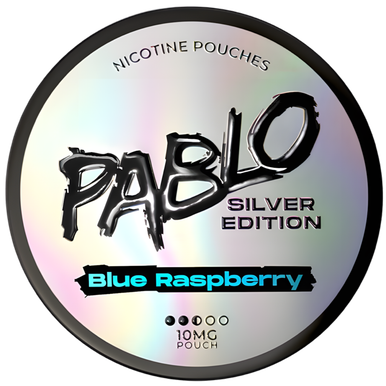
Pablo · 10mg · 10-can pack
Read the full guide
Pablo Silver Edition Blue Raspberry Nicotine Pouches
£39.90
✔ In stock — ready to ship
100% tobacco-free
Free over £20
Same-day dispatch
Secure checkout
This page covers Pablo Silver Edition Blue Raspberry Nicotine Pouches. Our record gives a listing price of £39.90, a pack containing 10 cans, one declared strength of 10mg, one flavour tag — berry — a single product image, one variant, and a stock state reading in stock as this page was written. Unusually for this catalogue, the cans-per-pack figure is populated here, which means one piece of arithmetic is available to us that is unavailable on most listings: £39.90 across ten cans works out at £3.99 a can. That is division, not marketing, and it is the only per-can figure on this page.
Everything else below is a description of the object, a comparison against other cans on our own shelves, or a plain statement that we do not hold something. We do not print ingredient lists. We do not explain what happens inside a pouch or inside a person. We make no statement about anybody's wellbeing in any direction, favourable or otherwise. We do not tell any individual which figure on a lid belongs to them. Where a reasonable question runs past our data, the answer is that our data stops there.
The full guide to Pablo Silver Edition Blue Raspberry Nicotine Pouches
4,871 words on how it eats, who it suits, how to serve it and what to put beside it.
What the Silver Edition Blue Raspberry listing actually is
A word about the name before anything else. Silver Edition is the manufacturer's own line name. It is not a grade, not a rating and not a position in a queue. The same brand puts a Gold Edition on our shelves and also sells cans with no edition word at all, and the everyday English suggestion that gold outranks silver which outranks plain does not describe anything in our data. The declared figures make that obvious: this Silver Edition listing carries 10mg, the Gold Edition cans we stock carry 17mg, and the plain-named Pablo cans carry 30mg. If silver were a rung on a ladder it would be an oddly arranged one. Treat the word as a family label and read the figure separately.
On our shelves the listing is filed in three places: the Medium Strength band, currently 135 listings; the Pablo brand page, with the other 55 lines we carry from that brand; and the berry flavour grouping, which runs to 76 listings. This is an adult nicotine product, sold to buyers aged 18 or over who already use nicotine, and the full wording sits at the foot of the page.
Ten milligrams as a printed number
The 10mg on this listing is a declared figure. The manufacturer prints it on the can and we reproduce it. It is not a score, not a rating, not a difficulty setting, and no reading of it as better or worse than a different number is one we endorse. A higher figure is not an accomplishment and a lower one is not a shortcoming; both are label information about different products.
We sort declared figures into three bands so that a catalogue of hundreds of listings can be browsed: Medium Strength, Strong, and Extra Strong. This can sits in the Medium band. Those names are our own shelving convention, not an industry standard and not a measurement of anything, and a product is not altered by which shelf it is filed on. They exist to narrow a browse and for no other purpose.
Two limits on the number are worth stating flatly. It is not a common currency between manufacturers — pouch size, moisture, format and flavour construction all vary between lines and none of them is contained in a milligram figure, so two cans printing the same number are not thereby the same product. And it says nothing whatsoever about an individual. People ask which figure they should be on, and we cannot tell you. A retailer has no basis for that judgement about a person, and an answer delivered with confidence would be a guess wearing a uniform. We print every figure we hold and leave the decision where it belongs.
Blue raspberry, described as a taste and as a tag
There is a gap between this product's name and this product's flavour tag, and it is worth opening with rather than glossing over. The name says blue raspberry. Our record files it under the single word berry. Those are not the same statement, and the difference tells you something about how our shelves work.
Blue raspberry is a confectionery flavour rather than a botanical one. There is no such fruit; the name belongs to a sweet-shop tradition of bright, sharp, unmistakably artificial fruit flavours that are recognisable precisely because they do not taste like the fruit they are named after. Anyone who has had a blue slush drink or a blue boiled sweet knows the register: sharp at the front, sweet behind it, with a clean, glassy quality and very little of the soft, seedy, jammy character of an actual raspberry. It is one of the most distinctive flavour names in confectionery and one of the least literal.
Our tag, berry, is broader than that by design. Flavour tags on this site are shelving labels whose job is to let a shopper filter the catalogue down to something browsable, so a single tag has to cover raspberry, blueberry, blackcurrant, strawberry, forest-fruit blends and confectionery constructions like this one, across every brand we stock. Useful for navigation, close to useless as a description of an individual can. So when this page says the record files the product under berry, it is telling you which shelf the can lives on and not what is inside the tin.
What can be said about the taste itself is a reading of the name and the flavour family rather than a specification, and we would rather label it that way than let it pass as fact. The aroma from a freshly opened tin in this register is usually the sweet side of the flavour rather than the sharp side, because sharpness is largely a tongue impression. Whether that matches the can in your hand is a question only the can can answer, and impressions vary between people and between batches in ways nobody can usefully quantify.
One thing we can state from the record: there is no cold tag against this listing and no ice word in the name. If a cold layer over the fruit is what you are after, this is not the can in this family that offers it — Silver Edition Blueberry Peach Ice, also £39.90 for ten cans and also in stock, is the one in the same line that puts an ice word in the title.
How this sits against the other cans we shelve at this kind of figure
This is the longest section on the page, and it needs an honest preface, because the obvious version of it is one we cannot write. A shop could line up every product it files at a given declared figure and present them as equivalents. We are not going to, for a simple data reason: the link records behind this page do not carry each neighbour's declared figure. We know what shelf each one is on and what it costs, and on this page we know this can declares 10mg. We do not have a table of everybody else's numbers to set beside it, and rather than imply one exists we will say what we do have.
What the Medium band actually is
The Medium Strength shelf holds 135 listings at the time of writing. That is the largest single strength band on the site and it spans many brands, formats and prices. Being on it means we have filed a product's declared figure into our middle bracket. It does not mean two products on it are interchangeable, and it does not mean a shopper who is comfortable with one will find another the same. The band is a filing decision, and treating it as an equivalence class is the most common mistake people make with shelves of this kind.
Price is where the comparison is real
Where a comparison can be made without inventing data is on price, and the spread across the berry shelf is wide enough to be worth setting out. At the low end, Nordic Spirit Blueberry lists at £4.49 and Velo Strawberry Ice at £4.19, both currently available. In the middle, ZYN Blackcurrant Forest is £19.99 and Fumi Blackcurrant is £27.90, both in stock. Higher up, SYX Blueberry is £29.90, 77 Strawberry is £39.90 and XQS Berrynana Twist is £39.90, all three available as this was written.
Those prices describe different things, which is the point. Some are single-can listings, some are multi-can packs, and our record does not hold a cans-per-pack figure for every product. This listing is one of the few where it does, which is why £3.99 a can can be stated here and why it cannot be stated for most of the cans in the paragraph above. Comparing £39.90 against £4.19 without knowing what each contains is the kind of arithmetic that produces confident nonsense, so the honest instruction is to read each listing for what it holds rather than to rank the prices.
Two on that shelf you cannot buy today
Two of the berry neighbours our system pairs with this can are currently unavailable, and it would be poor form to link them without saying so. Edge Strawberry is listed at £14.95 and is out of stock at the time of writing. Klint Blueberry is listed at £36.90 and is also out of stock. Both pages are worth a look if you want to see how those brands name and price their berry lines, but neither will let you complete an order today, and we would rather tell you that here than let you find out at the basket. Stock states do move, and the live listing is always more current than this paragraph in either direction.
What a comparison at the same figure would still not settle
Suppose we did hold every neighbour's declared number and could line them up. It would still not tell you which can suits you, because the variables that people actually notice — pouch size, how dry or damp the material is, how the flavour is built, how long the taste holds — are not in that number and are not in our data either. A shelf comparison is a way of seeing what exists at what price. It is not a shortlist and it is certainly not a recommendation, and we are not going to convert one into the other.
The can as an object: lid, well, count, pocket
The second thing this page is built around is the tin itself, because with a ten-can listing you are buying rather a lot of tins and it is worth knowing what they are like to live with.
The lid and the lip
The tin is the shallow round type the whole category uses. The lid lifts clear and presses back down onto a lip; it is a press fit, not a seal, and it is engineered for being opened and closed many times a day rather than for keeping air out for a month. The lid face carries the brand, the line, the flavour and the milligram figure, which is more useful than it sounds the moment more than two cans are stacked in a drawer — you read the tops rather than picking each one up, and a legible figure on the lid is the difference between a five-second decision and turning a whole stack over.
The catch compartment
The underside of the lid is hollow: a shallow well with a rim around it. That well is the catch compartment, and it is the single feature that makes a tin workable on a train, in a passenger seat or anywhere else without a bin to hand. It holds several spent pouches before it needs emptying. The habit worth keeping is emptying it often rather than letting a fortnight of used pouches sit a few millimetres above the fresh ones. Some people bin each one immediately and keep the well permanently empty, which is tidier and costs nothing at all.
Portion count, and what we do not hold
Our record does not state how many pouches each can holds. It gives the number of cans in the pack — ten — and stops there. We are not going to multiply an unknown portion count by ten to produce a total, because the first figure would be invented and the product of an invented figure is also invented. The portion count is printed on the packaging by the manufacturer. Likewise the weight of a single pouch and the diameter of the tin: printed on the can, absent from our data, and on all three of those the can is the authority.
What fits in a pocket, and what ten cans look like
One tin sits flat in a trouser pocket, a jacket pocket or a small bag compartment and survives a day without complaint. What it does not survive well is being loose in a bag with keys and a bottle, where the lid is worked open by degrees over a few hours and a can dries out quietly with nobody noticing until it tastes flat. An inside pocket or a zipped section solves it.
Ten cans is a different proposition and worth picturing before ordering. A ten-can pack is a column of tins, not a pocketable object, and the sensible way to use one is to keep a single can in circulation and the other nine closed and put away somewhere cool and dark. People who open five at once tend to find the later ones flatter than the first, which is not a fault in the product but the predictable outcome of five press-fit lids being opened and closed across a month rather than one. There is no clever storage solution required: a drawer will do.
The format, in ordinary use
A pouch out of one of these tins is a small soft rectangle with rounded corners, light enough to disappear in a closed hand. One goes under the upper lip and stays there. A fresh one usually feels bulkier than it looked in the tin, and that impression fades inside a minute or two as it settles into the space and takes its shape. After that it is largely unremarkable to hold in place. People talk with one in and drink with one in; some eat with one in and some take it out first, which is a preference and not a rule, and we are not going to present a preference as guidance.
How long one stays in has no single answer and any figure offered as typical would be a guess. The honest range runs from about ten minutes at one end to the better part of an hour at the other, and the same person will vary between one day and the next and between one flavour and another. The taste is not level across that time either: it arrives, holds through a middle stretch, then thins until what is left is closer to a background impression than a flavour. Many people treat the moment the flavour stops being identifiable as the moment to change, which is a habit rather than an instruction.
Removal is a fingertip job. Spent pouches go into the well under the lid, and when the well is full its contents go into general waste — not into a sink, not into a plant pot, not out of a car window. Used pouches are small, pale and easy to lose track of on a desk or a console, which is exactly why the tin should be closed and out of reach of children and animals whenever it is not in a hand.
Where this listing sits inside Pablo
We carry 56 Pablo listings, arranged as several parallel lines rather than one ladder. There are plain-named cans, an Exclusive line, and the Edition lines with metal words in their names, and as set out at the top, the naming does not track the declared figure in any consistent direction.
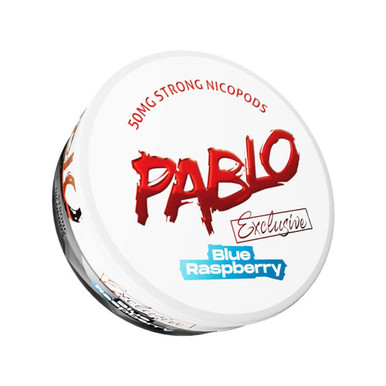
On price the lines differ sharply, and here the cans-per-pack figure matters. The Exclusive line sits at £3.85 for a listing, and this ten-can pack works out at £3.99 a can — very close on a per-can basis, and very different in what you commit to in one go. Pablo Exclusive Blue Raspberry is the obvious comparison, since it shares the flavour name and sits at £3.85; it is in stock at the time of writing. What our record does not tell us is whether the two products are otherwise the same, and we are not going to assert that they are simply because the flavour words match.
Across the rest of that line, Blueberry Cranberry Cherry stacks three fruits into one name, Exclusive Blueberry Peach Ice pairs fruit with a cold word, Banana Ice takes a soft fruit in the same direction, Blue Mint is the mint entry, and the Bubblegum can is the sweetest-sounding name on the shelf. All five are £3.85 and all five are marked in stock. To see the brand in one view with prices and stock marks against each entry, all 56 Pablo listings sit on a single page.
What people keep alongside a berry pack
Ten cans of one flavour is a lot of one flavour, and the commonest reason people buy something else at the same time is that a single taste used continuously stops registering as a taste. What goes alongside is usually chosen to be unlike it.
Staying inside the berry family, the variation is mostly in which fruit gets named and how sweet the register sounds: a blackcurrant reads darker and sharper than a strawberry, and a blend reads rounder than either. Moving outside it, the mint listings are the largest flavour grouping we keep and the most common counterweight to a sweet fruit. The practical point is that a £3.85 single can is a cheap way to add a contrast without committing to a second ten-can pack, which is why the Exclusive line does a lot of work in these baskets.
If you would rather browse the field than read about it, the 76 berry listings show the whole shelf with prices and availability visible, and everything we stock does the same job for the full catalogue.
Keeping ten cans in good condition
Storage matters more on a multi-can listing than on a single tin, simply because the last can will be opened a good while after the first. The variables are few and none of them is complicated.
Moisture leaves and does not return. Pouches in this category are produced at different moisture levels and our record does not state where this line sits, but whatever level a tin starts at, an open lid moves it one way only. A tin left ajar will be drier a week later, and a drier pouch reads as duller and shorter in flavour. Closing the lid all the way round, pressing evenly rather than pushing one edge down, is the entire technique — a lid seated at three-quarters looks shut and is not.
Heat does more damage and does it faster. A dashboard in summer, a coat pocket over a radiator, a laptop that has been running all day: all three get warm enough to change how a can behaves, and a tin that has been hot and then cooled does not return to where it started. Sunlight does a slower version of the same thing, including through glass on a cool day. Cool, dark, dry and closed covers all of it, and a drawer achieves it.
On refrigeration, we hold no manufacturer guidance for this line, so we neither suggest it nor argue against it; anything we said would be opinion dressed as advice. If you do keep sealed cans cold, let a tin come up to room temperature before opening it, because a cold tin in a warm room collects condensation on the outside. On dating, our record holds no expiry, batch or best-before figure for this listing. Whatever dating is printed on the can is the authority. With ten tins, work through them oldest first and keep the rest sealed, cool and out of the light, and keep every can — open or not — out of reach of children and pets.
Choosing between the pack and the single can
There is one variant behind this page: 10mg at £39.90 for ten cans. No second strength, no alternative size. So the real choice is not within this listing but between this listing and a single can elsewhere on the shelves, and the numbers make that choice unusually clear for once. £3.99 a can here against £3.85 for a single Exclusive can is a difference of pennies per tin; the meaningful difference is commitment. Ten cans of a flavour you have not had before is ten cans of a flavour you may not want.
The other half of the decision is the declared figure, and that is the half we cannot help with. We will not tell anyone which number suits them. If you want to see what else we file in the same bracket, the Medium band is the shelf to browse; the Strong and Extra Strong shelves hold what we file above it. Those are filing brackets, not rankings, and browsing one is a way of seeing options rather than narrowing to a recommendation.
Buying, delivery and the age check
£39.90 is the listing price and the basket confirms what the order contains before anything is paid. Our stock mark reads in stock as this was written, but stock moves and the live listing is always more current than prose. If something becomes unavailable between reading this and clicking through, the product page will say so rather than quietly taking an order it cannot fill.
These are age-restricted goods. We sell to adults aged 18 or over, we operate age verification on orders, and identification may be requested when the parcel is handed over; a courier is entitled to refuse the handover to anyone who cannot produce it or whom they judge to be underage. We will not knowingly supply an order placed on behalf of someone under 18. Parcels arrive in plain outer packaging. A ten-can pack is a larger and heavier parcel than a single tin, which is worth bearing in mind if it is going to a workplace or a neighbour, and the storage logic applies from the moment it lands — a box left in a hot porch all afternoon is worth collecting sooner rather than later.
Routes out of this page
The three shelves this listing sits on are the quickest ways to something adjacent: the Medium band for what else we file in that bracket, the Pablo page for the rest of the brand, and the berry shelf for the same flavour family across every brand we carry. Sideways from Pablo, the Cuba brand page is the other large single-brand grouping we keep, organised similarly with several distinct families under one name. For a wider sweep without guessing at a category, the full shop index lists everything at once with prices and stock states visible.
Questions we get about this pack
Does Silver Edition mean it is a lower grade than Gold Edition?
No. Both are the manufacturer's own line names and neither is a grade, a rating or a rank. Our record shows the Silver Edition cans declaring 10mg and the Gold Edition cans declaring 17mg, but a different number is a different number rather than a different quality, and nothing we hold supports reading one line as superior to the other. Judge the listings on price, declared figure, flavour tag and stock state, which are the only things we can evidence.
Is it really ten cans for £39.90?
That is what our record holds: cans per pack, ten; price, £39.90. That is where the £3.99 per can on this page comes from, and it is one of the few listings on the site where we can do that division honestly. The basket shows exactly what the order contains before payment, so if precision matters, confirm it there rather than relying on prose.
Why does the name say blue raspberry but the tag say berry?
Because the tag is a shelving label and the name is a product name. Our tags are broad on purpose so that hundreds of listings can be filtered into a browsable shelf, and berry has to cover everything from blackcurrant to a confectionery construction like this one. The name is more specific than the tag, and neither is a tasting note.
Is blue raspberry a real fruit?
No. It is a confectionery flavour name rather than a botanical one, familiar from sweets and slush drinks, and it is recognisable precisely because it does not taste like an actual raspberry. That is a fact about the flavour tradition rather than about this specific can, and we cannot tell you how closely this product follows the convention.
How many pouches are in each can?
Not something we hold. Our record gives ten cans in the pack and no portion count per can, so any total we published would be built on a figure we invented. The count is printed on the packaging, and the packaging is the authority.
Is 10mg mild?
Ten milligrams is the figure the manufacturer declares, and it places this listing in our Medium Strength band. That band is our filing convention for organising a shelf and not a verdict on how anybody will find the product. Whether a number reads as mild is a judgement about a person, and a retailer is not in a position to make it. We are not going to try.
Two of the cans you linked to are unavailable. Why link them?
Because a shopper comparing a shelf is often interested in how a brand names and prices a line even when they cannot buy it today, and because hiding unavailable listings would make the comparison less honest rather than more. We flag the stock state in the same sentence as the link so nobody arrives at a page expecting to complete an order. Stock does come back, and the live page is always more current than this one.
How does this compare with the Blueberry Peach Ice pack in the same line?
Both are Silver Edition listings at £39.90 for ten cans and both are in stock at the time of writing. The difference our record can evidence is the flavour: this one is tagged berry alone, while the other carries an ice word in the name and a broader set of tags. Beyond that, our data does not describe what else does or does not differ between them, so we are not going to claim they are otherwise identical.
Can I buy a single can of this flavour instead?
Not as this listing — it is a ten-can pack and there is no single-can variant behind this page. The Exclusive line carries a blue raspberry name at £3.85 for a single listing, which is the nearest equivalent on our shelves, though our record does not tell us whether the two products are the same beyond sharing a brand and a flavour name.
How long will ten cans stay good?
Sealed cans hold their condition better than open ones, and we hold no expiry date for this listing, so the dating printed on the can is the figure to work to. The practical approach is one can open at a time, the rest closed, cool, dark and dry, and oldest first. The lid is a press fit designed for repeated opening rather than a seal, so an open tin declines steadily while a sealed one does not.
Will the ten cans in the pack all be the same flavour?
Our record describes this as a single listing with one flavour name and one declared figure, so nothing in our data suggests a mixed pack. We hold no statement from the manufacturer describing the contents can by can, which means we are reporting what the listing says rather than confirming what is inside the outer. If a mixed selection is what you are after, buying several single cans from different listings is the way to build one deliberately rather than hoping a pack does it for you.
Is anything on this page a claim about my wellbeing?
No. Nothing here says or implies that this product is good for you, bad for you, better than anything else or worse than anything else. The page describes an object, prints the figures our record holds, compares prices across our own shelves, and states plainly where the data runs out.
The compliance wording
Nicotine is an addictive substance. That applies to this pack exactly as it applies to every other nicotine listing we sell, and it is the most important sentence on the page.
- Sold only to adults aged 18 or over who already use nicotine. We do not sell to under-18s, and identification may be requested on delivery.
- This product is not a licensed stop-smoking medicine and is not offered, described or intended as one.
- It is not intended for non-smokers, for anyone who does not already use nicotine, for under-18s, or for anyone pregnant or breastfeeding.
- Nothing here is medical advice. Questions about nicotine and your own circumstances belong with a qualified professional rather than a retailer's product page.
- Keep every can closed and out of reach of children and animals, and put spent pouches into general waste.
The short version
Pablo Silver Edition Blue Raspberry is a £39.90 listing of ten cans — £3.99 each — carrying a declared 10mg and a single berry flavour tag, filed on the Medium Strength band, the Pablo brand page and the berry shelf, and in stock as this was written. Silver Edition is the manufacturer's name and carries no rank; blue raspberry is a confectionery flavour name rather than a fruit; and our berry tag is a shelf label rather than a tasting note. Portion count, dating and the finer flavour detail are printed on the cans, and on every one of those the can outranks this page.
More from Pablo
More medium strength pouches
More berry pouches
Where this sits
Pablo Silver Edition Blue Raspberry Nicotine Pouches appears in these categories. Browse them, or jump to something close.
You might also like