
Home / Extra Strong / Pablo Exclusive Blueberry Cranberry Cherry Nicotine Pouches
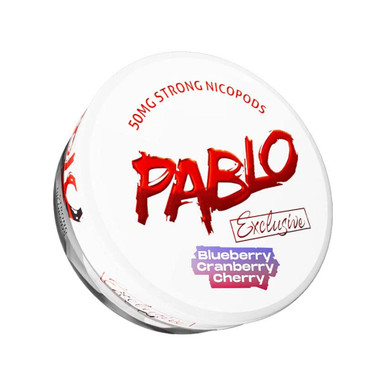
Pablo · 50mg
Read the full guide
Pablo Exclusive Blueberry Cranberry Cherry Nicotine Pouches
£3.85
✔ In stock — ready to ship
100% tobacco-free
Free over £20
Same-day dispatch
Secure checkout
This listing is Pablo Exclusive Blueberry Cranberry Cherry Nicotine Pouches, priced at £3.85, carrying one declared strength of 50mg, and showing as in stock at the time this page was written. That short list — brand, product name, price, declared figure, flavour record, availability — is the entirety of what our catalogue holds for this can. Everything that follows is either a description of the physical object, a comparison with other cans sitting on the same shelves, or a plain statement that a particular detail is not something we have. Where you find a gap below, the gap is deliberate.
The container is the standard round pouch tin. In the hand it is a shallow cylinder, wider than it is deep, with a lid that lifts clear of the base and presses back down onto it. The printing on the lid face carries the brand mark, the flavour name and the declared figure, which is the arrangement almost every manufacturer has settled on, and for a sensible reason: if you keep two or three tins in the same drawer, the lid is the only surface you ever read. A can whose top does not state what it is becomes a can you have to open in order to identify.
The full guide to Pablo Exclusive Blueberry Cranberry Cherry Nicotine Pouches
5,434 words on how it eats, who it suits, how to serve it and what to put beside it.
The Blueberry Cranberry Cherry can, as our record holds it
Our record does not carry a pouch count for this listing, and it does not carry a cans-per-pack figure either. The cans per pack field in our data is empty, so this page treats the product as a single can at the price shown, because that is what the record supports. If you want the number of pouches inside, the printed tin is the place that figure lives. The same applies to the weight of an individual pouch, the dimensions of the tin, any batch or date marking, and anything else stamped into the packaging by whoever produced it. We would rather leave those lines blank than fill them with numbers we have worked out by inference.
One point of housekeeping before anything else, because it governs the way the rest of this page is written: this is an age-restricted nicotine product, sold to adults who already use nicotine. The full compliance wording sits in its own section at the foot of the page. It is worth reading rather than scrolling past, and nothing in the descriptive sections above it is intended to persuade anybody to consume anything.
Three fruits in the name, two words in the record
The first thing to flag about this can is a mismatch you will notice if you look at the product data rather than the label. The name lists three fruits — blueberry, cranberry and cherry — while our flavour record carries only two entries: berry and cherry. That is not a contradiction so much as a coarsening. Our tagging vocabulary has a single berry bucket, so blueberry and cranberry both collapse into it, and cherry gets its own tag because cherry happens to be a category we file separately. If you were expecting the tags to reproduce the name fruit for fruit, they do not, and the name is the more specific of the two.
Described strictly as a taste, the blend reads as a dark fruit blend with a sour edge rather than a single clean fruit. Blueberry, in flavouring terms, is the rounded, slightly jammy, slightly floral element — it is the part that gives the blend its body and its sweetness, and on its own it tends to sit soft and low. Cranberry is the opposite character: thin, tart, astringent, with the drying quality you get from the skin of the fruit rather than the flesh. Cherry then sits between the two, carrying a deeper, darker, faintly almond-like sweetness that is recognisably cherry and not simply generic red fruit.
What that produces, in the mouth, is a blend with a sequence rather than a single note. The sweetness arrives first and reads as blueberry; the sourness follows a moment behind it and reads as cranberry; and the cherry runs underneath both, holding the two ends together. The finish is drier than the opening, which is characteristic of anything with cranberry in it. There is no cooling element declared in the name and none in the flavour record, so this is a fruit blend without a mint or menthol layer over the top — a straightforwardly warm fruit profile rather than a cold one.
The aroma on opening the tin is close to the taste but simpler. Fruit blends of this kind tend to smell predominantly of the sweetest element, which here is the blueberry, with the cherry audible behind it and the cranberry contributing more to the finish than to the smell. It is a noticeable aroma rather than a subtle one, which is worth knowing if you keep an open tin in a bag or a coat pocket alongside other things. If you would rather browse fruit blends by category than by name, the berry shelf collects seventy-six listings and the cherry shelf a further twenty, and this can appears on both.
The tin, the pouch, and what handling one actually involves
A pouch is a small soft rectangle with rounded ends, sealed shut, sized to sit between the gum and the upper lip without being obvious from the outside. It goes in dry and stays where it is put; it does not need to be held in place or adjusted once it is settled, though most people give it a press with the tongue in the first few seconds to seat it properly. It is not chewed and it is not swallowed. That is the whole of the mechanics, and it is the same mechanics whichever brand or flavour you buy.
How long an individual keeps one in varies enormously between people, and we are not going to publish a figure and pretend it is guidance. Some people take one out after a few minutes; others leave one in for the better part of an hour. The manufacturer's own labelling on the tin is the place to look for any instruction on that, and the practical answer for most people is that you take it out when you decide to. We hold no data on this listing that would let us be more precise, and a number invented for the sake of completeness would be worse than no number at all.
The lid on a tin of this type is a catch lid: the upper section is hollow, so a used pouch can be pressed up into it and the lid closed again. That is a convenience for disposal rather than a storage feature. A pouch held in the lid keeps the moisture and the smell of a used pouch inside the tin, which is preferable to carrying one loose in a pocket, but it is not somewhere to accumulate a week's worth. The lid compartment fills quickly, it makes the tin harder to close cleanly once it is full, and anything left in there for long makes the whole tin unpleasant to open.
Disposal itself is straightforward and worth stating plainly: a used pouch goes in a bin, not down a sink, not out of a car window, and not into a plant pot. It is a small object and it is easy to be careless with it, but it is also a nicotine-containing object and it should be kept away from children and animals at every stage, including after use. Emptying the lid compartment into a bin at the end of the day is the habit most regular users settle into, and it is the one we would describe as normal practice rather than advice.
50mg on the lid, read as a printed number
The declared figure for this can is 50mg, and that is the only strength this listing carries. There is no second variant at a different figure, no mini or light version of it in our record, and no choice to make on this page — the single entry in the variants field is 50mg at £3.85, and that is what arrives if you order it.
It is worth being precise about what that number is. It is a figure declared by the manufacturer and printed on the packaging, which we reproduce in our catalogue exactly as we received it. It is not a measurement we have taken, and it is not a figure we can translate for you. Manufacturers do not all declare on an identical basis, and we do not hold the basis for each brand's declaration, which means we are genuinely unable to tell you how 50mg on this tin compares with a different number on a tin from another producer. Where two figures look comparable, that appearance may or may not be reliable, and we are not in a position to say which.
On our own shelves, this can is filed under our Extra Strong shelf, which holds ninety-eight listings. We also maintain a medium-strength shelf and a shelf labelled Strong. Those three labels are a filing convenience so that the catalogue can be browsed by declared figure rather than scrolled through in one block. They are descriptions of where a product sits in our sorting, and nothing more than that.
We want to be completely direct about the one question this section cannot answer. We cannot advise which strength suits any individual, and we will not try. That is not modesty and it is not a legal hedge for its own sake — it is that the question is a personal and in some cases a medical one, and a retailer is the wrong party to answer it. Nothing on this page says that a higher figure is better, more serious, more advanced, or something to aim at. A larger number on a lid is a larger number on a lid. It is not an accomplishment, it is not a rank, and the range on our shelves is not a ladder anyone is expected to climb. If you are unsure, that uncertainty is a matter for you and, where relevant, for a qualified professional — not for a product page.
Moving between cans: what actually changes, and what does not
Most people who use this catalogue regularly do not buy the same can indefinitely. They move — between flavours, between brands, sometimes between formats — and the thing worth setting out clearly is which of those moves changes something real and which of them changes almost nothing. This is the practical question the rest of the shelves exist to answer, and it is the one we get asked about most.
Start with what does not change. The physical object is broadly constant across the catalogue. A round tin, a lid that lifts and presses back, pouches lying flat in a ring, a hollow lid for used ones. The routine of taking one out, putting it in, leaving it, removing it and binning it is the same whichever tin you have bought. If you already know how to use one can, you know how to use every can on our shelves, and there is no learning curve attached to moving between brands. The differences that matter are elsewhere.
Price is the first thing that genuinely changes, and on this catalogue it changes dramatically — far more dramatically than newcomers to the shelves expect. This Pablo can is £3.85. Cuba Black Blueberry, a comparable dark-fruit can from a different producer, is listed at £39.90, and so is Clew Blueberry. Killa Blueberry sits at £33.50, Elf Bar Blueberry Raspberry at £29.90, Fumi Blackcurrant at £27.90, and Nordic Spirit Blueberry at £4.49. That is a ten-fold spread across listings that all describe themselves in similar terms. What a listing actually covers differs between those entries, and the individual product page is where that is set out. We are not going to imply that the expensive ones are better made or that the cheap ones are a compromise, because we hold nothing that would support either statement.
Flavour naming is the second thing that changes, and it changes more than people expect. Every producer names its own blends, and no two use the same conventions. One brand's berries is another's forest fruits is another's three-fruit list of the kind this can carries. 77 Strawberry names one fruit and means one fruit; the Iceberg Berries listing names a whole category and leaves the composition to the tin. Iceberg Berries is also currently out of stock, so treat that one as a page to look at rather than a can to order today. The honest position is that a flavour name tells you the producer's intention, not a recipe, and that two cans sharing a word on the lid may taste nothing alike.
The third thing that changes is the declared figure, and this is where the caution in the previous section matters most. When you move between brands you are moving between labelling regimes as well as between tins, and the numbers are not interchangeable in the way the shelf labels might imply. Our strength shelves group listings so you can find them; they do not certify that two cans filed together will read the same. If you are moving to a producer you have not bought from before, the sensible expectation is that the can will be its own thing rather than a match for the last one.
The fourth is availability, which changes week to week and is the reason every link on this page carries a stock note. A catalogue of this size always has listings that are temporarily unavailable, and there is nothing wrong with browsing them — they come back — but there is something wrong with sending a shopper to a page they cannot buy from without saying so first. Two further comparisons worth a look while you are moving around: Maggie Original Jamaican Cherry Tonic Wine, at £39.90 and in stock, takes cherry in an entirely different direction from this can, and Denssi Berry Beast Energy Pouches, also £39.90 and in stock, is filed among our energy pouches rather than with the nicotine cans — its own listing is the place to check what it holds before you add it to anything.
Keeping a tin in usable condition
Pouches are not indestructible and a tin that has been treated badly is noticeably worse to use than one that has not. This is the part of the subject where we can be genuinely useful, because it is all physical and none of it requires a claim about anything.
The main variable is moisture. Pouches arrive at a particular level of dampness, and an opened tin loses that dampness to the air steadily from the moment the seal is broken. A pouch that has dried out is a different object from a fresh one — stiffer, less comfortable to seat, and duller in flavour, because the flavouring carries in the moisture and a dry pouch has less of it to give. Nothing about that is dangerous and we are not suggesting it is; it is simply a worse experience than the tin offered on day one. The fix is dull and it works: close the lid properly every time, press it down until it seats, and do not leave a tin open on a desk while you do something else.
Heat is the second variable and it acts faster than most people expect. A tin left on a dashboard in the sun, on a windowsill above a radiator, or in a coat pocket next to a hot car vent will dry out in a fraction of the time it would in a drawer. Heat also tends to flatten the top notes of a fruit blend first, so a warm tin of a blend like this one loses the blueberry brightness before it loses the cranberry dryness, leaving something that tastes thinner and more sour than it did. A cool, dark, ordinary indoor place — a drawer, a cupboard, a bedside table — is all any tin needs.
The opposite problem, excess damp, is less common but does happen. Bathrooms are the usual culprit: a tin kept on a shelf above a shower takes on humidity every time the room steams up, and a pouch that has been repeatedly damped and dried is worse than one that has simply dried. Kitchens near a kettle have the same issue on a smaller scale. Neither is a catastrophe, but if you have a choice of where to keep a tin, the bedroom drawer beats the bathroom cabinet every time.
On refrigeration, our position is that we do not have one to offer. Some people keep tins in a fridge; we hold no information from the producer about whether that is intended for this product, and we are not going to invent a recommendation. What we can say safely is that an unopened tin kept somewhere cool and dark, away from direct sun and away from a heat source, is a tin in the condition the producer packed it in. Anything beyond that is a matter for the labelling on the can.
Two last practical points. First, open one tin at a time if you can: two opened tins dry at the same rate as one, so running a pair means both are ageing rather than one. If you buy a spare, leave it sealed until the first is finished. Second, and most importantly, storage is also a safety matter. A tin is small, brightly printed and easy to leave on a table. Keep it out of reach of children and animals at all times — in a drawer rather than on a worktop, and closed rather than open. That applies to a tin with used pouches in the lid just as much as to a fresh one.
Where this can falls in the Pablo line on our shelves
We carry fifty-six listings under this brand, and you can see the whole set on the Pablo shelf. The Exclusive line, which this can belongs to, is the part of that range with the widest flavour spread, and the pricing across the line is consistent: the Exclusive cans we stock are all listed at £3.85, so the choice between them is a choice of flavour rather than a choice of budget.
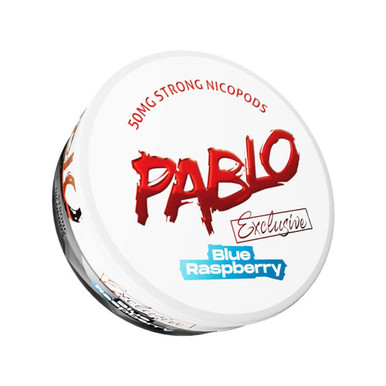
Within the line, this can is one of the more complicated blends. Where Blue Raspberry at £3.85 puts a single sweet-sharp fruit front and centre, and Pablo Exclusive Banana Ice, also £3.85, pairs one soft fruit with a cold finish, this one is three fruits layered so that the sweetness and the sourness arrive at different moments. That makes it the busier can of the three, and whether that is what you want is a matter of taste rather than a matter of quality.
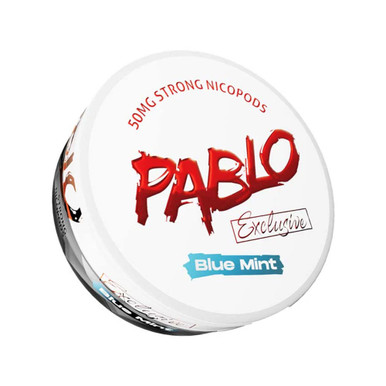
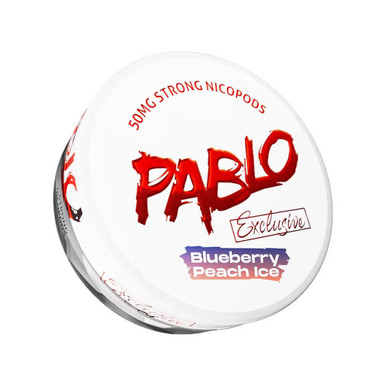
The rest of the line splits along familiar lines. The Blue Mint can and the other cold entries put a mint layer over the fruit, which this can does not have. Blueberry Peach Ice shares the blueberry element with this one but adds a stone fruit and a cold finish, so it is the nearest relative in the range if you like the blueberry here but want something cooler. The Bubblegum tin and Cherry Cola from the same line step away from fruit blends altogether — the first into confectionery-style sweetness, the second into a cola base with a cherry note on it. All four are £3.85 and all four are currently in stock.
Cans people keep beside a dark-fruit tin
Plenty of people keep two or three flavours going rather than working through one tin at a time, and the usual logic is contrast: something that is not the same shape as the can you already have. For a dark, sour-edged fruit blend like this one, the obvious companions are a clean single fruit, a cold can, or something from a completely different flavour family.
For a single clean fruit, the £39.90 listings from other producers are the easiest place to look. Cuba's blueberry entry is the closest direct comparison to the blueberry element here, and the Clew can approaches the same fruit from a different house style. For something sharper rather than sweeter, the Fumi blackcurrant at £27.90 is the nearest thing on our shelves to a pure tart dark fruit, and Killa's blueberry at £33.50 sits between the two.
For a cold contrast, the Elf Bar entry at £29.90 pairs two berries and finishes cool, and the Nordic Spirit blueberry at £4.49 is the cheapest way to put a second berry can in the drawer. If you would rather step sideways out of the fruit family altogether, the Maggie cherry tonic wine listing is the most unusual thing we carry that still shares a fruit with this can, and the Denssi berry entry sits in a different part of the catalogue entirely.
A note on the one currently unavailable option in that group: Iceberg's berries listing is not orderable at the moment. It is worth a look if you are building a shortlist for later, but do not plan an order around it this week. The rest of the cans named in this section were showing as in stock when this page was written, and the product page for each is the place to confirm that at the moment you actually buy.
What there is to choose between on this listing
Very little, and that is a genuine point in its favour if you dislike being made to make decisions. This listing has one strength, 50mg, one price, £3.85, and one configuration. There is no strength ladder on this page, no pack-size option, and no bundle. You add the can or you do not.
Where a decision does exist, it exists across listings rather than within this one. The choice is between this blend and another flavour, or between this producer and another, and the price consistency across the Exclusive line makes that a simpler comparison than it is in most of the catalogue: at £3.85 across the board, moving between Pablo flavours costs you nothing but the flavour change. Moving outside the brand is a different matter, since the listings named above run from £4.49 up to £39.90, and what each listing covers varies.
On pack size specifically: our record for this product carries no cans-per-pack value, so this page describes a single can and nothing more. If you want more than one, the practical route is to order more than one can. Where a listing elsewhere in the catalogue is sold as a multi-can pack, that listing says so on its own page — we are not going to assert it for a product where our data is silent.
Ordering, delivery and the age check
Ordering works the way the rest of the site works: add the can at £3.85, check out, and the order joins the normal dispatch queue. Stock positions on this site are live, so the state shown on the listing at the moment you order is the state we are working from — which is why this page keeps saying "as this was written" rather than promising anything about next week.
Age verification is not optional and it is not a formality. We sell to adults aged 18 or over only. An age check runs as part of checkout, and ID may be requested on delivery. Where it is requested and an adult cannot produce it, the parcel is not handed over. If you are ordering to an address where somebody else will take the parcel in, that person needs to be able to satisfy the same check. This is not a hurdle we have invented and it is not one we can wave anybody past.
The returns and delivery terms that apply to this order are the standard ones for the site, and they live on the relevant policy pages rather than being restated here, because a product description is the wrong place for terms that might change. If you have a question about a specific order, the contact route on the site is the right one — a page like this one cannot see your order.
Finding this page again, and what the shelf labels mean
This can is filed in four places, and any of them will bring you back to it. By declared figure it sits with the ninety-eight cans filed as Extra Strong. By producer it sits with all fifty-six Pablo listings. By flavour it appears on both the berry and the cherry shelves, which is a direct consequence of it carrying two flavour tags rather than one.
Above those, everything we stock is the full index, and it is the right starting point if you know roughly what you want but not which producer makes it. The brand pages are the right starting point if you have found a house style you get on with — the Cuba brand page is the other large one, and the difference in pricing between the two brands is immediately visible when you put the two shelves side by side.
The strength labels deserve one more line of explanation, because they are the labels most likely to be misread. Medium, Strong and Extra Strong are our own sorting categories, applied so that a catalogue of this size can be browsed in sections. They are not ratings, they are not endorsements, and they carry no implication that one section is a destination and another is a starting point. A shelf is a place to find things.
Questions we actually get about this can
Why does the flavour record only list two things when the name lists three?
Because our tagging vocabulary is coarser than the product name. We have one berry tag, so blueberry and cranberry both land in it, and cherry has a tag of its own. The name on the tin is the more detailed of the two descriptions and it is the one to trust for composition. The tags exist so the can can be found from the berry and cherry shelves, not to reproduce the label.
Is there a cooling version of this blend?
Not of this exact blend, no. The nearest thing in the same line is Blueberry Peach Ice, which keeps the blueberry, swaps the cranberry and cherry for a stone fruit, and adds a cold finish. It is a different can rather than a cold version of this one, and it is listed at the same £3.85. We do not hold any information about the producer's future plans, so if you are asking whether one might appear, the honest answer is that we do not know.
How many pouches are in the tin?
We do not hold that figure. Our record for this listing has no pouch count and no cans-per-pack value, so any number we printed here would be an estimate dressed up as a fact. The printed tin carries it, and if it is not legible on the can, the manufacturer's own labelling is the authority rather than us. We would rather answer a straightforward question with "we do not know" than close the gap with a guess.
Does 50mg here mean the same as 50mg on a can from another producer?
We cannot tell you that it does. The figure is declared by the manufacturer and printed on the packaging, and we reproduce it as received. Producers do not all declare on the same basis and we do not hold the basis for each. So two identical-looking numbers on two different tins may or may not be comparable, and we are not in a position to say which. Treat the figure as a label on that specific can.
Which strength should I buy?
We cannot answer that and we will not pretend otherwise. Choosing a strength is a personal question and in some circumstances a medical one, and a retailer is the wrong party to be answering it. Nothing on this page recommends a figure to anybody, and nothing here should be read as suggesting that a higher number is preferable, more advanced, or a target. If you are unsure, that is a matter to take up with a qualified professional rather than with a product description.
Why is this can £3.85 when similar-sounding cans are £39.90?
Because price on this site reflects the brand, the format and what the particular listing covers, and those differ substantially between producers. The listings named on this page run from £3.85 to £39.90. A higher price is not a quality statement from us and should not be read as one, and a lower price is not a warning. The individual product page is where you can see what each listing actually includes before comparing the numbers.
Can I keep an opened tin in the car?
You can, but it is the place most likely to spoil it. Cars swing between cold overnight and very warm in sun, and a tin on a dashboard or in a door pocket dries out far faster than one in a drawer indoors. With a fruit blend like this, heat tends to take the brighter sweet notes first and leave the sour edge behind, so a car-stored tin tastes thinner. A glovebox is better than a dashboard, and indoors is better than either.
What do I do with a used pouch when there is no bin nearby?
The hollow section in the lid is built for exactly that: press the used pouch up into it and close the tin. It will hold a few, and it keeps the smell and the damp contained until you reach a bin. It is not intended as long-term storage — a lid left full for days makes the whole tin unpleasant to open, and it stops the lid seating properly. Empty it into a bin, and keep it away from children and animals in the meantime.
Do you know where this product is made, or who makes it?
No. Our record holds the brand name, the product name, the price, the declared strength, the flavour tags and the stock position, and that is the complete list. There is no country of origin on this page, no company history and no manufacturing detail, because we do not have those things and we are not going to compose them. The packaging is the next place to look, and if it is not there either, ask us rather than trusting a page that has filled the gap.
Is it worth buying two tins at once?
That depends entirely on how quickly you get through one, and we have no way of knowing that. The practical consideration is the storage one: a sealed spare keeps in the condition it was packed in, but a second opened tin ages at the same rate as the first, so there is no benefit to having two on the go. If you order a spare, leaving it sealed until the first is done is the sensible habit. Whether you want a spare at all is your call.
What happens if I do not get on with this flavour?
Taste is individual and we cannot predict yours. The catalogue is arranged so that moving sideways is quick: the berry and cherry shelves collect the nearest alternatives, and the full shop index covers everything else we carry, across every producer and flavour family. Our standard returns policy applies to this listing exactly as it does across the site, and the terms of it are on the relevant policy page rather than restated here.
Legal and compliance information
Nicotine is an addictive substance.
This product is sold to adults aged 18 or over who already use nicotine, and on that basis alone. We do not sell to anyone under the age of 18. An age check forms part of checkout, and ID may be requested on delivery; where it is requested and cannot be produced by an adult, the parcel will not be released.
Pablo Exclusive Blueberry Cranberry Cherry Nicotine Pouches are not a licensed stop-smoking medicine and are not authorised, licensed or intended for any such purpose. This product is not intended for non-smokers, for anyone who does not already use nicotine, for under-18s, or for anyone who is pregnant or breastfeeding. Nothing on this page constitutes medical advice, nothing on it should be read as encouragement to begin using nicotine, and nothing on it recommends any particular declared strength as suitable for any particular person.
Keep this product out of reach of children and animals, including after use. Every factual detail on this page — the product name, the brand, the price, the declared strength, the flavour record and the stock position — comes from our own product record for this listing. Where that record is silent, this page says so rather than estimating. The can itself, and the manufacturer's labelling printed on it, is the authoritative source for anything appearing on the packaging.
The short version
Pablo Exclusive Blueberry Cranberry Cherry is a single-strength can: 50mg declared, £3.85, a dark fruit blend that opens sweet, turns tart and finishes dry, with no cooling element. It is filed under Extra Strong, tagged berry and cherry, and was in stock as this page was written. Our record holds no pouch count and no cans-per-pack figure, and this page does not invent either.
Keep the lid shut, keep the tin out of a hot car, open one at a time, and keep it away from children and animals. Everything we hold about this product is on this page, and where we hold nothing, that is on the page too.
More from Pablo
More extra strong pouches
More berry pouches
Where this sits
Pablo Exclusive Blueberry Cranberry Cherry Nicotine Pouches appears in these categories. Browse them, or jump to something close.
You might also like