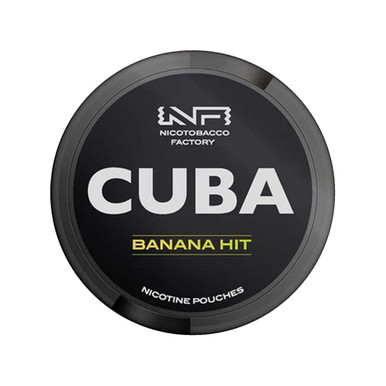
Home / Extra Strong / Cuba Black Apple Juice Nicotine Pouches
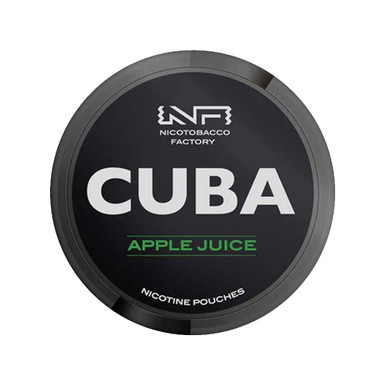
Cuba · 43mg
Read the full guide
Cuba Black Apple Juice Nicotine Pouches
£39.90
✔ In stock — ready to ship
100% tobacco-free
Free over £20
Same-day dispatch
Secure checkout
Cuba Black Apple Juice Nicotine Pouches are listed at £39.90 in a single declared strength of 43mg. There is one variant, not a range — 43mg is the only figure we hold for this product. It shows as in stock at the time of writing, and we hold one image of it.
Three clarifications belong at the top of this page rather than buried in it, because all three are the sort of thing a reader could reasonably misread.
The full guide to Cuba Black Apple Juice Nicotine Pouches
5,204 words on how it eats, who it suits, how to serve it and what to put beside it.
The listing, and three things worth clearing up first
One: "Apple Juice" is the name of the product, not a statement about what is in it. It is a flavour name printed on a can, in the same way that a sweet called a cola bottle is not a statement about bottling. Nothing on this page should be taken as telling you what this product contains. We do not publish contents or composition information for any product on this site, and the can itself is the only place that information is declared.
Two: "Cuba Black" is a product line name and says nothing about origin. Cuba is the brand and Black is the line within it. We make no claim whatsoever about where this product is made, by whom, or under what arrangements, because we hold no such information. Anyone telling you the name implies a country is reading something into it that is not there.
Three: we do not hold a pack count for this listing. The field is empty in our data. That matters more here than it would elsewhere, because £39.90 on this site sometimes buys a multipack and sometimes does not, and without a count we cannot tell you which this is or work out a per-can figure. The listing page and the product itself are where to check. We would rather say that than publish a number we have guessed.
With that out of the way: this is an age-restricted nicotine product for adults over 18 who already use nicotine, and the compliance section at the foot of this page is not decoration.
The name on the can and the flavours in our data do not match
This is unusual enough to deserve its own section. The product is called Apple Juice. The flavour classification we hold for it lists two terms, and neither of them is apple. They are mint and tropical.
We are not going to resolve that discrepancy by picking whichever one suits the copy better. Both pieces of information are real: the name is what the brand calls the can, and the classification is how the product is filed in our catalogue, which is why it appears on both our mint flavour shelf and the tropical flavour shelf. What we can do is set out what each one tells you and let you weigh them.
The name suggests an orchard-fruit character — the sweet, slightly tart, pressed-apple flavour that the words apple juice call to mind. That is a specific and recognisable thing, and if the can delivers it, you would know it immediately.
The classification suggests something else: that there is a cooling mint element in the profile, and that the fruit character sits in the tropical family rather than the orchard one. Those two things together describe a fruit-and-cool construction, which is the single most common architecture in this whole category — a sweet fruit with a cooling partner alongside it to stop the sweetness becoming wearing over a long sitting.
The likeliest reading, and we flag it as a reading rather than a fact, is that the can is a fruit-and-mint build whose fruit component our classification has filed as tropical while the brand has named it after apple. Flavour classification is a blunt instrument, and a fruit that does not sit neatly in a category often ends up in the nearest broad one. But we do not know that, and we are not going to print it as though we do.
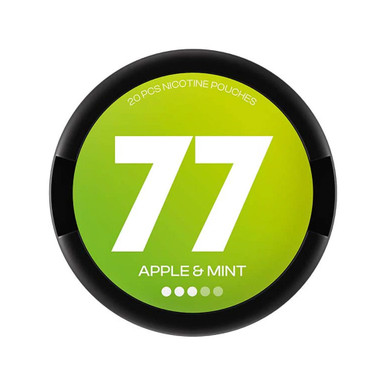
What we can say with confidence, because it follows from the classification rather than from speculation, is this: expect a cooling element. If you specifically want a plain fruit with no mint in it, the presence of mint in this product's classification is a reason to look elsewhere, and 77 Apple Mint at £39.90 is worth noting as a can that puts both halves of that combination in its name rather than leaving you to infer one.
Beyond that we are describing taste and aroma only, and we are describing what the categories mean rather than pretending to a tasting note for a can we have no flavour notes on. Mint, as a category, reads cool. Tropical, as a category, covers the sweeter, softer, heavier fruits rather than the sharp citrus ones. Together, that is a sweet fruit with a cool edge. It is not a complicated profile and it is a popular one for good reason.
43mg, and what a single-figure listing means
Most products on this site are listed across several declared strengths. This one is not. There is a single figure — 43mg — and it is the only variant we hold.
The figure is a manufacturer-declared number that describes the can. That is the whole of what it is. It is filed on our Extra Strong band, alongside 97 other cans, and 43mg is a high number by the standards of the figures that appear across this site.
Now the part we will not do, and it is worth being explicit about why. We do not advise on strength. We will not tell you whether this figure is appropriate for you, we will not describe it as suitable for any person, any level of experience or any circumstance, and we will not characterise what it is like. Those are not things a shop can responsibly say, and a high figure is not a reason to soften the rule — if anything it is a reason to hold it more firmly. If you already use nicotine products you will have your own points of reference, and they are worth more than anything written here.
Two pieces of genuinely useful context we can give. First, declared figures are not reliably comparable between brands, because brands declare on different bases. A number on one maker's can is not automatically the same measurement as the same number on another's, so comparing across brands by figure alone is less informative than it looks. Second, our strength bands — the Medium Strength shelf, the Strong shelf and the Extra Strong one this sits in — are how we file products so they can be found. They are navigation. They are not a measurement, a rating or an endorsement of anything.
Because there is only one variant, there is no strength decision to make on this listing at all. You are choosing the product or not choosing it. That simplifies things compared with a multi-strength listing, where the same flavour appears several times over.
A format that asks nothing of the room — and what we cannot tell you about that
People ask about this constantly, usually phrased as a question about a specific setting: an office, a train, a long flight, a building site. The honest answer has two halves, and the second half matters more than the first.
The first half is about the object. A pouch is small, it goes in the mouth, and after that it stays where it is put. There is no device involved. Nothing has to be charged, filled, carried in a case or held. Once it is in place your hands are free and there is nothing to put down. It makes no noise. It produces nothing that travels across a room — no plume, no aerosol, nothing airborne at all. It does not need a window, a doorway or a designated area to work, because it is not doing anything to the air. Compared with the practicalities of most nicotine formats, the logistics are minimal: one tin, a lid, a place to put the used one.
The second half is about permission, and here we have to stop being useful and start being accurate. Whether you may use this product in any particular place is not a question about the product. It is a question about that place's rules, and we do not hold those rules for any venue, employer, operator or country.
Specifically, and we are listing these because they are the settings people actually ask about:
- Workplaces set their own policies. Many employers have a written policy covering nicotine products, and many of those policies prohibit them indoors regardless of format. Your employer's policy is the authority, not us.
- Airlines set their own conditions of carriage, and those conditions frequently address nicotine products explicitly and frequently prohibit their use on board. The airline's own terms are the only reliable source, and they vary between carriers and between routes.
- Rail and transport operators likewise have their own rules and enforce them through their own staff. A rule that applies on one operator's service does not necessarily apply on another's.
- Sites and regulated premises — construction, industrial, healthcare, educational and similar — usually have controls that go well beyond general law, for reasons specific to the site, and those controls are set by whoever runs the site.
- Other countries regulate these products very differently from one another. Some restrict them heavily. Some prohibit them outright, including for personal possession by a traveller. Before taking any nicotine product across a border, the destination country's own rules are the thing to check, and a UK retailer's product page is emphatically not a substitute for that.
We cannot check any of those for you, we do not hold them, and we are not going to imply permission by staying quiet about it. Do not treat the discretion of a format as evidence that it is permitted. Those are unrelated questions. A product that nobody would notice can still be entirely against the rules of the room you are in, and the fact that a rule would be hard to enforce is not a reason to assume it does not exist. If you are unsure, the person to ask is whoever runs the space — the employer, the airline, the operator, the site manager.
What the format does genuinely simplify is the ordinary logistics of carrying something around: a flat tin that fits in a pocket, no charging, no leaking, no case, nothing to assemble, and no need to find somewhere specific to stand. That is a practical observation about an object, and it is as far as we are prepared to take the subject.
There is also a disposal problem that the format creates rather than solves, and it belongs in an honest account of settings. A used pouch has to go somewhere. The lid recess buys you time, but it does not empty itself, and a bin is still required eventually. In a setting where you are away from one for a long stretch — and the settings people ask about are mostly exactly that — the recess is doing all the work and it has a finite capacity. Anyone who has opened a can and found the recess full from a previous outing knows the result. If you are going to be somewhere without easy access to a bin, that is the practical thing to plan for, not the flavour.
And a note on the tin in confined spaces. A lid that comes off in a bag is a minor nuisance at a desk and a considerably larger one in a suitcase. The tins are not sealed containers and they are not designed to survive being crushed. If a can is travelling in luggage rather than a pocket, keeping it in the outer packaging, or somewhere it will not be compressed, is worth the ten seconds it takes. This is not advice about using the product anywhere in particular — it is advice about not opening a bag to find a tin has emptied itself into it.
Building a rotation: what pairs with a sweet, cool can
Almost nobody runs one can and nothing else, and the reason is straightforward: a single unvarying flavour over a long period gets tiring in a way that has nothing to do with whether it was good in the first place. The practical question is what a second and third can should be, and there is a logic to it that is more useful than a list of suggestions.
The principle is to differ on a named axis. Picking a second fruit that sits next to the first on the same axes achieves very little — two sweet tropical cans with a cooling edge are the same purchase twice. The pairings that work are the ones where you can say what is different about them. Four axes cover most of it: how cool, how sweet, how sharp, how much bitterness underneath.
Given that this can is classified as mint and tropical — sweet fruit with a cool edge — here is how the shelf divides up around it.
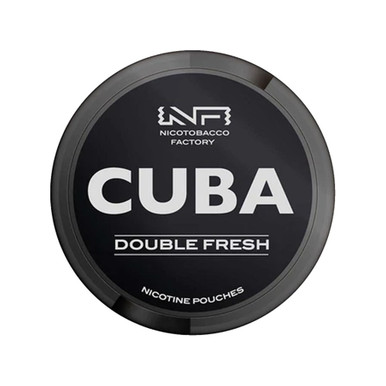
More cool, less fruit. The most common second can is something that keeps the cooling and drops the sweetness, which gives you somewhere to go when the fruit has become wearing. Within the same brand and at the same £39.90, Cuba Black Cold Dry and Cuba Black Double Fresh are the two that sit at that end of the line. Outside the brand there is a wide choice at very different prices: Edge Mint at £14.95, Klint Arctic Mint at £36.90, Denssi Cold Mint at £39.90, Clew Cool Mint at the same £39.90, and Elf Bar Cool Storm at £29.90. Those five are not identical to each other — the mint family spreads across a real range — but they all sit at the cool end relative to this can.
Same family, different fruit. If you like the construction and just want to vary what is inside it, the Cuba Black line is the obvious place to look, because everything in it is £39.90 and the differences are purely flavour. Cuba Black Blueberry takes the dark, rounder berry route. Cuba Black Cherry is the sweeter stone-fruit reading. Cuba Black Banana Hit is a soft, heavy fruit rather than a sharp one — and, as with this can, the name is a flavour name and nothing more. Cuba Black Cola steps outside fruit altogether into the confectionery-drink family, which is a bigger change than it sounds.
Elsewhere in the same fruit territory. Outside the brand, Velo Peach Ice at £4.19 and Killa Banana Ice at £33.50 both pair a soft fruit with a cooling element, which is the same architecture under different hands. Pablo Exclusive Banana Ice at £3.85 is a third reading of that pairing again. Note the spread of listed prices there — £3.85 against £33.50 against £39.90 — and note that we do not hold pack counts for all of them, so those figures are not comparing the same thing. Check the pack basis before drawing any conclusion about value from a price.
Somewhere genuinely different. If the point of a second can is contrast rather than variation, the useful move is to leave the sweet-and-cool corner entirely. Fumi Dark Spice at £27.90 is the clearest example here — a spice-led profile has a completely different shape from a sweet fruit, and it is the sort of can that resets a palate rather than continuing a theme. The 77 apple and mint can at £39.90 is the other interesting comparison, for the specific reason set out earlier: it names the apple-and-mint combination outright, which makes it a useful reference point against a can named for apple but classified under tropical.
A word on how rotations actually fail. The common mistake is not picking the wrong second can — it is picking three cans that are all variations on the first. Somebody who likes a sweet cooled fruit will often end up with three sweet cooled fruits in different colours, and will then conclude that pouches in general have become boring, when what has actually happened is that they have bought the same thing three times. The test is whether you can name the axis on which two cans differ. If you cannot, they are probably not doing different jobs, whatever the names on the lids say.
The other failure is rotating too fast. A can opened and abandoned after two pouches is a can that will still be sitting in a drawer in six months, and a rotation of five or six open tins means most of them are ageing rather than being used. If you are going to keep more than one going, keeping it to two or three open at a time is simply better housekeeping — and it is a large part of why the prices matter less than they appear to. A cheap can that sits unused is not cheaper than an expensive one that gets finished.
A last practical note on rotation. Two or three cans is where most people settle, and beyond that it stops being a rotation and starts being a collection. Nothing on this page is an argument for buying more than you came for.
The pouch itself, and handling it
A nicotine pouch is a small sealed pouch placed in the mouth between the lip and the gum and left there. It is not chewed and not swallowed. That description applies to everything on this site.
The can is the standard shallow round tin: a body holding the pouches flat in a ring, and a lid that lifts clear and presses back down. The lid carries the brand, the product name and the strength figure, which is the face you read when there is more than one can in a drawer. Inside the lid there is normally a separate recess intended for a pouch you have finished with, so you are not holding one while looking for a bin.
Placement is usually at the front under the top lip, where the lip holds it. It stays where it is put. If it is uncomfortable in one position, move it; if it is uncomfortable in all of them, take it out. No product page should be encouraging anyone to persist with something that is bothering them.
How long people keep one in varies widely and we do not publish a recommended duration, because that would amount to advising on how much to consume. Flavour generally reads strongest early and fades from there.
Disposal: empty the lid recess into a bin regularly. It is a temporary holding space, not storage, and a full one is the commonest reason a lid stops seating flat, which in turn is the commonest reason a can dries out sooner than expected. Used pouches go in general waste — not down a sink, not down a toilet — and they need keeping away from children and animals exactly as unused ones do.
On pouch size and format: we hold no size classification for this product. That is declared on the can.
Cuba's shelf, and where the Black line sits on it
The Cuba brand page is one of the largest on this site, with 47 cans on it. That is a range big enough that it is organised into lines rather than being a flat list, and Black is one of those lines.
Within the Black line, the six siblings we list alongside this can are all priced at £39.90 — the same as this one — which makes the line easy to read. There is no price signalling between them at all, so the only thing separating one from another is flavour. Set out plainly, those six run from the fruit end through to the cool end: blueberry and cherry in dark and sweet fruit, banana in the soft heavy fruit territory, cola in the confectionery-drink corner, and the Cold Dry and Double Fresh cans at the cooling end of the line.
Forty-seven cans against the seven described here means there is a good deal more on the brand shelf than this page covers — other lines, other profiles, other strength bands. Rather than characterise what we have not listed, we would point you at all 47 Cuba cans directly, since a shelf is always more current than body copy.
One thing worth understanding about big brand ranges generally: the line name tells you about the family a can belongs to, not about its strength. Lines and strength bands are separate axes, and a single line can have cans filed across several bands. So finding this can under Extra Strong does not mean the whole Black line lives there.
Keeping a can in good order
Not much to it, but the basics are worth stating.
Press the lid fully home every time, and clear the used-pouch recess so that it can seat flat. A lid sitting slightly proud is the single most common cause of a can going off faster than expected, and it is almost always the recess that is stopping it.
Keep cans away from heat and direct sun. The three places cans reliably suffer are the windscreen shelf of a parked car, a radiator, and a sunny windowsill. A drawer, a cupboard or a bag pocket is fine, and room temperature is fine.
Some people keep cans in the fridge. That is a habit rather than an instruction, and we are not going to tell you it achieves anything, because we hold no storage guidance from the manufacturer for this product. Whatever is printed on the can — including any date marking — takes precedence over anything written on this page.
Because we do not hold a pack count for this listing, we cannot tell you how many cans will arrive or how many will be sitting in storage while one is in use. If more than one does arrive, the sensible approach is the usual one: keep the unopened ones in the outer packaging rather than loose in a drawer where lids get knocked, and open one at a time rather than several.
And as with anything nicotine-related in a household: store it, and used pouches, where children and animals cannot reach them.
What there actually is to decide here
Less than on most listings, which is worth saying plainly.
There is no strength decision, because there is one figure: 43mg. There is no pack-size decision visible to us, because we do not hold a pack count — what you see on the listing itself is what governs. So the decision reduces to whether you want this can, at £39.90, with a mint-and-tropical classification and a name that points at apple.
The one thing genuinely worth weighing before ordering is the mismatch covered earlier. If you are buying because the words "apple juice" appeal, understand that our flavour data does not file this as an apple can and does indicate a cooling element. If that is not what you want, the 58 tropical cans and the 148 filed under mint are both large shelves with plenty of alternatives on them, and one of those is likely to get you closer to what you are actually after.
Ordering, delivery and age verification
You must be 18 or over to buy, and we sell only to adults who already use nicotine.
Age verification is carried out at checkout, and you may be asked to confirm your age before an order is accepted. The courier may also ask for identification at the door. If there is nobody aged 18 or over present to take the parcel and show ID, it will not be left — that applies to every order without exception, and it is worth planning the delivery around.
We show this product as in stock at the time of writing. Stock changes, and the live listing is always more current than the body of a page, so if the two ever disagree the listing is the one to believe. Prices are in pounds sterling.
Getting around from here
Four shelves lead to this page, which is more than most products have, and each one is a different way of thinking about it.
By strength band, it sits with the 98 cans filed as Extra Strong, with the Strong shelf and the Medium Strength shelf below it. By brand, Cuba's shelf holds the full 47. By flavour it appears twice over, on the mint shelf and on the tropical one, which is a direct consequence of carrying both classifications.
If you would rather browse by maker, the Pablo brand page is another of the larger ranges. And if filtering is getting in the way of just looking, the full shop listing puts everything in one place.
Questions we get about this can
Does it contain apple juice?
Apple Juice is the name of the product, not a statement of what is in it, and we do not publish composition or contents information for anything on this site. What a product contains is declared by the manufacturer on the packaging, and the can is the only place to read that. We are not able to confirm or deny the presence of any particular ingredient.
Why does the page say mint and tropical when the can says apple?
Because both are true of the information we hold: the brand's name for the product is Apple Juice, and our own flavour classification files it under mint and tropical. We have not picked one and suppressed the other. The practical takeaway is that you should expect a cooling element, and that the fruit character is filed in the tropical family rather than the orchard one.
Is it made in Cuba?
Cuba is the brand name and Black is the line name within it. Neither tells you anything about where the product is made, and we hold no country of origin or manufacturing information for it. We are not going to guess. Whatever the manufacturer declares on the packaging is the only reliable source.
How many cans do I get for £39.90?
We genuinely do not know — the pack count field is empty in our data for this product, which is why this page does not state one and does not work out a per-can price. The listing page itself is where that is confirmed. We would rather flag the gap than fill it with a number that might be wrong.
Is 43mg suitable for me?
We cannot answer that and are not permitted to. We do not advise on strength, do not describe any figure as suitable for any person or level of experience, and do not characterise what any figure is like. 43mg is the single declared figure for this product and it is filed in our Extra Strong band. That is the extent of what we can tell you.
Can I use these on a plane, at work or on a train?
We do not hold those rules and cannot advise on them. Airlines set their own conditions of carriage, employers set their own workplace policies, transport operators set their own rules, and many of those prohibit nicotine products regardless of format. The organisation running the space is the authority. Please do not treat the fact that a product is unobtrusive as evidence that it is permitted — those are separate questions.
Can I take them abroad?
That depends entirely on the destination, and it is not something we can answer. Countries regulate these products very differently and some prohibit them outright, including for personal possession. The destination country's own rules are the thing to check before travelling, and a retailer's product page is not a substitute for doing that.
How many pouches are in a can?
We do not hold a portion count for this product, and we are not going to estimate one from what other brands do, because counts vary between makers. The can carries that number printed on it.
How long does one last?
It varies between people and we do not publish a duration, because doing so would amount to advising on how much to use. Flavour is generally most pronounced early on and tails off from there, and many people treat the point where it has gone quiet as the natural end.
Is this one of your more popular cans?
We do not publish sales figures, rankings, reviews or customer ratings, so we cannot tell you and would not want to imply anything either way. The comparisons on this page are drawn from our own catalogue data — prices, brands, classifications and shelf counts — and from nothing else.
What else should I get with it?
That depends on what you want a second can to do. If it is to have somewhere to go when the sweetness gets wearing, something at the cool end like the Double Fresh can in the same line is the usual answer, at the same £39.90. If it is for genuine contrast, something structurally different such as the Fumi spice can at £27.90 does more. Both routes are set out at greater length above.
Do you have this in a lower strength?
Not as this product. There is one variant of this listing and it is 43mg. Other products are listed across several figures, and the medium band and the strong band are where to look if you want to browse what sits in the lower bands — though as noted above, figures are not reliably comparable between brands.
Legal and compliance
Sold only to adults aged 18 or over. We supply nicotine pouches exclusively to adults who already use nicotine. Age verification is carried out at checkout and ID may be requested on delivery; the parcel will not be handed over to anyone who cannot show they are 18 or over.
Nicotine is an addictive substance. That applies to this product, at its declared figure of 43mg, and to every other can we sell at every figure.
Cuba Black Apple Juice is not a licensed stop-smoking medicine and is not supplied as one. It is not intended for non-smokers, for anyone who does not already use nicotine, for anyone under 18, or for anyone who is pregnant or breastfeeding. Nothing on this page is medical advice and nothing on it is guidance on how much to use. If you have questions about nicotine and your own health, they belong with a qualified healthcare professional rather than with a shop.
Keep all nicotine products, including used pouches, out of the reach of children and animals.
The short version
Cuba Black Apple Juice is a single-variant listing at £39.90 with one declared figure of 43mg, filed in our Extra Strong band and classified under both mint and tropical despite the name on the can. We do not hold a pack count for it, we make no claim about where it is made, and the name is a flavour name rather than a statement of contents. All three of those are gaps and caveats rather than selling points, and we would rather you had them up front.
What we can offer with confidence is the comparative picture: where this sits among the Extra Strong shelf, how it relates to the rest of the Cuba range, and what pairs with a sweet, cooled fruit can if you want a rotation rather than a single tin. And if you want the whole catalogue rather than a filtered view of it, everything we stock is one click away.
More from Cuba
More extra strong pouches
More mint pouches
Where this sits
Cuba Black Apple Juice Nicotine Pouches appears in these categories. Browse them, or jump to something close.
You might also like