Home / Medium Strength / Fumi Dark Spice Nicotine Pouches
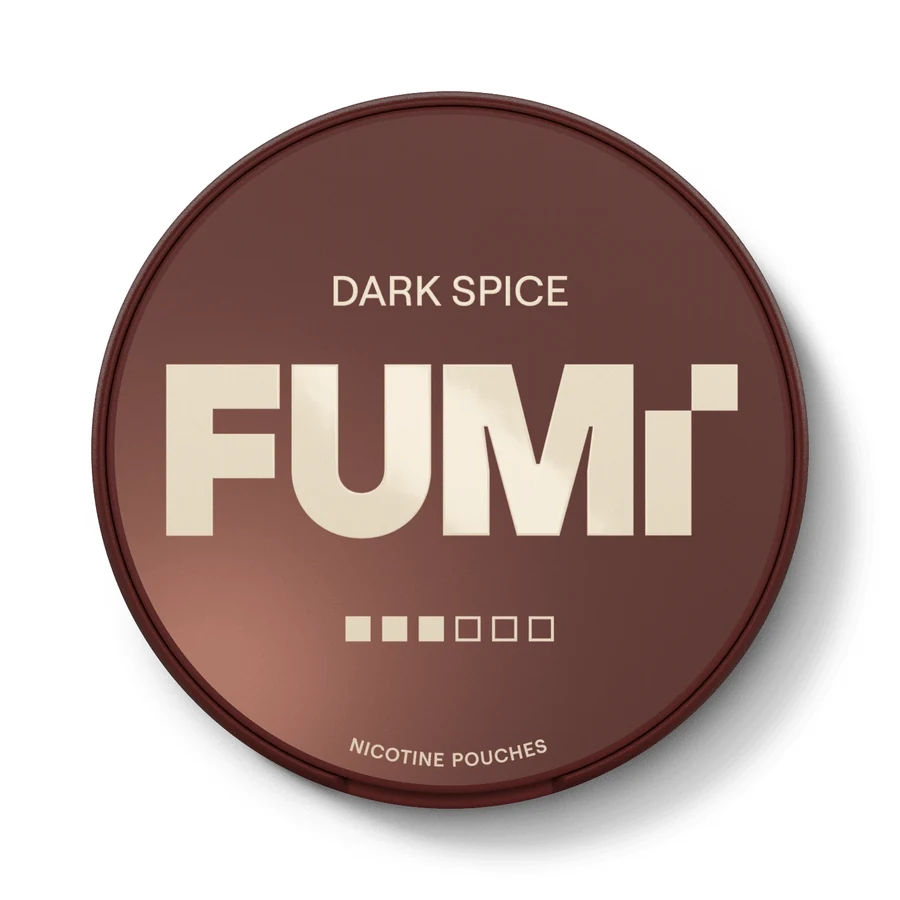
Fumi · 4mg–8mg · 10-can pack
Read the full guide
Fumi Dark Spice Nicotine Pouches
£27.90
✔ In stock — ready to ship
100% tobacco-free
Free over £20
Same-day dispatch
Secure checkout
Fumi Dark Spice Nicotine Pouches is a ten-can listing priced at £27.90, held in two declared figures, 4mg and 8mg, both at that same £27.90. Our catalogue files one flavour tag against it: mint. Stock showed as available at the time of writing, and one photograph accompanies the row. That is everything we hold. Nothing on this page comes from anywhere else, except where it is plainly a comparison with another can on our own shelves or a division we have done ourselves.
Ten cans at £27.90 works out at £2.79 per can. We have done that sum so the row can be set against the single-can listings elsewhere on the site, but the amount that actually leaves your account is £27.90 for the box.
The full guide to Fumi Dark Spice Nicotine Pouches
5,002 words on how it eats, who it suits, how to serve it and what to put beside it.
Fumi Dark Spice: what the catalogue row actually says
This is an adult product containing nicotine. It is sold only to people aged 18 or over who already use nicotine, and the complete statement of that sits in its own section towards the end of this page.
The two figures, side by side
| Declared figure | Box price | Per can |
|---|---|---|
| 4mg | £27.90 | £2.79 |
| 8mg | £27.90 | £2.79 |
Two steps rather than three, both at one price, and both sitting at the lower end of the numbers you will find across the catalogue. That is a narrow ladder by the standards of this site, and it is a deliberate shape rather than an incomplete one.
A mismatch worth stating outright
There is a problem with this row and we are going to put it in front of you rather than write around it. The product is called Dark Spice. Our catalogue files it under mint. Those two things do not obviously agree, and we cannot reconcile them from anything we hold.
Here is the full honest position. Our flavour tags are a categorisation applied across the whole site so that shelves can be built, and they are not a full description of what any individual can tastes like. It is entirely possible that this can carries a spiced reading over a cool base and that our system has recorded the cool part because that is the shelf it best fits. It is also possible the tag is simply wrong for this row. We do not know which, and rather than pick the interpretation that reads better in a product description, we are telling you that the record is ambiguous.
What we are not going to do is describe a spiced flavour to you in detail as though we had verified it. That would be inventing a tasting note to cover a gap in our data, which is exactly the thing that makes product copy across this category untrustworthy. The words on the lid are the manufacturer's, the tag on our shelf is ours, and the can itself is the only authority that settles the question.
What the two words on the lid conventionally signal
We can at least say what the naming convention usually indicates, clearly labelled as a reading of a name rather than a statement about contents. Dark in this trade generally points away from bright, sweet and fruity, towards something lower and rounder. Spice generally points to a warm rather than a cold character. Taken together, the name sets an expectation of something at the opposite end of the flavour map from the fruit-and-ice cans that dominate the shelves.
That is why the mint tag is surprising enough to be worth a section of its own. If you are choosing between cans on the strength of the flavour name, this is a row where the name and the shelf point in different directions, and you should know that before you order ten cans of anything.
If it matters to you before you buy
Ask us. We would rather read the packaging on a product in front of us and tell you what it says than have this page guess. For a ten-can purchase in particular, a flavour question is worth resolving in advance, and there is nothing unusual about asking a shop to check a label.
What 4mg and 8mg are as numbers
A milligram figure on a can is a quantity declared per pouch by the manufacturer and printed on the packaging. That is the whole of what it is, and this page presents it as information and attaches nothing to it.
Several things follow that are easy to get wrong. The figure is per pouch, not per can and not per box, so a comparison between two listings is only sound if you also know both pack structures — here you do, since this is ten cans, but plenty of rows elsewhere do not state one. Different manufacturers do not necessarily measure or declare on an identical basis, so an 8mg from one maker and an 8mg from another are not guaranteed to be describing the same thing with the same precision. And, most commonly misunderstood of all, the figure has no relationship whatsoever to flavour intensity. The 4mg and 8mg versions of this row carry the same flavour build as each other.
Where these two figures sit in our sorting is straightforward: this row is filed on the Medium Strength shelf, which currently holds a hundred and thirty-five listings, and 4mg and 8mg are both comfortably within that band rather than straddling it. That is a cleaner fit than many rows manage — the Strong shelf carries a hundred and thirty-two and the Extra Strong shelf takes the upper end, and rows with wide ladders often sit awkwardly across the boundaries.
We will not tell you which of the two figures is right for you. That is not a judgement a retailer is in any position to make, and it is not one we are permitted to offer.
Where this box sits against everything else at these figures
This is the comparison that actually helps, because a declared figure only means something once you can see what else occupies the same band and what each of those costs. The medium shelf is the largest of our three strength bands and the most crowded, so the field here is wide.
The price ladder, per can where we can calculate it
The headline prices across comparable cans span a range that looks dramatic until you account for pack structure, at which point a good deal of the drama disappears. The honest way to present it is to give both numbers where we have both, and to say so where we do not.
- Velo Bright Spearmint at £4.19 and Nordic Spirit Frosty Berry at £4.49 sit at the bottom of the headline range.
- Edge Spearmint at £14.95 and UBBS Cola Ice at £19.95 occupy the middle ground.
- This box, at £27.90 for ten, works out at £2.79 a can — below every one of the headline figures above it on this list, which is the entire point of reading the two numbers together.
- SYX Cool Mint at £29.90, White Fox Double Mint at £34.90 and Klint Arctic Mint at £36.90 step up from there.
- 77 Apple Mint and Pablo Silver Edition Blueberry Peach Ice both sit at £39.90, the top of this particular field.
Why the headline price is the wrong number to compare on
Because a £4.19 listing and a £39.90 listing are frequently not selling the same quantity of product, and a shelf price tells you what leaves your account rather than what arrives at your door. Where we hold a can count we publish it and do the arithmetic, as we have here. Where we do not hold one, we say so and leave the division undone rather than assuming a number that would make the comparison look tidier. Anyone who ranks this category by headline price alone is ranking pack sizes with the flavour names attached.
This is also why we are not going to declare a winner. We can show you what each row costs, what quantity it represents where we know it, and where it sits in our sorting. Turning that into a recommendation is a different act entirely, and it is not one a shop should be performing on a nicotine product page.
What is genuinely distinctive about this row in the field
Three things, all of them factual. The ten-can structure at £27.90 gives a per-can figure that very few headline prices on the medium shelf beat. The two-step 4mg and 8mg ladder is narrower than most and keeps both options inside one band. And the flavour position — whatever it turns out to be — is unusual on a shelf where the field above is almost entirely mints, berries and colas. The name alone puts this row somewhere the rest of the list is not, and that is worth something even before the tag ambiguity is settled.
What changes when you move between brands at the same figure
People assume that matching a declared number across two brands produces a matched experience, and it is worth setting out plainly why that assumption is shakier than it looks. Three separate variables move at once when you change maker, and only one of them is the number.
The first is portion size. Brands do not build to a single standard, and a pouch from one maker can be physically a different object from a pouch of the same declared figure from another. Since portion is the variable most likely to decide whether you get on with a can, this is the one that catches people out.
The second is declaration practice. Manufacturers measure and print according to their own conventions, and we are not in a position to audit anyone's. The printed number is reliable as the manufacturer's own statement about their own product; it is less reliable as a common unit that lets you rank two companies against each other to a decimal place.
The third is flavour construction, which has nothing to do with the figure at all but changes the whole impression of a can. An 8mg here and an 8mg from a maker whose flavours land somewhere quite different will read as two different products, and the shared number will have contributed almost nothing to the difference or the similarity.
The practical upshot is that the number is a useful filter and a poor equivalence. Use it to narrow a shelf; do not use it to predict that two cans will match.
The nearest thing to a like-for-like
For a strict comparison you want the same brand, the same box structure and the same price, which means looking inside Fumi rather than outside it. Fumi Watermelon Mint at £27.90 is the closest on those terms, and the difference between the two rows is the flavour and the declared figures rather than anything structural. That is a cleaner comparison than any of the cross-brand ones above, and if you want to know what changes when only the flavour changes, it is the pairing to make.
Living with the format, in detail
Ordering ten cans is a bigger commitment to a format than buying one, so it is worth being specific about what that format is and what it is like in ordinary use. Nothing in this section is particular to this flavour.
Portion size, and the classification we will not supply
Pouch portions are described across the trade in a small vocabulary of sizes, and the differences between them are physical and immediately obvious to anyone who has used more than one. Our record does not place this row into that vocabulary, so we are not going to place it for you. The packaging states it, and the packaging is the only source worth trusting on it.
Why it matters more than most specifications: portion size is the variable that most often decides whether someone gets on with a particular can at all. Flavour preferences are negotiable and printed figures are a matter of choice, but a portion that does not sit comfortably will spoil a can regardless of everything else about it. People who have found a size that suits them are generally better served by matching that across brands than by matching anything else.
Where it goes and how it behaves there
A pouch is positioned under the lip and left alone. It is not held, not moved and not fiddled with, and the whole design assumes it will stay where it is put. Anyone doing this for the first time finds it peculiar for a minute or two, and then almost universally stops noticing. Conversation is unaffected. Cold drinks are unaffected. Hot drinks are the one thing people consistently report as more noticeable, which is a comment about temperature rather than about anything else.
A pouch that will not stay put is usually seated badly or is a size that does not suit the person holding it. Both are things you sort out in the first few days and neither is a defect. It is also worth saying that there is nothing about the object that reports on itself while it is in use — no signal, no marker, nothing to check.
Duration, honestly bounded
Across this category, reported usage runs from roughly a quarter of an hour at the brief end to about an hour at the long end, with most people falling into a twenty-to-forty-minute habit. Flavour typically fades a good while before anyone takes a pouch out, which makes taste an unreliable clock and leaves most people working from habit.
That is a description of what is reported, and it is where the description ends. How long anyone keeps a pouch in is not a matter on which a shop should offer guidance, and we are not going to convert a range of observed behaviour into an instruction.
The lid, the recess and getting rid of things
The upper part of the lid on cans of this shape is a separate chamber, generally called the catch. Its purpose is narrow and practical: it gives a used pouch somewhere to go when there is no bin available. Cap off, pouch in, cap back on.
Two limitations, stated because they are real. We do not publish a capacity figure for it, since that would depend on how wet the pouches going in are and we would only be guessing. And it is not sealed the way the lower body is, so leaving used pouches there across several days becomes noticeable. Emptying it daily makes the whole issue disappear. Used pouches belong in general waste in a bin. The tins are plastic and go wherever your local authority directs plastic of that kind, which differs by council and is not something this page can answer for your address.
Ten cans as a physical object
The box is not large — ten shallow tins stack into a package roughly the size of a paperback stood on end, and it does not need a shelf of its own. In practice most people put nine cans somewhere cool and dark and carry the tenth. There is a small discipline in that arrangement worth mentioning: keeping the working can separate from the stored ones means the stored ones stay in good conditions rather than riding around in a bag all week.
Ten cans also changes how you think about the format rather than just the flavour. With a single can, a format that does not suit you is a minor loss. With a box, it is ten times that, which is a fair argument for having tried the portion size a brand uses before committing to a multi-can row. It is not an argument against buying boxes — the per-can arithmetic is genuinely better — it is an argument for doing the format experiment on something cheap first.
Taking one out of the can
A small practical note that rarely appears anywhere. A freshly opened can is packed tightly and is harder to get a single pouch out of than one that is half gone, which surprises people the first time. Tilting the tin so a pouch presents itself at the edge works better than digging at the middle, and once the technique is habitual it is a one-handed, two-second business. Doing it badly is conspicuous in a way that nothing else about the format is, so it is worth the thirty seconds of practice.
The Fumi shelf and where this row falls on it
The Fumi shelf runs to sixteen listings, and the notable thing about it is the pricing: the £27.90 ten-can structure is the pattern across the range rather than an exception on this row. That has a real consequence for choosing — within this brand, moving between products is a decision about flavour and declared figures only, because the money does not change.
The range divides roughly into a fruit group, a mint group and a small number of rows like this one that do not fit either. On the fruit side sit Fumi Blackcurrant, Fumi Chilled Cherry, Fumi Fiery Mango and Fumi Fiery Peach, all at the same £27.90 for ten. The citrus position is held by Fumi Fiery Lime and the mint position by Fumi Fiery Mint, again at the same price.
What that flat pricing hides, and what is worth pulling out, is that the declared figures are not uniform across the shelf even though the money is. Different Fumi rows offer different ladders, so moving from one to another can change the numbers available to you even when nothing else changes. Anyone treating the brand shelf as sixteen interchangeable boxes will occasionally find that the flavour they wanted is not offered at the figure they were using. Reading the strengths listed on each row before ordering avoids that, and it takes a moment.
Against all of those, Dark Spice is the odd row — the only one in the group whose name points somewhere other than a fruit or a mint. Whether the can delivers on that is, as set out above, something we cannot confirm from our own record. But as a position within a brand range it is clearly meant to be the different one, and a sixteen-listing shelf that includes exactly one such row is telling you something about how the range was planned.
What people run alongside a box of ten
A ten-can purchase is a larger commitment to a single flavour than most people want to make without a second option in the house, and palate fatigue on any one note is the ordinary reason. A few directions, each with a reason from our own listings.
- Inside the brand, at the same £27.90 and the same box structure, the Fumi cherry row and the blackcurrant one are the least disruptive companions — no change of format, no change of price, only a change of flavour.
- For a plain cool contrast bought cheaply as a single can, the Velo spearmint listing at £4.19 and the Edge spearmint at £14.95 are the two least expensive routes.
- For a mint at the other end of the money, White Fox Double Mint at £34.90 and the Klint arctic mint at £36.90 are the comparison points.
- For something in a different flavour family altogether, the UBBS cola can at £19.95 and the 77 apple mint at £39.90 sit a long way from anything spiced.
- For a berry reading, Nordic Spirit Frosty Berry at £4.49 and the Pablo Silver Edition blueberry peach can at £39.90 bracket the price range almost perfectly.
Keeping ten cans in good order
Storage matters more for a box than for a single can, simply because the last one gets opened weeks after the first. Cool, dry, dark and stable is the whole specification. A drawer or a cupboard does it. Sustained warmth and repeated temperature swings are the two things that degrade a can, which rules out a car in summer and any surface that gets direct sun.
Press the lid fully home between uses. It is a friction fit rather than a seal, and a can left slightly open in a bag loses aromatic character over days rather than weeks. If the ninth can reads noticeably flatter than the first, storage is the thing to examine before the manufacturer is — nine cans in a hot cupboard will do that, and the batch is very likely innocent.
Dating is printed on the packaging; we hold no shelf-life information in our catalogue and will not estimate one. And a box of ten is ten times the reason to keep the lot somewhere people under 18 cannot get at it.
Choosing between 4mg and 8mg
Since both figures cost £27.90 for ten, price is not a tiebreaker, and since both carry the same flavour build, taste is not one either. The decision rests on the number alone.
What we can state: the figures are declared per pouch; both sit within the medium band as we sort it; the box structure, can size and handling are identical between them; and the only difference between the two products is the number printed on the packaging. What we will not state, in any form and however politely it is asked: which one you should buy. We are not going to describe either figure as a sensible place to begin, as suitable for anyone, or as appropriate to any circumstance. If the question is really about your own situation, it belongs with a healthcare professional rather than with a retailer.
On pack size there is no decision to make on this row. Ten cans is the only structure we hold for it.
Ordering, delivery and proving your age
£27.90 buys the box of ten at either declared figure, so the basket total does not move with your choice. Stock showed as available when this page was generated; the listing itself carries the live position and will tell you before checkout does if anything has changed.
Age verification applies and is not a formality. This is an 18+ product sold only to adults who already use nicotine, checks run at the point of purchase, and ID may be requested on delivery. Whoever accepts the parcel should be ready to produce it, and a courier who is not satisfied is entitled to take the order away again.
Parcels go out in ordinary packaging. We do not print courier timings on product pages because they change; that information has its own place on the site where it can be kept accurate. Anything that arrives damaged, short or not as described should come back to us with the order reference attached.
Getting around the rest of the site
If the flavour ambiguity on this row puts you off — which would be a reasonable response — the site is arranged to get you elsewhere quickly. The sixteen Fumi listings all share this box structure and price. The mint shelf, at a hundred and forty-eight listings, is the largest flavour collection we hold and is where our tagging places this row. The medium band holds a hundred and thirty-five rows across every flavour family.
Two brand shelves referenced in the comparisons above are worth knowing separately: the Pablo range and the Cuba range. And if filtering is not how you like to shop, the whole catalogue sits on one page.
Questions we get about this one
So what does it actually taste like?
We cannot tell you with confidence, and this page has been explicit about why: the name says one thing and our flavour tag says another, and we do not hold anything that settles it. What we will not do is write a persuasive tasting note to cover the gap. The packaging describes the product, we are happy to read it for you if you ask, and a can in your hand will answer the question more reliably than any product page could.
Is the mint tag a mistake?
Possibly, and possibly not. Our tags are a categorisation used to build shelves rather than a full description, so a can with a cool element and a spiced element could reasonably end up filed under mint without the tag being wrong exactly. We are not going to assert either reading. We are flagging the discrepancy because you should know about it before committing to ten cans, which is more useful than a confident answer we cannot support.
Is £27.90 for ten good value?
£2.79 a can is below the headline price of most single-can listings on the medium shelf, which is a fact rather than a verdict. Whether that represents value depends on whether you want ten cans of one flavour, which is a question about your own habits rather than about the arithmetic. We publish both the box price and the per-can division so the comparison can be made properly, and we leave the conclusion to you.
Do the 4mg and 8mg boxes look different?
Our record does not state packaging differences between the two, so we cannot confirm one. What we can say is that both are ten-can boxes at £27.90 carrying the same flavour, and that the declared figure is printed on the cans themselves. If you keep both in the house, reading the lid before you open one is the reliable method, and it is a habit worth forming with any brand.
Can I mix flavours within a ten-can order?
Not within this listing, which is a single box of one flavour. If you want a mix, ordering more than one Fumi row achieves it, and since every listing on that shelf shares the £27.90 price and the same box structure, the arithmetic stays simple. Several people do exactly that rather than committing ten cans to a flavour they have not tried.
How many pouches are in each can?
We do not hold a per-can count for this row. Our catalogue records the box structure — ten cans — but stops there, and we are not going to publish a pouch count we cannot verify. The number is printed on the can. For a ten-can purchase it is a reasonable thing to want to know in advance, so ask us and we will read it rather than estimate it.
Is this one of the stronger cans you sell?
No. At 4mg and 8mg it sits in the medium band as we sort it, and both figures are towards the lower end of the numbers that appear across the catalogue. That is a statement about where a printed number falls in a range and nothing more — it is not a description of what the product does, which is not something this page will comment on in any direction.
Does the spice name mean it is warm in the mouth?
We are not going to read a sensation into a product name. Spice is a word a manufacturer has printed on a lid, and treating it as a description of a physical effect would be inventing information. Our record does not describe any sensation for this row, or for any other row, and that is deliberate rather than an oversight.
Will the whole box be from the same batch?
Usually, though we do not track batch numbers and cannot promise it for a given order. Cans packed together generally come from one production run, and where people notice differences they tend to notice them between orders rather than within a box. A can that reads flatter than its neighbours is more often a storage story than a batch story, particularly if it is the last one out of a box that has been open for a while.
Why does this row only go up to 8mg?
Because those are the two figures the manufacturer offers on it, and our catalogue records what is offered rather than deciding it. Plenty of rows on the site run higher, and the strong and extra strong shelves are where those live. A narrow two-step ladder is a range decision by the maker, not a limitation imposed by us, and we have no insight into the reasoning behind it beyond what is printed.
Does the per-can price change if I order several boxes?
Our catalogue holds one price for this row — £27.90 for the box of ten — and does not record any structure that varies with quantity ordered. If there are basket-level offers running at any given time, they are applied at checkout rather than recorded against the product row, so the listing itself is the wrong place to look for them. What this page can tell you is the arithmetic on one box, which is £2.79 a can, and that figure is fixed.
Is there a bigger or smaller pack?
Not on this row. Our catalogue holds a single structure for it — ten cans at £27.90 — and no alternative. The same is true across the Fumi shelf generally, where the ten-can box is the standard rather than one option among several. If you want a single can to try, a different brand is the route, and the cheaper listings referenced above are all single-can rows.
The legal position, set out in full
This product is for adults aged 18 or over who already use nicotine. We do not sell it to anyone under 18. Age checks apply at the point of purchase and ID may be requested on delivery.
Nicotine is an addictive substance. That applies at both declared figures on this row, 4mg and 8mg alike, and to every nicotine product listed on this site.
This product is not a licensed stop-smoking medicine and is not licensed as a medicine of any kind. It is not intended for non-smokers, for anyone who does not already use nicotine, for anyone under 18, or for anyone who is pregnant or breastfeeding. We make no health claim about it in any direction, and nothing on this page constitutes medical advice. Any question that touches your own circumstances is one for a healthcare professional and not for a shop.
In summary
Fumi Dark Spice is a ten-can box at £27.90, £2.79 a can, in 4mg and 8mg at one flat price, sitting on our medium shelf among a hundred and thirty-five rows. Its per-can figure undercuts most headline prices in that band. Its ladder is narrow and tidy. And its flavour is the one thing we cannot state with confidence, because the name on the lid and the tag on our shelf disagree and we would rather say so than write around it. The Fumi shelf, the medium band and the mint collection are all one click from here if that uncertainty is not something you want to buy ten cans of.
More from Fumi
More medium strength pouches
More mint pouches
Where this sits
Fumi Dark Spice Nicotine Pouches appears in these categories. Browse them, or jump to something close.
You might also like