Home / Medium Strength / Fumi Fiery Mango Nicotine Pouches
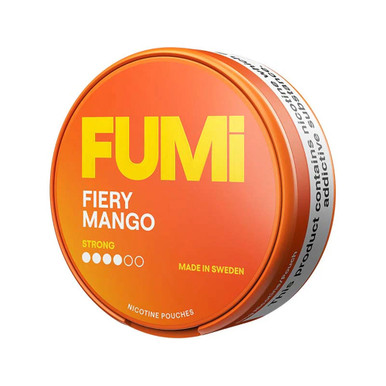
Fumi · 8mg · 10-can pack
Read the full guide
Fumi Fiery Mango Nicotine Pouches
£27.90
✔ In stock — ready to ship
100% tobacco-free
Free over £20
Same-day dispatch
Secure checkout
Fumi Fiery Mango Nicotine Pouches is a ten-can listing at £27.90, held in a single declared strength of 8mg. Our record files the flavour as mango. Stock showed as available when this page was written. One product photograph sits with the listing. That is the whole of what our catalogue holds on this product, and everything below is built from those facts, from comparisons with other cans on our own shelves, and from plain admissions wherever our record has nothing to say.
This is an adult nicotine product. It is sold only to people aged 18 or over who already use nicotine, the full wording sits in its own section near the bottom of this page, and nothing written here is meant to encourage anybody to consume anything at all.
The full guide to Fumi Fiery Mango Nicotine Pouches
5,122 words on how it eats, who it suits, how to serve it and what to put beside it.
The Fumi Fiery Mango listing, stated plainly
Ten cans for £27.90 comes to £2.79 a can. We have done that division ourselves so the listing can be read against single-can products elsewhere on the site; the sum that leaves your account is £27.90 for the box of ten. On the Fumi shelf, which currently carries sixteen listings, that ten-can-for-£27.90 structure is the pattern rather than the exception, so comparing one Fumi listing with another is mostly a question of flavour and declared strength rather than of price.
A word about the name before we go further. Fiery is the manufacturer's own name for this flavour, printed on the lid as part of the product title. It is a label, not a description of temperature, not a description of any sensation, and we are not going to read anything into it beyond the fact that it identifies which mango can you are holding. Fumi uses the same prefix on Fumi Fiery Lime, Fumi Fiery Mint and Fumi Fiery Peach, all four at £27.90 for ten, which tells you it is a range name doing range-name work. The useful information is in the second word — mango, lime, mint, peach — and that is where the differences actually live.
The can in the hand: lid, catch, and what a pocket will take
Most of what a customer notices day to day is not the copy on a website, it is the object itself. Fumi ships this in the standard round pouch can: a low plastic tin, wider than it is tall, roughly the footprint of a large coin and about as deep as a stack of a dozen of them. The lid lifts clear of the body and presses back on. It is the same basic industrial format used by nearly everything on the full shop, which is convenient, because it means a Fumi can and a can from another brand behave the same way in a coat pocket and store the same way in a drawer.
The lid and the catch compartment
The upper section of the lid on cans of this type is a separate chamber, sometimes called the catch, sometimes the disposal compartment, sometimes just the top. It is there so that a used pouch has somewhere to go when a bin is not immediately available. You lift the outer cap, drop the used pouch into the recess, and close it again. The point of it is entirely practical: without it, a person on a train or in a meeting room has to hold a used pouch or wrap it in something.
Two honest notes on that compartment. First, we do not hold a figure for how many used pouches it will take before it is full, and it would vary with how wet the pouches are when they go in, so we are not going to invent a number. Emptying it into a bin at the end of the day is what most people end up doing, and the compartment is best thought of as a temporary holding place rather than long-term storage. Second, the catch is not sealed the way the main body is. If you leave used pouches in there for days it will start to tell, in smell if nothing else. Empty it and the problem disappears.
Disposal itself is straightforward: used pouches go in general waste, in a bin, not down a toilet and not on the pavement. The can body and lid are plastic and should go wherever your local authority tells you plastic of that kind goes — that varies by council, we are not going to guess at yours, and the can itself carries whatever markings the manufacturer has applied.
Portion count, and the number we will not state
The obvious question about any can is how many pouches are inside it. Our catalogue holds the pack structure — ten cans to this listing — but it does not hold a per-can pouch count for Fumi, and we are not going to publish a figure we cannot stand behind. The number is printed on the can itself, and it is the only source worth trusting. If it matters to your buying decision, and for a ten-can order it reasonably might, read it off the tin when the first box arrives and you will know for every future order.
The same applies to pouch weight and to the physical size of the individual portion. Pouch formats across the trade run from slim to regular to large, and the difference is real to anyone who has used both, but our record for this listing does not classify it, so we will not. What we can tell you is that the can is the standard round can, and that nothing about the way it is packed differs from the rest of the sixteen Fumi listings we hold.
What ten cans looks like, and what one can does in a pocket
A single can of this format slides into the front pocket of a pair of jeans, the inside pocket of a jacket, the coin pocket of a bag, or a car door bin. It is small enough to be forgotten and hard enough to survive being sat on, which is more than can be said for most things you might carry. It does not rattle much when full and rattles more when it is half empty, which some people find useful as a rough gauge and others find irritating.
Ten cans is a different proposition. Boxed together they make a block roughly the size of a paperback, and that block has to live somewhere. Most people who buy ten-can boxes keep nine of them in a cupboard, a drawer or a car glovebox and carry one. That is worth thinking about before ordering, because a ten-can box bought on price is also a storage decision, and we cover keeping cans in good condition further down this page.
Where the can sits when it is in use is, in practice, under the upper lip. It is a dry format, it does not require a device, a battery or a charger, and it produces no smoke and no vapour, which is a description of the format and nothing more than that. How long a person keeps one in varies enormously between individuals and we do not hold a figure for this product. Fumi prints whatever guidance it prints on the can. We are not going to publish a duration, because any number we gave would be guesswork dressed up as information.
What is printed on it, and why that matters more than anything we write
The can carries the brand, the product name, the declared figure, a date, and whatever statutory wording the manufacturer is obliged to print. Between that lid and this page, the lid wins every time. We have built this description out of a catalogue record, and a catalogue record is a summary of a product rather than the product itself; if the tin in your hand says something different about a date, a count or a warning, the tin is correct and we would rather you trusted it than trusted us. That is not false modesty, it is how a shop that sells other people's manufactured goods ought to talk about them.
Practically, the first thing worth doing with a new ten-can box is opening one can and reading the whole lid before the box goes in a cupboard. You will learn the pouch count, the date and the printed wording in about fifteen seconds, and you will not have to think about any of it again for as long as you keep buying the same listing.
Mango, described as taste and aroma
Our record files this flavour under one word — mango — and the mango category currently holds sixteen listings, so that word on its own does not narrow things very far. Here is what is actually worth saying about how a mango note behaves in a dry pouch, and about what tells this one apart from its siblings.
Mango is a heavy, resinous fruit note. Where a berry flavour is bright and quick and a citrus flavour is thin and sharp, mango is thick and slow. The sweetness is honeyed rather than sugary, closer to the taste of dried mango slices than to the taste of a boiled sweet, and underneath it there is a faintly piney, almost turpentine edge that is what makes mango recognisable as mango rather than as generic tropical sweetness. The best mango notes in this format keep that resinous edge. The weaker ones sand it off and end up tasting like peach syrup with the label changed.
On opening, the aroma is sweet and slightly jammy, with a green, skin-like sharpness sitting just behind it. It does not carry far across a room the way a strong citrus or a heavy mint can. Lift the lid and you get a short, warm-smelling fruit note; close it and it is gone.
Across the run of the flavour, mango in pouch form tends to arrive sweet, hold a fairly flat plateau, and then thin out into something more like the skin of the fruit than the flesh — a little bitter, a little green. That tail is normal for the flavour family and is not a fault in the can.
Mango against the peach and the lime in the same range
Because three Fumi cans share the Fiery prefix, the honest comparison is between the fruits and not between the names. The peach can, filed on our shelves as tropical rather than as a single-fruit flavour, is the softer and the more floral of the two stone-fruit readings. Peach in this format leans on blossom and nectar; it is powdery at the edges, rounder in the middle, and it finishes shorter and cleaner. Mango is denser, darker in character, and finishes with that green-skin bitterness that peach simply does not have. Put bluntly: if peach is the fruit tinned in syrup, mango is the fruit dried in the sun.
Fumi's lime can, also £27.90 for ten, is the outlier of the three. Lime is rind and acid — thin, sharp, bitter at the top rather than at the tail, and much faster to announce itself. There is no overlap worth speaking of between lime and mango beyond the shared word on the lid. If you have tried the lime and did not get on with it, that tells you very little about how you will find this one.
And the mint in the Fiery run is not a fruit at all, so it sits outside this comparison entirely. It is worth mentioning only because the shared prefix leads people to assume the four cans are variations on one theme. They are not. They are four unrelated flavours under one range name, offered at one price.
What the 8mg on the lid is, and what it is not
This listing is held at a single declared strength: 8mg. That figure is a manufacturer's declaration about the product, printed on the can, and it appears on our listing because Fumi puts it there. It is a number for comparing one can with another can. It is not a serving instruction, it is not a measure of anything you will experience, and we are not going to tell you what strength is right for you — that is not a judgement a shop is in any position to make, and we will not make it on a page you might be reading before buying.
What the figure does allow is shelf arithmetic. Our strength categories exist for exactly this purpose: 8mg puts this can on the medium strength shelf, which currently runs to 135 listings. Cans declared higher than that sit on the strong shelf, and higher again on the extra strong shelf. Those three shelves are how most people navigate the catalogue when they already know roughly where they want to be and are looking for a flavour rather than a figure.
Two caveats that matter more than they look. First, declared figures are not necessarily measured the same way by every manufacturer, so an 8mg from one brand and an 8mg from another are not automatically equivalent, and we cannot reconcile them for you. Second, the number tells you nothing about flavour intensity. A sweet, mild-tasting can and an aggressive, sharp-tasting can can carry the same declared figure. People conflate the two constantly, and it is worth separating them before you order.
Eight milligrams across our shelves: how this can sits among its neighbours
The more useful way to place this listing is against the other cans we actually stock. Not by claim — by price, by flavour family, by pack structure, and by where each one lands on the strength shelves. What follows is that comparison, done honestly, including the places where a neighbour is simply a different proposition rather than a better or worse one.
The other mango cans we carry
Cuba White Mango is the closest flavour neighbour in the catalogue and costs £39.90, which is the top of the range this listing sits in. It is the straighter, plainer reading of the fruit — mango carried on its own without a second note pulling at it. If what you want is mango and nothing else in the can, that one and this one are the two to weigh against each other, and £27.90 against £39.90 is the first thing most people weigh.
Denssi Mango Freeze, also £39.90, pairs the fruit with a mint-family second note, which changes the flavour considerably — the fruit arrives first and the mint takes over the tail, where the Fumi can lets the fruit run all the way through to its own green-skinned finish. Killa Mango Ice at £33.50 does something similar but with a heavier hand on both halves, and it sits up on the extra strong shelf rather than down here on medium. Pablo Exclusive Mango Ice at £3.85 is the single-can option in this flavour family and is the obvious way to try the mango-plus-ice construction for the price of a sandwich before committing to a ten-can box of anything.
Cans at similar money, in other flavours
UBBS Cherry at £19.95 and SYX Apple Kiwi at £29.90 bracket this listing on price from either side. The UBBS is a single-fruit dark berry note, closer in weight to mango than you would expect — cherry and mango share a certain density — while the SYX is a two-fruit construction with a sharp green apple over a softer kiwi. Neither is trying to be a mango can; both are reasonable places to look if you want a fruit flavour at broadly this money and this listing is not it.
On the mint side of the shelf, Edge Spearmint at £14.95 is the cheapest entry point we hold in that family and Klint Arctic Mint at £36.90 is nearer the top. 77 Apple Mint at £39.90 sits between the two worlds with a fruit-and-mint construction. And Nordic Spirit Blueberry at £4.49 is a single can of a plain berry flavour, which is a useful reference point for anyone who wants to know what a can at the low end of our price range looks like next to a ten-can box.
Reading the price column honestly
Price per can is the comparison most people actually want and almost no listing shows. This one works out at £2.79 a can. A £39.90 ten-can listing works out at £3.99. A single can at £3.85 or £4.49 is a single can — you pay less today and more per can. None of that says anything about which product is better; it says what the packs cost, which is the only thing a price column can honestly tell you. Brand pages such as the Pablo shelf and the Cuba shelf are the quickest way to see a whole manufacturer's pricing in one screen if that is how you shop.
Where this can falls in the Fumi range
Fumi keeps sixteen listings with us and they are priced identically at £27.90 for ten, which makes the range unusually easy to read: there is no premium tier and no budget tier, so the only questions are flavour and declared strength. This mango can is one of the single-strength listings, held at 8mg, where several of its siblings carry more than one option.
The fruit side of the range runs from Fumi Blackcurrant, a dark, tart, jammy berry note, through Fumi Chilled Cherry, which puts a cool second note behind a sweet stone fruit, to the two stone-fruit readings already discussed. Fumi Dark Spice is the odd one out and the most interesting can in the range for anyone bored of fruit — warm, aromatic, closer to a spice cabinet than to a fruit bowl, and not remotely sweet in the way the rest of the range is.
If you are working through the brand rather than buying one flavour repeatedly, the sensible order is to treat the range as four groups: berries, stone fruit, citrus, and the mint and spice outliers. This can is the anchor of the stone-fruit group along with the peach.
Keeping something else alongside it
Flavour fatigue is the ordinary reason people keep two cans on the go rather than one. A heavy, sweet, resinous flavour like this one is more prone to it than most, because the palate adapts to sweetness faster than it adapts to sharpness. Nobody needs to do anything about that, but it explains why a second can in a different direction is the most common thing customers pair with a mango box.
The usual pairings, with a reason for each: something mint-family for contrast, which is why the mango listings and the mint shelf get bought together so often; something citrus and sharp, where the Fumi lime at the same £27.90 is the obvious in-brand option; or something dark and unsweet, where the Dark Spice can does a job nothing else in the range does. If you would rather keep the second can cheap, a single at £3.85 or £4.49 costs less than a round of drinks and tells you whether the pairing works before you order ten of anything.
Storage, and keeping a can in usable condition
Pouch cans keep best somewhere cool, dry and dark, with the lid properly closed. A cupboard, a drawer or a shelf away from a window is all that is required. The enemies are heat, direct sunlight and being left open, in that order. A can left on a dashboard in summer or on a radiator shelf will dry out and the flavour will flatten; a can left open overnight will do the same more slowly.
Some people keep cans in the fridge, and that is a matter of preference rather than a requirement. It slows drying out and it changes how the flavour reads when the pouch is cold, which some customers like and others do not. If you do it, keep the can sealed so it does not pick up the smell of everything else in there — a jammy fruit note and last night's curry are a poor combination. We do not hold storage instructions from Fumi for this product beyond what is printed on the can, so the can is the authority if it says something different to this paragraph.
For a ten-can box the practical approach is to open one at a time and leave the rest boxed in a cupboard. Nine unopened cans in a dark drawer will be in the same condition in a few months as they are today. Nine cans opened and scattered around a house, a car and a work bag will not be. Check the date printed on the can when the box arrives so you know what you are working with, and rotate a new box behind the old one rather than in front of it if you buy regularly.
Strength and pack size: what there is to choose between here
On this listing, very little, and it is better to say so than to manufacture a decision. Fumi Fiery Mango is held in one declared strength — 8mg — and one pack structure — ten cans at £27.90. There is no five-can option, no single can, and no second strength. If you want this flavour, that is the pack.
Where there is a real choice is one level up, across the brand and across the shelf. Several Fumi listings do carry more than one declared figure at the same £27.90, so a customer who wants a different number on the lid can stay inside the brand and change flavour, or stay with mango and change brand. Both routes are set out in the comparison sections above. The medium shelf's 135 listings are the widest place to start if the figure is what matters most to you, and the whole catalogue is there if it is not.
What we will not do is tell you which figure to pick. That is a decision for the person buying, who knows their own use and we do not, and any shop that tells you otherwise is guessing.
Ordering, delivery and the age check
Ordering is the same as anything else on the site: the listing goes in the basket at £27.90 for the ten-can box, and you pay at checkout. Stock showed as available when this page was written, but stock moves, so the listing itself is the live answer rather than this paragraph.
Age verification is not optional and not a formality. This is an 18+ product, sold only to adults who already use nicotine. Our checks run at the point of order, and the courier may ask for photographic ID on the doorstep. If nobody of age is there to receive it, the parcel does not get left. That is how it has to work, and it is worth knowing before you choose a delivery address — a workplace reception desk, for instance, is a poor choice for a product that requires the named adult to sign.
Deliveries go out in plain outer packaging. Delivery timings, carriers and any thresholds for postage are set out at checkout and on the site's delivery information, because those change and a product page is the wrong place to pin a figure that will be out of date in a month.
Finding this page again, and what sits around it
This listing appears in three places in the site's own filing. It is on the medium strength listing because of the 8mg declaration, on the brand's own page alongside its fifteen siblings, and on the mango flavour page with the fifteen other mango cans we hold. Those three routes cover most ways a person arrives here.
If you are browsing rather than looking for something specific, the shop index lists everything we carry, and the strength shelves — medium, strong and extra strong — are the fastest way to cut 385 listings down to a workable number. Brand pages such as Cuba's and Pablo's do the same job from the other direction.
Questions we are actually asked about this can
How many pouches are in each can?
We do not hold that figure in our catalogue for this product, so we are not going to publish one. It is printed on the can itself. For a ten-can box, read it off the first tin you open and you will know it for every future order. We would rather admit the gap than put a number on a page that turns out to be wrong for a product we sell by the box.
Is this the same flavour as the Fiery Lime and Fiery Peach?
No. The word Fiery is a range name that Fumi applies across several cans; it identifies the family, not the taste. Mango is heavy, honeyed and resinous with a green edge on the finish. Peach is softer, more floral and finishes shorter. Lime is sharp, rindy and bitter at the top. They are three unrelated flavours sold at one price under one prefix.
Does "Fiery" mean it is hot or spicy?
It is a product name and we do not read it as a description of anything. Our record files this can's flavour as mango and nothing else. We have no information from the manufacturer that the name refers to heat, to any sensation, or to anything other than the branding of the range, and we are not going to invent an explanation for it.
Why is there only one strength?
Because that is what our record holds: one declared figure of 8mg, one pack structure, one price. Some other Fumi listings carry two or three declared figures at the same £27.90. If the number on the lid is the deciding factor for you, those listings and the strength shelves are the places to look rather than this one.
Can I buy a single can instead of ten?
Not on this listing. Fumi Fiery Mango is sold here as a box of ten at £27.90 and there is no single-can option in our catalogue for it. If you want to try a mango-family flavour without committing to ten cans, single cans do exist elsewhere on the site at lower prices, and the mango category page is the quickest way to find them.
How long does a can last once it is opened?
That depends entirely on how often it is used, which varies so much between people that any number we gave would be meaningless. What we can say is that an opened can kept closed, cool and out of sunlight will hold its condition considerably longer than one left open or left somewhere warm. Any date printed on the can is the manufacturer's, and it is the one to go by.
What do I do with a used pouch?
Into the compartment in the lid if there is no bin to hand, and into general waste when there is. Not down a sink or toilet, not out of a car window. Emptying the lid compartment daily rather than weekly is the difference between a can that is pleasant to open and one that is not.
Where is it made?
We do not hold that information and we are not going to guess at it. Our catalogue carries the brand, the flavour, the declared strength, the pack structure and the price. Country of manufacture is not in that record. Whatever the can itself states is the answer, and it will be printed on the packaging when your order arrives.
Is this stronger than a can at the same declared figure from another brand?
We cannot tell you that. Declared figures are manufacturers' own declarations and they are not necessarily arrived at the same way across different companies, so two cans showing the same number are not automatically equivalent. We publish the figure each brand gives us and we do not convert between them, because we would only be making it up.
Which one should I buy?
That is genuinely not ours to answer. We can tell you what each can costs, what flavour family it belongs to, what figure is declared on the lid and how it compares with its neighbours on our shelves, and all of that is above. Which one suits you is a decision for you, and we are not going to dress a recommendation up as information.
Will the flavour be the same in every can of the box?
It should be, within the ordinary variation you get between production batches of anything manufactured. Cans from one box are normally from one batch, and most people who notice a difference notice it between orders rather than within them, and usually after a can has been stored somewhere warm. If a can seems noticeably flatter than the one before it, storage is the first thing to look at before the manufacturer is.
Is the mango flavour sweet or sharp?
Sweet, and on the heavy side of sweet — honeyed and thick rather than bright and sugary — with a green, slightly bitter edge arriving late rather than early. If sharpness is what you are after, a citrus can is the flavour family to look at instead, and the lime in this same range is the nearest one at the same price. Everything in this answer is a description of taste and aroma and nothing else.
Does the price change between strengths?
Not across the Fumi range on our shelves — all sixteen listings sit at £27.90 for ten cans regardless of the declared figure, and this one has only the single 8mg option in any case. That is unusual enough across the wider catalogue to be worth knowing: with most brands, changing the number on the lid does not change what you pay with Fumi, but it can elsewhere.
The legal part, in full
This product is for adults aged 18 or over who already use nicotine. We do not sell it to anybody under 18, and ID may be requested when your order is delivered as well as at the point of purchase.
Nicotine is an addictive substance. That is a plain statement of fact about what is in the can and it applies to every nicotine product on this site, at every declared strength, including this one.
This product is not a licensed stop-smoking medicine and is not licensed as a medicine of any kind. It is not intended for non-smokers, for anyone who does not already use nicotine, for anyone under 18, or for anyone who is pregnant or breastfeeding. We make no health claim of any sort about it, in either direction, and nothing on this page should be read as medical advice. If you have questions about nicotine use and your own circumstances, a healthcare professional is the person to ask — not a shop.
In short
Fumi Fiery Mango is a box of ten cans at £27.90, £2.79 a can, in one declared strength of 8mg, carrying a heavy, honeyed mango note with a green edge on the finish. It sits on our medium strength shelf, in the middle of a sixteen-strong brand range priced flat, and its nearest comparisons are the more expensive mango cans from other brands and the softer peach reading from Fumi itself. If that is the can you want, the listing is above; if it is not, the shelves and brand pages linked throughout this page will get you somewhere better.
More from Fumi
More medium strength pouches
More mango pouches

Where this sits
Fumi Fiery Mango Nicotine Pouches appears in these categories. Browse them, or jump to something close.
You might also like