Killa · 16.5mg
Read the full guide
Killa Mango Ice Nicotine Pouches
£33.50
✔ In stock — ready to ship
100% tobacco-free
Free over £20
Same-day dispatch
Secure checkout
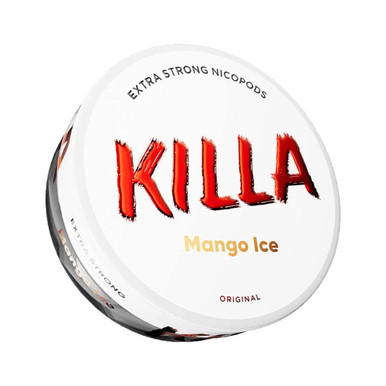
Killa Mango Ice Nicotine Pouches are priced on this catalogue at £33.50. One declared figure appears against the product, 16.5mg, and one variant sits behind the listing at that figure and that price. There is no size option and no second strength. Our data marks the can as in stock as this is written, and we hold one photograph of it.
Everything else on this page is either drawn from those facts, describes the category the product belongs to, or states where our record runs out. It runs out in four places, and each one is flagged at the point it becomes relevant rather than collected into a disclaimer at the bottom.
The full guide to Killa Mango Ice Nicotine Pouches
5,004 words on how it eats, who it suits, how to serve it and what to put beside it.
Killa Mango Ice: the listing and what stands behind it
One preliminary. The brand word on the lid, Killa, is a trade name and nothing else — the word a company has chosen for its tins, in the way every manufacturer in this catalogue has chosen one. It is not a description of the contents, not a specification, and not an instruction. We file it as a brand, which is why the can turns up on the shelf we keep for this maker alongside 30 other listings.
A second preliminary, since the web address for this page raises it: the address contains the words extra strong while our own strength band for the can reads Strong. Those come from two different sources — the address from naming that arrived with the product, the band from our own filing across 385 listings — and where they disagree we would rather explain the discrepancy than tidy it away. Neither affects the printed figure, which is 16.5mg either way.
Mango and Ice: two words on the lid, two tags in our data
Our classification holds mango and mint for this can. Only the first of those corresponds to a word on the product.
Mango puts the can on the mango shelf, a narrow grouping of 16 listings. That one is self-explanatory.
Mint is less so, because the word does not appear on the product at all. The second word in the name is Ice, and our system records cooling constructions under the mint heading because that is where people go looking for them. So the can also appears on the mint shelf, which at 148 listings is the largest flavour grouping we run. The tag is registering a cool element, not a herb, and anyone arriving from a mint search should read it that way. Whether there is an identifiable mint note in the can alongside the cooling is not something our record says, and we are not going to assert it.
What a maker decides when building a note like this
Since we hold no tasting note for this can, the useful thing to write about is the set of decisions that sit behind any fruit-and-cool construction in this format. That is category information, and it is real, where a description of this specific can would be fiction.
Which mango to aim at
Mango is not one flavour. Ripe mango is heavy, dense and almost floral, with a sweetness that sits low and wide. Under-ripe mango is sharper, greener and considerably more acidic — an entirely different experience of the same fruit, and the basis of several well-known preparations. Then there is the mango of drinks and confectionery, which is a convention rather than a fruit: brighter, simpler and more immediately recognisable than either of the real versions.
A maker building a mango note has to pick a target among those, and the choice determines everything downstream. A construction aimed at ripe fruit will read as rounder and softer; one aimed at the convention will read as cleaner and more emphatic. Both are perfectly legitimate and they taste noticeably unlike each other. Our record does not say which this can is, and the name will not tell you.
Making it survive the interval
The second decision is about duration. A pouch releases what it has slowly over a long stretch, which is a harsher test of a flavour than a drink or a sweet imposes. A construction that matched fresh fruit precisely would be gone within a few minutes, leaving most of the interval with nothing in it.
What is built instead is a version with its identifying characteristics pushed forward, so that something recognisable is still present later on. This is why fruit notes in this category often read as more emphatic than the fruit they are named after. Some people find that accurate enough and some find it obviously constructed, and both reactions are reasonable descriptions of the same object.
What the cool element is doing
Cooling is a sensation rather than a taste, and in a pairing like this it works on the fruit rather than beside it. It stretches the note out so it feels longer and thinner. It lowers apparent sweetness without removing any, because cool and sweet compete for the same attention. And it puts a defined edge on the finish where a warm fruit would fade out gradually.
On a heavy fruit like mango, that interaction matters more than it would on a light one. A dense, low, sweet note paired with a cool element is a deliberate contrast — the two halves are pulling in opposite directions, which is the point of the pairing. How far it is pushed here is not something we know.
Where aroma carries the weight
Static formats favour flavours with a strong aromatic component, because aroma travels upward on its own without needing heat or movement to release it. Mango has an unusually pronounced aromatic top end, which is probably why it appears as often as it does in this category despite being a narrow shelf on our site.
The corollary is that mango's aromatic character is usually the first thing to fade, since top notes go before base notes do. In a fruit-and-ice pairing that produces a familiar arc: recognisable fruit early, and mostly cool later. That is a property of the construction rather than a fault in a can.
Why two cans of the same flavour are not the same flavour
Every point above is a decision, and different manufacturers decide differently. That is why two cans both labelled with the same fruit and the same cooling word can be quite unlike each other, and why moving between houses is often a bigger change than moving between flavours inside one house. It is also why comparing a flavour name across brands tells you very little.
The line this section stops at
Everything above describes decisions and conventions in the category. None of it describes what is inside this particular can, because we hold no manufacturer note and we do not write tasting notes in-house. We are not going to tell you how this one tastes. A confident description invented by a retailer reads exactly like an accurate one and is worth nothing.
The pouch, the can and the lid
A pouch is a small soft sachet with a fabric-like outer, placed between the lip and the gum and left there. Not chewed, not swallowed, used one at a time. That is the whole mechanic and it has not changed.
Portion sizes go by a loose vocabulary — slim portions long and flat along the gum line, minis shorter and thicker, standard portions between them. The difference determines where the bulk sits rather than how much there is. We hold no format designation for this listing, which is the first place our record stops, and the can states it plainly.
The can is a squat cylinder about the footprint of a large coin. Its lid ordinarily contains a shallow second chamber, separated from the fresh pouches underneath, and that chamber takes finished pouches. Empty it into a household bin. Not a sink, not a lavatory, not a drain, not a window. The chamber exists so that correct disposal is the easy option rather than the inconvenient one.
Duration is personal and no figure is published here. People stop when the flavour has gone; the pouch then comes out by hand and goes in the lid until a bin appears.
Carrying one, and whose rules apply where
This is the longest section on the page, and it is about setting rather than product. It is also the section where a retailer has to be most careful about the difference between describing something and giving permission for it.
What the format is like to have on you
Physically, it is one object. A can goes in a pocket without shaping the fabric around it, and it goes in the small compartment of a bag without needing to be found again. There is nothing to charge, nothing to refill, no liquid, no spare parts and no second item that has to travel with it. When the can is empty the whole thing is over.
That is a description of a format, not an argument for using it. The practical consequence worth noting is the one covered earlier: a format with no accessories is also a format where the can is everything, so a can left at home is simply a can you do not have.
Venues set their own rules
Pubs, restaurants, cinemas, gyms, sports grounds, hospitals, schools and private premises of every kind set their own policies about what may be used on site. Those policies are theirs. They vary between one venue and the next, they change, and they are frequently not written down anywhere a customer can find in advance.
We are not going to tell you where this product may or may not be used. We are a shop, we are not the operator of anywhere, and a retailer implying permission it cannot grant would be doing something genuinely unhelpful. If a venue's position matters to you, the venue is the only source that can answer it.
Employers set their own rules
The same applies at work, with an additional wrinkle: workplace policy is often specific, often written into a staff handbook nobody reads until it matters, and sometimes differs between sites of the same organisation. Some employers address this product category explicitly and some do not address it at all, which is its own kind of answer.
Your employer's policy is the authority on your employer's premises. Nothing on a product page overrides it, nothing on a product page has visibility of it, and we would not attempt to characterise what any employer allows.
Transport operators set their own rules
Airlines, rail operators, coach companies and ferry services each publish conditions of carriage, and those conditions cover what may be carried and what may be used on board — two separate questions that people often merge. Airlines in particular distinguish between hold baggage and cabin baggage, and between carrying something and using it during a flight.
Those conditions are published by the operators and we do not reproduce them, because they change and because getting one wrong on a product page would be worse than saying nothing. The operator's own current terms are the reference.
Crossing a border
Different countries regulate this product category very differently. Some permit sale, some restrict it, some prohibit it outright, and personal import allowances vary independently of all that. A product bought legally here is not automatically a product you may carry into somewhere else.
We sell within the UK and we do not publish guidance on other jurisdictions, because the accurate answer changes by destination and by date. Anyone travelling should check the position for where they are going, with a source that is current for that country. This paragraph is not that source and is not pretending to be.
Disposal away from home
The one point in this section where we will be direct. A used pouch goes in a bin. The lid chamber holds it until a bin is available, and the interval it covers is exactly the interval where the wrong options are tempting. Not on the ground, not in a plant pot, not down a drain, not out of a vehicle. This is litter like any other litter and the can is built to make it avoidable.
Shared and domestic spaces
Households are their own jurisdiction, and the rule there is set by whoever lives in the house. Where the practical question comes up most often is not use but storage: a can left on a coffee table, a kitchen worktop or a bedside shelf in a home with children in it is a storage decision with an obvious right answer. A drawer that shuts, or a shelf that is genuinely out of reach, costs nothing and settles it.
The same applies to shared cars and shared desks. A can that lives in a glovebox in a family car is a can that a child can reach, and the fact that it happens to be closed is not the point. This is the one part of this whole section where we do have a firm view, because it is about keeping the product away from people it is not for rather than about where anyone may use it.
What none of this amounts to
Nothing in this section is a statement about where using the product is acceptable. It is a list of the people who are entitled to decide that, none of whom are us. The reason it belongs on the page is that it is the part of owning the format that generates real questions, and answering them with "ask the venue" is more useful than pretending we know.
16.5mg, as a figure on packaging
The declared figure is 16.5mg, copied here exactly as our record holds it. It is a specification the manufacturer publishes and prints. It attaches to the can. It is not a grade, not a score, not a measure of anything about the person buying it.
We sort listings into three bands to make browsing possible. This one goes into the Strong band, which holds 132 listings, with the Medium band beneath it and the Extra Strong band above. Those names are ordered by the size of the figures inside them and mean nothing beyond that. A can in the top drawer is not better, more desirable or more worth owning than one in the bottom drawer.
The bands are not a route and we would ask that they are not read as one. There is nothing here to progress along, nothing to work up towards, and no sense in which a larger number is an accomplishment. Where the figure is not the axis you care about, the whole catalogue with no strength filter is a better place to begin, because flavour and brand are how most people actually navigate.
Figures do not convert between makers, either. Every company reaches its declared number its own way, so two similar numbers from two houses do not make two similar products. Inside one brand the comparison is firmer, and each Killa listing carries its own figure on its own page.
We cannot advise which strength suits any individual, and we will not attempt it. That is our honest position rather than a formality. We run a catalogue and a stock system; we have no knowledge of who is reading; and the question belongs with someone qualified to answer it, not with a retailer.
The brand's shelf as we hold it
Thirty-one listings carry this brand and every one is priced at £33.50. A range priced flat is unusual and it has a straightforward effect: inside this brand, changing can costs nothing either way, so the decision is entirely about flavour.
Among the fruit cans, Killa Banana Ice is the closest structural relative to this one — another heavy, low, sweet fruit paired with a declared cooling element, built on the same contrast. Killa Blueberry at £33.50 is a darker berry with skin character and no cooling word in its name. Killa Apple at the same price is orchard fruit, crisper and more acidic than anything in the tropical family.
Away from fruit the range widens sharply. Killa Bubblegum is the brand's most openly confectionery name on our shelves. Killa Cola carries a spiced, slightly bitter edge that no fruit listing in the range has. Killa Cappuccino is the only coffee-family can we hold from this maker and sits at the opposite end of the catalogue from a cooled tropical fruit.
Each of those has its own declared figure on its own page, and we do not restate another listing's label from here.
What sits near this can on our shelves
Because the can is tagged in two families, there are two directions worth looking in.
Keeping the fruit: Pablo Exclusive Mango Ice at £3.85 is the direct counterpart from another house — same fruit, same cooling word, very different listed price, which almost certainly reflects a difference in what each listing contains rather than anything else. 77 Ghost Mini Mango at £39.90 names a mini format explicitly, so it changes the portion as well as the maker, which makes it a two-variable comparison rather than a one-variable one.
Going towards the cool end and dropping the fruit entirely, the mint shelf holds the alternatives. Clew Cool Mint and Denssi Cold Mint at £39.90 each are cool-forward by name. Cuba Ninja Ice Cool at the same price is a third. Klint Avalanche Mint at £36.90 and Elf Bar Cool Storm at £29.90 both name themselves in the same register. Fumi Fiery Mint at £27.90 is the exception, pairing a warm word with a cool one, which describes a genuinely different construction rather than a variant of the others.
At the lower end of our pricing, Edge Mint at £14.95 is the plainest mint name we list and Nordic Spirit Max Frosty Mint at £4.49 is the cheapest can named in this section by a considerable distance. As always, price comparisons across listings are only meaningful where the quantities behind them are known, and on several of ours — including this one — they are not.
If you would rather browse than follow a list, the Pablo range and the Cuba shelf are two of the wider brand groupings we run.
Keeping the can in reasonable condition
Lid on. It is the simplest instruction on the page and it prevents most of what goes wrong, and it needs stating because the damage is quiet — a can left open overnight looks unchanged and simply holds less flavour than it did.
Heat does the same thing over a longer period. A dashboard in summer, a windowsill in direct sun, a bag next to a radiator: none ruins a can on the first day, but repeated warming and cooling pulls moisture out over a week or two, and moisture is where the flavour lives in a dry format. A drawer or a cupboard away from any heat source is entirely sufficient. Stability and shade are the requirement, not cold.
Refrigerating cans is a habit some people keep in warm weather. We hold no manufacturer statement that it is intended here, so it is reported as a practice rather than recommended as one, and any instruction printed on the can overrides this page without exception.
A can that has dried out will not recover. Pouches feel firmer, flavour is shorter, and the only useful response is to store the next one better. On dates, cans carry manufacturer markings and those are the reference — our catalogue holds no date information at listing level, so we cannot say how long a particular can has left.
The most important point in this section is not about flavour at all: keep cans out of reach of children and away from anyone the product is not meant for. The lid chamber is part of that. Empty it into a bin rather than leaving used pouches sitting in a can that gets put down around a house.
What there is to choose on this listing
One figure at 16.5mg, one price at £33.50, one variant. Nothing to select.
That removes the usual adjustment. Where a listing has several variants you can keep the flavour and move between figures; here the only change available is to a different product, which means the strength bands. We will not point a direction along them.
Pack count and portion count are both missing from our record. Those are the third and fourth gaps on this page and between them they block the comparison people most want: we cannot tell you whether £33.50 covers one can or several, and we cannot tell you how many pouches a can holds, so no per-can or per-pouch figure can be produced here. We are not going to reconstruct either from a neighbouring listing. The product listing and the basket at checkout are where the quantity becomes visible.
Ordering, delivery and the age check
The price is £33.50. Ordering runs the ordinary way: basket, review, checkout. Delivery options, costs and timescales appear at checkout, since they depend on the order and the address and any figure printed here would be wrong for somebody.
This is an age-restricted product. Sales are to adults aged 18 or over. Checks may be applied at the point of order and ID may be requested on delivery before a parcel is handed over. A courier declining to release a parcel where age cannot be established is the process working rather than failing. Orders placed on behalf of anyone under 18 are not something we will knowingly supply.
On availability, our record shows this as in stock at the time of writing, but a page prepared in advance is not a live feed. The listing is the current position, and a single-variant product has no alternative size to drop back to.
Where this page sits on the site
Four shelves hold this can. The brand shelf gathers the rest of the maker's range. The Strong band gathers everything filed into the same strength drawer, 132 listings deep. The mango shelf is narrow at 16, and the mint shelf is the widest flavour grouping on the site at 148 — this can appears on both, for the reason given near the top of this page.
Above all of those sits the full catalogue, which is the sensible starting point when you do not yet know which axis you want. Every brand shelf on the site behaves like this one's, so once the pattern is clear the whole catalogue is reachable from any product page.
Questions we are asked about this one
Why is a mango product on the mint shelf?
Because our classification files cooling constructions under mint, and the second word of the name is Ice. The tag records a cool element rather than a herb, which is why the can sits on both the mango and mint shelves. It is a filing convention. If you arrived from a mint search expecting spearmint or peppermint, this is not that, though the mint shelf holds a great many listings that are.
Why does the address say extra strong when your band says Strong?
The address carries naming that arrived with the product; the band is our own filing decision applied across the catalogue. They came from different places and they do not always line up. We would rather explain that than quietly change one to match the other. Neither affects the declared figure, which is 16.5mg regardless of which words sit around it.
What kind of mango is it?
We do not know and will not guess. Mango constructions in this category aim at different targets — ripe fruit, under-ripe fruit, or the brighter convention used in drinks and confectionery — and those taste materially different from one another. Our record holds the flavour tag and nothing more. The can is the only thing that will settle which direction this one has gone in, and we would rather say that than write a description we cannot stand behind.
How strong is the cooling?
Not something we hold. Cooling varies widely across the category, from a faint edge to a very pronounced one, and names do not indicate it reliably — a can saying Ice may be gentler than one saying nothing. We publish the flavour tag and the name, neither of which measures intensity. There is no figure for cooling in the way there is a figure for strength, so there is nothing for us to reproduce even in principle.
How many pouches in a can?
Not in our record. We will not estimate it from the price or from a similar listing, because a confident guess is worse than an admitted gap. Cans in this format normally print a portion count on the label and that printed number is the reliable one. If the count is part of your decision, check the listing or the can before ordering rather than relying on a figure we have not published.
Does £33.50 buy one can?
We cannot tell you. The pack count field is empty for this listing and prices in that region on this site cover both single cans and multiples depending on the product. That is a genuine gap in our data rather than an evasion. The basket at checkout displays exactly what quantity is being purchased, and that is the right place to confirm before paying.
Can I use this at work or on a flight?
That is not ours to answer. Employers set policy on their own premises and transport operators set their own conditions of carriage, and both vary and change. We would be overstepping badly by implying permission we have no ability to grant. Your employer's handbook and the operator's current published terms are the sources, and they are the only ones that will be right for your situation.
Can I take it abroad?
Depends entirely on the destination, and we do not publish guidance on other jurisdictions. Countries regulate this product category very differently and personal import rules vary on top of that, so an answer that was accurate for one destination would be wrong for another. Anyone travelling should check the current position for where they are going with a source specific to that country.
What does 16.5mg tell me?
It is the figure the manufacturer declares for this product, printed on the label and reproduced on our listing. That is the whole of it. We do not interpret the number, we do not convert it into an expectation, and we do not set it against other makers' figures, because companies arrive at their declared numbers by different methods and the numbers are not a shared unit across brands.
Is that high?
Our catalogue files it in the upper of three bands, which is a statement about our shelving and not about the product or about any person. Bands exist to make 385 listings browsable. We cannot advise which strength suits anyone, and a shop attempting that would be well outside its competence. A question about your own use belongs with someone qualified to answer it.
What is the chamber in the lid for?
Finished pouches. Most cans in this format have a shallow compartment built into the lid, separate from the fresh pouches below, and its job is to hold used ones until a bin turns up. Empty it into a household bin rather than into plumbing. It is a minor feature that does a great deal of work, since a used pouch away from home otherwise has nowhere appropriate to go.
Is the mini format in the 77 listing better than a standard portion?
Neither is better; they are different shapes. A mini is shorter and thicker and occupies less width along the gum line, while a slim portion is longer and flatter and a standard sits between the two. Which suits a given person is a matter of where they prefer the bulk to sit, and people generally know after trying both. We flag it here only because the 77 listing names its format explicitly and this listing does not, which makes that comparison a two-variable one.
Why do your prices for the same flavour vary so much?
Mostly because the listings are not selling the same amount of product as each other, though we cannot demonstrate that on this page because the pack count is one of the fields we do not hold for this listing. Brand, format and quantity all move a price, and a figure quoted without knowing what it covers is not really comparable to another figure. The basket resolves it for any individual order. Until then, the prices are honestly stated and only loosely comparable.
Where is it produced?
We hold no origin or manufacturing information for this listing and we are not going to infer any from the brand name or the packaging. Anything you read elsewhere assigning an origin on the basis of how the can is named is reading in something that is not there. The can and the manufacturer are the only reliable sources, and an unanswered question is better than a fabricated answer.
Legal and compliance for this listing
Sold only to adults aged 18 or over who already use nicotine. We do not sell to anyone under 18, and we will not knowingly supply an order placed for someone under 18. Age checks may be applied at the point of order, and ID may be requested on delivery before a parcel is released.
Nicotine is an addictive substance.
This product is not a licensed stop-smoking medicine and makes no medicinal claim of any kind. It is not intended for non-smokers, for anyone who does not already use nicotine, for under-18s, or for anyone who is pregnant or breastfeeding. Nothing on this page is medical advice, and nothing on it suggests that anyone should use nicotine or choose any particular declared figure. Questions about your own use belong with a qualified healthcare professional and not with a shop.
Keep out of reach of children and away from animals.
In summary
Killa Mango Ice is a one-variant listing at £33.50 with a declared figure of 16.5mg, tagged under mango and mint, and filed on the Strong band whatever the web address says. We hold no tasting note, no cooling measure, no format designation, no portion count and no pack count for it, and each of those blanks is stated on this page rather than filled with something plausible. Where the product may be used is decided by venues, employers and operators rather than by us. The rest is printed on the can.
More from Killa

More strong pouches
More mint pouches
Where this sits
Killa Mango Ice Nicotine Pouches appears in these categories. Browse them, or jump to something close.
You might also like