Killa · 16.5mg
Read the full guide
Killa Banana Ice Nicotine Pouches
£33.50
✔ In stock — ready to ship
100% tobacco-free
Free over £20
Same-day dispatch
Secure checkout
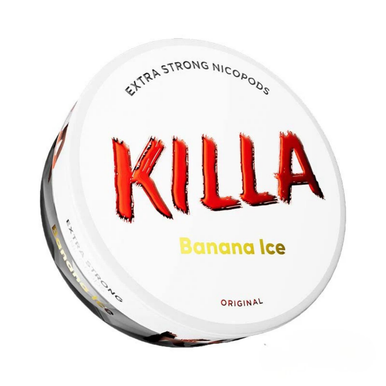
The product on this page is Killa Banana Ice Nicotine Pouches. The brand is Killa and the product name as we hold it is Banana Ice. Our listed price is £33.50. One strength is declared, 16.5mg, and because there is only one, the top and bottom of the range we record are the same number. The listing is marked in stock as this is written, it carries a single product image, and the flavour tags filed against it are mint and tropical.
That is the whole of it. Name, brand, price, one declared figure, stock state, one image, two flavour tags. Our product record does not hold anything else, and this page is written under that constraint rather than around it. What follows is a description of the physical thing, a comparison with other cans on the same shelves, and — several times over — a plain statement that we do not know something. If you reach a question below and find us saying we cannot answer it, that is not evasion. It is the shape of an honest product page for a product we did not manufacture.
The full guide to Killa Banana Ice Nicotine Pouches
4,980 words on how it eats, who it suits, how to serve it and what to put beside it.
What is on this listing: Killa Banana Ice
A word about the naming before anything else. The address of this page carries the words extra strong. That phrase is part of how the product line is named and filed; it is not a description we are offering and not a claim about anything. Our own shelving puts this can on the Strong shelf with 132 others, which uses a different word again. We are not going to resolve the discrepancy by picking whichever label sounds better. Both are reported here, and the packaging in your hand is the final word on how the manufacturer describes its own product.
This is an adult nicotine product, listed and sold to people aged 18 or over who already use nicotine. The complete compliance wording has its own section at the bottom of the page.
Banana Ice: the name, the taste and the aroma
Two words, two halves, and they pull in different directions — which is the point of the name.
Banana as a flavour is one of the more polarising words in any catalogue, because it splits cleanly into two families. There is the fresh version, which is soft, creamy, mild and a little green at the edges, the flavour of actual fruit and fairly restrained on sweetness. And there is the confectionery version, which is the one most people picture when they see the word on a package: rounder, brighter, sweeter, with that distinct sugared character that reads as banana sweet rather than banana fruit. The two taste noticeably different from one another, and the single word gives you no way of telling which a given product aimed at.
The second half of the name, Ice, is used across this category to signal a cooling character laid over the top of whatever the base flavour is. It generally reads as a cool, brisk edge rather than as a flavour of its own — something that sits alongside the fruit rather than replacing it, most obviously on the first minute or so and on the exhale of breath afterwards.
Where this particular can lands within all that is not something we can tell you. We hold the name; we do not hold a manufacturer's tasting note, and inventing one would be the easiest paragraph on this page to write and the least defensible. On aroma, the same applies. A closed tin concentrates whatever flavouring is inside it, so opening any can gives a stronger impression than a single pouch held in the hand does. Whether this one opens sweet or opens cool is a thing you find out by opening it.
Reading the two flavour tags
Our record files this can under mint and tropical. Neither word appears in the product name, so it is worth explaining how to read that.
The most plausible reading is that the tropical tag follows banana and the mint tag follows Ice, since cooling-named products are commonly grouped with mints in a catalogue like ours. That is a reasonable inference and we are flagging it as an inference rather than presenting it as fact, because we did not apply the tags and cannot confirm the reasoning behind them. What is certain is the practical effect: this can appears on our Mint shelf among 148 products, and also within the Tropical grouping of 58. If you were browsing mints and found a banana-named can in the list, that is the explanation. If you are shopping by tag, treat our tags as a coarse sorting tool rather than a precise account of what a can tastes like.
16.5mg on the lid, and what a milligram figure does not tell you
The declared figure for this product is 16.5mg. It is worth going slowly here, because this is the number people lean on hardest when choosing between cans and it carries less information than it appears to.
What the figure is
It is what the manufacturer prints, per pouch, reproduced by us exactly as given. That is the entire scope of it. It is a label fact — the same category of information as the flavour name or the brand mark. We copy it across from the product data because an accurate number is useful; we do not calculate it, verify it or adjust it.
What the figure lets you do
Compare two cans on one narrow axis: the numbers printed on them. If one lid says a larger number than another, the larger number is on that lid. That is genuinely useful when you have two listings open and you want to know how they differ on paper, and it is why we sort shelves by declared figures at all.
What the figure does not do
Several things, and each of them matters more than the comparison above.
It does not tell you how any person will find the can, because that depends on the person, and we have no information about the person. It does not make two cans equivalent just because the numbers match, since format, pouch size and flavour all differ independently of the figure. It does not necessarily give a like-for-like comparison across brands, because manufacturers are not obliged to present the figure on an identical basis, and we publish what each one publishes rather than normalising them into a common scale we would have to invent.
And it is not a ranking. A can with a larger number is not a better can, a more advanced can, or a can that anyone should be aiming at. There is no sequence to work through in this catalogue, no level to reach and nothing demonstrated by picking one figure over another. We arrange shelves by declared number because sorting a few hundred products needs some neutral order, and a printed figure is the most neutral one available. The order of the shelves is not an order of merit and should not be read as one.
The plainest way to put the whole section: we cannot advise which strength suits anyone. Not you, not somebody you are buying for, not in general. Every softer version of that question — what most people go for, what is a sensible place to begin, what to move to — is the same question and gets the same answer. A shop is not in a position to give it, and we would rather say so directly than imply an answer through the way we arrange a page.
For orientation only, the shelves that sort by these numbers are the Medium Strength shelf, the Strong grouping this can belongs to, and the Extra Strong shelf. They are filters. They are not advice and not a progression.
The half milligram
One small thing about the number itself, since it invites a question. Most declared figures in this catalogue are whole numbers, and this one is not: 16.5mg, with a decimal place. People occasionally read a figure like that as unusually precise, as though it were the result of a finer measurement than a round number represents. It is not, and we have no basis for saying it is. It is simply what this manufacturer has chosen to print on this can, in the same way another has chosen to print a round figure on another can, and we reproduce it exactly rather than rounding it to something tidier.
The only practical consequence is a filing one. A figure sitting between two round numbers still has to land in one shelf band or another, and this one lands in Strong. Somebody scanning a strength shelf for round numbers may read past it, which is the whole of the difference the decimal point makes.
The can, the pouch, and what using one is actually like
The tin is a shallow round container, broader than it is deep, with a lid that lifts clear and presses back down. The lid face carries the brand, the flavour name and the figure, which earns its place the moment you have several cans in the same drawer and are reading the tops rather than picking each one up to check. Inside, the pouches are arranged in a ring around the base of the tin, sitting flat.
An individual pouch is a small soft rectangle with rounded corners, light enough to lose track of in a closed hand. Our record does not state how many are in a tin. We are not going to estimate that from the price or from other products, because the count is printed on the can and a guess from us would only be a guess. The same goes for the tin's dimensions and the weight of a pouch: if it is on the packaging and not in our data, read the packaging.
Where it goes and how it feels
A pouch sits under the upper lip and stays there. Most people notice a slight sense of bulk when a fresh one goes in and then stop noticing it within a minute or two as the pouch settles into the shape of the space. From that point it is unremarkable to hold in place. Talking is unaffected. Most people drink with one in without difficulty. Eating with one in is down to preference — some do, some take it out first, and the ones who take it out generally say it is about tasting the food rather than any problem with the pouch itself.
Position varies. Some people keep a pouch central, some tuck it round to one side, plenty shift it about while it is in. There is no correct placement and no reason to invent one. A pouch that has been moved once tends to sit more settled in its second position than its first, simply because it has flattened a little by then.
How long people keep one in
This varies so widely between individuals that a single stated figure would be misleading, so we will not give one. The honest summary is that it is neither instantaneous nor open-ended. Some people treat a pouch as a short thing measured in a few minutes. Others keep one in considerably longer and open a tin only a couple of times a day. Both patterns are entirely ordinary. If you already use this format, your existing habit is a far better guide than anything we could print, and changing the name on the tin does not change the habit.
The catch lid and getting rid of a used pouch
The underside of the lid is hollow: a shallow well with a lip. That is the catch compartment, and it exists for the practical problem of what to do with a used pouch when you are on a bus, in someone's kitchen or halfway through a walk. The used pouch goes into the well, the lid presses back on, and it stays contained until you reach a bin.
It is a holding place, not a bin. It fills up, and once it is full the lid stops seating cleanly, which is both annoying and bad for the can. It also sits directly above the unused pouches, so leaving used ones in there for days affects how the tin smells next time you open it. Empty it when you pass a bin and the tin keeps working as designed. Used pouches go in general waste — not down a toilet, not down a sink, not on the ground.
Keeping a can in good condition: moisture, heat and time
This is the part of owning pouches that people work out by getting it wrong once, so it is worth setting out properly. A can of pouches is a small sealed environment, and almost everything that goes wrong with one comes down to that environment being opened too often, left open, or left somewhere warm.
Dry and moist, as a matter of feel
Pouches in this category are not all the same to the touch. Some lines are noticeably dry — you can handle them with clean fingers and leave nothing behind. Others feel damper, and a can of them opens with a different impression entirely. This is a straightforward physical difference between products rather than a measure of anything, and we are describing it here only because it determines how a can behaves over the weeks you own it.
A drier pouch is generally less affected by being handled and less prone to the slow change that comes with an open lid, though it is not immune to it. A damper one holds its character better while sealed but has more to lose when it is not. In both cases the direction of travel over time is the same — towards drier and towards less flavour — and it is a one-way trip. Nothing brings a dried-out can back. Nobody should be adding water to one, which people do occasionally ask about and which is not something we recommend or would want to see attempted.
The lid is the whole of the maintenance
Ninety per cent of keeping a can in good order is closing it properly, every time, straight away. Not resting the lid on top. Not leaving it half-seated in a bag where it will be knocked. Press it down until it seats and the can looks after itself.
The failure mode people describe most often is a tin left open on a desk or a worktop for an evening. It does not ruin a can outright, but it starts the drying process early and the flavour is the first thing to go. Repeat that a few times over a week and the difference between that can and a freshly opened one is easy to notice.
Heat and light
Warm places are hard on flavourings. The list of places that go wrong is short and predictable: a car dashboard in summer, a parked car generally, a windowsill in direct sun, the top of a radiator, a bag left in a sunny room, and a coat pocket that spends the day next to a heater. A drawer, a cupboard, a bedside table or an inside bag pocket are all better and none of them require any thought.
Cold is less of a problem than heat, and some people keep tins in a fridge. We have no instruction to give either way, because storage guidance is the manufacturer's to give and not ours to invent, and our record holds no storage information for this product. The one practical point we will offer is about consistency: repeatedly moving a can between a cold fridge and a warm room is more disruptive than picking one place and leaving it there.
Time, dates and what we do not know
If there is a date marking on the can, it is printed on the can. Our record carries no dates, no shelf-life figure and no manufacturing information, and we are not going to estimate any of those. Anyone offering you a confident number for how long a tin lasts unopened is telling you something they do not know.
A few small habits worth the effort. Store tins upright so the pouches stay in their ring rather than bunching to one side, which makes opening tidier. Keep the catch well empty. Open the can you are working through and leave the sealed ones sealed rather than opening several at once for variety — a sealed can loses nothing, an open one does. And keep cans where children and animals cannot reach them, which is both a storage point and a legal one.
This can within the Killa range we stock
We carry 31 products under this brand, collected on the Killa shelf. Banana Ice sits in a group of flavour-named cans that share its exact price of £33.50, which means price does not separate them and the name on the lid is the only practical difference from where we stand.
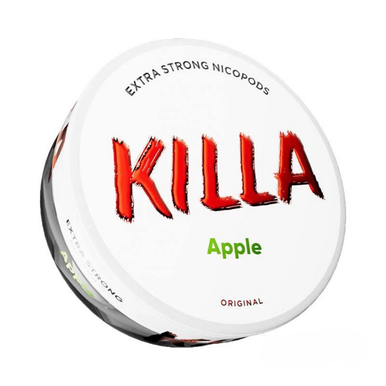
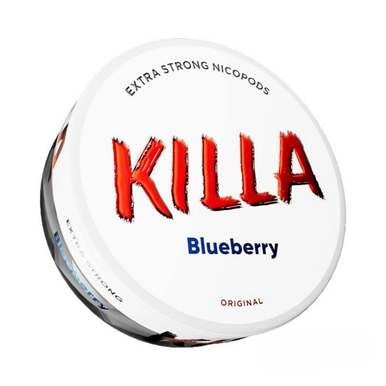
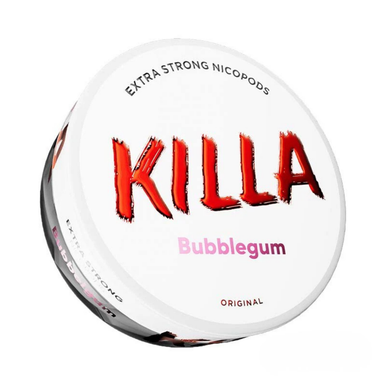
Its immediate neighbours in that group are Killa Apple, Killa Blueberry, Killa Bubblegum, Killa Cappuccino and Killa Cola, each listed at £33.50. Of those, Cappuccino is the one furthest from this can on flavour naming, being a coffee word rather than a fruit or sweet one, and Cola is the only listing in the group named after a soft drink. Killa Cold Mint, also £33.50, is the straightforwardly mint-named option — worth knowing about specifically because this can carries a mint tag without a mint word in its name, and Cold Mint is what the brand's actual mint listing looks like.
We are not ranking these. Same brand, same price, different names — which one somebody reaches for is about what they want to taste, and that is not a thing a shop can work out on a customer's behalf.
What else people put in the basket
Ordering more than one flavour at a time is common and the reason usually given is simple: the same taste repeatedly gets monotonous. Here is the surrounding stock with an actual reason attached to each, rather than a bare list.
Because this can carries a mint tag, the mint-named neighbours are the natural comparisons. Clew Cool Mint and Denssi Cold Mint are both listed at £39.90, Klint Avalanche Mint at £36.90, Fumi Fiery Mint at £27.90 and Edge Mint at £14.95 — five mint-named cans at five distinctly different listed prices, which tells you something about how little the flavour word alone determines a price. Elf Bar Cool Storm at £29.90 sits in the same cooling-named territory without using the word mint at all, and Nordic Spirit Max Frosty Mint at £4.49 is the lowest listed figure among all of this can's neighbours.
On the fruit side, Cuba White Apple Juice at £39.90 is a single-fruit name from a different brand, 77 Apple Mint at £39.90 pairs a fruit with a mint in one name much as this can pairs a fruit with a cooling word, and Pablo Gold Edition Blueberry Peach Ice at £19.95 stacks two fruits and an Ice element into a single product name.
One caution before you read that spread of prices as a value ranking. It is not one, and the reason is in the next section.
What our price does and does not tell you
The field in our record for the number of cans per pack is empty on this product. That is a real gap and it changes how the £33.50 should be read.
Without a cans-per-pack figure we cannot tell you whether that price covers one tin or several. We are not going to work it out backwards from the price, because inferring a quantity from a number is exactly the sort of invention this page is written to avoid. The same gap appears on other listings, which is why the range of prices across this can's neighbours — from £4.49 up to £39.90 — is not a like-for-like ladder and should not be treated as one. Two listings may simply be selling different quantities of a broadly similar thing.
The practical instruction is dull and reliable: check the quantity stated on the listing and on the packaging before comparing prices across brands. A price is only a comparison once you know what it buys.
Choosing, within what this page offers
There is very little to choose here and pretending otherwise would waste your time. The listing has one variant: 16.5mg at £33.50. No second figure, no alternative pack size, no dropdown. The only real decisions are whether to buy this can and how many.
Comparing across products, the method is the same each time and none of the steps involve us telling you what to pick. Read the declared figure on each listing as label information. Check whether either listing states a quantity, since a price without one is not comparable. Read the flavour naming as a name rather than a specification. Then decide, because that last step is yours.
Ordering, delivery and the age check
The purchase itself is unremarkable: the can goes in the basket at the listed price and the order is dispatched in the ordinary way. Our record shows this product in stock at the time of writing, though stock is live and can change between this page being written and an order being placed. The live listing is always the accurate one.
Age verification is the part worth reading properly. This is an 18+ product sold to adults who already use nicotine. Checks apply when the order is placed, and ID may be requested on delivery. A courier can decline to hand the parcel over if it is not produced, and the parcel goes back. That is how an age-restricted product is meant to move through a delivery network — a check that cannot fail is not a check.
The practical consequences: keep ID to hand if a delivery is due, do not arrange for the parcel to be left in a porch, with a neighbour or in a safe place, since nobody can be checked in any of those situations, and do not order on behalf of anybody under 18.
Routes back to this page
Four shelves carry this can, which is more than most listings have. The strength grouping holds 132 products, the brand grouping 31, the mint grouping 148 and the tropical grouping 58. Any of them leads back here, and which is useful depends on how you shop — by brand, by declared number, or by flavour word.
Two flavour shelves, one can
The two flavour tags are worth a paragraph of their own, because a listing appearing on two flavour shelves is the exception rather than the rule here and it changes how the can behaves in the catalogue.
Our record holds both mint and tropical against this product, so it turns up in the hundred and forty-eight mint entries and again in the fifty-eight filed as tropical. Neither placement is more correct than the other. The name on the lid pairs a fruit word with a cooling word, and our tagging has simply followed both halves rather than choosing one and discarding the information in the other.
Two practical consequences follow. The first is that a shelf count is not a count of distinct flavours — some of the hundred and forty-eight on the mint shelf are cans like this one, where mint is half the description rather than the whole of it, so a shelf that looks single-minded from its title is broader in practice than the title suggests. The second is that if you have this can in mind and cannot find it, you have two routes to it rather than one, and the tropical shelf is the shorter of the two by a wide margin. Adding the Strong band and its 132 entries as a second filter narrows either of them further, since a can has to satisfy both conditions to survive the cut.
Above all four, the full catalogue is a single page, with the brand shelves branching off it. Two of the larger brand collections to browse are the Pablo shelf and the Cuba shelf, either of which is a reasonable place to go next if this brand is not the one you are after. There is no intended path through the site.
Questions we can answer, and a few we cannot
Does Banana Ice taste of mint?
We cannot tell you. Our record holds the product name and two flavour tags, not a tasting note. The Ice element of the name is used across the category to signal a cooling character, and the mint tag we hold is most likely a consequence of that, but we did not apply the tag and are not going to state its reasoning as fact. The can itself is the authority on what it contains.
How many pouches come in the tin?
Not recorded in our data, so we are not stating a figure. The count is printed on the packaging. We would rather tell you we do not hold it than publish a number that turns out to be wrong for the version of the can you are sent, and there is no way to derive it from anything else we know.
Does £33.50 get me one can?
Our cans-per-pack field is empty for this product, so we genuinely cannot say. Check the quantity on the listing before ordering, and be careful about comparing this price against a listing at a very different figure — the two may not be selling the same amount. Reasoning from price to quantity is guesswork and we are not going to do it in print.
Which strength should I choose?
We cannot advise on that, and the answer stays the same no matter how the question is put. We do not know what anybody already uses, we have no way to find out, and directing a customer to a particular nicotine strength is not something we are prepared to do. We publish the declared figure on every listing exactly as the manufacturer gives it, and the choice remains yours.
Is 16.5mg a lot?
Compared to what, is the honest reply. It is larger than some declared figures in the catalogue and smaller than others, and beyond that comparison we have nothing to add. A figure on a lid is not a rating and not a position on a scale of merit. We will not characterise a number as high, low, serious or mild, because every one of those words would be doing the advisory job we have just said we cannot do.
My can has dried out — can I fix it?
No, and we would not suggest trying. Once the flavour has gone out of an open tin there is no way back, and adding liquid to pouches is not something we recommend or endorse in any form. The prevention is the whole of the answer: keep the lid seated properly and keep the can out of warm places.
Should I keep the can in the fridge?
We have no guidance to give. Our record holds no storage instruction for this product, and storage advice is the manufacturer's to issue rather than ours to improvise. Plenty of people keep tins at room temperature in a drawer and plenty use a fridge. If you do choose one, staying with it is better than moving a can back and forth between cold and warm repeatedly.
What is the well under the lid for?
Used pouches. It is a catch compartment — the pouch goes in, the lid goes back on, and it stays contained until you reach a bin. It is a temporary holder rather than a bin itself: it fills, and once it does the lid will not seat properly. Emptying it regularly also keeps the tin from smelling stale, since the well sits straight above the unused pouches.
How long can I keep an unopened can?
If there is a date on the packaging, that is your answer, and it is printed on the can rather than held in our data. We do not record shelf life and we will not estimate one. Storing sealed tins somewhere cool, dark and stable is sensible general practice for the format; anything more specific than that would be us making something up.
Is it the same as the brand's mint can?
No — they are separate products with separate names. Killa Cold Mint is the brand's mint-named listing at the same £33.50, and this one is a fruit-and-Ice name that happens to carry a mint tag in our system. Same brand, same price, different products. We cannot describe the difference in taste because we hold names rather than tasting notes for both.
Is it in stock?
Our record says in stock at the time of writing. Stock is live and a description page ages; if the product listing shows otherwise, the listing is right and this sentence is simply out of date.
Will someone check my ID?
They may. ID may be requested on delivery and the courier can refuse to hand over the parcel without it. Have it available, and do not set the order to be left unattended or with a neighbour, because no age check is possible in that scenario.
Compliance information for this product
Sold only to adults aged 18 or over who already use nicotine. This listing is not offered to, or aimed at, anybody else.
Nicotine is an addictive substance.
This is not a licensed stop-smoking medicine. It is not intended for non-smokers, for people who do not already use nicotine, for anyone under 18, or for anyone who is pregnant or breastfeeding. Nothing on this page is medical advice, and we do not give guidance on whether any product is suitable for any individual or any condition.
ID may be requested on delivery. Age verification applies to this order and a parcel may be refused or returned if proof of age cannot be shown.
Keep out of reach of children and animals.
To summarise
Killa Banana Ice is a single-variant listing at £33.50 with one declared figure of 16.5mg, one product image, mint and tropical tags, and an empty cans-per-pack field that we would rather point at than gloss over. It sits on four of our shelves and among a group of same-brand cans all priced identically.
Most of this page has been about the tin, how to keep one in reasonable condition, and the fairly long list of things a shop cannot honestly tell you about a product it did not make. If it is not the right can, the brand shelf is short enough to read end to end and the catalogue is one page away. If it is, the ordering process is ordinary, with an age check at the end of it.
More from Killa
More strong pouches
More mint pouches
Where this sits
Killa Banana Ice Nicotine Pouches appears in these categories. Browse them, or jump to something close.
You might also like