Home / Medium Strength / Fumi Chilled Cherry Nicotine Pouches
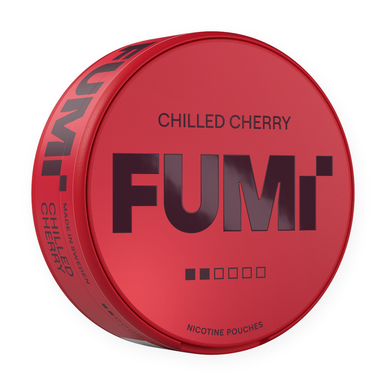
Fumi · 4mg–8mg · 10-can pack
Read the full guide
Fumi Chilled Cherry Nicotine Pouches
£27.90
✔ In stock — ready to ship
100% tobacco-free
Free over £20
Same-day dispatch
Secure checkout
This listing is Fumi Chilled Cherry Nicotine Pouches, a pack of ten cans at £27.90, recorded in two declared strengths — 4mg and 8mg — both at the same price. The flavour filed against it is cherry. We show it as in stock at the time of writing. Those are all the facts our product record holds, and everything factual on this page is taken from there rather than assembled around it.
Divided out, ten cans at £27.90 is £2.79 each. That division is ours and it exists purely so this listing can be held up against the single-can products elsewhere on the site. The number at checkout is £27.90 for the box. We do not hold a pouch count per can — that field is not in our data — so there is no per-pouch figure to be had from this page, and the printed can is where it is answered.
The full guide to Fumi Chilled Cherry Nicotine Pouches
4,957 words on how it eats, who it suits, how to serve it and what to put beside it.
Chilled Cherry, as our record has it
This is an age-restricted nicotine product for adults aged 18 or over who already use nicotine. Nicotine is an addictive substance. The full compliance wording has its own section further down. What sits between here and there is description: two numbers, a flavour word, a format and a shelf position, written for somebody who is already shopping rather than to persuade anybody to start.
The strength ladder, and what these numbers actually do
This listing offers two declared figures, which is the narrowest ladder we stock — some brands run to four or five rungs. A two-rung ladder is a good place to explain what the rungs are, because there is no clutter in the way.
| Declared strength | Pack price | Per can | Position within our catalogue's printed figures |
|---|---|---|---|
| 4mg | £27.90 | £2.79 | Near the bottom of the range printed on cans we stock |
| 8mg | £27.90 | £2.79 | Still in the lower half of that range |
What the figure is
It is a quantity the manufacturer declares and prints on the can. That is the whole of its definition. It is not a rating, not a score, not a grade and not a measure of quality. It sits on the packaging in the same category of information as a weight on a bag of flour: a declared number describing what is in the container.
Its one genuinely reliable use is ordering. Within this brand, a can marked 8mg carries a higher declared figure than a can marked 4mg. If you already know which figure you buy, the number lets you find it again on a shelf of hundreds. That is a real and useful function and it should not be undersold.
What the figure does not do
Three things, and all three are worth stating plainly because the number gets asked to do all of them.
It does not describe an experience. How a declared figure reads to a given person is individual, and neither this page nor anybody writing it has any way of knowing. Anything we wrote about how a number feels would be invention dressed up as information.
It does not compare cleanly across brands. Different manufacturers arrive at their printed figures by their own conventions, and two cans from two companies showing the same number are not necessarily describing the same thing. This is the single most common misunderstanding about pouch labelling and it catches experienced buyers as often as new ones.
And it is not a recommendation from us. We stock a spread of figures because manufacturers produce a spread of figures. We are not going to tell you which one suits you, we are not going to hint at it, and a shop that offers that advice is claiming knowledge it cannot possibly have about an individual.
Our shelving labels are not the ladder either
This listing appears on the Medium Strength shelf, which holds 135 listings. It is worth being precise about what that label is. Medium, Strong and Extra Strong are our own browsing categories, invented to break a catalogue of hundreds of products into navigable chunks. They are shelving, not measurement.
They exist because a single undifferentiated list of every can we carry is unusable, and because grouping by declared figure is the least arbitrary way to split it. They do not carry any endorsement, any implied progression, or any claim about anything. The Strong grouping and the Extra Strong grouping sit above this one in that arrangement and hold the listings whose printed figures are higher. That is all the relationship between them amounts to.
Why one brand's ladder does not map onto another's
If there is one practical point in this whole section, it is this. Nothing you know about how one brand's declared figure reads transfers reliably to a different brand's figure of the same number. Treat each brand's ladder as its own ladder, unconnected to the others.
The consequence for browsing is straightforward. When you move from this listing to, say, the ZYN black cherry listing at £19.99 or UBBS Cherry at the same £19.95 bracket, the printed numbers on those products are not a continuation of this one's scale. They are a separate manufacturer's declarations. We are not in a position to translate between them and are not going to pretend otherwise.
Two rungs, one price
Within this listing the ladder has an unusual property: it costs nothing to move along it. Both 4mg and 8mg are £27.90 for ten cans. There is no premium attached to the higher figure and no saving attached to the lower one. That is consistent across this brand, where every listing sits at the same price, and it is not universal — plenty of brands elsewhere on this site do charge differently by strength.
What that means in practice is that the choice between the two is purely a choice of printed number, with no financial consideration pulling in either direction. We will leave the choice there, where it belongs.
Cherry, and what the word "chilled" is doing next to it
The flavour recorded here is cherry, and the product name adds "Chilled". Both parts are worth taking separately, and what follows describes taste and aroma only.
Cherry is two flavours, not one
The cherry shelf divides more sharply than most. At one end is the bright, sweet, slightly almond-edged reading — glacé cherry, cherry drop, the flavour most people picture from confectionery. At the other is the dark reading: black cherry, deeper, less sugary, with a faint stone-fruit bitterness behind it and something closer to jam than to sweets.
The two are genuinely different to taste, and a product's name usually tells you which one it is aiming at. The XQS black cherry listing at £39.90 and Cuba Black Cherry at the same price both name the dark reading in their titles. SYX Wild Cherry at £29.90 names a third thing again — wild cherry being conventionally sharper and less sweet than either.
This listing says simply "cherry" with "chilled" attached, so our record does not settle which reading it takes, and we are not going to invent one. The flavour word is cherry. The can is where you find out which cherry.
What "chilled" means as a flavour term
Cooling is a flavour direction in its own right in this category, and a great many products combine it with a fruit. It is the reason a shelf that appears to be all fruit is really two shelves: fruit, and fruit with a cool character running underneath it.
What a cooling note does to a fruit flavour is fairly consistent. It sharpens the edges, thins the sweetness slightly, and gives the taste somewhere to go as it fades. A plain fruit flavour tends to get quieter and then stop; a cooled one tends to end on the cool rather than on the fruit. Whether that is an improvement depends entirely on what you want, and people divide on it firmly.
The comparison points on our shelves are useful here. Velo Cherry Ice at £4.19 names the same combination, and among the straightforwardly cool cans Klint Arctic Mint at £36.90 and Edge Spearmint at £14.95 are the cooling character on its own, with no fruit attached. Holding this listing against one of those is the quickest way to work out how much of what you like is the fruit and how much is the cool.
Aroma on opening
Cherry is a forward smell and a recognisable one — most people identify it instantly, which is not true of every fruit on this shelf. A cooled cherry reads slightly sharper on opening than a plain one, because the cool note carries in the air more readily than the fruit does.
It is a medium-weight aroma. It does not project across a room the way a citrus or a tropical can does, and it does not sit heavily the way a coffee or a liquorice can does. It fills the immediate space and then clears.
How it changes as it fades
With a fruit-and-cool combination the usual pattern is that the fruit thins first and the cool character outlasts it. That is the reverse of what happens with a plain fruit can, where the sweetness goes and something sharper is left behind. It means the end of a cooled cherry pouch tastes cool rather than tasting faintly of cherry, which some people much prefer and others find abrupt.
We do not hold timing data for this listing and are not going to produce any. How long a flavour stays interesting varies between people and is not something a product record can answer.
The format itself, in detail
The flavour is what people choose on. The format is what they actually live with, every day, and it gets described far less often than it deserves. This section is about the object rather than the taste.
The portion
A pouch is a small sealed portion — soft, roughly the size and shape of a flattened jellybean, with a fabric-like outer that holds its shape without being rigid. Out of the can it is light. It does not crumble, it does not leak and it does not come apart in normal handling.
Sizes vary between brands and the variation is real rather than cosmetic. Some ranges are built around a slim portion that is narrower and longer; others use a shorter, fuller shape. Our record does not state which format this listing uses, so we are not going to declare it. It is visible the moment a can is open, and the manufacturer's packaging is the authority on it. People who have used both usually have a firm preference, which is worth knowing before you order ten cans of an unfamiliar shape.
How it sits
A pouch goes between the upper lip and the gum and stays there. It is not chewed, not swallowed, and not moved around the mouth once placed. Settling one takes a few seconds — most people find a spot they return to, usually slightly off-centre, and stop thinking about it after that.
It stays put on its own. It does not require holding in position and it does not need spitting. It is visible if somebody looks for it directly and generally not otherwise, and the amount it shows depends more on where it is placed than on the brand.
The practical points people actually ask about are small ones. It is manageable to talk normally with one in, and most people do. Eating and drinking with one in is a personal preference rather than a rule. And a pouch that has been dislodged is easier to remove and replace than to reposition by feel.
How long people keep one in
This is the question we are asked most often about the format and the one we are least able to answer, so it is worth being direct about why.
We hold no usage data for this product, or for any product on this site. There is no field in our record that would tell us, and there is no honest way to derive one. What we can say is that the answer varies enormously between individuals and that it is not fixed by the product — two people with the same can will do entirely different things with it.
We are also not going to publish guidance on it even in general terms, because how much of anything a person uses is a matter for them and not something a shop should be directing. The point at which somebody takes a pouch out is their own business. If you are looking for an answer expressed as a number of minutes, this page does not have one and is not going to make one up.
The lid, the catch recess and disposal
The can uses a press-on friction lid rather than a screw thread, and most cans in this category include a second shallow recess intended for used pouches. That recess is the most practical piece of design in the category and the one people appreciate last.
Its use is obvious once you have needed it: a used pouch has somewhere to go when there is no bin, which means you are not improvising with a tissue or leaving anything anywhere. The trade-off is equally obvious and worth stating. It holds damp material against the outside of a can you are still taking fresh pouches from, and if it is not emptied for days it begins to smell. Emptying it when you empty your pockets rather than when it is full removes the problem entirely.
Disposal itself is one sentence. A used pouch is general waste — the lid recess or a bin. Not a sink, not a drain, not a toilet, and not the ground.
The cherry shelf, which is a short one
Our cherry grouping holds 20 listings. That is a small shelf by the standards of this site, where the berry and mint groupings run into three figures, and a short shelf has a particular practical quality: you can read the whole thing.
The shelf being short is not a judgement on the flavour. It is a consequence of how many manufacturers choose to make a cherry can, and cherry tends to appear as one entry inside a larger range rather than as a range of its own. The consequence for a customer is less internal variety than a big shelf offers — you are mostly choosing between the bright reading and the dark one, at whatever prices those particular brands happen to sit at.
The price spread across those twenty is wide, as it is everywhere here, and for the usual reason. The Velo cherry listing shows £4.19 and the Cuba dark cherry box shows £39.90, and those are not comparable numbers — they describe different quantities of product. Comparing headline prices without checking pack arrangement first is the most common way to misread this catalogue, and the fix is to open both pages and look.
One listing on that shelf sits slightly outside the two readings: Killa Exclusive Cherry Cola at £33.50 combines cherry with a cola character rather than treating it as a fruit on its own, which is a third direction again.
The cherry listings named on this page, by the price they show
Prices appear scattered through the paragraphs above wherever a flavour comparison called for one, which is the wrong order for looking at money. Set out together, the eight cherry listings this page names run like this. These are eight of the twenty cherry listings, not the whole shelf, and the shelf itself is the complete picture.
| Listing | Price shown |
|---|---|
| Velo Cherry Ice | £4.19 |
| UBBS Cherry | £19.95 |
| ZYN Black Cherry | £19.99 |
| Fumi Chilled Cherry (this listing) | £27.90 |
| SYX Wild Cherry | £29.90 |
| Killa Exclusive Cherry Cola | £33.50 |
| XQS Black Cherry | £39.90 |
| Cuba Black Cherry | £39.90 |
Two rows of that table are worth a warning. The £19.95 and the £19.99 sit four pence apart, which looks like a like-for-like contest and almost certainly is not, because we have no reason to think the two listings sell the same quantity. And the £4.19 at the top is a different kind of purchase again. This listing is the only row where this page states the arrangement outright: ten cans for £27.90. For the other seven, the number in the right-hand column is the price of a listing and the listing's own page is where the arrangement is set out.
Read with that caution, the column is still useful for one thing. It shows that cherry, on our shelf, is not a flavour concentrated at any particular price — it appears at the cheapest end of the catalogue and at the dearest, which is not true of every fruit we stock and means the shelf is worth reading in full rather than sampled.
Where this can falls in the Fumi range
The Fumi shelf holds sixteen listings, all at £27.90. A brand that prices everything identically makes the shopping decision unusually clean, because there is no cost pulling you toward or away from any particular flavour.
This cherry can is one half of the brand's dark-fruit pairing; the blackcurrant listing is the other, and it is sharper and less sweet than this one. The peach can and the mango can cover the stone-fruit and tropical directions. The lime listing is the citrus entry. The mint can is the cooling flavour on its own. The dark spice listing is the one that sounds least like the others.
A note on the naming, because it recurs across this shelf. "Fiery" and "Dark Spice" are words the manufacturer has chosen for its flavour titles. On this site they mean nothing beyond that — they are names printed on cans, describing a taste direction the brand wanted to signal. They are not statements about heat, about strength, or about any sensation, and they should not be read as any.
A second can to keep going alongside
Most regular buyers keep two or three flavours in rotation rather than working one can to the end. A sweet fruit with a cool note is a flavour people tire of at a moderate rate — faster than a plain mint, slower than a heavy dessert flavour — and having something structurally different to hand is the usual answer.
The clean contrast is a plain cooling can with no fruit in it. The Edge spearmint listing at £14.95 is the least expensive way to have that in a drawer, and the Klint mint box at £36.90 is the same idea at a different pack arrangement.
For a second fruit that is genuinely different rather than merely another fruit, change the family rather than the intensity. The 77 apple and mint listing at £39.90 is a crisp orchard reading with its own cooling note; Fumi's blackcurrant box keeps you at the same £27.90 while moving to a sharper, leafier dark fruit.
If you would rather browse than be pointed at things, the Pablo shelf and the Cuba shelf are the two largest brand ranges we carry and the most efficient places to start.
Keeping ten cans in reasonable condition
Storage matters more on a ten-can box than on a single tin, simply because the last can will be opened a good deal later than the first, and the gap is where conditions do their work.
Air is the variable. A lid pressed fully home holds a can's condition; a lid sitting proud of the rim slowly lets the contents dry, and a dried pouch does not come back. The check takes a second — push until it seats and you feel it stop.
Heat accelerates it. Dashboards, sunlit windowsills and the top of a radiator will flatten a can faster than a drawer will. Nothing dramatic happens and it is not a safety point; the can simply opens duller than it needed to. Somewhere cool and dark is better, and a closed box in a cupboard with one can in circulation is the arrangement that keeps the tenth can closest to the first.
Store cans upright where you reasonably can, particularly any with something in the catch recess, and empty that recess regularly. We do not hold a shelf-life figure for this product — the printed can carries whatever dating the manufacturer declares — and we are not going to advise on refrigerating or freezing, because we have no data on it and would be making it up.
What buying ten cans changes
Three practical things, none of them about the product itself.
It changes where the stock lives: a box is a drawer item, not a pocket item. It changes the arithmetic you compare with: £2.79 a can is the figure to hold against single-can listings, not £27.90. And it changes the cost of being wrong about a flavour — one can is a trial, ten is a commitment to a word you may only have read on a page. With a cooled fruit in particular, where people divide firmly on whether they want the cool note at all, that is worth a moment's thought before ordering.
The one can that leaves the drawer
Since the box stays put and a single tin travels, most of what can go wrong with a ten-can purchase happens to the one can in circulation rather than to the nine still sealed. A few observations, none of them dramatic.
A tin loose in a bag with keys and coins comes to grief at the lid rather than the body. Nothing crushes it, but the rim collects grit and a rim with grit on it never seats cleanly again, which is the slow route to a dull can. An inside pocket, a zipped compartment or simply a corner of the bag that is not the main one solves it.
A car is the other recurring problem, in both directions. A can left on a dashboard in summer gets the heat described above; a can left in a cold car overnight and opened first thing in a warm house pulls damp air in as it warms. Neither ruins anything, but a can that lives permanently in a vehicle will be the worst tin of the ten by the time it is finished, and there is no reason for it to be the one you are carrying.
The last one is a habit rather than a hazard: take the next can from the box when the current one is finished, not when it is nearly finished, and put the empty straight in the bin. Two part-used tins of the same flavour in circulation is how people end up finishing neither.
Ordering, delivery and the age check
This is an 18+ product and the process treats it as one throughout. Age verification applies to the order and ID may be requested on delivery. That is not discretionary, and it is not something the courier decides at the door on the day.
Choose the delivery address with that in mind. An address where an adult over 18 will be present is the one that works. Workplace receptions, neighbours and parcel shops differ in whether they can complete an age check at all, which is better established before you select one than after a parcel has been returned.
The price here is £27.90 for ten cans at either declared figure. Delivery options, order minimums and anything promotional live at checkout and on our delivery pages, which are authoritative in a way a product description read months later is not. On stock, we show this listing as available at the time of writing; the live product page is the position to trust, and where something has sold out we say so rather than leaving the page looking normal.
How to get back to this page
Three routes lead here and they suit different questions. By brand it sits under Fumi with fifteen siblings at the same price, which is the route for somebody who has settled on the maker. By flavour it sits in the cherry grouping with nineteen others, which is the route for somebody who has settled on the fruit. By our shelving it appears in Medium Strength with 134 others.
If none of those matches how you shop, everything we stock is listed in one place. It is a long page and it is the honest starting point when you do not yet know what you are after. The filters are shortcuts through that list rather than separate shops.
Questions we get about this listing
Is £27.90 the price of one can?
No — it is the price of a ten-can pack, which works out at £2.79 a can. We say this early and repeat it because our catalogue mixes single cans with multi-can boxes, and comparing a box price against a can price is the single most common way to misread a shelf here. Before comparing this with any other listing, open that listing and check what it contains.
How many pouches are in a can?
We do not hold that figure. The per-can pouch count is not a field in our product record, and we are not going to estimate it from what other brands do, because other brands are not this one. The count is printed on the can. It also means no per-pouch price can be calculated from anything on this page.
Is the 8mg more expensive than the 4mg?
No. Both declared figures are £27.90 for the ten-can pack. Neither is positioned as a premium version of the other, and that holds across this brand, where every listing carries the same price regardless of flavour or printed figure.
Which of the two strengths should I pick?
That is not something we can advise on. The milligram figure is a manufacturer's declared quantity and how any given figure reads to any given person is individual. We list 4mg and 8mg because those are the two figures produced for this listing. The choice is the buyer's, and a shop that offers to make it is claiming knowledge about an individual that it does not have.
How long should I keep a pouch in?
We hold no usage data for this or any product here, so we have no figure to give, and we would not publish guidance on it even if we did. How much of anything a person uses is a matter for them. What we can say is that it varies enormously between individuals and is not determined by the product. If you want a number of minutes, this page does not have one and will not invent one.
Does "chilled" mean it is a mint flavour?
Not as our record has it. The flavour filed against this listing is cherry; "Chilled" is part of the product name and indicates a cooling character alongside the fruit rather than replacing it. A plain cooling can with no fruit in it is a different thing, and the mint and spearmint listings elsewhere on this site are where that sits.
Is the cherry the sweet kind or the dark kind?
Our record says cherry and nothing more precise, so we cannot tell you, and we are not going to invent a tasting note on the manufacturer's behalf. The shelf does divide between a bright, sweet reading and a darker, jammier one, and several listings name which they are in their own titles. This one does not, so the can is where it gets settled.
Are these slim or standard-format pouches?
Our record does not specify, so we are not stating it. It is a genuine distinction — the shapes feel different and people who have used both usually have a preference — and we would tell you if we held it. The packaging declares it, and it is obvious the moment a can is open. Worth confirming before committing to ten cans if the shape matters to you.
Can I order one box of each strength?
Yes. The two figures are variants of the same listing and mixing them carries no price consequence, since both are £27.90. Each variant ordered is its own ten-can pack, so one of each is twenty cans in total, which is worth being clear-eyed about before confirming.
Will somebody need to show ID?
Possibly. This is an age-restricted product, age verification applies to the order and ID may be requested at the door. A parcel that cannot pass an age check will not be left. The practical answer is to choose a delivery address where an adult over 18 will be there to receive it, and to sort that out when ordering rather than afterwards.
Do you show ratings or customer reviews?
Not on this page. We do not publish ratings, review counts or testimonials against listings, and we are not going to summarise opinions we have not gathered. Everything above comes from our product record, and where that record is silent — pouch count, portion format, shelf life, how the cherry is pitched — we have said so rather than filling the gap with something that reads like evidence.
The legal position
This product is for adults aged 18 or over who already use nicotine. We do not sell it to anyone under 18, and it is not intended for, aimed at or suitable for anybody who does not already use nicotine.
Nicotine is an addictive substance.
It is not a licensed stop-smoking medicine and is not offered as one. It is not intended for non-smokers, for people who do not already use nicotine, for under-18s, or for anyone pregnant or breastfeeding. Nothing on this page constitutes medical advice, dosage guidance, or a suggestion that any strength is suitable for any particular person or circumstance. Health questions about nicotine belong with a qualified professional rather than a product description.
Age verification applies to orders placed on this site, and ID may be requested on delivery. Keep this product out of reach of children and dispose of used pouches in general waste.
The short version
Ten cans for £27.90, 4mg or 8mg at the same price, filed under cherry with a cooling note in the name, shown as in stock. The two declared figures are a manufacturer's numbers and nothing more; our Medium Strength label is shelving and nothing more. We do not hold the pouch count, the portion format or any usage figure, and we have said so in each case rather than guessing.
If this is not the can, the rest of the cherry shelf is twenty listings long and readable in a sitting, and the full catalogue holds everything else we carry.
More from Fumi
More medium strength pouches
More cherry pouches

Where this sits
Fumi Chilled Cherry Nicotine Pouches appears in these categories. Browse them, or jump to something close.
You might also like