Fumi · 8mg–15mg · 10-can pack
Read the full guide
Fumi Fiery Peach Nicotine Pouches
£27.90
✔ In stock — ready to ship
100% tobacco-free
Free over £20
Same-day dispatch
Secure checkout
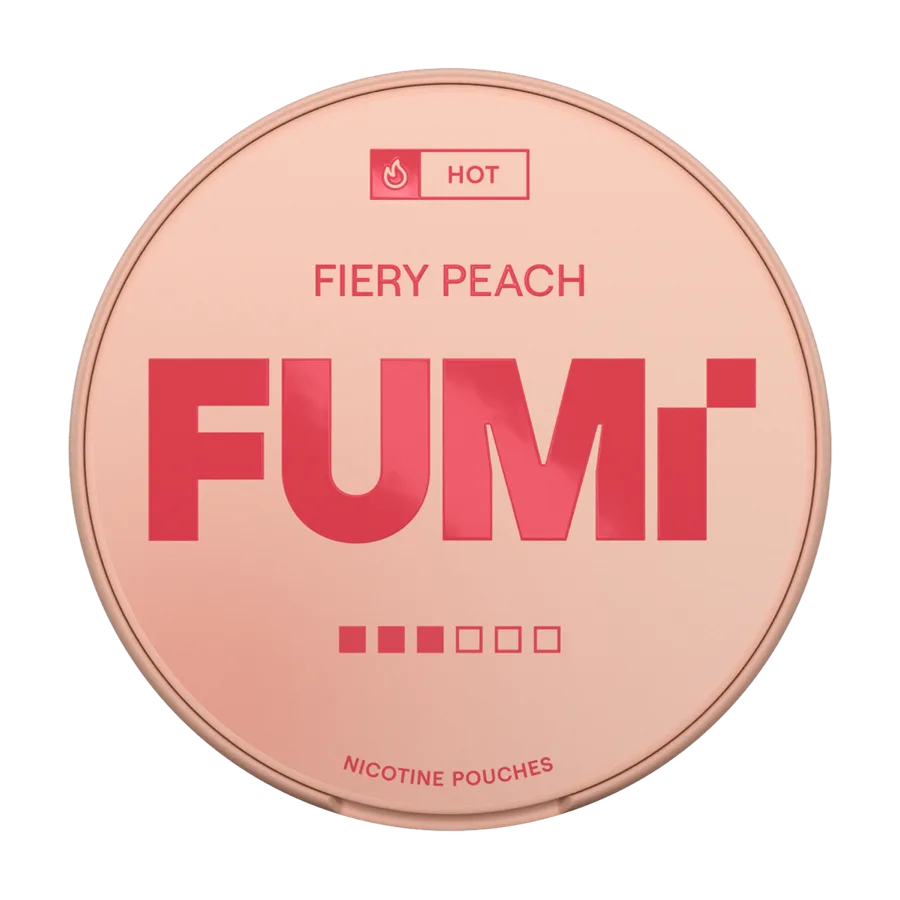
Fumi Fiery Peach Nicotine Pouches is a ten-can box at £27.90, held in two declared strengths, 8mg and 15mg, priced identically. Our catalogue files the flavour under tropical rather than under a single fruit — more on that below, because it is the kind of small discrepancy that a product page ought to explain rather than quietly smooth over. The listing showed as in stock when this was written and carries one photograph. That is the sum of our record, and this description is built from it, from comparisons with cans we actually stock, and from saying so where the record is silent.
The necessary statement first: an adult nicotine product, sold only to people aged 18 or over who already use nicotine. Full wording has its own section further down. Nothing on this page is intended to persuade anybody to consume anything.
The full guide to Fumi Fiery Peach Nicotine Pouches
5,047 words on how it eats, who it suits, how to serve it and what to put beside it.
Fumi Fiery Peach: what is on the listing
Ten cans at £27.90 works out to £2.79 for each tin. Both declared figures cost the same, so on this listing the number on the lid is not a price decision. That is consistent across every one of the sixteen Fumi listings we hold, which makes this a straightforward brand to shop: flavour and declared figure are the only things that change, and £27.90 is the constant.
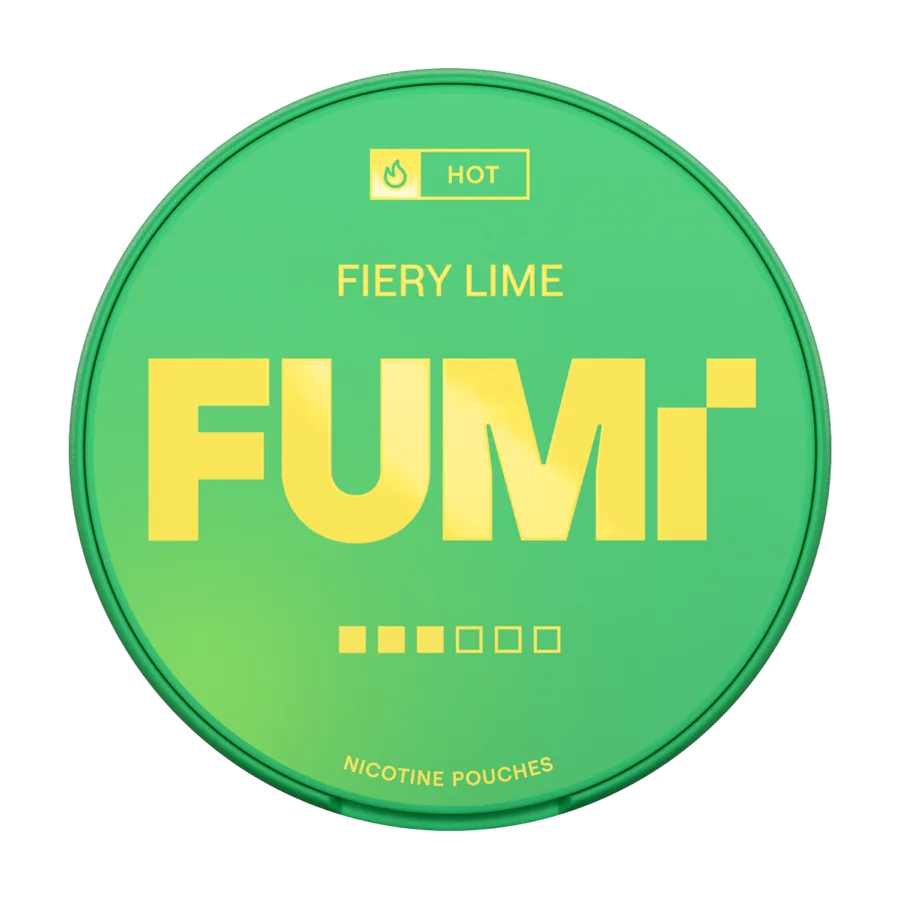
On the word Fiery: it is Fumi's range name, printed on the lid as part of the title, and we treat it as branding and nothing more. It is not a description of heat, not a description of any sensation, and no information we hold from the manufacturer explains it. The same prefix appears on Fumi Fiery Lime, Fumi Fiery Mango and Fumi Fiery Mint. A citrus, a heavy tropical fruit and a mint have nothing in common as flavours, so the prefix cannot be describing a shared characteristic. The second word is the one carrying the information.
The tasting note: sweet, sharp, cool and bitter
Most flavour writing in this trade collapses into adjectives that do not distinguish anything — refreshing, smooth, bold. A more useful method is to take four axes and place a can on each of them, because that produces a description a customer can actually check against their own experience. The four we use are sweetness, sharpness, cool character and bitterness. Everything in this section is about taste and aroma. No other kind of claim is being made, and none should be read into it.
Sweetness: high, and soft rather than sugary
Peach is one of the sweeter fruit notes available in this format, and this can does not hold back on it. What separates a peach note from, say, a berry note is the quality of the sweetness rather than the quantity. Berry sweetness is bright and slightly acidic at the edges. Peach sweetness is soft, rounded and a little powdery, closer to the taste of tinned fruit in syrup than to fresh fruit off a tree. It coats rather than sparkles.
Behind the sweetness sits a floral element that is genuinely characteristic of the fruit — blossom and nectar, not perfume. That floral quality is what makes a good peach flavour recognisable as peach rather than as generic sweet-fruit, and it is the first thing lost when a peach note is made badly. On the sweetness axis this can sits high, and it is one of the sweeter cans in the Fumi range alongside the cherry.
Sharpness: low
There is very little acid in this flavour. Peach is not a sharp fruit and the can does not pretend otherwise. If you set it beside the lime in the same range, the contrast is total: lime is rind and acid from the first second, thin and bright and bracing, while this is broad and low and rounded throughout. Customers who want something with an edge to it are better served by a citrus or by a sharper berry, and the shelves linked from this page will take you to both.
A modest sharpness does appear late, at the very tail of the flavour, which stops the sweetness becoming cloying. It is subtle and it is not the point of the can.
Cool character: present, and mild
By "cool" in a tasting note we mean the mint-and-menthol family of flavour notes, the ones that taste cold in the way a mint sweet tastes cold. It is a flavour description and not a statement about any physical sensation, and we would rather define the word than let it do work it cannot support. On this axis the can sits low to middling: there is a faint cool note sitting under the fruit, enough to lift the finish slightly, nowhere near enough to make this a fruit-and-ice construction.
The difference matters when cross-shopping. Pablo Gold Edition Blueberry Peach Ice at £19.95 and Denssi Blueberry Freeze at £39.90 are both explicitly built as fruit-plus-cool, where the second element is a headline feature rather than a background one. This is a fruit can with a quiet edge. Those are fruit-and-ice cans. That is a construction difference, not a quality difference.
Bitterness: very low, with a short tail
Peach has almost no bitter component, which is precisely what separates it from the other stone fruit in this range. The finish is clean and it is short. Where a heavier tropical fruit leaves a green, skin-like dryness behind, this one simply fades. People who dislike a lingering aftertaste tend to get on with peach notes for exactly this reason, and people who want a flavour that stays present for a long run often find it disappears sooner than they expect.
Putting two cans side by side
If you are trying to place a flavour rather than simply have it, the order you taste in changes the answer, and it is worth knowing that before drawing conclusions. A soft sweet note tried after a sharp one reads flatter than it is; the same note tried after nothing at all reads sweeter. Leave a real gap between two cans rather than going straight from one to the next, and if you are comparing this with the lime or the blackcurrant, taste this one first, because the acidic cans flatten what follows them and the soft ones do not.
Take the aroma off the open lid before anything else, since that is the part a second can will interfere with most. Then hold the two descriptions apart in your head: what the flavour does at the front, what it does in the middle, and what it leaves behind. Most of the disagreement between two people about a fruit can turns out to be about the finish rather than the opening, and the finish is the part hardest to remember an hour later, so it is the part worth noting down if you are keeping track across a rotation.
One caveat on all of it: judge a flavour on a tin that has been kept properly. A can that has spent a fortnight somewhere warm is not evidence about the product, and a first impression taken from one is worth very little.
The aroma, separately
On the lid coming off: sweet, soft, slightly floral, with a syrupy edge. It is one of the quieter cans to open — nothing like a citrus or a mint, which announce themselves across a table. The aroma also reads sweeter than the flavour does, which is common in this family and worth knowing if you are judging a can by its first sniff.
Peach on the tin, tropical in our record
Our catalogue files this can's flavour as tropical, and puts it on the tropical shelf with 57 other listings, while the product name on the lid says peach. Both are accurate in their own way and it is worth explaining rather than hiding.
Flavour categories on this site are broad groupings, not ingredient statements. Tropical is where stone fruits, pineapples, mangoes, coconuts and mixed-fruit constructions all end up, because a catalogue with a separate shelf for every named fruit would have forty shelves and nobody would use it. So the category tells you the neighbourhood, and the product name tells you the house. Where the two differ, the name on the can is the more specific information and our category is the more useful navigation.
The practical consequence is that if you browse the tropical shelf expecting fifty-eight peach cans you will be disappointed, and if you browse it expecting a range of sweet fruit constructions you will find exactly that. We would rather set the expectation here than have it set by the shelf.
Peach and mango: two stone fruits, two different cans
Fumi puts two heavy fruit cans on our shelves at the same £27.90 and, because they share the range prefix, they get treated as variations on one theme. They are not. The difference is large enough to be the main reason to buy one rather than the other.
The mango can is dense and resinous. Its sweetness is honeyed and thick, closer to dried fruit than to fresh, and underneath it sits a faintly piney, almost turpentine edge that is the signature of a mango note done properly. It finishes long, and the tail turns green and slightly bitter, like the skin of the fruit rather than the flesh.
This peach can is softer in every direction. The sweetness is syrupy where mango's is honeyed, the middle is floral where mango's is resinous, and the finish is short and clean where mango's is long and green. Mango is the fruit dried in the sun; peach is the fruit tinned in syrup. On the four axes above, mango sits higher on bitterness and sharpness and roughly level on sweetness, and that bitter tail is the single clearest tell if you are tasting them one after the other.
One further practical difference: the mango listing is held at 8mg only, where this one carries both 8mg and 15mg. So a customer who wants the higher declared figure in a Fumi fruit can has this one and not that one, which for some people settles the question before flavour comes into it at all.
Two declared figures, one price
Both 8mg and 15mg are manufacturer declarations printed on the can. They exist to let one product be compared with another. They are not instructions, they are not measures of anything a person will experience, and we will not tell you which to buy — that is not something a retailer can responsibly do, and any shop that offers to is guessing at your circumstances.
What the figures do is determine filing. Because the top of this listing's range is 15mg, it sits on the strong shelf and its 132 listings. The 8mg box, considered alone, would belong with the medium shelf and its 135. Anyone who filters by strength and then finds a listing in an unexpected place is usually meeting that rule.
Two limits on the number. It is not comparable across manufacturers as though it were a common unit — different companies declare in different ways and we do not convert between them. And it carries no information at all about how strongly the can tastes. A quiet-tasting can and a loud one can print the same figure. Keeping flavour intensity and declared figure separate is the single most useful habit when reading any listing on this site.
The Fumi range, and what each can is for
Sixteen Fumi listings sit on the brand's shelf here and all of them are £27.90 for ten cans. A flat-priced range is rare and it changes how you shop it: there is no entry-level can and no premium can, so the entire decision is flavour and declared figure. Below is how the range actually divides, and who each part of it is likely to suit — meaning which existing preference it answers, not any claim about what a can will do.
The sweet fruit group
This can, the mango, and Fumi Chilled Cherry form the sweet core of the range. The cherry is the interesting middle term: a sweet stone fruit with a cool note sitting behind it, which makes it structurally closer to a fruit-and-ice can than either of the other two. Someone who finds this peach a little soft and wants more lift in the finish should look at the cherry before looking outside the brand.
The sharp and dark group
Fumi Blackcurrant is the tart one — dark, jammy, with real acid behind it, and the obvious contrast can for anyone whose main tin is this one. The lime is sharper still and thinner with it, an unambiguous citrus with no sweetness to hide behind. Between them they cover the half of the fruit spectrum that peach does not touch.
The mints and the outlier
Two mints sit in the range and they are not the same flavour. The sweeter mint is confectionery in style, full and sugared with a herbal base underneath. The drier one is leaner and sharper at the top with a shorter finish, and it carries three declared figures — 4mg, 11mg and 15mg — which is the widest spread in the brand. Fumi Dark Spice belongs to no group at all: warm, aromatic and not built on sweetness, it is the one can in the sixteen that someone tired of fruit and mint alike should try.
How people actually work through it
With a flat price and sixteen flavours, the common pattern is not brand loyalty so much as range loyalty — a customer settles on two or three cans from the sixteen and rotates them. Because every box costs the same, rotating costs nothing extra, which is a genuine practical difference from brands whose flavours are priced in tiers. If that is how you intend to shop, buying two different flavours in one order is the fastest way to find your pair.
The can, and the format in practice
Fumi uses the standard round pouch tin — shallow, plastic, a lid that lifts clear and presses back on. The top of the lid is a separate compartment for used pouches, which exists so there is somewhere to put one when no bin is in reach. We hold no figure for how many it takes and would not publish one if we did, since it depends on how wet the pouches are; treat it as a few hours' holding space, empty it into general waste daily, and it stays pleasant to open. Used pouches go in a bin, not a sink, not a toilet and not a hedge.
The number of pouches in each can is not recorded in our catalogue for this brand, so we will not state it. It is printed on the tin, and reading it off the first can of a ten-box settles it for good. Pouch size and weight are likewise unclassified in our record and will not be guessed at here.
In use the pouch sits under the upper lip. The format needs no device, no battery and no charging, and produces neither smoke nor vapour — a description of what it is, and nothing further. How long anyone keeps one in varies too much between individuals for an average to carry meaning, and we do not hold a figure from the manufacturer. Whatever wording Fumi prints on the can is the guidance to follow.
Beyond the brand: cans this gets compared with
Within the tropical family, SYX Tropical at £29.90 is the closest thing we stock to a direct alternative on money, built as a mixed-fruit construction rather than around a single named fruit. Elf Bar Pineapple, also £29.90, goes the other way and puts one sharp, high-acid tropical fruit front and centre, which is about as far from a soft peach as the category allows. Cuba Ninja Coconut at £39.90 is the creamy end of tropical and the only can in this group that is not fruit-acidic in any direction.
Cheaper, Velo Tropical Mango at £4.19 is a single can and the least expensive way in the shop to try a heavy tropical fruit before committing to ten of anything. Dearer, Killa Apple at £33.50 is a crisp orchard fruit sitting well up the strength shelves, and Clew Blueberry at £39.90 is the berry alternative at the top of our price range.
Two mint-side reference points for contrast rather than similarity: Edge Mint at £14.95 is our cheapest multi-can mint, and 77 Apple Mint at £39.90 is the fruit-and-mint construction people most often buy alongside a sweet fruit can. If you shop by manufacturer instead of flavour, Pablo's pages and Cuba's pages set out two whole ranges at once, and the full index holds everything we carry.
What £27.90 buys, set against the shelf
Comparing prices across a shelf like this one is less straightforward than it looks, and the commonest error is an easy one to fall into: reading a headline price as though every listing sold the same kind of thing. They do not. Some entries in the catalogue are single tins and some are boxes, and the figure on the shelf is the price of whatever that listing sells, not the price of a can.
This listing is a ten-can box. The single Velo tropical tin at £4.19 is one can. Put those two numbers beside each other and one appears to be six times the other, which tells you nothing useful, because they are not the same purchase. Set tin against tin, the arithmetic runs the other way. That is not an argument for either listing, it is a warning about the comparison.
The complication is that our record does not carry a pack count for every product, only for some, and this brand happens to be one where it does. Where the figure is missing we will not estimate it, which means a true per-tin table across the whole shelf is not something this page can honestly give you. What it can give you is the headline prices, labelled as headline prices, for the cans named above:
| Listing | Listed price | Pack structure in our record |
|---|---|---|
| Fumi Fiery Peach (this page) | £27.90 | Ten cans |
| Velo Tropical Mango | £4.19 | Not recorded here |
| Edge Mint | £14.95 | Not recorded here |
| Pablo Gold Edition Blueberry Peach Ice | £19.95 | Not recorded here |
| SYX Tropical | £29.90 | Not recorded here |
| Elf Bar Pineapple | £29.90 | Not recorded here |
| Killa Apple | £33.50 | Not recorded here |
| Cuba Ninja Coconut | £39.90 | Not recorded here |
| Clew Blueberry | £39.90 | Not recorded here |
| 77 Apple Mint | £39.90 | Not recorded here |
Nine blanks in a ten-row table is not a good look, and we have left them visible rather than filling them, because a pack count invented on a description page becomes a per-can price invented on a description page, and that is the kind of error that costs a customer money. Each of those listings states its own structure on its own page, at the point where it is actually being sold.
What the spread does show is that the headline figures on this shelf run from £4.19 to £39.90, roughly a tenfold range, and that the range is driven as much by how many tins a listing contains as by anything about the tins themselves. Reading the pack structure before reading the price is the habit that makes the shelf legible.
Keeping the box in good order
Cool, dry, out of the light, lid closed. A cupboard or a drawer is ideal; a windowsill, a dashboard or a shelf above a radiator is not. Heat is what flattens a fruit flavour fastest, and a soft, floral note like this one shows the damage sooner than a heavy or a sharp flavour does, because there is less structure to hide behind.
Chilling cans is optional and entirely a matter of preference. It slows drying and changes how the sweetness reads. Keep the lid shut if you do it — a syrupy peach note will pick up the smell of a fridge with remarkable efficiency. We hold no storage instruction from Fumi beyond the tin's own printing, and the tin outranks this paragraph if the two disagree.
Open one can at a time and leave the remaining nine boxed. Sealed tins in a dark cupboard stay as they arrived; opened tins scattered around a house, a car and a work bag do not. Check the date printed on the can when the box arrives, and if you reorder on a rhythm, shelve new boxes behind old ones.
Reordering, and the rhythm of a ten-can box
A box changes the shape of buying in a way a single tin does not, and the differences are worth thinking through before the first order rather than somewhere around the ninth can.
The obvious one is commitment. Ten tins of a soft, syrupy stone fruit is a lot of the same flavour to have agreed to in advance, and a flavour that seemed fine across one tin can wear thin across ten. If you have not had this particular can before, that is an argument for looking at a single-tin listing in the same family first, and the 58 cans filed as tropical is where the cheaper singles in that family are grouped. It is a slower route to a box, but it is a cheaper route to finding out you did not want one.
The less obvious difference is in the reordering itself. People who buy singles reorder constantly and hold no stock; people who buy boxes reorder rarely and hold a good deal of it. The second pattern has one failure mode, which is ordering on the last tin. Availability on this site is live and it moves — this listing showed in stock when the page was written, and we publish no restock dates, because we do not hold them and a guessed date is worse than an honest silence. Placing the next order when two or three tins remain rather than when none do leaves room for a delivery window and for a listing that has gone quiet.
The third is the flat price, which matters here more than on most brands. Because every box across the range is £27.90, splitting an order between two flavours costs exactly what buying two of the same costs. There is no discount for repetition and no premium for variety, so the arithmetic is neutral and the decision is purely about what you want in the cupboard. None of that is an argument for ordering more than you meant to, and it is not intended as one.
What there is to choose between
On this listing: two declared figures, 8mg and 15mg, at one price of £27.90 for ten cans. No single-can option, no five-can option, no third figure. Since the price is identical, the only question is which number you want printed on the lid, and that is yours to answer rather than ours.
If neither figure suits, the brand offers a third option only in the drier mint, which holds 11mg between its 4mg and 15mg. Otherwise the strength shelves are the place to look: medium, strong, and extra strong between them cover the whole catalogue, and every product page states its own declared figures. What we will not do is suggest a figure as suitable for anyone, at any point, for any reason.
Ordering, age checks and delivery
Pick the declared figure, add the £27.90 box to the basket, pay at checkout. Stock shown on the listing is live; this page is a snapshot of a record and the listing is the current position.
Age verification applies to every order and is not waivable. This is an 18+ product for adults who already use nicotine. Checks run when the order is placed, and the courier may request photographic ID at the door. Where no adult of age is present the parcel will not be left. It is worth choosing the delivery address with that in mind, because a parcel that needs a signature from a named adult does badly at a workplace post room.
Parcels go out in plain outer packaging. Carriers, delivery windows and any postage thresholds are set out at checkout and on the delivery pages, where they can be kept current — a product description is the wrong place to fix numbers that change.
Where this page sits in the site
Three routes lead here: the strong strength page, by virtue of the 15mg declaration; the Fumi listing page, alongside its fifteen siblings; and the tropical flavour page, with 57 other cans. If you are browsing rather than hunting, the shop index is the widest view and the strength shelves are the fastest filter.
Questions we get about this can
Is this a peach flavour or a tropical flavour?
Both, depending on which field you are reading. The product name on the lid says peach, which is the specific description. Our catalogue files it under tropical, which is the broad shelf that holds stone fruits, pineapples, mangoes and mixed-fruit constructions together. Neither is wrong. If you want peach specifically, the name on the can is your evidence and the category is just how you find it.
How does it differ from the mango in the same range?
Peach is softer, more floral and more syrupy, and it finishes short and clean. Mango is denser and more resinous, honeyed rather than syrupy, and finishes long with a green, faintly bitter tail. They are two genuinely different flavours that happen to share a range prefix and a price. The mango is also held at 8mg only, where this carries 8mg and 15mg.
Does "Fiery" mean it tastes hot?
We hold nothing from the manufacturer that explains the word, so we are not going to interpret it. It appears on four unrelated flavours in this range, which is what a range name does. Our record describes this can's flavour as tropical and the lid calls it peach. Beyond that we make no statement about what the prefix is meant to convey.
How many pouches are in a can?
Our record does not carry that figure for this brand and we will not invent one. The number is printed on the tin. With a ten-can box you need only open the first can and read it once. We would rather leave the gap visible than publish a count that turns out to be wrong ten times over.
Is 15mg more expensive than 8mg here?
No. Both are £27.90 for ten cans, and the same flat pricing applies to all sixteen Fumi listings we stock. That is unusual enough to be worth saying plainly: on this brand the declared figure has no effect on what you pay. On several other brands in the catalogue it does, so check the listing rather than assuming.
Which of the two figures should I order?
That is not a decision we are able to make for you and not one we will pretend to. The facts are identical between the two boxes apart from the number itself — same flavour, same tin, same pack, same price. Which number you want depends on your own use, which you know and we do not.
Is the flavour sweet enough to become sickly?
It is a sweet can, and a soft, syrupy sweetness is more prone to fatigue than a sharp one — that is a property of the flavour family rather than a fault in this product. People who find sweet cans tiring over a long run usually keep something sharper alongside, and within this range the blackcurrant and the lime are the two that pull hardest in the other direction.
Where is it manufactured?
We do not hold that information and will not guess. Our record covers brand, flavour category, declared strengths, pack structure, price and stock. Country of manufacture is not one of the fields. Whatever the packaging states is the answer, and it arrives with the order.
Can I buy one can rather than ten?
Not on this listing — it is sold as a ten-can box only. Single cans do exist elsewhere in the catalogue at lower prices, and the tropical shelf is the quickest way to find one in a similar flavour family if you would rather try before buying a box.
Does it contain a cooling element?
As a taste description, there is a mild cool note sitting under the fruit, which is the mint-family character that lifts the finish slightly. It is a background element, not a headline one, and this can is not built as a fruit-and-ice product the way several cans on our shelves openly are. We are describing flavour here and making no other kind of statement.
Will it taste the same as the last box I bought?
Within the normal batch variation of any manufactured product, it should. Cans in one box usually come from one run. Differences people notice are most often between orders placed a long way apart, or the result of a can spending time somewhere warm, which is storage rather than manufacturing. If a tin seems flat, check where it has been kept before concluding anything else.
Is there a version with a different fruit at this strength?
Within the brand, the 15mg figure appears on this can and on both mints, so a fruit can at that figure means this one. At 8mg the brand offers considerably more choice across the fruit flavours. Outside the brand, the strength shelves list every product by declared figure and the flavour shelves cross-cut them, which between them will answer most versions of this question faster than we can.
The legal section
This product is for adults aged 18 or over who already use nicotine. We do not sell to anyone under 18. Proof of age may be requested when the order is placed and again by the courier at the door.
Nicotine is an addictive substance. That holds for this listing at both declared figures and for every nicotine product sold on this site.
It is not a licensed stop-smoking medicine and carries no medicinal licence of any description. It is not intended for non-smokers, for people who do not already use nicotine, for under-18s, or for anyone pregnant or breastfeeding. We make no health claim about it in any direction, and none of this page is medical advice. For questions about nicotine and your own situation, a healthcare professional is the right person to ask.
To summarise
A ten-can box at £27.90, £2.79 a tin, in 8mg and 15mg at the same money. As a flavour it is high on sweetness and low on sharpness and bitterness, floral in the middle, with a quiet cool note and a short clean finish — the soft, syrupy stone fruit against the dense, resinous one its sibling holds. Filed under tropical, shelved as strong, and priced identically to the other fifteen cans in a flat range. The listing is above; the shelves linked throughout will take you elsewhere if this is not the can.
More from Fumi
More strong pouches


More tropical pouches
Where this sits
Fumi Fiery Peach Nicotine Pouches appears in these categories. Browse them, or jump to something close.
You might also like