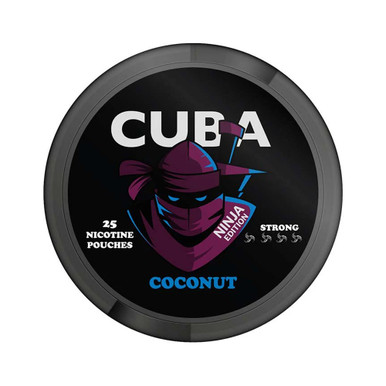
Cuba · 30mg
Read the full guide
Cuba Ninja Coconut Nicotine Pouches
£39.90
✔ In stock — ready to ship
100% tobacco-free
Free over £20
Same-day dispatch
Secure checkout
Cuba Ninja Coconut Nicotine Pouches is priced at £39.90 and carries one declared strength, 30mg. The product name is Coconut. In our own flavour filing it sits under tropical, which is worth knowing because it is how you will find it when browsing. It shows as in stock as this is written.
That short paragraph is the whole of what we hold. We have no pouch count for this listing, no can count, no weight, no dimensions, no dates and no manufacturing information. Where our records are empty this page says so and points at the printed can, which is the only document that can settle any of it. We would rather leave a gap visible than fill it with something plausible.
The full guide to Cuba Ninja Coconut Nicotine Pouches
5,026 words on how it eats, who it suits, how to serve it and what to put beside it.
What is listed on this page
On the name: Cuba is the brand, Ninja is the name of a line within that brand, and Coconut is the flavour. Those are labels on a lid. None of them tells you where the product is made, we hold no origin information at all, and we are not going to read any character or meaning into a line name that the manufacturer has not stated. A word on a tin is a word on a tin.
Standard note before anything else: this is an adult nicotine product, sold only to over-18s who already use nicotine. The compliance section towards the bottom of the page states that properly.
Using one, described plainly
Nothing about the format is specific to this can, so if pouches are familiar to you this section holds no surprises. A nicotine pouch is a small sealed pouch placed in the mouth between the lip and the gum and left there. It is not chewed, and it is not swallowed.
The container is a shallow round plastic tin with a press-on lid. It shuts inside a closed hand and lies flat in a pocket. The lid carries brand, line, flavour and the declared figure, and that printing does more work than it appears to — when there are several cans in a drawer, the top of the lid is the only surface anyone ever reads.
Putting one in takes a couple of seconds. It goes at the front of the mouth, usually up under the top lip, held there by the lip. It can be moved across if it is sitting badly. If it is uncomfortable in every position, take it out; comfort is individual and nothing about the format asks anyone to persevere with something that does not suit them.
On how long a pouch stays in, we have no useful number to give. The range across people is very wide and any average would misrepresent most readers. The usual trigger for taking one out is that the flavour has run out, which on a sweet flavour like this one tends to be noticeable rather than gradual. We set no duration, we cannot tell you what yours should be, and the manufacturer's printed guidance on the can is the guidance that applies.
The lid has a catch compartment underneath it, walled off from the part holding the unused pouches, and that is where a used one goes when there is no bin nearby. Empty it often. A full compartment stops the lid seating flush, and a lid that does not seat flush means the can is effectively open even when it looks shut. Final disposal is general waste — a bin, not a sink, not a toilet, not a car window. The empty tin is plastic and goes in household recycling as far as your local authority accepts that plastic, which is a question for them.
We do not hold pouch dimensions or a format designation for this product, so this page will not tell you whether these are slim, regular or anything else. Every pouch in a can matches the others in it, and the can carries the specification.
30mg, and where that puts this listing on our shelves
One figure is declared on this listing: 30mg, at £39.90. There is no second variant to choose between here. The figure is the nicotine content the manufacturer declares and prints on the can, and we reproduce it exactly as supplied — no rounding, no conversion, no restatement.
What a milligram figure is, precisely: a declaration. Its function on our site is to let somebody who already knows the number they are looking for filter to it instead of opening every page. It is not a rating, not a rank, and not a suggestion. We do not advise anybody on what figure is appropriate for them, and nothing in this section is written to help you decide.
Because 30 is a lower declared number than the figures on a good part of our catalogue, this listing files under the Strong band, which currently holds 132 listings and is the largest of our three strength shelves. The other two are the Medium Strength band and the Extra Strong band, and a can lands on one of them because of the number printed on it and for no other reason. The bands are a filing system. They are not a scale anyone is meant to work along.
That last point deserves emphasis on a page like this one, because some Cuba listings on our site carry a higher declared figure than this one and some do not, and it would be easy to read a set of bands as a ladder. It is not. It is three boxes we sort stock into so the catalogue is navigable.
And the usual caution about comparing between brands: manufacturers declare against different formats and express the number in different ways, so the same printed figure on two different cans is not proof the two are equivalent. We publish what each manufacturer publishes and do not convert between them, because we do not hold what would be needed to do that honestly.
Coconut as a taste, and why it is filed under tropical
The product name says Coconut. Our flavour classification for this listing says tropical. Both are true and neither is a mistake — our shelves group by flavour family rather than by individual name, and coconut belongs to the tropical family the way lime belongs to citrus. If you browse the tropical shelf and its 58 listings, this can is in there among mangoes, pineapples and mixed-fruit blends.
As a taste, coconut is unlike most of what surrounds it on that shelf. Where mango and pineapple are bright and sharp-edged, coconut is soft, creamy and rounded, with a sweetness that sits low rather than at the front, and a faint woody or nutty character behind it. It is the least acidic thing in the tropical family. Nothing about it is tart.
That makes it one of the more polarising flavour names on a pouch shelf. People who like it tend to like it specifically, rather than liking it as one option among several tropical fruits, and people who do not like coconut generally do not like it anywhere. It is not a flavour that many people are neutral about, and it is a poor first choice if what you actually wanted was a fruit.
The aroma off an opened tin is the same character concentrated, and a stronger impression than the pouch itself gives. That is normal for a sealed can.
It is also worth setting expectations about which version of coconut a flavour name usually points at. In practice, coconut as a flavouring almost always reads closer to the confectionery form of the ingredient than to fresh coconut — the register of coconut in a sweet or a bakery item rather than the flesh cracked out of a shell. That is true of coconut flavours across food and drink generally, and it is not a criticism of any particular can. If what you have in mind is the fresh version, the flavour category as a whole is unlikely to give it to you, and that is a more useful thing for us to say up front than after you have bought something.
How a flavour name turns into something you can recognise
This is the section worth spending time on, because "coconut" on a lid and coconut in your mouth are connected by something less obvious than people assume, and understanding it makes the whole shelf easier to read.
First, the limit of what this page can say. We hold no information about what is inside a pouch or how any flavour is put there, and we are not going to describe, guess at or explain the composition of this product. That is the manufacturer's information and it belongs on the manufacturer's packaging, not in our copy. What follows is entirely about how a flavour reads — about perception and naming — and not about materials.
A dry object is a difficult place to put a flavour
Most of the flavours people know well, they know from liquids and from food: a drink, a sweet, a dessert. Those arrive warm or cold, wet, in quantity, and often with texture and sugar doing part of the work. A pouch is none of those things. It is small, it is dry, it does not melt and it does not change temperature. Whatever a flavour is going to do, it has to do from a fixed object sitting still in one place.
The practical consequence is that a pouch flavour is a sketch of the thing it is named after rather than a reproduction of it. Nobody tasting a coconut pouch mistakes it for coconut. What they recognise is the handful of characteristics that make coconut identifiable — the creaminess, the low sweetness, the slight woodiness — assembled well enough that the name on the lid makes sense. That is what a flavour name promises, and it is all it promises.
Why some flavour families survive the format better than others
You can see this across our shelves once you look for it. Mint names are the easiest to make recognisable, because mint is already a simple, dominant, immediately identifiable character and does not depend on texture or sweetness to read correctly. That is one reason mint dominates pouch shelves everywhere.
Sharp fruits come next. Apple, cherry, blueberry and citrus all have one or two defining characteristics that survive being reduced to a sketch — a sharpness, a specific kind of sweetness, a recognisable edge. The Killa apple listing at £33.50 and Clew Blueberry at £39.90 are both examples of names that most people would identify without being told what they were.
Creamy and soft flavours are the hardest of the lot, and coconut is squarely in that group along with vanilla, banana and anything dessert-shaped. Their defining quality in real life is partly texture — richness, thickness, mouthfeel — and texture is precisely what a dry pouch cannot supply. A coconut pouch has to suggest creaminess using taste alone. That is a harder job, which is why coconut pouches vary more between brands than mint pouches do, and why opinions on any given one are more divided.
A flavour name is not a specification
The corollary of all this is that a word on a lid is a category, not a measurement. Two cans from two brands can both say coconut and read noticeably differently from each other, because each manufacturer has decided independently which characteristics of coconut to foreground and how sweet to make the result. Neither is wrong. They are two sketches of the same subject by two different hands.
This is why we are careful about how we write flavour on product pages. When our records hold a single word, that single word is what we pass on, and we describe the family it belongs to rather than pretending to a precision we do not have. You will not find us telling you that a can is "seventy per cent coconut with a vanilla finish", because we do not hold anything of the kind and the sentence would be decorative rather than informative.
It also means that a flavour name is a reasonable basis for a first purchase and a poor basis for an argument. If a can does not read the way the name led you to expect, that is usually the gap between category and specification rather than a fault in the can — and the only way to close that gap is to have tried the specific listing, which is why people who care about flavour tend to buy across several brands rather than settling on one.
Reading a flavour across its life in the mouth
A useful way to think about any pouch flavour is in three stages, all of them purely about taste.
The first is the lid-off aroma, which is the most concentrated impression you will get and is not representative of the rest. The second is the opening period after the pouch goes in, when the flavour is at its most defined and the name on the lid makes the most sense. The third is the long tail, where the flavour thins out and the characteristics drop away — usually not all at once but unevenly, with the sweetness generally outlasting the more specific notes. On a coconut can that means the identifiable coconut character tends to go before the sweetness does, leaving something softer and less specific behind.
None of that is a fault and none of it is particular to this product. It is how the format behaves.
Why single-name cans and blended cans read differently
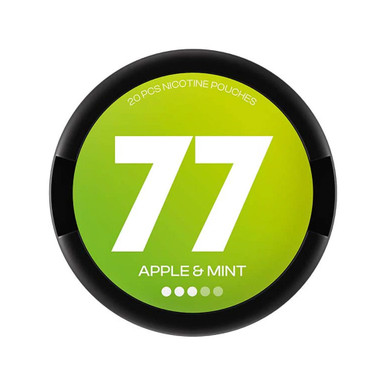
A single-name can like this one is making one claim and has to land it. A blended can is making two or three and can lean on the interaction between them, which is a different kind of proposition. The Pablo Gold Edition blueberry and peach listing at £19.95 and 77 Apple Mint at £39.90 are both examples of the blended approach, where what you are recognising is a combination rather than a single thing. SYX Tropical at £29.90 goes further and does not name its fruits at all, offering the family rather than any member of it.
Single-name cans are easier to judge before buying, because the name tells you almost everything. Blended cans are harder to predict and more interesting to try. Neither is better; they are different bets, and knowing which you are making is most of what this section is for.
Where a pouch is used, and who actually decides that
The second question people bring to a pouch listing is about settings, and the useful answer is mostly about responsibility rather than about the product.
Nobody at a shop can tell you where you may use one
We sell these. We do not write the rules for the places you go, and neither does anybody else selling them. Policy on nicotine products in any given building, vehicle, workplace or venue belongs to whoever runs it, and there is no national answer we could give you even if we wanted to.
What we can do is set out where those rules actually live, because most people looking for an answer are looking in the wrong place.
Where the policy is written down
In a workplace, the relevant document is usually a staff handbook, an intranet policy page or a contractual term, and the section is rarely headed in a way that makes it easy to find. The phrase to look for is a catch-all: many organisations now write their policies to cover all nicotine products rather than listing product types individually, and where that wording exists it settles the question and a pouch is covered. If you cannot find the document, HR or a line manager is the person to ask, and asking creates a record that protects you.
On a construction or industrial site, the relevant rules come through the induction and the site-specific rules, which are set by the principal contractor and can be stricter than any employer's general policy. The induction is where to raise it.
For a carrier — air, rail, coach or sea — the relevant document is the operator's conditions of carriage and whatever crew instruct on the day. Those differ between operators and between routes, they change, and crew instructions override the written document. We hold none of that information, do not monitor it and will not interpret it. Ask the operator before you travel.
In someone else's home, car or office, the rule is whatever they say it is, and asking costs nothing.
Silence is not permission
Here is the part worth sitting with. Using a pouch involves no action anybody would notice, which means that in practice nobody is going to stop you at the time. It is tempting to read that as permission. It is not. It means only that the consequences, if there are any, arrive later and are had with somebody more senior than the person who would have said something at the time.
Equally, signage is not a ruling. A notice prohibiting one category of product tells you about that category. It is not a statement about a different category, and reading it as one is a decision you have made rather than a permission you have been given. Where a place has not addressed the question, the correct conclusion is that you do not know the answer, and the correct action is to find somebody who does.
What we will not say
We are not going to describe this product as suited to any setting, suggest using it anywhere in particular, or present it as the thing to reach for where something else is not allowed. Those are claims we have no basis for and no business making. The object is a tin. The rules belong to whoever owns the room. Asking is cheaper than assuming, and that is the end of what a shop can usefully contribute.
What sits alongside this can in a drawer
Few people keep only one flavour. The common pattern is two or three at a time, because a taste you have had continuously for a fortnight stops registering as it did at the start. What follows is described purely through flavour, brand and price.
Because coconut is a distinctive and slightly polarising flavour, the usual second can is a straightforward fruit rather than another soft or creamy one. Within the brand, the Black line is where most people look, and it runs at the same £39.90 across the board. Cuba Black Cherry is the sharpest fruit on that shelf and about as far from creamy as the brand gets. Cuba Black Blueberry is the dark-berry reading, and Cuba Black Apple Juice is the orchard-fruit one. All three are direct contrasts with a coconut can rather than variations on it.
Cuba Black Banana Hit, also £39.90, is the closest thing in the Black line to this can's register — banana is another soft, sweet, low-acid fruit — so it is the pairing to pick if you want a second can that will not clash, and the one to avoid if you specifically want contrast.
Two Black listings sit outside the fruit half entirely. Cuba Black Cola at £39.90 is the soft-drink flavour, and Cuba Black Cold Dry at the same price is named for a cold, dry character rather than any flavour at all — the furthest point in the range from a sweet coconut, and the usual choice for somebody who wants the second can to have nothing in common with the first.
The brand also runs lines other than Black and Ninja. Cuba White Apple Juice at £39.90 is an example of the same flavour idea appearing under a different line, and it is a reminder to check each page's own declared figure rather than assuming one carries across lines.
Outside the brand, the tropical shelf gives you the obvious neighbours at a range of prices. Velo Tropical Mango at £4.19 is the least expensive way to keep a second tropical option in the house. Elf Bar Pineapple at £29.90 is the sharp single fruit that contrasts most directly with a creamy one, and Fumi Fiery Peach at £27.90 is the stone-fruit reading. Denssi Blueberry Freeze at £39.90 puts a cold register over a berry, which is a third direction again.
If none of that is quite it, the tropical listings, the Pablo shelf and the full catalogue are the three places to browse from here.
Looking after an opened tin
Most of storage is one habit: put the lid back on properly, straight away, every time. Pressed down until it seats — not balanced on top, not left at an angle.
What goes wrong when that habit slips is gradual rather than dramatic. The pouches dry out slowly and the flavour gets quieter than it was on the first day. Soft, sweet flavours show that sooner than cold ones do, so a coconut can is one of the places you would notice it early. That is a comment about taste and about the physical state of the pouches, and we take it no further, because anything beyond that is not information we hold.
The commonest reason a lid stops seating is an over-full catch compartment, which is why emptying it counts as storage rather than tidiness.
Otherwise: room temperature, out of direct sun. A drawer, a cupboard, a bag. The problem places are a car in summer, first and worst, then a sunny windowsill, then a bathroom shelf with its steam and temperature swings. On refrigeration — a question we get regularly — we hold no manufacturer storage instructions for this product and will neither recommend it nor advise against it. If the can carries storage guidance, that guidance beats this page.
We hold no shelf life, no best-before period and no production date, and we will not estimate any of them. Sealed cans hold their condition better than opened ones, so where you keep several, run one at a time rather than four at once.
What is actually being chosen here
Not much. One flavour, one declared figure of 30mg, one price of £39.90, and no can count in our records, so there is no pack size to weigh either. The decision on this page is whether to buy it.
The choices that do exist sit one step away. A different flavour within the brand, where the Black line holds at £39.90 and only the lid changes. A different brand at a different price, with the tropical listings named above spanning £4.19 to £39.90. Or a filter by declared figure, using the Strong shelf with its 132 listings, the Medium Strength shelf or the Extra Strong shelf.
Which of those to pick is not something we will offer a view on. A shop steering people towards particular nicotine strengths is doing something it should not do, and we do not.
Buying it, and the age check
The listing goes into the basket at £39.90 and you check out as normal. It shows in stock as this is written; stock moves, and the live product page is always more current than a description written in advance.
Age verification applies and is not a formality. Sales are to over-18s only, and ID may be requested on delivery. Where a check is asked for and cannot be met, the parcel is not handed over — so keep ID to hand, and make sure the name on the order matches the name on the ID. Do not order on behalf of anyone under 18, in any circumstances.
Delivery timings, packaging and courier arrangements live on our checkout and delivery pages, which stay current in a way this text cannot.
Routes back to this listing
Three, corresponding to the three ways people search. The Cuba range, 47 listings across more than one line, is the brand route. The tropical shelf, 58 listings, is the flavour route and is where this can lives despite Coconut being the name on the lid. The Strong band, 132 listings, is the figure route.
If scrolling suits you better than filtering, the whole shop is one page, and the Pablo range and the Extra Strong band are the shelves people most often move across to from here.
Common questions, answered honestly
Why is a coconut product filed under tropical?
Because our shelves group by flavour family rather than by individual flavour name, and coconut belongs to the tropical family. It is a filing decision, not a claim that this can tastes like mango. The product name on the lid is Coconut, our flavour record says tropical, and both statements are accurate at the level they operate on. Browsing the tropical shelf is how you will find it.
Is this one flavour, or coconut with something else in it?
The flavour information we hold points to a single named flavour with nothing else named alongside it. No mint is listed and no second fruit is listed. If the can names anything further, the can is the authority. For blends, the Pablo Gold Edition blueberry and peach listing at £19.95 and 77 Apple Mint at £39.90 are examples of the two-flavour approach.
What is in the pouch?
We do not publish that and we do not hold it. Composition is manufacturer information and it belongs on the manufacturer's packaging, which is where you should read it. We are not going to summarise, paraphrase or estimate it, and any page that did so without holding the underlying data would be guessing. The can is the document.
How many cans is £39.90 buying?
We do not hold a can count or a pouch count for this listing — those fields are empty in our data and we will not invent a figure to fill them. The printed packaging carries it. We recognise that is unsatisfying at this price and we would rather give it than a number we cannot stand behind.
Does Cuba mean it is made in Cuba, and what does Ninja mean?
Cuba is a brand name and Ninja is a line name within it. Neither tells you where the product is made, and we hold no country-of-origin information for this listing at all. Nor are we going to read any meaning, character or suggestion into the word Ninja — it is a name the manufacturer has given a line, and that is all we know about it.
How does 30mg compare with the higher figures on your other Cuba pages?
As arithmetic, 30 is a smaller declared number than the figures on some other listings, which is why this one files under the Strong band rather than the extra-strong one. That is the whole of the comparison we will make. The bands are filing brackets rather than a scale, we do not present them as a progression, and we will not say which figure is appropriate for anybody.
Can I use one at work or while travelling?
Not our call, and we will not guess. Employers, site operators and carriers set their own policies; many are written to cover all nicotine products; and crew or site instructions override written documents. Signage about one category is not permission regarding another, and nobody noticing is not the same as being allowed. Check the staff handbook, the site induction or the operator's conditions of carriage, and ask before rather than after.
How long does one last?
We cannot give a figure. Individual variation is wide enough that an average would mislead most people who read it, and advising anyone on their own use is not something we do. Descriptively, the usual reason given for taking one out is that the flavour has finished, and on a soft sweet flavour the specific character tends to fade before the sweetness does. The can's printed guidance is what to follow.
Should it be kept in the fridge?
We hold no manufacturer storage instructions for this listing, so we will not recommend refrigeration and will not advise against it. Some people do it. Generally, heat and direct sunlight are what people regret: a car in summer is where most complaints about a flat-tasting can begin. If the can carries storage guidance, follow that in preference to anything written here.
I do not like coconut. What is the nearest thing that is not coconut?
Depends which part you were after. For the same soft, low-acid register with a different fruit, the Banana Hit can at £39.90 is the closest. For something sharper and more defined, the Elf Bar pineapple listing at £29.90 or the Killa apple can at £33.50. For a tropical family flavour without any single fruit named, SYX Tropical at £29.90.
Is it available at the moment?
It is listed as in stock at the time of writing. Stock moves and the live listing page will always be more current than this text. If it shows unavailable when you get there, the tropical shelf is the place to look for something in the same family while it is out.
What the law requires us to tell you
This is an age-restricted product. None of the following is small print.
- 18+ only. Cuba Ninja Coconut is sold exclusively to adults aged 18 or over who already use nicotine products. We do not sell to under-18s in any circumstances, and we do not sell to adults who do not already use nicotine.
- Nicotine is an addictive substance. That applies to this can exactly as it applies to every other nicotine product we list.
- This is not a licensed stop-smoking medicine. It is neither authorised nor intended for that purpose, and it is not intended for non-smokers, for anyone who does not already use nicotine, for under-18s, or for anyone pregnant or breastfeeding.
- ID may be requested on delivery. Age verification applies at checkout and may be repeated at the door. Where a check cannot be satisfied, the order is not handed over.
Questions about nicotine and your own health or circumstances belong with a qualified healthcare professional rather than with a retailer. We sell products. We do not give medical advice, we do not assess whether any product is appropriate for an individual, and nothing on this page should be read as either.
Where that leaves it
Cuba Ninja Coconut is a £39.90 listing with one declared figure of 30mg, filed under the Strong band and on the tropical shelf despite Coconut being the name on the lid. It is a soft, creamy, low-acid flavour in a family otherwise full of sharp ones, which makes it distinctive and makes it a poor blind guess if what you wanted was a fruit. We hold no can count, no composition and no origin for it, and this page has said so rather than filled the gaps.
More from Cuba
More strong pouches

More tropical pouches
Where this sits
Cuba Ninja Coconut Nicotine Pouches appears in these categories. Browse them, or jump to something close.
You might also like