Home / Medium Strength / 77 Peach Mint Nicotine Pouches
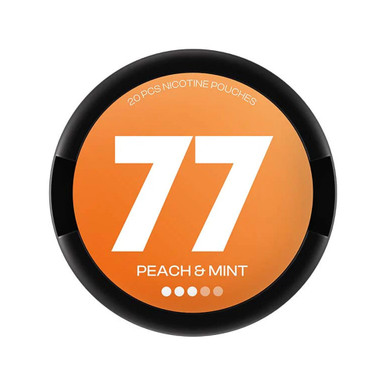
77 · 10.4mg · 10-can pack
Read the full guide
77 Peach Mint Nicotine Pouches
£39.90
✔ In stock — ready to ship
100% tobacco-free
Free over £20
Same-day dispatch
Secure checkout
This page describes 77 Peach Mint Nicotine Pouches. There is one declared strength on the listing, 10.4mg, and one price, £39.90, which covers ten cans. Our flavour record gives two entries for it: mint and tropical. And the thing that ought to be said at the top rather than buried at the bottom — we currently list this product as out of stock.
That last fact changes how a page like this should be read. There is no point writing a description that pretends you can put the thing in a basket this minute. What a page is still good for when the shelf is empty is everything else: telling you what the product is so you know whether it is worth waiting for, placing it accurately against the cans that are available, and being specific enough about the flavour that you can decide whether one of those alternatives would do instead. That is what the rest of this page tries to do.
The full guide to 77 Peach Mint Nicotine Pouches
5,180 words on how it eats, who it suits, how to serve it and what to put beside it.
The listing in plain terms, including the stock line
Everything factual above comes from our own product record and nowhere else. Where that record is silent — and it is silent on several things people reasonably ask about — this page says so rather than inventing a plausible-sounding answer. A gap stated honestly is more useful than a number somebody made up.
One standing note before the detail: this is an adult nicotine product, sold only to people aged 18 and over who already use nicotine. The compliance wording in full has its own section at the foot of the page.
Ten cans for £39.90, and what that changes
Unusually for our listings, we do hold a can count here: this is a ten-can listing. That single fact reshapes the whole purchase, and it is worth separating out rather than leaving it in a specification line.
The first thing it changes is the arithmetic. £39.90 across ten cans works out at £3.99 a can, which puts the per-can figure at the low end of anything on our shelves, and well below several products that look cheaper at first glance because they are priced singly. When you are comparing this page against, say, Velo Peach Ice at £4.19, you are comparing a ten-can total against a single-can price. Both numbers are correct. They are not the same kind of number, and that is the most common way people misread a pouch shelf.
The second thing it changes is commitment. Ten cans of one flavour is a lot of one flavour. If you already know the flavour and buy it regularly, that is exactly what you want and the reason multi-can listings exist. If you have never had it, ten cans is a large bet on a description written by somebody who has not tasted what is in your mouth. That is a genuine argument for putting a single-can listing of something similar alongside it rather than ordering ten of an unknown — and it is an argument about shopping, not about the product.
The third thing it changes is storage, which sounds trivial until you have ten pouch cans in a kitchen drawer. They stack, but a stack of shallow tins is unstable and tends to spread. The section on keeping cans, further down, covers the practical side of that.
Peach against mint, described as taste and aroma
The name on the can is Peach Mint. Our flavour filing gives mint and tropical, which is the shelf we put peach on, and it is worth saying openly that the shelf tag and the printed name are two different systems: the tag says which of our categories the can belongs to, the name says what the manufacturer called it. Where they read differently, the can is the authority.
Peach, as a flavouring, is one of the softer fruit characters. It is sweet without being sharp, and its distinguishing feature is a sort of roundness — there is no edge on it the way there is on citrus, and none of the dark, jammy weight of a blackcurrant or a forest berry. Peach flavourings often carry a faintly floral top note, which is the part that makes them recognisable as peach rather than as generic sweet fruit, and a slightly thick or nectar-like quality in the middle. It is a flavour that fills the mouth rather than cutting through it.
Mint here is the counterweight. A soft, round, sweet fruit on its own can read as cloying after a while, and mint is the standard answer to that: it puts a cool, green line underneath the fruit and stops it from spreading out. In a pairing of this shape you should expect the mint to be the second voice rather than the first — present throughout, clearly identifiable, but not the thing the can is named after.
The aroma on opening tends to run the other way round from the taste. Cool notes are the more volatile, so the mint usually arrives at the nose first and the peach follows underneath it. That is a normal characteristic of fruit-and-mint cans generally and nothing peculiar to this one.
An honest limit on all of this: we hold flavour categories, not formulations. Describing peach as a flavour family is fair; claiming to know the exact balance in a particular manufacturer's pouch is not. Two cans with identical tags can be noticeably different, and the only way to settle that is to have one.
Placing this can on four axes
The most useful way we have found to describe a flavour without exaggerating it is to place it on four plain axes — how cool it reads, how sweet, how sharp and how bitter — and to say where the uncertainty is. This is the section of the page doing the real descriptive work, so it is the longest.
The cool axis: present, but not the headline
Cool is the axis where fruit-and-mint cans vary most, and the range across our shelves is enormous. At one extreme are the frost-and-ice presentations, where cold is the entire proposition and any fruit in the name is essentially a colour. At the other are fruit cans with a whisper of mint that you would struggle to identify blind.
A peach-and-mint construction almost always sits in the middle of that range, for a straightforward reason of flavour design: peach is a delicate character and a heavy cold treatment obliterates it. If you build the cold up past a certain point, you no longer have a peach can, you have a cold can with something vaguely sweet behind it. So expect the cool here to be moderate — enough to give the fruit definition, not enough to take it over.
For contrast at the high end of this axis, Klint Arctic Mint at £36.90 and Edge Spearmint at £14.95 are the cans on our shelves where cold and mint are the whole description rather than the supporting one. Put either beside this can and the difference on the cool axis is the first thing you would notice.
The sweet axis: high, and the defining feature
Of the four axes, this is the one where a peach can sits furthest from the middle. Peach is a sweet flavour by nature — sweeter, in the flavouring vocabulary, than apple, sharper berries or anything in the citrus family — and a peach-named can is going to read as sweet unless the maker has worked hard against it.
What that means practically is that this is not a subtle or austere flavour. If your usual can is a plain mint or a dry, savoury-leaning description, a peach pairing will read as noticeably sweeter than what you are used to, and that is worth knowing before ordering ten of them. If your usual can is already a sweet fruit, it will read as ordinary.
The comparison that makes this concrete is UBBS Cola Ice at £19.95, where the sweetness is a confectionery cola sweetness rather than a fruit one, and Killa Banana Ice at £33.50, which is the other soft, round, high-sweetness fruit character we stock. Banana and peach are near neighbours on this axis in a way that banana and, say, blackcurrant are not.
The sharp axis: low
Sharpness — the acid edge, the thing that makes a citrus or a sour berry bite — is largely absent from a peach description. Peach is not an acidic flavour, and nothing in our flavour record for this can suggests anything acidic has been put alongside it. The mint contributes coolness, which people sometimes describe as sharp, but coolness and acidity are different axes and it is worth keeping them apart when you are comparing cans.
If sharpness is the quality you want, the cans to look at are elsewhere: SYX Apple Kiwi at £29.90 pairs two of the more acidic fruit characters we stock, and Nordic Spirit Frosty Berry at £4.49 puts a berry against a frost treatment, which is a much more angular construction than this one.
The bitter axis: minimal, with one caveat
Bitterness in a pouch generally comes from one of two places: a deliberately bitter flavour note — coffee, liquorice, certain herbal characters — or from the base material itself, which every pouch has to some degree and which people notice to very different extents. Neither peach nor mint is a bitter flavour, so the first source does not apply here.
The caveat is the second source, and it is honestly variable. Some people report a background note under any pouch regardless of flavour; others never mention it. We cannot tell you which you are, and we hold no data on how pronounced it is in this particular product. What we can say is that it is not a flavour-design feature of a peach-and-mint can, and anything of that sort you notice is coming from the format rather than from the name on the lid.
For a can where bitterness is deliberately part of the description rather than a background, Fumi Dark Spice at £27.90 is the clearest contrast we stock — a spiced, darker profile that sits at the opposite corner of this four-axis map from a sweet peach.
Reading the four together
Taken as a set: high on sweet, moderate on cool, low on sharp, minimal on bitter. That is a roundly sweet fruit can with a cooling line through it and no angles. It is one of the less complicated shapes a pouch can have, and if you already know you like soft sweet fruit characters, the description will hold few surprises. If you prefer angular, cold or dry cans, this shape is not going to convert you and we are not going to pretend it will.
The format, for anyone comparing it against something else
A pouch is a small sealed sachet that goes in the mouth between the lip and the gum, most often at the front under the top lip, and stays there. It is not chewed, not sucked and not swallowed. It comes out in one piece when the person is done with it. That is true of every product we sell and there is nothing brand-specific about it.
The handling routine is three movements: lid off, pouch out, lid on. The pouch is held in place by the lip and stays where it is put. It can be moved from one side of the mouth to the other if the spot it occupies becomes uncomfortable, and if it is uncomfortable everywhere, taking it out is the sensible response. There is nothing to be gained from persevering with something that does not sit well.
Duration varies enormously between people and we will not pretend to a single number. The span people describe across the category runs from something like twenty minutes to about an hour, with plenty outside it in both directions. The flavour is the part that changes most obviously — clearest early, fading from there — which is why most people take a pouch out when the taste has gone rather than by timing it. That is an observation about behaviour, not an instruction.
Used pouches go in a bin. Cans of this general type usually include a shallow catch compartment under the lid for holding used pouches until a bin appears; we do not hold a specification for this can and will not promise you the compartment is there, so look when you open one. If it is there, empty it often — it is the part of the can that gets unpleasant if ignored, and it is for carrying rubbish rather than storing it.
What 10.4mg is doing on the lid
The figure printed on this can is 10.4mg. It is a declared amount per pouch, published by the manufacturer, and it is best understood as a label that allows products to be sorted rather than as a forecast of anything.
Its practical function on this site is filing. Because of that figure, this listing sits on our medium-strength shelf, which is the biggest strength category we run at a hundred and thirty-five cans. Above it are the strong shelf and the extra-strong shelf, which carry the listings with higher declared figures. That is the whole of what the number does here: it puts the can in a row with other cans.
What the figure does not do is guarantee that two cans printed with the same number behave alike. Pouch size, moisture level, flavour intensity and the way a particular maker builds a pouch all vary between products, and none of that is captured in a milligram figure. We hold the declared number. We do not hold anything behind it and will not speculate about it.
And to be explicit about what this section is not: it is not advice. We cannot tell you which figure is right for you, we know nothing about you, and choosing is your business rather than ours. What we provide is the shelf layout so you can find the part of it you already buy from.
Rotation: what people put beside a peach can
Very few regular buyers keep a single flavour and nothing else, and with a ten-can listing the question of what goes alongside it becomes more pressing rather than less. Ten cans of one sweet fruit is a long run at one taste. What follows is how a second and third can usually get chosen, with the reason for each stated from our own shelves.
Staying inside peach
The closest thing we stock by description is Pablo Silver Edition Blueberry Peach Ice at £39.90, which keeps the peach but puts a blueberry alongside it and an iced treatment over the top. That is a genuinely different can — three elements rather than two, and the cold pushed further up — while still being recognisably in the peach family. The other is the £4.19 Velo Peach Ice, which is a single-can listing and therefore the cheapest way on our shelves to put a second peach in the house without committing to another ten.
Those two cover the two obvious directions from here: peach made more complicated, and peach made colder. Both sit with this listing on the fifty-eight-can tropical shelf, which is where our filing puts stone and tropical fruit characters.
Changing the temperature rather than the fruit
The second common move is to keep a fruit can and a cold can in rotation, so that the two never blur into each other. On our shelves the cold end is well populated: Klint Arctic Mint at £36.90 and Edge Spearmint at £14.95 are two different readings of it — the first built around an arctic presentation, the second around the sharper, greener spearmint character. Either makes a clean contrast against a sweet peach, and both live on the mint shelf, which at a hundred and forty-eight cans is the largest flavour category we run.
Leaving the fruit shelf altogether
The third move, and the one that produces the most variety for the money, is to pick something that shares no flavour tag with this can at all. UBBS Cola Ice at £19.95 is a cola presentation rather than a fruit one. Fumi Dark Spice at £27.90 is the spiced, darker end of what we carry and about as far from a peach as our range goes. Cuba Black Apple Juice at £39.90 is a straight fruit with no mint underneath it, which is a different construction rather than a different fruit.
Building a rotation that actually works
If you want a rule of thumb that is about shopping rather than about consumption, it is this: pick cans that differ on at least two of the four axes above, not one. Two sweet fruit cans that differ only in which fruit is named will start to read as the same thing within a week. A sweet fruit, a cold mint and something dry or spiced will not. The cans named in this section were chosen on exactly that basis — SYX Apple Kiwi at £29.90 for sharpness, Killa Banana Ice at £33.50 for a different soft-sweet fruit, and the £4.49 Nordic Spirit Frosty Berry for a berry-and-frost construction, each of them moving on a different axis from where this can sits.
Where Peach Mint falls in the 77 range
We carry twenty-nine listings from this maker, and the 77 brand page holds all of them together. The range is broad: fruit cans, mint cans, fruit-and-mint pairings like this one, cola presentations, tea-flavoured entries, dessert-leaning names and a sub-line of smaller cans.
Within that, Peach Mint is one of the brand's fruit-plus-mint entries, and it has a direct structural counterpart in 77 Apple Mint at £39.90 — the same two-word construction with a sharper, crisper fruit in place of the soft one. If you like the shape of this can but not the particular fruit, that is the first place to look.
Away from mint, 77 Forest Fruits is the brand's mixed dark-berry entry, again at £39.90, and a much deeper flavour family than anything peach. The two cola variants, 77 Cola Ice and 77 Cola Vanilla, both at £39.90, show what the maker does outside fruit entirely — one cold, one sweet and vanilla-led.
The brand also runs a smaller-format sub-line, which is a format difference rather than a flavour one and worth knowing about for that reason alone. 77 Ghost Mini Mango keeps to the tropical family in a mini can, and 77 Ghost Original Mini is the plainer entry in the same format, both at £39.90. A mini can is a noticeably different object in a pocket from a standard one.
Looking after cans, particularly ten of them
The storage rules for pouches are short, and the only thing a ten-can order changes is that you will be storing most of them unopened for a while.
For the can in use: keep the lid on and pressed down flush. The lid is all that separates the contents from the air, and a can left open overnight will be drier and less flavoursome in the morning. This is the single most common way people spoil a can they have already paid for.
For the cans not yet in use: leave them sealed, keep them somewhere cool, dark and dry, and keep them out of direct sunlight. The three places cans most reliably suffer are a sunny windowsill, a car interior and a shelf above a radiator — heat is harder on flavour than anything else short of leaving the lid off. A drawer or a cupboard is entirely adequate. A fridge is not required; some people use one by preference and we neither suggest it nor warn against it.
Check the printed date on the base, and work through a multi-can order oldest first. With ten cans in a drawer it is genuinely easy to lose one behind the others for a year, so putting new stock at the back is worth the two seconds it takes.
Finally, and not as a formality: store every can well out of reach of children and animals. A pouch can is small, brightly printed and simple to open. Ten of them in a low drawer is ten opportunities. This is an adult product and the storage should reflect that.
One variant on the listing: what there is and is not to choose
This page carries a single variant — 10.4mg at £39.90 for ten cans — so there is no strength selection to make and no price that moves depending on what you pick. Whatever decision you make about this product, it is not a decision about which option on the page.
What that leaves is the question of whether ten cans of one flavour is the shape of order you want, and that is genuinely worth a thought at this quantity. Ten is the right number for a flavour you already buy. It is a large number for a flavour you are meeting for the first time. Where a single-can listing of something comparable exists on our shelves — and for peach it does, in the £4.19 Velo — that is the cheaper way to find out whether the family suits you.
If the declared figure rather than the flavour is what does not suit, the answer is a different shelf rather than a different option here. The medium shelf holds a hundred and thirty-five cans at figures in this region, and the strong and extra-strong shelves hold the listings above it. We are telling you where they are, not suggesting you go there.
Ordering, waiting for stock, and the check at the door
Because we list this product as out of stock, the honest first sentence is that you cannot order it from this page at the moment. The listing stays up because stock positions change, because people want to know what a product is before it returns, and because taking pages down every time a shelf empties makes a catalogue impossible to navigate.
When it is available, buying it is unremarkable. It goes in a basket with anything else from our full catalogue — flavours, brands and strengths all mix freely in a single order, and there is no rule requiring separate baskets for different kinds of can. One basket means one parcel and one occasion on which somebody has to be in to receive it.
We sell to adults aged 18 and over only. Age verification forms part of the order process and is not optional. Photographic ID may be requested on delivery, and a courier can refuse to hand over a parcel to anyone who cannot produce it or who appears to be under 18. A refused parcel goes back. Having ID to hand on the day, and not arranging for someone under 18 to take the delivery, avoids the whole problem.
On delivery timings and carriers, our shipping pages carry the current position and are a better source than a paragraph in a product description that will be out of date within months. The one durable piece of advice is to consolidate: one order rather than three.
The shelves this page belongs to
This listing appears in four places in our navigation, and any of them will bring you back to it. It sits on the 77 range page with the maker's other twenty-eight listings; on the medium-strength shelf among a hundred and thirty-five cans; on the mint shelf, our largest flavour category; and on the tropical shelf, which holds fifty-eight.
Of those four, the tropical shelf is the most efficient way back to this specific can, simply because fifty-eight entries can be scanned and a hundred and forty-eight cannot. If you are browsing rather than hunting, brand pages tend to work better than flavour ones, because a maker's range has a consistency that a flavour category does not: the Pablo range and the Cuba range are two of the larger ones we carry. And the complete shop listing holds everything in one place if you would rather start from the top and work down.
Questions people ask about this one
When will it be back in stock?
We do not know, and we are not going to guess. Restock dates depend on supply, and a date printed on a product page that then slips is worse than no date at all. The product listing is the live record: when it can be added to a basket, it is available. If waiting is not practical, the peach cans mentioned on this page are the nearest things we stock by description, and one of them is a single-can listing.
How many cans do I get for £39.90?
Ten. This is one of the listings where our record does carry a can count, which puts the per-can figure at £3.99. That is worth holding in mind when you compare this page against single-can listings elsewhere on the site — a £4.19 listing and a £39.90 listing are not comparable numbers until you know what each one covers, and here we can tell you exactly what it covers.
How many pouches are in each can?
We do not hold that figure. Our record carries price, can count, strength, flavour tags and stock position, and no pouch count. Rather than print a number that sounds right, we will say plainly that it is not something we know. The printed can carries it, so it can be read the moment one is in your hand. The same applies to can weight, dimensions and anything else stamped on the packaging.
Why is it filed under tropical when it is a peach?
Because that is the flavour shelf our categorisation puts stone and tropical fruit characters on. The tag tells you which of our categories the can appears in; the name on the lid tells you what the manufacturer called it. The two systems answer different questions and occasionally read oddly against each other. Where they differ, treat the printed can as the authority and the tag as a navigation aid.
Is the peach or the mint stronger in the flavour?
Our record gives both tags and the name leads with peach, which is as far as the facts take it. Beyond that we would be describing a formulation we do not hold. What can be said generally about this construction is that the cool note tends to reach the nose first when the can is opened and the fruit tends to read as the sweeter of the two in the mouth. Balance is the thing that varies most between cans that look identical on paper.
Which strength should I choose?
We do not make that recommendation. It is a personal decision, we know nothing about the person asking, and a shop is the wrong source for it. What we will tell you is the layout: this listing is 10.4mg, it sits on a medium shelf of a hundred and thirty-five cans, and there are strong and extra-strong shelves above it holding products with higher declared figures. That is information, and the decision is entirely yours.
Will it taste the same as the other peach cans you stock?
Probably not, and any shop that promises otherwise is overreaching. Shared flavour tags mean shared shelves, not shared recipes. Two products can both be filed as peach and be noticeably different in the mouth, because pouch size, flavour intensity and the maker's own formulation all vary and none of those appear in a category tag. The only way to compare two cans reliably is to have both.
Can I order it in the same basket as other brands?
Yes, whenever it is available. There is no restriction on mixing brands, flavours or strengths in one order, and most orders are mixed. Practically, a single basket means a single parcel and a single delivery to be in for. If you are assembling a mixed order, the 77 range page is the quickest way to pick several cans from the same maker without searching for each one individually.
How long do people keep one in?
We do not issue instructions on that. The range people describe across the pouch category runs roughly from twenty minutes to an hour, with plenty of people at either end of it and beyond. The flavour fades before the end of that span for most people, which is why taste rather than a clock is usually what decides it. Take it out whenever you want to — there is nothing that needs finishing.
Do you publish ingredients or technical information?
No. We do not publish ingredient lists, composition, manufacturing detail or technical specification for this or any other listing, and we do not paraphrase what is printed on the packaging either. The can and the manufacturer's own materials are the right source for that. Our product pages cover price, strength figure, flavour category, format, availability and comparison with other stock, and stop there on purpose.
Where is it made?
We do not hold that information. Country of origin, manufacturing site and company ownership are not part of the record we keep for this listing, and guessing at any of them would be worse than leaving the question open. If the printed can carries that detail, read it there.
Will I be asked for ID?
Assume yes. Age verification is built into the order process, and photographic ID may also be requested at the door. Whether a particular courier asks on a particular day is their judgement, but the parcel can be refused if ID cannot be produced or the recipient appears to be under 18. We sell only to adults aged 18 and over who already use nicotine, and the checks are what keep that true. There is no way around them.
What if I order ten cans and do not like the flavour?
That is the real risk of a multi-can listing and we would rather name it than skate past it. Our returns position for opened consumable products is set out in our terms, which are the authority rather than anything written here. The practical answer costs nothing: if the flavour is new to you, buy a single can of something comparable first. The peach listings named on this page include one priced as a single can for exactly that reason.
Compliance, stated plainly
This product is for adults aged 18 and over. We sell it only to adults who already use nicotine.
Nicotine is an addictive substance.
It is not a licensed stop-smoking medicine, and it is not intended for non-smokers, for anyone who does not already use nicotine, for anyone under 18, or for anyone who is pregnant or breastfeeding. Nothing written on this page is a health claim, a medical claim or advice about your own use. Questions about nicotine and your own health belong with a healthcare professional and not with a retailer.
Age verification is carried out during the order process, and photographic ID may be requested on delivery. Couriers may refuse to release an order to anyone unable to produce acceptable identification or who appears to be under 18. Store this and every product of its kind securely and out of the reach of children and animals.
Last word
77 Peach Mint is a single-strength listing at 10.4mg, priced at £39.90 for ten cans, tagged mint and tropical, and currently out of stock on our shelves. On the four axes this page uses, it reads high on sweetness, moderate on cool, low on sharpness and minimal on bitterness — a round, sweet fruit with a cooling line through it and no hard edges.
Where we hold a fact, this page has printed it, including the can count and the awkward one about availability. Where we do not — pouch count, origin, formulation, restock date — it has said so. We would rather a listing be short on answers than long on invented ones.
More from 77
More medium strength pouches
More mint pouches
Where this sits
77 Peach Mint Nicotine Pouches appears in these categories. Browse them, or jump to something close.
You might also like