Home / Medium Strength / 77 Watermelon Ice Nicotine Pouches
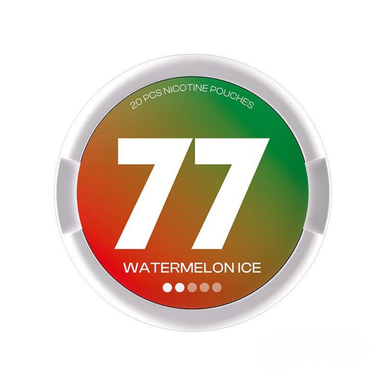
77 · 5.2mg–10.4mg
Read the full guide
77 Watermelon Ice Nicotine Pouches
£39.90
✔ In stock — ready to ship
100% tobacco-free
Free over £20
Same-day dispatch
Secure checkout
77 Watermelon Ice Nicotine Pouches, listed at £39.90, available here in two declared strengths — 5.2mg and 10.4mg — both at that same price. Our records show it in stock. The brand is 77 and the maker's product name is Watermelon Ice. Our flavour data attaches two tags to it: watermelon and mint.
Most of this page is about taste. That is deliberate, because a fruit-and-ice pouch is bought almost entirely on flavour — the format is the same across every product we sell, the price is identical between the two strengths, and so the only real question in front of you is whether this is a taste you want in your mouth. So we have given the tasting note the long treatment rather than the customary two adjectives, and followed it with a section on why a flavour name and a flavour are not the same thing.
The full guide to 77 Watermelon Ice Nicotine Pouches
4,987 words on how it eats, who it suits, how to serve it and what to put beside it.
What is listed on this page
Everything factual here comes from the small set of fields we hold. Where those fields stop, we say so instead of writing past them, and on a page this concerned with flavour that happens more than once — we hold no formulation data of any kind and will not pretend otherwise.
The necessary line before anything else: this is an age-restricted nicotine product sold to adults who already use nicotine. Full wording at the bottom.
The tasting note: four axes
Adjectives on a product page tend to be useless because they are unanchored — "refreshing" and "bold" tell you nothing you can act on. A more useful approach is to place a flavour on a few axes that can be described in ordinary language, so we have used four: cool, sweet, sharp and bitter. Here is where this can sits on each.
| Axis | Where this can lands |
|---|---|
| Cool | High. The mint tag and the word Ice both point the same way, and the cold is a leading characteristic rather than a finish. |
| Sweet | Moderate to high. Watermelon is one of the sweeter fruit directions, though the cold cuts across it. |
| Sharp | Low. This is not a citrus and not a sour berry; there is little acidity in the watermelon direction. |
| Bitter | Low. Nothing in either tag points at bitterness, unlike a coffee, a liquorice or a dry citrus. |
Cool
The cold is the first thing to arrive and the most structurally important part of the flavour. Both signals in the product point at it: the mint tag in our data, and the word Ice in the name. In a can built this way the cold is not a finishing touch laid over the fruit at the end — it runs underneath the whole thing and is what stops the sweetness becoming cloying over a long sitting.
Compared with a straight mint, the cold here is a component rather than the subject. White Fox Double Mint at £34.90 or Klint Arctic Mint at £36.90 are cans where the cold mint is the entire proposition; here it is doing a supporting job behind a fruit. If you want cold as the headline, those are the pages to look at rather than this one.
Sweet
Watermelon sits at the sweeter end of the fruit spectrum and reads as sweet almost by definition. It is a round, soft, watery kind of sweetness rather than a concentrated or jammy one — the difference between a melon and a berry preserve, roughly. In a pouch, that sweetness is usually the second thing you register after the cold, and it is what carries through the middle of the sitting.
How sweet this particular can is relative to another is not something we can put a number on, because intensity is not a field we hold for any product. What we can say is which direction it belongs to, and on the sweetness axis it belongs to the fuller end rather than the dry one.
Sharp
Low, and this is the axis that most distinguishes a melon from the fruits people often group it with. A citrus brings acidity. A blackcurrant or a raspberry brings a tartness behind the sweetness. Watermelon brings very little of either — it is sweet without being sour, which is unusual among fruit flavours and is a large part of why it reads as gentle even at a reasonable intensity.
The practical consequence is that this is not a flavour that cuts. If what you want is something with an edge to it, a fruit like the one in Pablo Silver Edition Blueberry Peach Ice at £39.90 brings a stone-fruit sharpness this can does not have.
Bitter
Also low, and for the same reason. Neither tag on this can points anywhere near bitterness. Coffee flavours have it as their backbone; dry citrus and liquorice carry it as an undertone; a cooled melon has essentially none. If a slight bitter edge is something you look for in a flavour, this can does not offer it and we are not going to suggest otherwise.
The four together
Put the axes side by side and the shape is: cold and sweet, with almost nothing in the way of sharpness or bitterness to complicate it. That is a straightforward flavour, in the literal sense — not much is happening besides the two things the name announces, and what it does it does plainly.
Whether that is what you want is genuinely a matter of preference and not something a page can settle. Some people want a flavour with corners on it and find a cooled melon too simple to keep in the mouth for long. Others want exactly that simplicity. Both are reasonable and we are not in a position to arbitrate between them.
How a fruit note gets built into a dry pouch
This is the part of flavour that product pages almost never discuss, and it explains a great deal about why a can labelled with a fruit does not taste like the fruit.
A flavour name is a target, not a description
When a can says Watermelon, it is naming what the flavour is aiming at. It is not claiming to be the fruit, and nobody involved thinks it is. The name is a shorthand that lets you predict roughly what will happen in your mouth, and it succeeds or fails at that job to different degrees for different fruits.
This matters because the gap between name and experience varies a lot. Mint is a small gap — mint flavourings read as mint and most people are satisfied by them. Cola is a small gap too, because the thing being imitated is itself a manufactured flavour rather than something growing on a plant. Fruits vary wildly: some render convincingly, some are famously difficult, and the difficulty has nothing to do with the quality of the product.
Why watermelon is one of the hard ones
Watermelon is an interesting case because so much of the actual fruit is texture and water. Bite into a melon and a large part of what you experience is coldness, wetness and the way it gives — the flavour compounds are a fairly delicate top note sitting on all that. A dry format cannot reproduce texture or water content. It can only work with the flavour part.
The result, across every brand that attempts it, is that pouch watermelon is a recognisable flavour rather than a convincing imitation. It reads as "watermelon" the way a watermelon sweet reads as watermelon — you know immediately what is meant, and you would never mistake it for the fruit. That is not a criticism of this can or any other; it is what the flavour category is, and it is worth knowing before you order rather than after.
It also explains why so many watermelon products carry a cold note alongside. Look at the group we stock: this can, Velo Watermelon Ice at £4.19, Fumi Watermelon Mint at £27.90, ZYN Watermelon Mint at £19.99. Every one of them pairs the fruit with mint or ice. The cold stands in for the coldness and wetness of the real fruit that a dry format cannot deliver, which is why the combination is nearly universal and why a plain uncooled watermelon pouch is a rarity.
What the word "Ice" is doing
Across the shelf, Ice attached to a fruit name is a naming convention, and a fairly reliable one. It signals that a cold note has been set alongside the fruit rather than the fruit standing alone. You see it working the same way on UBBS Cola Ice at £19.95, where the cola is the subject and the ice is the modifier, exactly as the melon is the subject here.
What it is not is a graded scale. There is no standard defining how cold "Ice" must be, no body policing it, and no consistency between makers beyond the general direction. It tells you cold is present. It does not tell you how much, and anyone claiming to read a precise temperature off a label is inventing.
Aroma and taste are not the same event
One genuinely useful thing about a can is that you smell it before you taste it, and the two do not always match. Cold and mint notes are volatile and carry, so they tend to dominate what you get when the lid comes off. Softer fruit notes do not carry as well, so a can can smell more of mint than it tastes of mint.
That is worth knowing because people sometimes judge a can on the first sniff and conclude the fruit is missing. Give it the actual sitting before deciding. The order in which a flavour presents itself — aroma first, then the cold, then the fruit underneath — is a property of how flavours behave, not a measure of how much of each is in there.
Where this section stops
Firmly here. We are describing how flavour naming and flavour perception work, which is legitimate to discuss. We are not describing what is inside a pouch, and we will not: we hold no formulation information for this product or any other, we do not publish ingredient detail, and we are not going to explain the composition of something we have never been given details of. For anything of that kind, the manufacturer's own printed information on the can is the only source worth having.
5.2mg and 10.4mg: reading two numbers
This listing carries two declared strengths — 5.2mg and 10.4mg — and both variants are priced at £39.90. Those figures are the manufacturer's own declarations per pouch, printed on the can, and we publish them exactly as they are given to us without adjustment.
The two numbers are, as it happens, one exactly double the other, and that is the only relationship between them we are in a position to state. It is arithmetic about two printed labels. It is not a statement about what either will be like, it is not a scale of any kind, and it is certainly not a suggestion that one is a step toward the other.
Both figures put this can in our medium band, which holds 135 products. That band is a filing system of our own: we sort cans by declared figure so that the catalogue can be browsed that way. The Strong band and the Extra Strong band hold cans declaring higher numbers. Those are sorting decisions, not rankings, and a higher band does not mean a better product.
Two standing cautions apply, as they do on every strength section we write. Declared figures are not comparable between brands — makers declare in different ways against different formats, so matching numbers on two different cans do not mean matching cans. And we will not tell you which figure is right for you. We do not know you, we are not qualified to advise, and a retailer giving that kind of guidance would be doing something it should not.
What the format does to a flavour
The mechanics of the format are the same for everything we sell: a small sealed pouch goes between lip and gum, usually under the top lip, and stays there. Nothing is chewed, nothing is swallowed. You place it, leave it, take it out, and put it in the catch compartment under the lid or in a bin. Used pouches are general waste.
What is worth adding on a page about flavour is how the format shapes the taste over time, which is different from how a drink or a sweet behaves. The flavour does not arrive all at once and then stop; it comes up over the first minutes, holds for a while, and then thins gradually. Nobody can tell you when that fade will happen for them, which is why we publish no duration figure — the honest range across people runs from a few minutes to the better part of an hour, and an average of that would describe nobody. The manufacturer's usage guidance is printed on the can and takes precedence over any general description here.
The fade is also why the cold and the fruit can seem to change places over a sitting. The cold, being the more volatile part, tends to lead early and recede first, leaving the sweeter fruit more exposed later on. That is a general property of cold-plus-fruit cans rather than a measured claim about this one.
Two practical notes to close this section. The catch compartment under the lid is where a used pouch goes when there is no bin nearby; empty it before it stops the lid seating flat. And we hold no pouch dimensions for this product, so we will not tell you whether it is a slim format or a regular one — the can states that.
Where this can sits among 77's other flavours
The 77 brand page holds 29 products, and the six nearest neighbours are all listed at £39.90, the same as this can. Arranged by how far they sit from a cooled melon:
- 77 Apple Mint — the closest relative structurally, being another fruit with mint set against it, though an orchard fruit brings a crispness a melon does not.
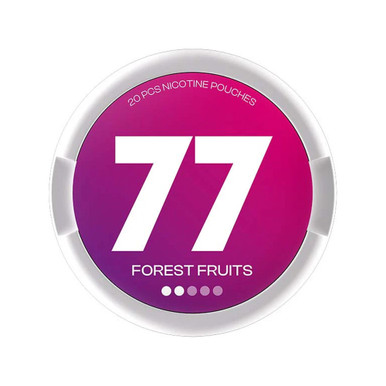
- 77 Forest Fruits — dark mixed berry, sweeter and considerably deeper, with none of the cold this can has.
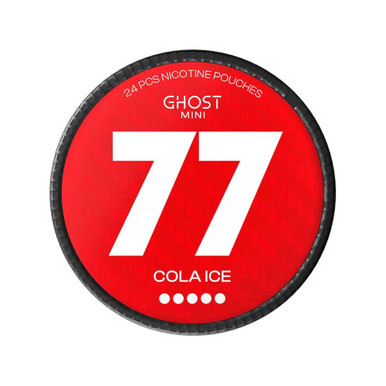
- 77 Cola Ice — the same Ice convention applied to a soft-drink flavour instead of a fruit, which makes it the best comparison if you want to isolate what the cold does.
- 77 Cola Vanilla — the cola family without the cold, rounded out with vanilla.
- 77 Ghost Mini Mango — a tropical fruit in the brand's mini-format line, so both the flavour and the can differ from this one.
- 77 Ghost Original Mini — the plain version of that same mini line.
The two cola cans are genuinely instructive if you are trying to understand your own preferences: the same brand offering one flavour with the Ice treatment and one without lets you see what that modifier contributes, on a flavour that is not a fruit.
A small shelf: watermelon on this site
The watermelon shelf holds 23 products, which makes it one of the smaller flavour categories we run — for comparison, the mint shelf carries 148. That is worth knowing if watermelon is what you browse on, because it means the shelf is short enough to read end to end rather than filter through.
Within that shelf, the cans nearest this one show how wide the price band is for what is broadly the same idea. Velo Watermelon Ice at £4.19 is the cheapest listing of the group and shares both the fruit and the Ice convention. ZYN Watermelon Mint at £19.99 and Fumi Watermelon Mint at £27.90 sit in the middle, both naming the mint explicitly rather than using Ice. Nordic Spirit Melon Fresh at £4.49 goes to melon generally rather than watermelon specifically, which is a real distinction — melon covers a broader and usually softer family.
Those price gaps are about what each listing contains, not about one product being nine times the object another is. We say more about that in the buying section, and it matters here because this is a group where the spread is unusually wide.
Three ways of naming the same idea
Something becomes visible once you line up the melon cans we stock, and it is worth a section because it changes how you read a shelf. Four products, all pointing at roughly the same flavour idea, all naming it differently.
Fruit plus Ice. That is this can, and it is the Velo can at £4.19 as well. The convention puts the fruit first as the subject and appends Ice as the modifier. It signals a cold note without naming what provides it, which is why our data still records a mint tag on products named this way — the tag is doing the work the name leaves implicit.
Fruit plus Mint. The ZYN listing at £19.99 and Fumi's watermelon and mint can at £27.90 both take this route. It is the more literal naming: it tells you outright that mint is the second component rather than leaving you to infer a cold note. Whether a can named this way differs in practice from one named Ice is not something we can tell you — the naming is a choice made by the maker, and we hold nothing that would let us translate between the two conventions.
A broader fruit, plus a mood word. The Melon Fresh can at £4.49 does something different again. It names melon rather than watermelon, which is a genuine widening — melon covers a family that includes softer, more perfumed varieties as well as the watermelon direction. And it uses a vaguer modifier in place of Ice or Mint, which tells you less about what has been set alongside the fruit.
The practical upshot is a caution about shopping by name. Two cans with near-identical names may differ; two cans with quite different names may be aiming at much the same thing. Naming conventions are chosen by each maker for their own reasons, no standard governs them, and none of these words is a measured quantity of anything. The flavour tags on our listings are more consistent than the names are, because we apply them ourselves to the same small vocabulary across the whole catalogue — which is why the tags rather than the titles are what build our flavour shelves.
That is also the honest answer to the question people really want settled, which is whether one of these four cans is closest to this one. We cannot rank them. We can tell you they share a flavour direction and that their prices run from £4.19 to £39.90; the rest is a matter of trying them.
What people keep alongside it
A cooled fruit is generally rotated rather than used exclusively, and the second can people keep tends to fall into one of two categories.
A plain mint, as a contrast to the sweetness. Edge Spearmint at £14.95 takes the leafy direction; SYX Cool Mint at £29.90 and Klint Arctic Mint at £36.90 take the cold one; White Fox Double Mint at £34.90 doubles up on mint entirely. Any of them is a different enough experience from a sweet cooled melon to be worth having on the shelf beside it.
Or a different fruit, for variety within the same general idea. Pablo Silver Edition Blueberry Peach Ice at £39.90 matches this can's price and keeps the Ice treatment while changing the fruit completely, and the UBBS Cola Ice can at £19.95 keeps the cold but leaves fruit behind altogether.
This is a description of what people do with a shelf of cans, not an encouragement to buy more than you came for.
Looking after a can
The lid does most of the work. Seated flat, the can is closed and the contents keep; left off or sitting crooked, it is not, and a cold note in particular will thin noticeably because the cold is the volatile part of the flavour. On a can like this one, a badly stored tin loses its cold edge before it loses its sweetness, which changes the balance described further up this page.
Keep it somewhere cool and dark. A drawer, a cupboard, a bag, a glovebox in winter. Not a windowsill, not a dashboard in summer, not above a radiator. Heat and direct light are the two things that degrade a can over weeks and both are trivially avoidable.
Refrigerating cans is a habit plenty of pouch users have. It does nothing bad. Whether it makes a difference you would notice is argued about and we are not going to pronounce on it; if you do it, keep the can sealed and keep it away from anything you would rather not taste of cold melon.
Keep cans out of reach of children and animals, and store them somewhere deliberately rather than leaving them on a table. That is the most important sentence in this section and it is not about flavour at all.
Otherwise: empty the used-pouch chamber often enough that the lid keeps closing properly, check the date printed on the can, and leave the pouches in the can they came in.
Choosing between 5.2mg and 10.4mg
There are two variants and they cost the same, so price is not a factor in the decision. That leaves the declared figure as the only difference between them, and here we have to be direct about what we will and will not do.
We will tell you what the numbers are: 5.2mg and 10.4mg, both £39.90, both in our medium band, one exactly twice the other as printed. We will tell you that the flavour is the same across both, since the flavour tags apply to the product rather than to a variant. We will tell you that both are in stock as we write.
We will not tell you which to choose. That is not reticence for its own sake — it is that a recommendation about a nicotine strength is advice about how much nicotine a person should use, and a shop is not the right source for it under any circumstances. We do not know you, we have no basis for an opinion, and a page that offered one would be doing something it should not. The figures are printed on the can for you to read, and the decision is yours.
The one genuinely practical point we can make about the two-variant structure is to check which variant you have selected before checking out, because both display at the same price and it is easy to click past the selector when nothing changes on screen.
Ordering, delivery and proving your age
We sell to adults in the UK aged 18 or over who already use nicotine. Age verification applies at checkout and ID may be requested on delivery — if it cannot be produced, the courier may decline to hand the parcel over. We will not knowingly supply anyone under 18 or anyone ordering for someone under 18.
On price comparison, and this page has quoted a wider range than most: from £4.19 to £39.90 for cans that are broadly attempting the same flavour. That spread reflects what each listing contains rather than any judgement about the products. Our data holds no can count for this listing — the field is empty — so we cannot tell you what £39.90 buys here, and we are not going to reason backwards from the price to a number. Check the listing page and its image before ordering, and ask us if it is not clear.
Delivery charges, carriers and timings are shown at checkout against your actual basket and address, which is where they can be accurate. We do not quote timescales in product copy because copy does not get updated when a carrier changes a schedule.
Finding things from here
Flavour is the natural route from a page like this one. The watermelon listing is short enough to read in full, and the mint listing is the place to go if the cold rather than the fruit is what you are after. Brand is the other common route: the 77 page for this maker, and two of the larger ranges on the site are the Pablo listing and the Cuba listing.
If you would rather sort by the declared figure, the three band shelves do that. And the full catalogue shows everything at once if you prefer to narrow down yourself rather than start from a category.
Questions we are asked
Does it actually taste like watermelon?
It tastes like watermelon flavouring, which is a recognisable thing but not the fruit. Much of a real melon is texture and water content, and a dry format cannot reproduce either — only the flavour part. Expect something closer to a watermelon sweet than to a slice of melon. That is true of every watermelon pouch on the market, not a characteristic of this one specifically.
What is the difference between the 5.2mg and the 10.4mg?
The declared figure printed on the can, and nothing else we hold. Both are £39.90, both carry the same flavour tags, both sit in our medium band, and both are in stock. One figure is twice the other as printed. We cannot advise which to choose and will not — that is advice about nicotine use, which a shop should not give.
How much mint is in it?
We cannot quantify that. Our data records that this product carries both a watermelon tag and a mint tag, and the name adds the word Ice, which conventionally signals a cold note alongside the fruit. How the balance falls is not a specification we hold for any product, and putting a ratio on it would be invention.
Why do nearly all watermelon pouches have mint in them?
It is close to universal across the category, and the likely reason is that the cold stands in for the coldness and wetness of the real fruit that a dry format cannot deliver. Every watermelon can we stock pairs the fruit with mint or ice in some form. An uncooled watermelon pouch is a genuinely unusual thing to find.
How many cans do I get for £39.90?
We do not hold that figure — the cans-per-pack field for this listing is empty, and we hold no pouch count either. We will not infer a number from the price. The listing page and the product image are where to check before ordering, and asking us is better than assuming, because pack-size assumptions are the commonest cause of a disappointed order.
Is the flavour different between the two strengths?
Not as far as our data goes. Flavour tags attach to the product rather than to an individual variant, so both are recorded as the same watermelon-and-mint flavour. Whether the two taste identical in practice is not something we hold information on, and we are not going to claim they do or do not.
How long does the flavour last?
Longer than a few minutes and shorter than forever, which is as precise as we can honestly be. Flavour comes up over the first minutes, holds, then thins gradually rather than stopping. The variation between people is wide enough that publishing an average would mislead. Any guidance printed on the can by the manufacturer is what applies.
Is this one of the sweeter flavours you stock?
On direction, yes — watermelon belongs to the sweeter and rounder end of the fruit range rather than the sharp or dry end. On intensity, we cannot tell you, because we hold no measure of how sweet any can is and no way to rank one against another. Direction we can describe; degree we cannot.
Which strength is in stock?
Both variants show as available as this page was written. Stock moves, so the live answer is the listing page and its variant selector rather than this sentence. If a variant has gone, that will show on the page itself.
Where is it made?
We do not hold that information and will not state a country of origin we cannot verify. The manufacturer's details are printed on the can, which is the reliable place to read them. The same goes for company history, production and anything else outside the small set of fields we publish.
Can I keep one in while drinking something cold?
Physically nothing prevents it and people do. Whether it is pleasant is personal — a cooled sweet flavour alongside a cold drink is something some people like and others do not. There is no rule either way, and nothing here is guidance about when to use one.
Is the pouch size the same as other brands?
We do not hold pouch dimensions for this product, so we cannot compare it with anything. Sizes do vary between makers and between lines within a maker, and the designation is printed on the can. Every pouch within one can is the same as the others in it, so the first one tells you what the rest are like.
Compliance and legal wording
Sold only to adults aged 18 or over who already use nicotine. Age verification applies at the point of ordering and ID may be requested on delivery; where it cannot be produced, the parcel may not be released.
Nicotine is an addictive substance. We state that plainly here, as on every nicotine listing we publish, because it is the most important fact about the contents of the can.
This product is not a licensed stop-smoking medicine and nothing on this page presents it as one. It is not intended for non-smokers, for anyone who does not already use nicotine, for anyone under 18, or for anyone who is pregnant or breastfeeding. We make no health, medical or therapeutic claim about it in any direction.
Keep cans away from children and pets. Any medical question about nicotine is one for a qualified professional rather than a retailer, and we will not attempt to answer one.
To close
A two-variant can at 5.2mg and 10.4mg, both £39.90, tagged watermelon and mint, shelved in our medium band and on a watermelon category that runs to only 23 products. Cold and sweet, with little sharpness and no bitterness to speak of, and a flavour that reads as watermelon flavouring rather than as the fruit — which is what that category is everywhere, not a shortcoming of this can. If the cold is what you are after rather than the fruit, the mint category is the better shelf to browse; if the fruit is, the watermelon category holds the alternatives.
More from 77
More medium strength pouches
More mint pouches
Where this sits
77 Watermelon Ice Nicotine Pouches appears in these categories. Browse them, or jump to something close.
You might also like