Home / Medium Strength / ZYN Coffee Mini Nicotine Pouches
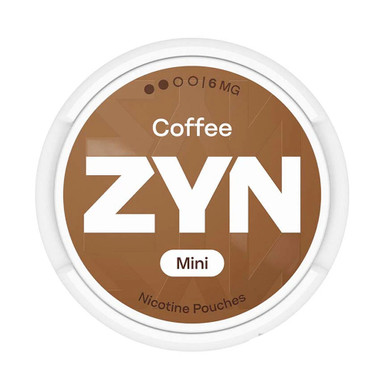
ZYN · 6mg–11mg · 5-can pack
Read the full guide
ZYN Coffee Mini Nicotine Pouches
£19.99
✔ In stock — ready to ship
100% tobacco-free
Free over £20
Same-day dispatch
Secure checkout
The product on this page is ZYN Coffee Mini Nicotine Pouches, listed at £19.99 for a pack of five cans. Two declared strengths sit against it — 6mg and 11mg — and both carry the same £19.99 price, so the figure you pick has no effect on what you pay. The flavour tag in our record is one word: coffee. The portion size is the manufacturer's mini format. The listing is in stock as this is written.
Those are the facts our record holds, and everything below is drawn from them, from comparisons against other cans on our shelves, or from saying outright that something is not known to us. Where the two are in tension we will take the admission over the invention every time.
The full guide to ZYN Coffee Mini Nicotine Pouches
5,047 words on how it eats, who it suits, how to serve it and what to put beside it.
ZYN Coffee Mini: what the listing holds
This is an adult nicotine product, supplied only to people aged 18 or over who already use nicotine. The formal wording on that has its own section further down, and nothing on this page is written to encourage anyone to consume anything.
Five cans at £19.99 is a shade under £4.00 each. That division is ours, not the manufacturer's, and it exists for one purpose: comparing this listing fairly with the single-can listings elsewhere on the site, where a £4.19 headline and a £39.90 headline describe completely different quantities. Compare per can, or the numbers on our shelves will mislead you.
We do not publish a pouch count per can. That field is not in our record for this listing, and the printed can is where the number lives. Small gap, better named than papered over.
Coffee here is the name of a flavour
This needs saying clearly and early, because the word does more work in people's heads than it should.
Coffee is the flavour tag recorded against this listing. It describes an intended taste. It is not a statement that the can contains coffee, and we are not making one. Our record holds flavour names, prices, strengths, formats and stock positions. It does not hold a contents list, and we do not publish contents for any product on this site, because inventing one would be worse than useless and copying one out of somewhere else would be no better.
The related question people ask is about caffeine, and the answer is the same shape. We do not hold any information about caffeine in this product, in either direction. We are not telling you there is caffeine in it and we are not telling you there is none. We genuinely do not know, that is not a field in our record, and the manufacturer's own labelling on the can and carton is the only place that question gets answered properly. If the answer matters to you, read the can before you open it rather than taking a shop's word for it.
The same logic applies to every flavour name in this catalogue. A cherry tag is not a claim about cherries, a cola tag is not a claim about cola, and a coffee tag is not a claim about coffee. Flavour names describe what something is meant to taste like. Treating them as ingredient declarations is a mistake that a great many product pages encourage and that this one is trying not to.
Building a roasted note into a dry pouch
The first thing this page is meant to examine properly is how a recognisable flavour gets built in a format like this one, and coffee is a particularly good case for it because it is the hardest kind of flavour to carry across.
Start with what a dry pouch actually offers a flavour. There is no heat. There is no liquid arriving in volume. There is no cup under your nose feeding the nose while the mouth works, and aroma normally does an enormous share of the job when anyone tastes anything. What there is, instead, is a small object at room temperature sitting in one place for a stretch of minutes, releasing its taste slowly and steadily into a mouth that is otherwise empty. Every flavour on this site has to work inside those limits.
That suits some flavour families far better than others. Mint translates almost perfectly, because mint is largely a cool, aromatic sensation and needs neither temperature nor volume to read as itself. Sharp fruit translates well, because acidity and sweetness both register immediately on the tongue and neither depends on heat. Coffee is the difficult one, because so much of what a cup of coffee is comes from things a pouch structurally cannot supply — the warmth, the weight of liquid, the huge aromatic cloud that comes off a hot surface.
So what a coffee-flavoured pouch has to do is isolate the parts of the experience that live on the tongue rather than in the nose or in the temperature, and build the flavour out of those. In practice that means three components. The first is bitterness, which is the backbone of coffee as a taste and the element that makes it recognisable at all. The second is the roasted, slightly burnt-sugar character that separates coffee from other bitter things — the note that says roasted rather than simply bitter. The third is a sweetness underneath, usually more pronounced than in a black cup, because without it the bitterness has nothing to sit against and reads as flat and medicinal over a long session.
The balance between those three is where individual cans differ from each other. Lean harder on bitterness and you get something dry and dark that people either respect or dislike. Lean harder on the sweetness and you drift towards the cappuccino and caramel end, which is a different flavour altogether and is usually named as such on the can. Where any particular can sits on that spectrum is not something our record captures, so we can tell you the shape of the problem but not the manufacturer's exact answer to it.
The other structural point about flavour in this format is how it behaves over time. It is not a constant. Flavour comes up over the first minute or two, holds at a level for a period, and then thins out gradually rather than ending. With a roasted flavour the sweetness generally fades before the bitterness does, which means the back half of a session tends to read drier and darker than the front half. That is normal behaviour for the family. It is not a can losing quality, and it is the main reason people describe coffee pouches as changing character as they go, where a mint can tends to stay more or less itself from start to finish.
What survives the translation, and what does not
It is worth being honest about the limits, because coffee is a flavour everybody has a strong reference point for and the reference point is a cup.
What comes across is the bitterness, the roast character, and enough of the sweetness to hold the two together. What does not come across is everything that depends on temperature and volume — the warmth, the body, the way a hot drink fills the nose. A pouch is not attempting to be a cup and it will not read as one. Anyone approaching a coffee-flavoured pouch expecting the experience of a drink is going to be disappointed by it, and that is a mismatch of expectation rather than a fault in the product.
What it does read as is a dark, bitter, roasted taste with a sweet edge, held at room temperature for as long as the pouch is in place. Judged on those terms it is a perfectly coherent flavour and it has a following among people who find every sweet fruit option on a shelf too similar to every other. Judged as a substitute for a drink it fails, because it was never structurally capable of being one.
The practical upshot: if you have never got on with dark, bitter tastes, this flavour family is unlikely to convert you, and the sweeter neighbours are the more sensible place to look. If bitterness is specifically what you want on a shelf otherwise full of berries and mints, this is one of only nine listings we hold with the coffee tag on it, and that scarcity is itself a reason people seek the family out.
Carrying it, and who decides where it can be used
The second thing this page has to cover is discretion, which is the reason a great many people use this format at all, and the rules around setting, which are not ours to write.
Start with the object. A tin of this kind is a shallow plastic cylinder that fits in a closed hand. It goes in a coat pocket, a trouser pocket, a bag, a glovebox or a car door bin without any fuss, and it survives being sat on rather better than it looks like it will. The failure mode is a lid knocked partly off in a warm pocket and left that way, which costs you the contents slowly over a day or two without anything obvious happening to announce it. Press the lid home when you put the can away; that is genuinely the whole of the maintenance.
In use, the mini portion is the quiet end of the format. A pouch placed under the upper lip and pushed off to one side does not interfere with speech in any way an ordinary listener would notice, and a smaller portion is less likely than a standard one to show as a fullness in the line of the lip. Whether it shows at all depends on your own mouth and on where you put it, which is not something a product page can predict for you. There is no visible object, nothing in the hands, and nothing in the air. That combination is the practical reason the format has the user base it has.
And now the part that matters more than any of it. We do not tell you where you may use this. Discretion is a property of the format; it is not permission, and the two are very easy to confuse. Whether a pouch may be used on a particular premises is a matter for whoever runs that premises. Whether it may be used at work is a matter for your employer and whatever policy they have written. Whether it may be used on a train, a coach, a plane or a ferry is a matter for the operator, and operators differ from each other and change their terms. Countries differ too, and some of them treat products in this category quite differently from the way the United Kingdom does, so an assumption carried across a border can be an expensive one.
None of those rules are ours to interpret and we are not going to guess at them on your behalf. A shop's opinion about somebody else's policy is worth nothing. Ask the venue, read the employer's policy, check the operator's conditions of carriage, and look up the destination's own rules before you travel with cans. The fact that something is unobtrusive is not the same as the fact that it is allowed, and we would rather say that plainly than let the word discreet do quiet work it should not be doing.
The mini portion, in practice
Mini is a format word. It describes the physical size of the portion and nothing else — not a rank, not a grade, not a stage in anything. The manufacturer names its own cans and we list the names as given.
A smaller portion means less to feel against the inside of the lip, less to accommodate, and less chance of it being noticeable to anyone else. People who have found the standard size intrusive sometimes find the smaller one is the one they stop thinking about. People perfectly happy with a standard portion usually have no reason to care about the difference at all. That is the whole of the trade-off, and it has nothing to do with the number printed on the can.
How long anyone keeps one in varies enormously and there is no correct figure to give. Reports across the format run from a few minutes to something close to an hour, with most of it in the middle. What usually ends a session is the flavour thinning rather than a timer, and since thinning is gradual, no moment announces itself. That leaves it as your decision, which is where it belongs.
Disposal is the part packaging tends to skip. A used pouch goes in the catch compartment in the lid — the shallow upper chamber with its own floor — and from there into a bin when you reach one. Not down a toilet, not on the ground, and never left anywhere a child or an animal could get to it. Empty the compartment when you open a fresh can rather than letting it fill up, because a packed catch chamber stops the lid seating and an unseated lid is exactly how a dry can goes flat. Where there is no compartment or it is already full, a folded tissue in a pocket is the unglamorous answer and it works.
6mg and 11mg on the same listing
Two declared figures sit against this product, at the same price, with the same flavour and the same pack size. That makes the decision between them a pure one, and it makes it worth explaining what the figures do.
A declared milligram figure is a number the manufacturer states and prints, expressed per pouch. On our site it performs exactly one function: it determines which shelf a listing is filed on so that a catalogue of several hundred products can be navigated. It is an organisational number.
It is not a rank and it is not a sequence. Two figures printed on one listing are two options, not a first step and a second step, and we have not built the catalogue as a route from any figure to any other. A larger number is not more advanced, is not a graduation, is not an achievement and is not better. A smaller number is not a rehearsal. We would ask you not to read the page that way, because that reading is not in the data and it is not something we would put our name to.
The figure also will not let you compare across brands the way a shared unit suggests. Manufacturers declare on their own terms, and portion size, format and flavour construction all change how any given can reads in use. Two cans printed with the same number from two different houses are not equivalent because of it. The figure describes a declaration. It does not describe a person's experience.
We cannot tell you which of the two to buy. Not on this page, not by email, not on the phone. That is not evasion. It is that the question is about you, and the only things we know about are cans. We publish what is declared and where we have filed it, and the choice stops with you. If you want a view on it, it needs to come from somebody qualified to give one.
The address, the title and the shelf
There is a small inconsistency on this listing and we would rather flag it than leave it lying around.
The web address of this page carries the word strong. The catalogue title we hold does not — it reads simply as ZYN Coffee Mini Nicotine Pouches. And our own band for the listing is Medium Strength rather than anything else. So an address, a title and a shelf label are all saying slightly different things about the same product.
The explanation is mundane. Addresses on a catalogue this size were built from names that have shifted over the years, and a published address is better left intact than broken, because breaking it breaks every link that points at it. An address is a filing string rather than a description, and where it disagrees with a declared milligram figure, the figure is the thing to trust — it is what the manufacturer states and what we sort by. None of the three words involved is a judgement about the product or a recommendation to anybody.
You will see the same pattern elsewhere on our shelves. Killa Cappuccino at £33.50 is another coffee-family listing whose address carries words its catalogue title does not, and the same advice applies there: read the declared figures on the listing rather than the words in the address bar.
The roasted corner of the catalogue
Coffee is a small shelf here. The coffee flavour shelf holds nine listings in total, which makes it one of the narrower classifications we keep, and if you are specifically after this taste family it is the fastest way to see the whole of it at once.
Within that small group, Clew Coffee at £39.90 is the ten-can option, which is the listing to look at if you already know the flavour suits you and want a supply rather than a sample. The Killa listing linked above takes the cappuccino route instead, meaning a sweeter, milkier reading of the same basic idea rather than a dark and bitter one. Those two plus this one give you three quite different answers to the same flavour brief, and between them they cover most of what anyone means when they ask for coffee on a pouch shelf.
Adjacent to coffee without being in it, 77 Cola Vanilla at £39.90 comes at the dark-and-sweet idea from the soft drink side, and UBBS Salted Caramel at £19.95 is the confectionery version of the same territory — though that one is out of stock at the moment, so treat the link as a look rather than an order.
The rest of the ZYN listings
The ZYN brand shelf holds twenty-two listings at a common £19.99 price, and this is the only roasted one among them. Everything else the brand gives us is mint, fruit or a blend of the two.
On fruit, ZYN Black Cherry is the dark, rounded option and the nearest the brand's fruit cans come to this one in weight, if not in character. ZYN Blackcurrant Forest is the sharper berry, and ZYN Citrus is the acidic, zesty end of the range — about as far from a roasted flavour as it is possible to get inside one brand, which is precisely why people who keep a coffee can often keep a citrus one beside it.
For fruit with a cold element, ZYN Blueberry Mint is the blend on the shelf. ZYN Cool Mint X is the plain mint listing and carries the brand's widest spread of declared figures, from 1.5mg to 11mg, all at the same price. And ZYN Guava Spice X is the range's oddity, a tropical fruit with a spiced note rather than a straightforwardly sweet one. All of those sit at £19.99 and all are in stock.
What people keep beside a coffee can
Nobody sensible uses one flavour continuously, because a flavour used continuously stops registering. A dark, bitter can in particular tends to want something completely unlike it in the rotation. Here is what sits near this one on our shelves, with a reason attached to each.
For maximum contrast, the mints. Klint Arctic Mint at £36.90 is the cold, aggressive end of that family and about as different from a roasted taste as anything we stock. Edge Spearmint at £14.95 is the sweeter, softer mint at a mid price point, which makes it a cheaper way to keep a second flavour going.
For fruit contrast, Fumi Blackcurrant at £27.90 is a dark berry that shares the weight of a roasted flavour without sharing the bitterness. Nordic Spirit Blueberry at £4.49 is the single-can way to put a soft berry into the rotation without buying a box of it. SYX Apple Kiwi at £29.90 is a sharper, greener pairing, and Pablo Silver Edition Blue Raspberry at £39.90 is the sweet, confected end of the fruit shelf for people who want the opposite of bitter.
If you are browsing rather than repeating an order, the Pablo shelf and the Cuba shelf are two of the larger brand pages we keep, and both hold more listings than a product page can usefully link.
Where a bitter flavour is awkward, and where it is not
One more practical observation about this taste family, offered as description rather than advice.
A dark, bitter flavour interacts with whatever else is in your mouth far more noticeably than a mint or a sharp fruit does. Straight after something sweet it reads as harsher than it is; straight after something acidic it can read as oddly flat. Neither effect lasts and neither means anything is wrong, but it does explain why the same can seems inconsistent to people who use it at scattered points across a day and quite consistent to people who reach for it at the same sort of moment each time. If you have tried a coffee-flavoured pouch once, at a bad moment, and written the family off, that is worth knowing before you write it off permanently.
Temperature has an effect too, though on the can rather than on you. A tin carried warm all day will taste slightly duller than the same tin out of a cool drawer, because warmth takes the lighter part of a flavour first and a roasted flavour has less of that part to spare. It is a small difference rather than a dramatic one, and it is the reason the storage section below is worth two minutes of attention rather than none.
Keeping five cans in good condition
These are dry pouches and drying out is the thing that goes wrong. Heat, direct sun and a badly seated lid are the causes, in that order of damage done.
Keep them cool and dark — a drawer, a cupboard, the inside of a bag. The worst place available in an ordinary life is a car dashboard in summer, with a sunny windowsill close behind. Sustained warmth pulls moisture out of the pouches and takes the lighter parts of the flavour with it. On a roasted flavour that shows up as the sweetness going first and the bitterness being left exposed, which is a fairly unpleasant way for a can to decline.
With five cans, open one and leave four sealed. A sealed can holds its condition far longer than an opened one, and there is nothing at all to be gained by breaking the seals in advance. Bring them into use one at a time. The people who open a whole multipack at once and then find the last can disappointing have generally explained their own problem.
Seat the lid properly every time, and empty the catch compartment before putting a can away for any length of time. A used pouch left sitting in a lid is unpleasant to reopen and prevents the lid closing cleanly, which brings you back to the drying problem by another route.
Refrigeration is optional rather than necessary. A sealed can takes no harm from it and it slows the drying, but for cans you will work through in a normal span it makes little difference, and repeatedly moving a cold tin into a warm pocket helps nothing. Above all, keep every can where children and animals cannot reach it. That one is not about quality.
Buying, ID and delivery
The listing is in stock as this page is written, at £19.99 for five cans at either declared figure. The basket is the authority on price and availability if it ever disagrees with body copy, which goes stale in a way a basket does not.
Sales are restricted to people aged 18 or over and the restriction is enforced rather than decorative. Age verification runs against orders, and where it cannot be completed electronically we will ask for something further before anything is despatched. The courier may also ask for photographic ID at the door, and the driver is entitled to refuse to hand over the parcel if it is not produced. Nothing is left with anyone under age and nothing is left unattended where age cannot be established.
Delivery choices, carriers and costs are shown at checkout against your own basket and address, and those are the figures that apply to your order.
Where this page sits on the site
Three classifications lead here. The listing is filed on the Medium Strength shelf by its declared figures, on the brand shelf linked above by its maker, and on the coffee flavour shelf by its tag.
Our other bands are the Strong shelf and the Extra Strong shelf. Those names are sorting labels, applied by us at listing level for navigation, and they carry no verdict and no recommendation of any kind. If none of the shelves is a useful entry point, the complete catalogue lists everything we hold in one place.
Questions people actually ask about this one
Does this contain coffee?
Coffee is the flavour name on the listing, describing an intended taste. It is not an ingredient declaration and we do not publish ingredient declarations for anything on this site. We hold flavour tags, prices, strengths, formats and stock — not contents. The can and carton carry whatever the manufacturer declares, and that is the only place to settle the question properly.
Does it contain caffeine?
We do not hold that information, in either direction. We are not telling you it does and we are not telling you it does not, because we genuinely do not know and that field does not exist in our record. If this matters to you — and for some people it will — read the manufacturer's own labelling on the can before opening it rather than relying on anything a shop has written.
How many cans is £19.99?
Five, and that figure comes from our record rather than an estimate. It works out at a shade under £4.00 a can, which is the number worth using when comparing this against single-can listings elsewhere on the site. Comparing headline prices across listings with different can counts is the commonest way to get the maths wrong on a shelf like ours.
How many pouches in a can?
Not held. Our record carries a can count for this listing but no pouch count, and we would rather tell you the field is empty than publish a number we cannot source. The printed can carries it, and if the exact count matters for the order you are planning, that is the place to check before you buy.
Is 11mg stronger in taste than 6mg?
Those are two different things, and the record does not connect them. The declared figure is a manufacturer's number about the pouch; the flavour tag for this listing is the same single word across both options. We have no data showing the taste differs between them and none showing it is identical. We are not going to assert either.
Is mini a weaker version?
Mini describes the physical portion, not the declared figure. A smaller pouch does not automatically carry a lower number — that depends entirely on the listing, and this one declares 6mg and 11mg regardless of its portion size. Read the figure rather than inferring anything from the word, which is the manufacturer's naming for a size and nothing more.
Can I use these at work?
That is entirely a question for your employer, and their written policy is the answer to it. We have no view on it, we have no visibility of it, and a shop's opinion about somebody else's workplace policy is worth nothing at all. The same goes for venues, licensed premises and anywhere else with rules of its own. Ask the people who set the rule.
Can I take these on a plane or abroad?
Carriers set their own conditions and countries set their own rules, and some treat this category very differently from the United Kingdom. We cannot tell you what applies to a particular flight, ferry, coach or destination, and we would be doing you a disservice if we guessed. Check the operator's conditions and the destination country's own rules before you travel with cans.
Which one should I order?
Not a question we answer. We do not advise on strength for anybody, under any circumstances, because the question is about a person rather than a product and we only hold facts about products. What we will do is state the declared figures exactly as the manufacturer gives them and tell you where each listing is filed. The decision remains yours entirely.
Why does the address say something the title does not?
Because catalogue addresses were generated from names that have moved over time, and a published address is better preserved than broken. The address is a filing string, not a description of the product. Where it appears to disagree with the declared milligram figures, the figures are what we file by and what the manufacturer actually states, so those are the ones to rely on.
Does the flavour hold up all the way through?
Not at a constant level. Flavour in this format builds over a minute or two, sits at a plateau, then thins out gradually. On a roasted flavour the sweetness tends to fade before the bitterness, so a session usually reads drier and darker towards the end than at the start. That is how the family behaves rather than a sign of a bad can, and many people end a session on taste rather than on time.
The notice that has to accompany this product
Adults aged 18 or over only. We supply this to people who already use nicotine and to no one else. Nicotine is an addictive substance. It is not a licensed stop-smoking medicine and is not offered, described or intended as one. It is not intended for non-smokers, for anyone who does not already use nicotine, for under-18s, or for anyone pregnant or breastfeeding. Photographic ID may be requested on delivery and the driver may decline to release the parcel without it. Keep out of reach of children and animals.
Closing note
ZYN Coffee Mini is a five-can listing at £19.99 with two declared strengths of 6mg and 11mg at one flat price, a mini portion size, a coffee flavour tag and stock on the shelf today. The word coffee on it is a flavour name and not a contents claim, and on the caffeine question we hold nothing and have said so rather than guessed. The rest of the page has been format, flavour structure, comparison, storage and navigation, because those are the subjects a shop can write about at length without straying into things it has no business saying. Where our record ran out, we stopped.
More from ZYN
More medium strength pouches
More coffee pouches
Where this sits
ZYN Coffee Mini Nicotine Pouches appears in these categories. Browse them, or jump to something close.
You might also like