Clew · 5mg–20mg · 10-can pack
Read the full guide
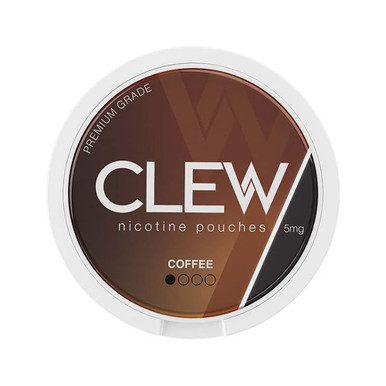
Clew Coffee Nicotine Pouches
£39.90
✔ In stock — ready to ship
100% tobacco-free
Free over £20
Same-day dispatch
Secure checkout
The listing on this page is Clew Coffee Nicotine Pouches, sold as a pack of ten cans for £39.90, in four declared strengths — 5mg, 10mg, 15mg and 20mg — every one of which carries that same price. The flavour recorded against it is coffee. We show it as in stock at the time of writing. Those six facts are the complete set our product record holds for this can, and the pages on this site are written from the record rather than around it.
Coffee is the least common flavour direction on a pouch shelf and the one that divides opinion hardest, which makes it an interesting listing to write about and an easy one to get wrong. So a marker before we start: this is an adult nicotine product, sold only to people aged 18 or over who already use nicotine, and the full compliance wording has its own section at the bottom. Nothing on this page is written to persuade anyone to consume anything.
The full guide to Clew Coffee Nicotine Pouches
4,893 words on how it eats, who it suits, how to serve it and what to put beside it.
What the coffee can actually is
Physically it is the standard round tin — a squat plastic cylinder with a press-on lid, the sort of thing that sits flat in a drawer and takes up about as much space as a bar of soap. The lid carries the brand and the flavour word. The declared figure is printed where the manufacturer has chosen to print it. Ten of them arrive as a box, not as a pocket item, which changes the practical questions a little compared with buying a single can; we come back to that in the storage section.
Ten cans at £39.90 is £3.99 each. That division is our own and it exists only to make this listing comparable with the single-can products elsewhere on the site. The number that matters at checkout is £39.90. We do not hold a pouch count per can for this product — the field is simply not in our data — so the printed can is where that gets answered.
Coffee on four axes: cool, sweet, sharp, bitter
Describing a flavour usefully means describing where it sits relative to other flavours rather than reaching for adjectives that mean nothing on their own. Four axes cover most of what separates one pouch flavour from another, and coffee has a distinctive position on all four. What follows is taste and aroma only — no claims of any other kind are being made, and none should be read in.
| Axis | Where coffee sits | What that means next to other cans we stock |
|---|---|---|
| Cool | Essentially absent | The opposite pole from the mint-family cans, which are built around a cooling character |
| Sweet | Present but dark and restrained | Much less sweet than a berry or melon can; closer to caramelised sugar than to fruit sugar |
| Sharp | Low | The opposite construction to a citrus can, which leads on acidity |
| Bitter | The defining note | Almost nothing else on our shelves carries bitterness as its main characteristic |
The bitter axis, which is the whole point
Bitterness is what makes coffee coffee, in a cup and on a pouch shelf alike. Every other flavour family we stock treats bitterness as something to be avoided or buried; this one treats it as the thing being described. That is why people either take to a coffee pouch immediately or find it the one can in a range they cannot get on with. There is not much middle ground, and we would rather say so than pretend this is a crowd-pleaser.
The bitterness here reads as roasted rather than raw — burnt-sugar and toasted-nut territory rather than the green, vegetal bitterness of something unripe. It is a warm bitterness. That distinction matters because a warm bitter note and a cold sharp note are opposite sensations, and someone arriving from a citrus can will find this is not a variation on what they had, it is a different axis entirely.
The sweet axis, and what kind of sweetness this is
There is sweetness in a coffee flavour, but it behaves like the sweetness in a dark chocolate rather than the sweetness in a boiled fruit drop. It sits underneath the roast and rounds off the bitter edge instead of covering it. Whether Clew has aimed this at an espresso reading — bitter forward, little softening — or at a cappuccino reading with a creamier, milkier character behind it is not something our record tells us, and we are not going to invent an answer. The word on our record is coffee. The can is where you find out which coffee.
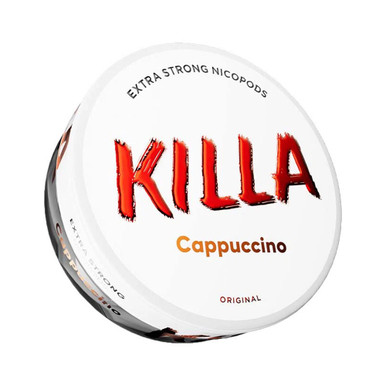
If a milky, dessert-style reading is what you are after, Killa Cappuccino at £33.50 names that reading explicitly rather than leaving it open, which makes it a useful comparison point even if you never buy it.
Aroma, on opening
Take the lid off and the smell is roast. It is a dry, toasted aroma with a faint charred edge, and it lingers in the way roast smells do — a coffee can left open on a desk announces itself across a room for a while afterwards. It is not a loud aroma in the way a citrus can is loud; it is a heavier, lower smell that spreads more slowly.
The aroma and the taste line up closely here, which is not true of every flavour. With some fruit cans the smell promises more sweetness than the taste delivers. With coffee, what you smell on opening is a fair preview of what you get.
How it behaves over the life of a pouch
Flavour in a dry pouch is at its most defined early and thins from there. In coffee's case the sweetness tends to go first and the bitterness holds on longer, which means the taste narrows as it fades rather than simply getting quieter. Some people regard that as the can's main flaw and others as the reason they buy it. We do not hold timing data for this product and will not manufacture any — how long a pouch stays interesting is individual, and the point at which somebody takes one out is their own business.
The coffee flavour shelf on this site runs to nine listings, which makes it one of the smallest flavour groups we keep. If coffee is what you are shopping for, it is a short enough shelf to read in full.
Nine listings, and what a short shelf tells you
It is worth pausing on that number. Our mint listings run to 148 and our citrus listings to 25; coffee has nine. A flavour shelf that short is not a judgement on the flavour — it is a straightforward consequence of how many manufacturers choose to build one. Fruit and mint are made by nearly everybody. Coffee is made by a handful of brands, usually as a single listing within a much larger range, which is exactly the position it occupies within Clew's own eight-can shelf.
The practical consequence for a customer is that the coffee shelf has less internal variety than the bigger shelves do. On the mint shelf you can move between a dozen genuinely different readings of the word without leaving the flavour. On the coffee shelf you are mostly choosing between a straight roast reading and a milky one, at whatever prices those particular brands happen to sit at. That is a narrower set of choices, and it is one reason people who settle on a coffee can tend to stay with it rather than shopping around within the flavour.
The price spread across that short shelf is wide, as it is everywhere on this site. This listing is a ten-can pack at £39.90; the cappuccino listing named above is £33.50; other products elsewhere on the site sit at a few pounds because they are single cans. Comparing headline prices between listings without first checking what each one contains is the single most common way to misread a shelf here, and the fix is simply to open the product page and look at the pack arrangement before comparing anything.
The pouch, handled as an object
A nicotine pouch is a small, soft, sealed pouch placed in the mouth and left there. It is not chewed and it is not swallowed. That is true of everything on this site and none of it is particular to the coffee flavour, but it is the part of the product people ask about most, so it belongs on the page.
It goes at the front of the mouth, between the lip and the jaw, and your own lip is what holds it in position. Nothing else fixes it there. You can move it around, from one side to the other or from top to bottom, and people do. If it is uncomfortable wherever you put it, the answer is to take it out — there is no reason to persist with an object in your mouth that does not feel right.
Duration varies so widely that publishing an average would be publishing a fiction. Some take one out inside five minutes; some leave one in for most of an hour. The reason usually given is that the taste has gone. We do not set a time, we do not suggest one, and the usage guidance printed on the can by Clew is the guidance that counts.
The lid has a shallow catch compartment in the top, separate from the chamber where the unused pouches sit, and used pouches go in there. It fills quickly — three or four and it is full, after which the lid stops closing flat and the can starts to feel wrong. Empty it earlier than you think you need to. Used pouches are general waste and go in a bin: not a sink, not a drain, not a car window. The tin is plastic and goes with household recycling as far as your local authority takes that grade, which is a council-by-council matter we cannot answer for your address.
We do not hold a format designation for this listing, so we will not tell you whether these are slim, regular or anything else. The can states it. What is certain is that every pouch inside one tin matches every other one, so a can holds no surprises after the first pouch.
Two small mechanical points that come up repeatedly and belong somewhere on a page like this. The first is that the pouches sit flat in a ring around the base of the tin, so the first one out is fractionally awkward to lift and the rest are trivial; tipping an open can upside down empties the whole ring onto the floor, which is a lesson most people learn exactly once. The second is that a pouch does not stick to the tin or to its neighbours, so there is no knack to separating them and no reason to dig about inside with a fingernail.
Speech is the question people put to a counter most often. A pouch under the top lip shows as a slight fullness to anyone looking for it, and it alters the shape of one or two consonants for the first minute until you stop noticing. That is a description of a physical object sitting in a mouth and nothing more — we are not going to build a claim about discretion or setting on top of it, and no product page should.
Four figures, one price
The declared strengths on this listing are 5mg, 10mg, 15mg and 20mg, and all four are £39.90. The milligram figure is the nicotine content Clew declares for a single pouch. We reproduce it exactly as given and we neither measure nor adjust it; if our page and the can ever disagreed, the can would be right.
As numbers they order themselves in the obvious way, and that ordering — 20 above 15, 15 above 10, 10 above 5 — is the whole of the comparison available to us within this product. It compares label declarations. It does not describe how anything will seem to a person, and it is emphatically not a suggestion about which one anybody should buy. We hold no information about you and a shop that pretended otherwise would be overstepping badly.
Across brands the comparison gets weaker still. Different manufacturers declare their figures against different formats and under their own conventions, so a 20mg on one can and a 20mg on another are two separate statements by two separate parties rather than one shared measurement. We publish what each manufacturer publishes and we do not convert between them, because we do not hold the technical detail that would let anyone do that honestly.
Our strength shelves exist for filtering and nothing else. This listing is filed under the Strong band, alongside 132 other products, and it does not also appear on our Medium Strength shelf or the Extra Strong listings. A product sits on one strength shelf here. Where a band label and a printed figure look like they disagree, the printed figure is the manufacturer's declaration and the band is our filing.
Building a rotation around a coffee can
Pairing is the angle worth taking at length on this particular listing, because coffee creates a pairing problem that a fruit can does not. Most people who buy pouches keep two or three cans on the go rather than one, for the plain reason that a taste met repeatedly stops registering. With a fruit can, finding a partner is easy — almost anything contrasts with it. With coffee, the flavour is so far from everything else that the usual logic inverts, and the interesting question becomes whether you want a partner that contrasts or one that does not fight.
Why coffee is an awkward can to pair
Coffee occupies a corner of the flavour map on its own. It is not cool, not sharp and only darkly sweet, which means it does not sit on a spectrum with anything else we stock — it sits off to one side. Set it against a mint and the two have nothing in common at all. Set it against a berry and the berry reads as sugary by comparison. Set it against another dark flavour and you get the closest thing to a family resemblance available.
Those three strategies — total opposition, sweet relief, or family resemblance — cover almost every coffee rotation we see in repeat orders. Each has a different set of cans behind it.
Strategy one: the total opposite
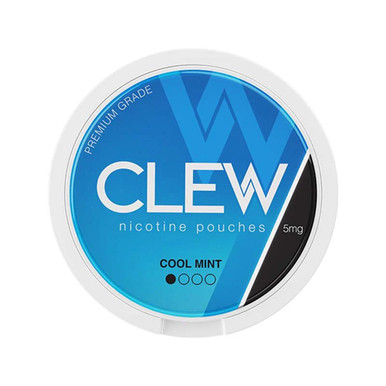
Most coffee buyers who keep a second can keep a mint, because it is the furthest thing available. Within the brand that is easy, since Clew Menthol, Clew Cool Mint and Clew Spearmint are all £39.90, the same price as this can, which means moving between them costs nothing and involves no trade-off beyond taste. Of the three, the menthol is the sharpest break from a coffee's warm bitterness and the spearmint the gentlest, since spearmint carries a green sweetness that softens the contrast.
Outside the brand, Edge Mint at £14.95 is a plain mint at a much lower price point, and Klint Avalanche Mint at £36.90 takes the colder reading. Both make the same point against a coffee can: the second tin tastes of nothing the first one does.
Strategy two: sweetness as relief
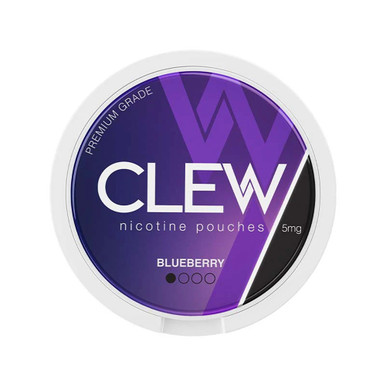
The second pattern is pairing coffee with something unambiguously sweet, so that the rotation swings between a bitter can and a sugary one. Clew Watermelon at £39.90 is the softest, roundest fruit in the range and about as far from bitterness as the brand goes. Clew Blueberry, same price, is the darker fruit option, which pairs slightly better with coffee than a bright fruit does because both are low, deep flavours rather than high, bright ones.
Beyond Clew, Elf Bar Blueberry Raspberry at £29.90 doubles the berry idea up, and Pablo Gold Edition Blue Raspberry at £19.95 takes the confectionery reading of raspberry rather than the fruit one — sweeter, less realistic, and a deliberate contrast to something as unsweet as coffee. Denssi Blueberry Freeze at £39.90 adds a cold edge on top of a berry, giving you both contrast strategies in one tin.
Strategy three: the family resemblance
The third group do not want contrast. They want a second can that lives in the same dark, sweet-and-roasted part of the map, so that moving between the two is a change of detail rather than a change of world. That is a smaller set of cans but it exists.
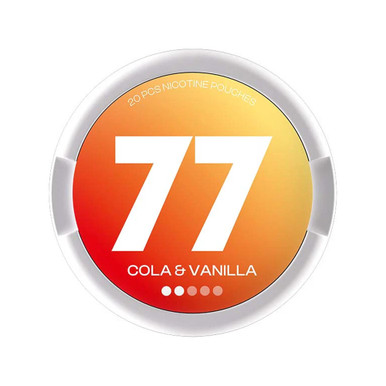
77 Cola Vanilla at £39.90 is the closest thing on our shelves: cola is a dark, spiced, slightly bitter flavour and the vanilla behind it does a similar softening job to the sweetness in a coffee. Cuba Ninja Coconut at the same £39.90 is the other one people name — coconut is nutty and creamy rather than fruity, and nutty-and-creamy is a recognisable neighbour to roasted-and-milky. Neither tastes of coffee. Both belong to the same half of the map.
Cans that make the point by being nothing like any of this
For completeness, two listings that sit as far from a coffee rotation as anything we stock. Fumi Fiery Lime at £27.90 is sharp citrus with a spiced edge — acidic where coffee is bitter, bright where coffee is low. Nordic Spirit Max Foresty Berry at £4.49 is a mixed-berry can from a line with its own declared figures, and at that price it is a completely different kind of purchase from a £39.90 ten-can pack. Check its own page for what sits behind the number.
If you would rather browse a whole range than pick individual listings, the Cuba range page and the Pablo range page each collect their line in one filtered view with prices and declared strengths on the cards.
Coffee's place on the Clew shelf
The Clew brand page holds eight listings. Six siblings are linked from this page, this coffee can makes seven, and the eighth is on the shelf itself — we would rather send you to the live page than describe a listing whose facts are not in front of us.
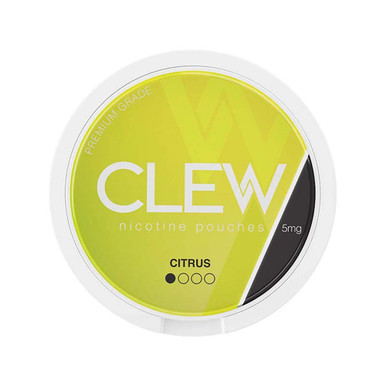
Within that range, coffee is the outlier and everything else is either a mint or a fruit. Three cans take the mint direction in three genuinely different ways; three take fruit — a berry, a melon and the sharp citrus can at £39.90. Coffee is the only listing that belongs to neither group, which is exactly why it turns up in so many Clew rotations: if you are buying two cans from one brand and want them to have nothing in common, one of them is nearly always this.
The flat pricing across the range is the other structural fact worth knowing. Every Clew listing we hold is £39.90, so choosing between them is a pure flavour decision with no money in it. That is not the case across the site as a whole, where prices range from a few pounds to the high thirties depending on what a listing contains, but within this one brand the price never enters the argument.
Looking after ten tins
Storage for a multi-can pack is a different problem from storage for a single can, and the difference is simply that nine of them are going to sit somewhere for a while. A cupboard is the right answer — cool, dry, out of direct light, and not above a heat source. Kitchen cupboards directly over a hob or beside an oven are the common mistake, because they cycle hot and cold every time somebody cooks.
Leave unopened cans sealed until you want them. Whatever the manufacturer has wrapped them in is doing a job and unwrapping the lot at once to make them stack better in a drawer removes that for no gain. The can in active use will lose aroma over time simply because it gets opened repeatedly; that is unavoidable, and the only thing that helps is pressing the lid down properly each time rather than balancing it on top.
Heat is the enemy of any aromatic product and a roasted aroma is no exception. A car glovebox in summer, a windowsill in the sun or a bag left against a radiator are all worse environments than a cupboard, and a can that goes hot and cold repeatedly is not being done any favours. There is nothing dramatic about the consequence — it is a slow flattening rather than a sudden failure.
There will be a date printed on the can by Clew. We do not carry it in our data and we are not going to estimate one. That printed date is the reference for an unopened tin. For an opened one, nobody can give you a figure that means anything, because it depends on the room, the season and how often the lid has come off.
Deciding on a figure, and on ten cans of one thing
Since the four declared strengths are all £39.90, nothing financial turns on which you choose. That is worth stating because on plenty of listings elsewhere the higher figures cost more, and people carry that assumption across. Here they do not.
The pack size is the part that carries consequence. Ten cans is ten cans of one flavour at one declared figure, and if it turns out not to be what you wanted, the remaining nine do not change their minds. Coffee, being the most polarising flavour on the shelf, is the listing where that matters most — it is genuinely not a flavour everybody gets on with, and we would rather say so on the product page than have somebody find out on can two.
What customers do about that is their own business, but the common approaches are obvious enough: try a single-can coffee listing from another brand first, or buy the ten-can pack of a flavour already known and treat the declared figure as the only open question, or split a pack with somebody. None of that is advice from us. It is a description of what people do.
On which figure to pick, we have nothing to offer and will not pretend otherwise. The four numbers are printed above, they are all the same price, and the decision belongs to you with the can's own labelling in hand.
Ordering it, and the door
The mechanics are ordinary. Choose the declared strength on the listing page, add it to the basket, and the basket states exactly what you are buying and for how much before anything is confirmed. £39.90 is the ten-can pack. Where a live listing field and a sentence in this description ever disagree, the listing is the one that is current and correct.
Stock status shows on the listing too. We hold this as in stock as the page is written, but a description is not a live feed, and the product page is the thing to trust. If it has gone, the page will say so rather than take an order we cannot fulfil.
Age checks are a legal condition of selling this at all. The product is 18+. Checkout requires confirmation of age, orders can be verified before they go out, and the courier may ask to see photographic identification when the parcel arrives. Without an adult present to receive it, the parcel does not get handed over. That applies to every nicotine order on this site without exception.
Parcels go out in plain outer packaging. That is a fact about packaging and we are not going to build anything else on top of it. Carriers, timings and delivery costs are set out in our delivery information, since they apply across all orders rather than to any single listing.
Where this page sits on the site
Four routes reach this listing. Through the brand, it sits with its seven siblings on the Clew shelf. Through flavour, it is one of nine on the coffee shelf. Through declared band, it is filed in the Strong group. And if filtering is not how you like to shop, everything we stock is on one page to scroll through.
Those category pages are plain filtered lists. They show what we hold with price and declared strengths on each card. Nothing is ranked, nothing is promoted, and the order products appear in carries no meaning whatsoever — it is whatever the shelf generates.
Questions people ask about this one
Does it actually taste like coffee?
It tastes like a coffee flavouring, which is a real but not identical thing — the same relationship a coffee sweet has to a cup of coffee. The roast and the bitterness are there, the aroma is recognisably roasted, and nobody would mistake the flavour word for anything else. Whether it matches your particular coffee is not a question we can answer, since our record holds the single word and nothing about what style Clew has aimed at.
Is there caffeine in it?
We do not hold that information. Our product record states that this is a nicotine product with a coffee flavour, and it does not carry a contents list. The can and Clew's own labelling are the only reliable place to read what is and is not in it, and we are not going to speculate on a question like that.
Is it espresso-style or milky?
Our record does not say. The flavour word we hold is coffee, without a style attached, so we cannot tell you whether the construction leans dark and bitter or creamier and rounder. If a milky reading is specifically what you want, a listing that names cappuccino in its own title removes the ambiguity, because the name is then doing the work rather than our guesswork.
How many cans and how many pouches?
Ten cans for £39.90, which is £3.99 a can by our own arithmetic. The pouch count per can is not in our data, so we cannot state it. It is printed on the can itself. We would rather admit the gap than publish a number that turned out to be wrong ten times over.
Do I pay more for 20mg than for 5mg?
No. All four declared strengths on this listing are £39.90. That is a feature of this product rather than a rule across the site, so it is worth checking each listing individually rather than assuming flat pricing everywhere.
Which strength is right for me?
We cannot say, and we are not going to imply an answer by describing one figure as milder or more suitable than another. We hold no information about you, and choosing on a customer's behalf is not something a shop should do. The four figures are stated, they cost the same, and the can's own labelling is the thing to read.
How long does a pouch last?
There is no honest average. People range from a few minutes to close to an hour, usually taking one out when the taste has gone. We hold no timing data for this product and will not invent any. Clew prints usage guidance on the can and that is the guidance that applies.
Where is it made, and by whom?
Our data does not include a country of origin or manufacturing detail for this listing, so we do not publish it. That information appears on the packaging along with importer details, which is where it belongs and the only place we would point anyone.
Is it slim or regular format?
Not something we hold. Format designations differ between manufacturers and this one is not in our record, so we will not state it. The can carries it, and every pouch within a single can is identical to the others regardless.
Will the coffee flavour make the other cans taste odd?
Flavours do linger, and a strong roasted note is among the more persistent ones on our shelves — people who rotate coffee with something delicate sometimes notice the coffee still faintly present afterwards. That is a plain observation about taste, not a warning. It is one reason mint tends to be chosen as the partner can: a cold, assertive flavour is the one least likely to be overshadowed.
Can I buy a single can instead of ten?
Not on this listing, which is sold as a ten-can pack. Other products on the site are single-can listings at much lower prices — the £4.49 and £19.95 products named earlier are examples — and those are the ones to look at if ten of a single flavour is more than you want. Each listing states its own pack arrangement.
Compliance, set out in full
Sales of this product are restricted to adults aged 18 or over who already use nicotine. We will not sell it to anyone else. Age confirmation is required at checkout, orders may be verified before dispatch, and photographic ID may be requested by the courier on delivery — no adult at the door means no handover.
Nicotine is an addictive substance. That statement sits here because it is true and because a product description of this kind has no business leaving it out or hiding it in small print.
This is not a licensed stop-smoking medicine, and it is not offered or described as one anywhere on this site. It is not intended for non-smokers, for anyone who does not already use nicotine, for under-18s, or for anyone who is pregnant or breastfeeding. We make no health, medical or safety claim about this product in any direction. Questions about nicotine and your own circumstances belong with a pharmacist or a doctor; we sell cans and we do not hold that expertise.
In summary
Clew Coffee is a ten-can pack at £39.90 with four declared strengths at a single price, carrying a roasted, bitter-led flavour that sits apart from everything else on our shelves. It is filed in the Strong band, it is one of nine coffee listings here, and it is the only can in its brand's range that belongs to neither the mint group nor the fruit group. Where a fact is not in our record — the pouch count, the format, the style of coffee, the origin — we have said so rather than filled the space. The can itself, and Clew's own labelling on it, is the authority over anything written on this page.
More from Clew
More strong pouches
More coffee pouches
Where this sits
Clew Coffee Nicotine Pouches appears in these categories. Browse them, or jump to something close.
You might also like