Home / Extra Strong / Cuba Black Raspberry Nicotine Pouches
Cuba · 43mg
Read the full guide
Cuba Black Raspberry Nicotine Pouches
£39.90
✔ In stock — ready to ship
100% tobacco-free
Free over £20
Same-day dispatch
Secure checkout
Here is our entry for Cuba Black Raspberry Nicotine Pouches, set out before anything else so you can stop reading early if this is all you came for. The brand is Cuba and the range is Black. The declared strength is 43mg and it is the only one on the listing. The price is £39.90. Our flavour classification for it is berry. We are currently showing it as in stock.
The fields our record leaves empty are worth naming too, because several paragraphs below depend on them being empty. We do not hold a pouch count, a can weight, a pouch format designation, a cans-per-pack figure, a shelf life or an origin. None of those will be filled in with a plausible guess anywhere on this page. Where the subject comes up, the page says the field is blank and moves on.
The full guide to Cuba Black Raspberry Nicotine Pouches
5,101 words on how it eats, who it suits, how to serve it and what to put beside it.
The Cuba Black Raspberry listing in full
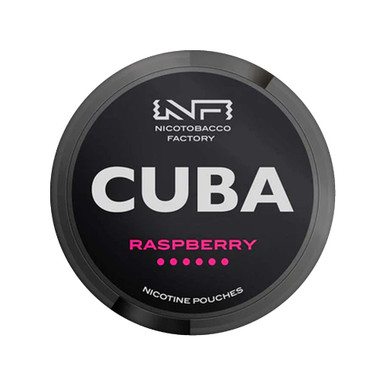
The physical item is the standard round tin — a low plastic cylinder with a lid that lifts off and presses back, small enough to disappear into a coat pocket. The printing on the lid gives the brand, the range, the flavour and the declared figure so that a stacked can can be identified without opening it. Inside, the pouches sit flat in a ring and are uniform, so the first one out is representative of all of them.
This is an age-restricted nicotine product for adults who already use nicotine. The full required wording is in its own section towards the foot of the page.
Raspberry: tart, perfumed, and not the same thing as blue raspberry
Raspberry is one of the most immediately recognisable fruit flavourings there is, and the reason is the perfume. Beneath the obvious berry sweetness there is a distinct floral top note — a scented, slightly heady quality that no other common berry has in the same way. Blackcurrant is darker and more resinous; blueberry is rounder and quieter; strawberry is sweeter and more confected. Raspberry is the perfumed one, and that note is doing most of the identifying work.
The balance sits on the tart side of the line. There is real sweetness in it, but the tartness leads by a short margin, and it is a berry tartness rather than an acidic one — softer and rounder than the sharpness you get from a citrus or a tropical fruit, closer to the pleasant sourness of the fruit itself when it is properly ripe rather than the bite of something unripe. It gives the flavour definition without making it cut.
There is a third quality that people notice without always identifying, and it is one of the more interesting things about raspberry as a flavouring: a fine, faintly dusty, almost woody character sitting underneath. In the fruit this comes from the seeds and from the way a raspberry is built out of many small parts rather than one solid piece of flesh. A good raspberry flavouring keeps a suggestion of it, and it is what stops the flavour from reading as pure jam.
The aroma off an open tin is jammy and perfumed and arrives promptly. This is not a subtle can to open. The scent is recognisable as raspberry within a second and it is closer to preserve than to fresh fruit, which is characteristic of the flavouring rather than a shortcoming of it — a cooked raspberry and a fresh one smell different, and most raspberry flavourings aim somewhere between the two.
Two raspberries, and which one this is
Worth separating out, because it causes genuine confusion on a berry shelf. There are two quite different things that go by the name raspberry in flavour work. One aims at the actual fruit: tart, perfumed, with that fine seedy undertone. The other is the confectionery version — the sweet-shop idea, much sweeter, far less tart, and with the perfume dialled up into something frankly artificial. That second version is the one that usually appears under the name blue raspberry, which is a flavour idea rather than a variety of fruit; nothing about it is blue except by convention.
Our record for this listing says berry and nothing more, and the manufacturer's name for it is Raspberry without qualification. On that basis we would describe it as the fruit reading rather than the confectionery one, and we would point out that Pablo Exclusive Blue Raspberry, listed at £3.85, is the can that goes at the other interpretation. If the sweeter sweet-shop version is what you are after, that is the listing describing it, and its own page is where to read about it.
The pouch in practice
The format is the same across everything we sell and there is nothing about this listing that changes it, so this is a short practical account rather than an extended one.
A pouch is a small sealed portion placed in the mouth and held between lip and gum. It is not chewed through and it does not go down. Most people set one at the front behind the top lip, where the lip keeps it pressed against the gum line; behind the bottom lip works too and some prefer it. Once in position it stays there without attention. If the particular spot proves uncomfortable it can be moved along or to the other side, and if no spot is comfortable the sensible response is to take it out rather than persist — comfort differs enough between people that nothing written here can anticipate yours.
Duration varies so widely across customers that we do not publish an average, because any single figure would misdescribe most readers. A few minutes at one end, most of an hour at the other, and the flavour running out is the reason people most often give for removing one. With a tart berry the tartness tends to go before the sweetness does, so what is left toward the end is a quieter, rounder version of where it started. We set no times, recommend none, and give no guidance on quantity; the manufacturer's own usage wording on the can is the instruction that applies.
The lid has a shallow catch chamber moulded into it, separated from the fresh pouches below, and that is where a used pouch goes when there is no bin to hand. Into general waste when there is one — not a sink, not a drain, not a hedge. The tin is plastic and can go into household recycling to whatever extent your own council accepts that grade, which differs by area and is not something we can establish for a given address.
On portion size, our record carries no format designation, so we will not state whether these are slim, regular or otherwise. If the manufacturer uses one of those words, it will be on the can.
Dry, damp and in between: keeping a can in the state it arrived in
The longest section on this page is about storage, which is an unglamorous subject that gets far less attention than it deserves. Almost every complaint a shop receives about a disappointing can turns out, on questioning, to be a storage problem rather than a product problem — and unlike most things on this page, it is entirely within the customer's control.
What actually changes in a neglected can
Start with what goes wrong, because the remedies make more sense once you know what they are remedying. A pouch begins life with a certain moisture level, and that level is what the manufacturer built the product around. Left exposed, that moisture goes into the air. The pouches become drier, stiffer and less pleasant to handle, and the flavour becomes noticeably flatter and shorter-lived — a dried-out pouch gives up what it has quickly and then has nothing further to offer.
The important point about this is that it is one-directional. There is no way to restore a can that has dried out. Adding water to it is not a repair, it is a different and worse problem. Once the moisture has gone, what is left is what you have, which is why the whole of this section is about prevention rather than rescue.
Heat is the main culprit
Warmth accelerates everything described above, and the places cans habitually get left are frequently the warmest places available. A car is the worst offender by a distance — a glovebox or a door pocket in summer reaches temperatures that will noticeably affect a can within a day or two, and a can left in a vehicle across a warm week can be meaningfully diminished by the time you get back to it. After cars, the usual suspects are sunlit windowsills, shelves above radiators, the top of a fridge where the motor vents, and bathroom cabinets in a house where the bathroom gets steamy.
The remedy requires no effort and no equipment. Somewhere indoors, out of direct sunlight, at ordinary room temperature and away from any heat source is entirely sufficient. A bedside drawer, a kitchen cupboard away from the oven, the inside pocket of a bag that does not live in a car. There is no benefit in going further than that and nothing complicated about doing it.
The lid, and the thing that stops it closing
The second cause of a spoiled can is mechanical rather than environmental: a lid that is not properly shut. Press it down until it seats flush rather than resting it on top of the tin. A lid that looks closed but is not has all the consequences of an open can with none of the visual warning.
Most of the time a lid that will not seat is being prevented from doing so by a full catch chamber. Used pouches accumulate faster than people expect, the chamber is not large, and once it is packed the lid rides slightly proud of the rim. This is, in our experience, the single most common route to a dried-out can, and it is entirely avoidable by emptying the chamber at the first convenient bin rather than the last possible one. It takes seconds and it is the highest-value habit in this whole section.
The related habit is not leaving the tin open while you decide something else. Take a pouch, close the can, then get on with whatever you were doing. A tin left open on a desk for an hour has lost more than a tin opened and closed twenty times in the same hour.
Damp, and the opposite problem
Less common but worth a mention: a can can also be kept somewhere too humid. A tin stored in a bathroom, a utility room with a drying rack in it, or a bag that regularly comes home wet can end up damp on the outside, and a damp tin is a tin whose lid seal and printed labelling both suffer. The consequence is a can that becomes unpleasant to handle and a lid that may not seat as cleanly afterwards. Dry storage is part of the same simple instruction as cool storage.
Time, dates and working through a stack
Time is the one factor nobody can manage away. Whatever date marking the manufacturer has printed on the packaging is theirs, is authoritative, and is the one to go by. We hold no shelf-life data in our record and therefore publish none, so this page cannot tell you how long an unopened can stays at its best.
What we can suggest is a habit rather than a figure: if you keep more than one can, use them in the order you bought them. Cans migrate to the backs of drawers and a tin that has sat unopened for eight months is not the same proposition as one bought last week. Putting new purchases behind old ones rather than in front of them solves this without any thought at all.
The refrigeration question
We are asked about this frequently enough that avoiding it would look evasive. A number of customers keep cans in a fridge and report that it keeps them in better condition for longer. We neither endorse nor contradict that. We have not tested it, we hold no manufacturer statement on it, and we do not publish claims we cannot stand behind, so the honest answer is that we do not know.
What we will say is that if the manufacturer has printed storage wording on the can, that wording takes precedence over anything a retailer, a forum or a fellow customer tells you. It is the only instruction on the subject that comes from the people who made the product.
Where a can goes in a household
Last and most important on storage: wherever you decide to keep cans, keep them out of reach of children and away from anyone in the household who does not use nicotine. A pouch tin is small, brightly printed and easy to mistake for something else, and the place it is stored matters more than any of the freshness considerations above. A high cupboard or a drawer that is not casually opened is the right kind of place. This is not a suggestion.
Checking a can without opening the whole thing up
A short practical postscript, since the section above is all about prevention and people reasonably want to know how to tell whether prevention has worked. There are three quick checks and none of them requires anything beyond looking.
The first is the lid. Put it on and press it home. If it seats flush against the rim and stays there, the seal is doing its job; if it sits proud on one side or lifts by itself, something is in the way — nine times in ten that is a catch chamber wanting emptying, and once that is cleared the lid usually behaves again.
The second is the aroma on opening. A can in good order announces itself when the lid comes off; with a perfumed flavour like this one that is especially obvious, because raspberry is not a subtle scent. If a tin you have been keeping for a while opens quietly when it used to open loudly, that is the most reliable early sign that it has been losing moisture, and it usually arrives before you would notice any difference in the taste.
The third is how a pouch feels between finger and thumb. A pouch in the condition it left the factory in has some give to it. One that has stiffened is one that has dried, and there is nothing to be done about it beyond adjusting where the next can gets kept. None of these checks is a judgement about whether a can is fit to use, which is not a question we take a view on; they are simply how you tell whether your storage arrangements are working.
43mg, and the shelves we sort the catalogue by
The second substantial thread is the milligram figure — what it is, what it is not, and how our strength shelves relate to it. All of it is information. None of it is advice, and nothing in this section is written to help anybody select a number.
One row in the variant table
This listing has a single variant: 43mg at £39.90. There is no second figure under this product name in our catalogue, which means there is no comparison available within this page and no decision for the page to assist with. If you are here, the strength question has already been settled by the product itself.
What a declared figure is
The number is the nicotine content the manufacturer declares for each pouch. They print it; we reproduce it exactly as printed. We do not round it, adjust it, average it or reinterpret it, and we attach no significance to it beyond ordinary arithmetic — forty-three is a larger printed value than thirty-five and a smaller one than fifty-five. That is the complete set of statements a number in isolation will support, and we make no others. In particular we make no statement about what a figure will seem like to any individual, because that is not something a retailer can know or should claim to.
Bands are a filing system
Our catalogue is divided into declared-strength bands so that a long list can be filtered by somebody who already knows what they are looking for. This can is filed on the Extra Strong shelf together with ninety-seven other listings. The Medium Strength shelf and the Strong shelf hold the bands beneath it.
Those three pages are drawers with labels on. They are not steps, they are not a sequence, and we are not proposing any movement between them in either direction. The band a product is filed in is a navigational fact about this website, not a judgment about the product and not a recommendation to anybody.
Between brands, the number does not travel
This is the part of the section that matters most in practice. Different manufacturers arrive at their declared figures in different ways, against differently constructed pouches, and there is no shared scale underlying the numbers. Two cans from two companies both showing 43mg have those two digits in common and nothing else guaranteed.
Consequently we publish no conversion, no equivalence chart and no rule of thumb for moving between brands. We do not hold the technical information that would be needed to build one honestly, and an approximation would be worse than silence because people would rely on it. Each can's own listing and its own printed label are the authorities for that can's figure.
What we will not do
To be explicit, since the subject invites questions we cannot take: we do not advise on which strength is appropriate for any person. We do not describe a figure as suitable for a situation, a circumstance or a level of experience. We do not rank the numbers in our catalogue from lesser to greater in any sense other than arithmetic. And we do not answer questions about how much anybody should use, which is a matter for a medical professional rather than a shop.
Raspberry among seventy-six berry cans
Our berry flavour shelf is one of the largest categories on the site, running to seventy-six listings, and the useful comparison for anybody on this page is not berry against other flavours but berry against berry. The category is broad enough to contain genuinely different tastes.
The nearest neighbours are the darker, rounder berries. Clew Blueberry at £39.90, Killa Blueberry at £33.50 and Nordic Spirit Blueberry at £4.49 all take that quieter, less perfumed berry direction — the opposite temperament to a raspberry, sweeter and with far less of a floral top note. The wide price spread across those three is exactly the sort of thing worth checking on each listing before comparing them, since we do not hold what quantity any of those figures covers.
For a berry with more darkness rather than less, Fumi Blackcurrant at £27.90 is the deepest of the set — blackcurrant carries a resinous, almost leafy quality that raspberry has no trace of. Going the other way, 77 Strawberry at £39.90 is sweeter and more confected than this can, with the tartness turned down rather than up.
Two listings on our nearby set blend berries instead of picking one. Elf Bar Blueberry Raspberry at £29.90 combines this fruit with the rounder one, which softens the perfume and the tartness at the same time. The Denssi Berry Beast listing at £39.90 is also a berry blend — it is a separate product whose own page states what it contains, and that page rather than this one is where to read about it.
Inside the Cuba Black range
Across the brand we hold forty-seven listings, collected on the Cuba brand page. Every Cuba Black can on our sibling list carries the same £39.90 as this one, so moving between them within the range is a decision about taste alone — the price does not enter into it.
The closest relative in the range is Cuba Black Blueberry at £39.90, which is the same brand's take on the quieter berry and the most natural second can for anybody who wants to stay in the category. Cuba Black Cherry, also £39.90, moves from berry to stone fruit while keeping a comparable level of tartness, which makes it a change of fruit rather than a change of character.
For a definite step away from tart, Cuba Black Banana Hit at £39.90 is the softest and lowest-acid flavour on the sibling list, and Cuba Black Apple Juice at the same price is crisper and juicier without the perfume. If you would rather leave fruit altogether, Cuba Black Cola at £39.90 is a manufactured flavour idea with no fruit reference, and Cuba Black Cold Dry at the same price is built on a cold character rather than a flavour in the fruit sense.
Outside the brand, two cans on our nearby list have nothing in common with a raspberry and are chosen for that reason. Maggie Original Jamaican Cherry Tonic Wine at £39.90 is the most distinctive flavour idea we hold nearby, built around a tonic-wine character rather than a plain fruit, and Siberia Mini at £39.50 is a small-format listing with its own declared figure stated on its own page. The Pablo brand page collects that maker's range if the blue raspberry listing mentioned earlier sent you in that direction.
What there actually is to choose between
Very little, on this listing, and it is worth being clear about why. There is one declared strength and one price, so the variant table offers nothing to pick from. There is no larger pack and no smaller one under this product name.
The quantity question we cannot answer at all. Our cans-per-pack field for this product is empty, which means this page is not able to tell you whether £39.90 buys a single can or several. We could guess from the price; we will not, because a guess in a description reads as a fact and then becomes a problem at the door. The listing states the unit, the basket states the quantity before payment, and the basket is the final authority. Reading it takes a moment and settles the question completely — which is worth doing particularly if you are comparing this against the listings on this page priced at a few pounds, since those figures may not describe the same unit at all.
Ordering, delivery and identification
The buying process is unremarkable: basket, checkout, parcel. Whatever stock position the live listing shows at the moment you order is the one that governs. We are showing this can as available as this description is written, and the listing page is more current than this sentence will be by the time you read it.
Age verification is a legal requirement and we apply it as one. This product is sold to over-18s who already use nicotine and to nobody else. You may be asked to verify your age at the point of ordering, and the courier may ask again at the door. A driver is entitled to ask for identification and entitled to withhold the parcel if nobody who can produce it is present. The practical consequences are worth knowing in advance: safe-place instructions and neighbour deliveries may not be available on an age-restricted order, and a refused handover means a second attempt. Being at home avoids all of it.
Carriage options, delivery timings and the returns position are published on the appropriate pages of this site. They are not repeated here, because a description page is a bad place to store information that changes and a stale estimate is worse than none at all.
Getting back to this page
Three routes reach this listing. By flavour, it sits among the seventy-six cans on the berry shelf. By brand, it is with the rest of the range on the page carrying all forty-seven Cuba listings. By declared strength, it is one of the ninety-eight listings in the Extra Strong band.
If you would rather see the whole catalogue at once, the complete stock index carries every product with its price and declared strength on the card. It is not sorted by merit and nothing on it is promoted or recommended; it is a list of what we hold, in whatever order the site puts it.
Questions, answered as honestly as we can
Is this the sweet-shop raspberry or the fruit one?
Our flavour tag says berry and the manufacturer's name for it is Raspberry without qualification, so we would describe it as the fruit reading — tart-leaning, perfumed, with a fine seedy undertone. The confectionery interpretation usually appears under the blue raspberry name, and there is a listing on this site that goes at that idea. Its page describes it; this one describes this can.
How many pouches does the tin hold?
Our record does not contain a pouch count, so we publish none. The printed can carries it. Answering with a number we were never given would be a guess, and it is the particular kind of guess people use to work out how much to buy, which makes it the worst kind to get wrong.
Does £39.90 buy one can?
We cannot tell you. The cans-per-pack field is blank for this product — not set to one, simply empty — so this page has nothing to go on. The listing page states the unit and the basket confirms the quantity before you pay, and the basket is the last word on it.
Will keeping it in the fridge make it last longer?
We do not know and we will not pretend to. Some customers do it and say it helps; we have not tested it and we hold no manufacturer statement on the subject, so we take no position. If there is storage wording printed on the can, that is the instruction that counts, because it comes from the people who made the product rather than from the people selling it.
My can has dried out — can I fix it?
No, and we would rather say that plainly than suggest a remedy that does not work. Moisture loss in a pouch is not reversible, and adding water to a can creates a different problem rather than solving the original one. The whole of the storage section above is about prevention for exactly this reason. Keeping the lid properly seated and the catch chamber empty prevents most cases.
Is there a version of this at a lower strength?
Not in our catalogue. This listing carries one variant, 43mg at £39.90, and nothing else appears under this name. Whether the manufacturer makes other strengths of this flavour is not something our record tells us, so we cannot answer it. Other flavours in the range are separate listings with their own figures on their own pages.
Is 43mg here comparable to 43mg from another brand?
Only as a printed number, which is a weak basis for comparison. Makers declare against their own formats using their own methods and there is no shared scale, so identical digits do not imply comparable products. We publish each figure exactly as given and convert between none of them, because we do not hold what would be required to do that properly.
How long should a pouch stay in?
We do not set a time and do not publish a recommended one. The range customers describe runs from a few minutes to most of an hour, and the flavour finishing is the usual reason given for taking one out. With a tart berry the tartness fades before the sweetness, so the taste shifts rather than simply quietening. Any usage wording on the can is the guidance that applies.
Where is this made?
We do not hold that information and will not imply any. Our record contains a brand, a range, a product name, a price, a declared strength, a flavour tag and a stock flag — nothing about manufacture. Cuba is a name a company chose for a product line and should not be read as a place. The packaging and the maker are the sources for that question.
Which berry can is the most similar to this one?
We can describe the shelf but we will not rank it. The blueberry listings are rounder and less perfumed, the blackcurrant is deeper and more resinous, the strawberry is sweeter with less tartness, and the blends soften whichever component would otherwise lead. All are set out above with their prices, and each has its own page with its own stock position and declared figure.
Can I carry a can around in a pocket all day?
Plenty of people do, and the only thing worth watching is warmth. A trouser pocket sits against you and a bag left in a car sits in whatever the car is doing, and of those two the car is by far the greater problem. A can carried about for a day and kept indoors overnight is in no difficulty. A can that lives permanently in a vehicle is the one that will disappoint you eventually.
Does the flavour fade in the tin as well as in the mouth?
Those are two separate things and it is a fair question to separate them. Within a single pouch, the taste diminishes over the time it is in — that is ordinary. Across a can, the flavour available in each pouch can also weaken if the tin has been kept badly, which is what the storage section above is about. A well-kept can should give you a broadly consistent experience from the first pouch to the last.
Can you tell me whether this strength is suitable for me?
No. We give no advice on strength, quantity or suitability for any person or condition, and nothing on this page is medical guidance. What is written above about the number 43 is a description of a figure printed on a tin. For anything concerning nicotine and your own circumstances, a medical professional is the right person to ask.
The notices
Sold only to adults aged 18 or over, and only to people who already use nicotine. Please do not buy it for anyone else.
Nicotine is an addictive substance.
Cuba Black Raspberry is not a licensed stop-smoking medicine and no medicinal claim is made for it on this page or anywhere else on this site. It is not intended for non-smokers, for people who do not already use nicotine, for under-18s, or for anyone pregnant or breastfeeding. Nothing written above is medical advice, and nothing written above should be read as encouraging anybody to take up nicotine.
Identification may be requested when the order is placed and again by the courier on delivery. Store the can out of reach of children and of anyone in the household who does not use nicotine.
Sign-off
Cuba Black Raspberry is a single-strength 43mg can at £39.90 in the Cuba Black range, carrying a tart, perfumed raspberry flavour with a fine seedy undertone, filed under berry, and currently listed as in stock. It can be found by flavour, by brand or by strength band. Everything above is drawn from our catalogue record, from a description of the object, or from an explicit note about where our information ends.
More from Cuba
More extra strong pouches
More berry pouches
Where this sits
Cuba Black Raspberry Nicotine Pouches appears in these categories. Browse them, or jump to something close.
You might also like