Velo · 6mg–17mg
Read the full guide
Velo Ruby Berry Nicotine Pouches
£4.19
✔ In stock — ready to ship
100% tobacco-free
Free over £20
Same-day dispatch
Secure checkout
Velo Ruby Berry Nicotine Pouches are in stock and orderable as this is written, at £4.19. Four strengths are declared against the product — 6mg, 10mg, 14mg and 17mg — and every one of them carries that same £4.19. Four variants at one price is the widest ladder of declared figures on any Velo can we hold, and it is the most distinctive structural thing about this listing.
Now the gap, because it is better dealt with at the top of the page than buried in an FAQ. The flavour record for this can carries one entry: berry. Not raspberry, not strawberry, not blackcurrant, not a named mix. Berry, as a family. The product name adds the word Ruby, which is a colour and a gemstone word — it describes the shade the can and the flavour are pitched at, in the same way that grape gets called purple and lime gets called green. It tells you the flavour is aimed at the red, dark end of the berry spectrum rather than the blue end. It does not tell you which berry, and neither does anything else on the listing.
The full guide to Velo Ruby Berry Nicotine Pouches
4,870 words on how it eats, who it suits, how to serve it and what to put beside it.
Velo Ruby Berry, and the thing the listing does not tell you
So if you have come to this page wanting to know whether this is a raspberry can or a mixed-berry can, the honest answer is that we do not hold that information and we are not going to invent it. What we can tell you is what the record holds: brand, price, four figures, one flavour family, one photograph, and a stock position. The rest of this page works with that and says so wherever it runs out.
Our record also carries no cans-per-pack figure for this product. That field is empty, so we cannot tell you whether £4.19 covers a single tin or several. The order screen is the place that resolves it.
Three shelf filings apply: the Strong strength shelf with its 132 entries, the Velo brand shelf with 21, and the Berry flavour shelf, the second-largest flavour grouping we run at 76 entries. This is an age-restricted product sold to adults who already use nicotine; the compliance wording has its own section near the end of the page.
Companion cans: what people keep beside a berry
Almost nobody runs one can and nothing else. A flavour used exclusively stops registering after a while — not because the recipe changes but because your attention does — and the standard response is to keep two or three cans going and move between them. This section is the practical core of the page: what we stock that works alongside a red-berry can, and why, with the price and stock position for each.
Staying inside the brand
The lowest-friction companion is another Velo can, because the format stays the same and so does the £4.19. Velo Icy Berries is the obvious near neighbour — same brand, same price, in stock, and a berry can in its own right, but one whose name carries a cold word where this one carries a colour. That makes it a change of character rather than a change of family. Velo Cherry Ice, also £4.19 and in stock, names a specific stone fruit rather than a berry family, which makes it the closest thing on the Velo shelf to a can where you actually know what you are getting.
Further from this one but still inside the brand and still £4.19: Velo Lime Flame is the line's citrus entry and is in stock, and it contrasts with a dark berry about as sharply as anything in the range does.
Other berry cans, from other brands
Move outside Velo and the berry shelf opens up considerably, but the format changes with the brand — portions differ in shape and size between makers, and that difference is usually more noticeable than the flavour one. Five in-stock berry-family neighbours are worth naming with their prices.
Clew Blueberry at £39.90 and Killa Blueberry at £33.50 both name a specific berry, which is exactly what this listing does not. Denssi Blueberry Freeze at £39.90 adds a cold word to the same fruit. Elf Bar Blueberry Raspberry at £29.90 is a two-fruit can and names both. Pablo Gold Edition Blue Raspberry at £19.95 names the blue-raspberry confectionery flavour, which is its own thing rather than a description of a fruit. All five are in stock as written.
For something in the same red, forest direction as Ruby Berry rather than the blue one, Nordic Spirit Max Foresty Berry at £4.49 is in stock and is the closest neighbour to this can on price. Cuba Ninja Strawberry at £39.90, also in stock, narrows it to a single named berry. The 77 VB Edition Mini Arctic Berry at £39.90 is a mini-format berry can and in stock, so it changes the portion size as well as the flavour.
One berry can you cannot currently buy
Iceberg Raspberry at £39.90 appears in this product's neighbour group and is currently out of stock. Its page is live and you can read it, but you cannot order it as this is written. We mention it because it is the nearest thing in the neighbour list to a straightforwardly named red berry, and because sending you to a page you cannot buy from without warning is a waste of your time. We do not publish restock dates, since any date we gave you would be a guess.
A can that is nothing like this one
The opposite pole is mint, and the cheapest listed mint in this neighbour group is Edge Mint at £14.95, in stock. A berry-and-mint rotation is the most common two-can pattern there is, precisely because the two do not compete: they occupy different parts of the palate, so neither dulls the other. If you want that contrast without leaving the brand or the price, Velo Crispy Peppermint at £4.19 and Velo Freezing Peppermint at the same price are both in stock, as is Velo Bright Spearmint, which is the spearmint rather than peppermint reading of mint.
How many cans a rotation should actually hold
Two works for most people. Three is the point at which the last can starts going tired before it is finished, because pouches are a dry product with a finite shelf life once opened and a can you only reach for occasionally will sit open for a long time. That is an observation about the goods, not a comment on how much anyone should use. The practical version: buy a second can when you know you will get through it, not because four flavours at £4.19 each felt like a reasonable basket.
Pairing across price bands rather than flavours
There is a second way to think about a companion can that has nothing to do with taste, and it is worth setting out because it is the one people work out for themselves eventually. The cans in this neighbour group fall into two clear price bands: £4.19 and £4.49 at one end, and £19.95 to £39.90 at the other. We do not hold cans-per-pack figures for the listings in the upper band, so we cannot tell you whether those prices buy one tin or a row of them — but the practical effect is the same either way. A can bought at the low end is a low-commitment purchase; a can bought at the high end is a larger one, whatever the reason for the price.
That matters for a rotation because the can you are least sure about is the one you want least of. Trying an unfamiliar flavour in the cheapest listing available and keeping the larger commitment for something you already know is ordinary sense rather than any kind of advice about use. On this shelf, it happens to mean that the Icy Berries can and the Foresty Berry can are the two low-commitment ways to test whether a cold note or a forest-fruit reading suits you better than a plain red berry.
Ordering a rotation sensibly
If you are building one from scratch, changing a single variable at a time makes the result readable. Same brand, different flavour tells you about the flavour. Same flavour family, different brand tells you about the format. Do both at once and you will not know which part of it you are reacting to. And if you are mixing prices — £4.19 here against £39.90 on several of the neighbours — check what each listing actually covers on the order screen, because we do not hold cans-per-pack figures for most of them and a bigger number may simply mean more tins.
The format in practice
The mechanics are the same for everything on these shelves, so they are worth setting down once. A pouch is a small sealed portion, soft, dry to the touch, meant to sit between the gum and the upper lip. It is not chewed and it is not swallowed. It is placed, it stays, and it comes out.
Portion shape is the variable that catches people out when they move between brands. Slim portions are longer and narrower and disappear under the lip more completely; rounder ones sit more noticeably. Our listing for this can does not publish a portion format, so we cannot tell you in advance which sort Velo uses here. It is the most common reason a new can feels wrong when the flavour is fine, and it is not something we can document from the record.
Duration varies enormously between people and we will not pretend there is a standard. Ten minutes and the better part of an hour are both entirely ordinary. We are not going to suggest a figure. The only thing worth saying about time is a statement about the flavour: it is at its clearest early and softens as it goes, and in a berry can the sweetness tends to be the part that thins first.
The tin is a shallow round press-fit can. The lid lifts clear and pushes back down until it seats; there is a catch compartment underneath it for used pouches, which is the most useful bit of design on the object and the bit most often left to overflow. A full catch compartment is the usual reason a lid will not close flush, and a lid that is not seated is the usual reason a can dries out. Used pouches go in general waste — not a sink, not a drain, not a street.
We do not publish a portion count for this listing. The can states its own. We would rather print a gap than an industry average dressed up as a fact about this product.
Where the flavour sits: sweet, sharp, bitter, and the cold note that is not there
Since the listing will not tell you which berry it is, the next most useful thing is to describe how a can named this way generally reads, as taste and aroma, and to be explicit about which parts are description and which are inference.
Sweetness is the dominant axis
Berry flavours are built on sweetness in a way that mint and citrus are not. In a dry pouch that sweetness reads fuller and rounder than in anything from the mint family, and it is the first thing most people notice on opening a can. A red-berry reading in particular tends to sit where jam sits rather than where fresh fruit sits — deeper, less watery, more perfumed in the aroma. Whether that is precisely how this can reads is not something we can certify, but it is how the family behaves.
Sharpness is the second axis, and it is where berries differ
Acidity is what separates one berry from another far more than sweetness does. Raspberry has a defined sharp edge; strawberry is softer and rounder; blackcurrant sits sharpest of all with a dark, almost resinous character behind it. This is exactly the information the listing withholds by filing the can as berry, and it is the main practical consequence of that gap: you can know it is a red-berry-aimed can and still not know whether it reads sharp or round. If knowing matters to you, the cans named earlier that specify a single fruit are the ones to look at.
Bitterness is faint and comes late
Most flavours carry a trace of bitterness underneath, and in berry cans it usually shows up in the back half of the time a pouch is in, once the sweeter top notes have thinned. It is normal and it is not a sign of a bad can. Dark and coffee-flavoured cans elsewhere in the catalogue carry a great deal more of it on purpose.
The cold note this can does not carry
Plenty of berry cans on our shelves are filed under mint as well as berry, because a cooling note has been built in as a second flavour. This one is not: its flavour record has a single entry and no mint filing. That is a documented difference rather than a guess. If you have used the Icy Berries can or the Denssi Blueberry Freeze and expected the same thing here, the absence of that cold note is the difference you will notice, and it is not a fault.
What the word Ruby is doing
It is a colour word. Ruby describes a shade — the red the can and the flavour are pitched at — and it belongs to the same naming tradition as purple for grape and green for lime. It is not a claim about an effect, it is not a description of a sensation, and we are not presenting it as either. It is on the can because it looks and sounds like the flavour is meant to taste, which is what flavour names do.
Four figures on one listing: 6mg, 10mg, 14mg and 17mg
This product declares more strengths than any other Velo can we hold. The figures are 6mg, 10mg, 14mg and 17mg, and all four are priced at £4.19.
Those numbers are label information. They are what the manufacturer prints and what our record reproduces, unchanged. They tell you which variant of this can you are looking at, and they let you compare variants of the same can against one another. That is the extent of what they do.
They are not a ranking and they are not a progression. A 17mg can is not a better can than a 6mg one, and four figures on a listing is not a staircase anybody is expected to climb. They are also not reliably comparable across brands, because different makers state their figures on different bases and we neither audit nor normalise them. The same number printed by two different manufacturers is two printed numbers, nothing more.
We cannot advise you which of the four is suitable for you. We do not have the information, it would not be our place, and there is no financial tie-breaker either since all four cost the same. Anyone who already uses nicotine will have their own reference points; anyone who does not should not be buying this at all.
One point about the filing, since a four-figure spread makes it obvious. This product is categorised on the Strong shelf because strength shelves are applied per product and the range tops out at 17mg — the 6mg variant carries the same shelf label as the 17mg one. Our Medium Strength shelf holds 135 entries and the Extra Strong shelf sits above the Strong one, but a shelf name describes where we filed a product, not the individual variant in your basket. Read the declared figures on the listing.
Seventy-six entries on the berry shelf
The Berry shelf holds 76 entries, which makes it our second-largest flavour grouping after mint. Practically, that means berry is the one family where you can be genuinely fussy: if a can does not suit, there are dozens of others filed the same way, at a wide spread of prices and from most of the brands we carry.
It also means that a can filed only as berry, like this one, sits in a large and internally varied group. Some of those 76 name their fruit, some carry a cold note, some are mini format. The shelf is a filing decision, not a statement that the cans on it taste alike.
The price spread across this product's berry neighbours runs from £4.19 here and £4.49 for the Nordic Spirit Max Foresty Berry up to £39.90 for several of the others. That is not a quality gradient. It is most likely a difference in how many tins each listing covers, and since we do not hold cans-per-pack figures for those listings either, the order screen is the only place it can be settled.
How our flavour filing works, and where it stops
Since this page turns repeatedly on what the flavour record does and does not say, it is worth explaining how that record is built, because it affects how you should read every listing on the site and not just this one.
Each product carries a set of flavour tags. Those tags are families — mint, berry, citrus, grape, strawberry — rather than recipes. A can can carry one tag or several: a berry can with a cooling note built in will usually carry both mint and berry, and a can that names a specific fruit may carry the family tag and the fruit tag together. The tags drive the flavour shelves, which is why the berry shelf holds 76 entries covering everything from a single named fruit to a mixed forest reading.
The limitation is obvious once stated. A tag tells you which shelf we filed a can on. It does not tell you the recipe, it does not rank intensity, and where a product name is more specific than the tag, the name is the better guide. This listing is the reverse case: the name adds a colour rather than a fruit, so neither the name nor the tag narrows it beyond the family. That is a gap in the information available to us, not a coy piece of marketing on our part, and the only reason to make it this explicit is that a reader deciding between cans deserves to know which parts of a listing are documented and which are inference.
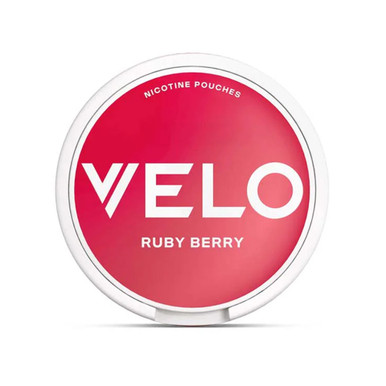
One further point about the single photograph on this listing. One image shows the can face and its printing. It does not show a pouch outside the tin, the underside of the lid, the catch compartment, or anything held against a hand for scale. If you were planning to judge portion size from the picture, you cannot, and no amount of enlarging it will help.
The Velo line as we hold it
Twenty-one Velo entries sit on the brand shelf. The six closest to this one are all £4.19 and all in stock as written: Bright Spearmint, Cherry Ice, Crispy Peppermint, Freezing Peppermint, Icy Berries and Lime Flame.
That set breaks down as three mint-family cans, two in the berry and stone-fruit direction, and one citrus. Ruby Berry and Icy Berries are therefore the two berry-filed entries in the group, which makes them each other's most direct sibling — same brand, same price, same family, different treatment of the cold note.
The flat price across the line is the most useful thing about this brand on our shelves. Choosing between Velo cans is a flavour-and-figure decision with no cost dimension at all. Most brands are not arranged that way: Pablo and Cuba both run wide internal price spreads across their listings, with editions and formats priced apart from one another.
Keeping a can usable
Heat and air are what degrade a tin of pouches, and a berry can shows it sooner than most because the perfumed part of the aroma is the most fragile thing in it.
Heat first: a can on a sunny windowsill, a dashboard, a radiator shelf or in a bag pressed against a warm laptop loses definition faster than one in a drawer. What is left is not unusable, just flatter and duller than it was. Air second: the press-fit lid works when it is seated and does very little when it is sitting proud, which is easy to do in a hurry and easier still when the catch compartment is full.
The remedies are dull. Room temperature, out of the sun, lid pressed home, compartment emptied. No refrigeration — there is nothing to gain from it. And, because this is an age-restricted product in a domestic setting, kept where an adult keeps things: out of reach of children and out of the way of anybody in the house who does not use nicotine.
Choosing among four variants
There is no pack-size decision here. No cans-per-pack figure is held and no multi-can variant is offered, so the only choice is which of the four printed figures you order, at £4.19 in every case.
What differs is the number on the lid. What stays the same, as far as our record shows, is the flavour entry, the format, the tin, the price and the shelf filing. Nothing indicates the berry flavour is reformulated between strengths.
The one genuinely practical consequence of four variants sharing a price and a face design is domestic: two cans of the same flavour at different figures look nearly identical on a shelf at home, and the printed number on the lid is the only thing distinguishing them. If you keep more than one variant in the house, do not cover that face with anything, and do not decant pouches out of the tin they came in. A pouch outside its own can is a pouch nobody can identify, which is a nuisance for you and a genuine problem if anyone else in the household finds it.
We are not going to steer you between them. Four figures on one listing is a wider choice than most cans offer, and a wider choice is not an invitation to work upward through it. Presenting the highest figure as a destination would be precisely the framing this page exists to avoid.
Buying, delivery and the age check
The can is in stock at £4.19 and you choose the strength on the product page before adding it to a basket.
This is an 18+ purchase. Age verification applies at checkout, and ID may be requested on delivery — a courier can decline to hand over an age-restricted parcel to someone who cannot show they are old enough to receive it. Keep ID to hand, and think twice before having a parcel left with a neighbour.
Combining cans into one order is the sensible move if you are buying more than one, since nothing on this listing changes with quantity and the only saving is on delivery. If you are adding a neighbour at £39.90, look at what that price covers before you compare it with this one.
Finding this page and what surrounds it
Three routes lead here. The Velo shelf lists all 21 entries from this brand and is the fastest way to move between cans at a single price. The berry shelf is the wide view — 76 entries across every brand we carry. The Strong shelf holds the 132 products filed at that level.
If filtering is not what you want, the whole catalogue can be browsed in one place. Either side of the Strong filing sit Medium Strength and Extra Strong, which describe where products are filed and nothing else.
Questions we are asked about this can
Which berry is it?
We do not know and the listing does not say. The flavour record holds one entry — berry — and the product name adds a colour word rather than a fruit. If you need a named fruit, the cans on this page that specify one are the ones to look at: blueberry, strawberry and blue raspberry all appear among the neighbours. We are not going to guess at this one to make the page tidier.
Is Ruby Berry the same as Icy Berries without the cold part?
We cannot tell you how the two recipes relate. What the records show is that both are Velo berry cans at £4.19, both in stock, with different product names, and that the Icy Berries listing carries a cold word this one does not. That is a difference in what is recorded. Anything more would be speculation.
Why does this can have four strengths when others have one?
That is the manufacturer's decision and we do not hold their reasoning. All four are offered at £4.19 on our shelf. Other cans in the same line carry fewer figures; some cans elsewhere in the catalogue carry only one. It is not a statement about the product's importance and we would not read it as one.
Does the 6mg taste different from the 17mg?
Nothing in our record suggests the flavour differs between variants — same flavour entry, same name, same price across all four. If two cans of different figures taste different to you, age and storage are the more likely explanations than a separate recipe, but that is reasoning about the format rather than a fact we hold about this product.
How many pouches are in a tin?
We do not publish a portion count for this listing, so this page cannot tell you. The can states it on the packaging, and you can ask us before ordering rather than relying on a general figure for round tins.
Does £4.19 buy one tin or more?
Our record carries no cans-per-pack figure, so we cannot answer it here. The order screen is what settles what the price covers.
Which of the four should I choose?
We cannot tell you. We hold nothing that would let us answer it for an individual, it is not a decision a shop should be making, and since the price is identical across all four there is not even a cost argument to fall back on.
Is the Iceberg raspberry can coming back?
We do not know. That listing is out of stock at £39.90 as this is written, the page remains live, and we do not publish restock dates because they would be guesses. An unavailable listing is not by itself a sign that a product is being discontinued.
Do you know who makes these, or where?
We do not hold that information and we do not publish it. The brand name is Velo, and nothing on this page is a statement about origin or manufacture.
Is there a cheaper berry can on the shelf?
By listed price, this one at £4.19 is the cheapest berry in its own neighbour group, with the Nordic Spirit Max Foresty Berry next at £4.49. But because cans-per-pack figures are missing across most of these listings, a higher number elsewhere may reflect more tins rather than a dearer product. Compare on the order screen, not the category page.
Will a can survive being posted in hot weather?
A sealed tin arrives intact; that part is not in doubt. What heat affects is flavour definition, and a parcel that has spent a summer afternoon in a hot van is more likely to arrive tasting flatter than one delivered in March. We cannot control the temperature of a delivery network and we are not going to pretend it makes no difference. If a can arrives and reads duller than you expected, that is the most likely explanation, and storing it properly afterwards will at least stop it getting worse.
Why does the shelf say Strong when the listing starts at 6mg?
Because the shelf is assigned to the product as a whole and this product's declared range runs up to 17mg. It is a filing convention rather than a description of the variant you are looking at. If the shelf name is what you are navigating by, read the four figures on the listing itself before drawing conclusions from where we happened to file it.
Can I use one in a pub, on a train or at work?
That is for the venue, the operator or the employer to say. Those rules differ from place to place and change over time. We sell the product; we do not speak for anyone else's policy.
The mini cans look smaller. Is that a different product?
Mini is a format rather than a flavour, and it means a physically smaller portion. The 77 VB Edition Mini Arctic Berry at £39.90 is the mini-format berry can in this neighbour group and is in stock. Moving to a mini changes the object in your mouth before it changes anything else.
Compliance, in full
Nicotine is an addictive substance. That applies at every one of the four declared figures on this listing, the 6mg included.
This product is sold only to adults aged 18 or over who already use nicotine. We do not sell to under-18s. Age verification applies at checkout and ID may be requested on delivery.
It is not a licensed stop-smoking medicine and is not offered, described or intended as one. It is not intended for non-smokers, for anyone who does not already use nicotine, for under-18s, or for anyone who is pregnant or breastfeeding.
Nothing on this page is medical advice and this page makes no claim about health, safety or harm in any direction. We cannot advise on strength and we do not tell anyone how much to use. Keep cans out of reach of children and away from anyone in the household who does not use nicotine.
Closing note
Velo Ruby Berry is a berry-family can at £4.19, offered at 6mg, 10mg, 14mg and 17mg for that single price, in stock as written. The listing does not name the berry and we have not pretended otherwise; it does not publish a portion count or a cans-per-pack figure, and we have not filled either gap with a guess. What we can point you at instead is the rest of the shelf — 76 berry-filed cans, the brand's own line at one price, and everything we stock if you would rather look at the lot.
More from Velo

More strong pouches


More berry pouches
Where this sits
Velo Ruby Berry Nicotine Pouches appears in these categories. Browse them, or jump to something close.
You might also like