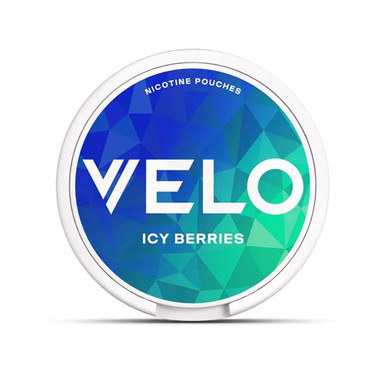
Velo · 10mg–17mg
Read the full guide
Velo Icy Berries Nicotine Pouches
£4.19
✔ In stock — ready to ship
100% tobacco-free
Free over £20
Same-day dispatch
Secure checkout
This page covers Velo Icy Berries Nicotine Pouches, listed at £4.19. Three strengths are declared — 10mg, 14mg and 17mg — and all three variants carry the same £4.19, so the choice between them has no effect on what you pay. Our record marks the product in stock at the time of writing. Two flavour tags are held against it: mint and berry.
That second detail is worth pausing on, because most listings in this catalogue carry one tag and this one carries two. A pair of tags tells you something a single tag cannot: the can was built as a crossover rather than as a straight statement of one flavour. It does not tell you the proportions, which way the balance leans, or how either element reads on its own — we hold no tasting notes, no intensity scales and no comparative testing for any listing on this site — but it does tell you the product was aimed at the overlap of two families rather than at the middle of one.
The full guide to Velo Icy Berries Nicotine Pouches
5,019 words on how it eats, who it suits, how to serve it and what to put beside it.
Velo Icy Berries: the facts on the listing
What we do not hold is a pack count. That field is empty, so we cannot tell you how many pouches are in the tin, nor whether £4.19 covers a single can or more than one. Both figures are printed on the packaging and confirmed at checkout, and those are the places to read them rather than a paragraph written by us.
A note on what this page is for. It describes an object, places it against other objects on the same shelves, and says plainly where our information stops. It does not publish ingredients, does not explain anything that happens once a pouch is in place, and makes no statement about anyone's condition in any direction. Where a reasonable question would need an invented answer, the answer here is that we do not hold it.
This is an adult nicotine product, sold on the basis that the buyer is aged 18 or over and already uses nicotine. The full compliance wording sits in its own section near the foot of the page.
Reading the name: berries, and the word Icy
The berry half of the name is doing straightforward descriptive work. Berry as a flavour family covers the dark, slightly jammy end of fruit — blackcurrant, blueberry, raspberry and their relatives — and it is characterised by a sweetness with an acid edge running through it. That acid edge is the part that stops a berry note tasting like confectionery, and its presence or absence is the main thing separating berry cans people return to from berry cans they abandon halfway down.
The second half needs saying clearly, because it is exactly the kind of word that gets over-read. Icy is a flavour name. It is not a claim about temperature and not a description of anything the product does to you. It belongs to a family of intensity words manufacturers use across this category — Icy, Frosty, Freezing, Arctic, Avalanche, Storm — and every one of them is a label on a lid rather than a statement of physics. What it signals, as a naming convention, is that a mint element has been set against the fruit rather than the fruit being left on its own. That reading is consistent with the two tags we hold, and it is a reading of a name, not a measurement.
While we are on the subject: where this page uses the word cool about a taste, it is using it the way the word hot is used about a chilli — as ordinary tasting vocabulary for a flavour family, not as a statement that anything changes temperature. We would rather be tedious about that distinction than leave it ambiguous on a page about a product named Icy.
On aroma, the honest note is brief. Fruit-and-mint cans generally announce the mint side first when a tin is opened, because the aromatic part of a mint is more volatile than the body of a fruit note and reaches the nose ahead of it. That is a general observation about this kind of can rather than a specific measured claim about this listing. The manufacturer's own account of the flavour is printed on the can and outranks anything we could reconstruct from two tag words.
The tin and what is inside it
The can is the shallow round tin used across this whole shop — flat enough for a shirt pocket, small enough to close a hand around. The lid lifts clear and presses back down; there is no hinge and no thread, and the fit is firm enough that a closed tin does not open itself in a bag.
The lid face carries the brand, the flavour name and the milligram figure. With three declared strengths on this listing, that figure is the only thing distinguishing two otherwise identical tins once the outer packaging is gone, so it is worth getting into the habit of reading the top of a can rather than reaching blind into a drawer.
Inside, the pouches sit in a ring, flat, even, pale and soft-edged. The underside of the lid is hollow — a shallow well with a small lip around it — and that is the catch compartment. It exists to hold a finished pouch until a bin is available: press it in, put the lid back on, deal with it later. Used pouches go into general waste. Not down a sink, not out of a window, not into recycling. Empty the well before it holds enough to stop the lid sitting flat, which is usually the prompt people notice.
The format in ordinary use
A pouch from this can is a small soft rectangle with rounded corners, dry to the touch, light enough to vanish inside a closed hand. It goes under the upper lip and stays where it is set. New pouches feel slightly bulkier than they looked in the ring, and that impression fades in a minute or two as the pouch settles into the shape of the space it occupies.
How long people keep one in varies far too widely for any single figure to be honest. Ten minutes is common; twenty to forty is more common; plenty go longer out of routine rather than intent. There is no correct duration and we are not going to print one as though there were. What is worth knowing is that the taste is at its most defined early and thins steadily from there, so the first few minutes are where a judgement about whether a can suits you is best formed.
Talking with a pouch in place is unremarkable once it has settled. Drinking is fine, although hot drinks tend to shorten how long the flavour holds. There is nothing to charge, refill, clean or put down on a surface, which is the whole appeal of the format to people who use it and also the reason there is so little to say about operating one.
What the three declared figures are, and are not
Ten, fourteen and seventeen milligrams are declared strengths per pouch, printed by the manufacturer and copied into our data unchanged. They are labels. They are not ratings, not grades, and not a ladder anybody is expected to climb. A higher figure is not a better product, a more advanced product, or a product for a more experienced buyer, and nothing on this page should be read as implying otherwise.
To put the limit of our position plainly: we cannot advise you on which of the three to buy, and we will not steer you towards one by implication. A shop holding a table of printed label figures has no basis on which to judge what suits any particular person. Because all three variants cost the same £4.19, price offers no steer either. Guidance of that kind has to come from a source qualified to give it, and a retailer is not one.
Where those figures sit in our filing is arithmetic and we can give it freely. All three variants are shelved on our strong shelf, which holds 132 listings. Below it is the medium shelf with 135, and above it the extra-strong shelf. Those shelves sort by the number on the label and by nothing else, so a listing arrives on one because of what its packaging says rather than because we have formed any view about it.
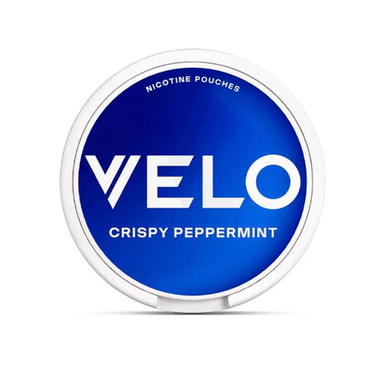
Within the Velo range, this listing shares its upper two figures exactly with Velo Freezing Peppermint, which declares 11mg, 14mg and 17mg, while its lowest figure matches the upper of the two on Velo Crispy Peppermint, declared at 6mg and 10mg. Both of those are in stock. Those overlaps are facts about labels and nothing more.
Carrying a can, and the rules that are not ours to write
Start with the physical facts, because they are the only part of this subject we are entitled to be confident about. The tin is flat and small. It goes in a pocket, a bag, a glovebox, a desk drawer. It does not rattle much, it does not leak, and it takes up less room than a set of keys. A pouch, once placed, is not visible to anyone who is not looking for it and stays put without being held. There is no equipment, no noise and nothing to set down on a table. That is a description of an object and a format, and every word of it is verifiable by looking at the thing.
Now the part that matters more, because it is where people get themselves into trouble. Being unobtrusive is not the same as being permitted, and we are not in a position to tell you where you may use one. That is not evasion. The rules genuinely belong to other people — to whoever owns or runs the place you are standing in — and a shop writing confident reassurance about somebody else's property would be guessing on your behalf with your inconvenience as the cost of being wrong.
Employers. Most organisations of any size set out what is permitted on site in a staff handbook or a site rule, and the range is enormous: a hospital, a school, a warehouse, an office, a food production site and a construction site will not have the same policy, and some distinguish between areas within a single building. Some address pouches explicitly, some are silent and leave it to a manager's reading of a broader rule. We hold no information about any employer's policy and could not obtain it. The written policy, and whoever administers it where it is ambiguous, is the only reliable source.
Venues. A pub, a restaurant, a hotel, a cinema, a gym, a members' club, a stadium — each sets its own conditions for its own premises, none of them are collected in any central place, and they change. Asking is quick and settles it. A page like this one telling you that something is "generally fine" would be inventing a consensus that does not exist.
Transport. Here the rules stack, which is what catches people out. The operator carrying you — a rail company, an airline, a coach firm, a ferry — sets its own conditions of carriage. The station, port or airport may add rules of its own on top. And on an international journey there is a third layer, which is the law of the place you are arriving in.
Crossing a border. This is the one we are most emphatic about. Rules on nicotine products differ sharply from country to country and several have changed in recent years. Some jurisdictions restrict sale, some restrict import, some restrict possession, and some have moved more than once in a short period. We are a UK shop describing a UK listing. We do not track foreign law, we will not summarise it, and we would be doing you a disservice if we implied otherwise. Check the current position for the specific country you are entering, and the specific operator carrying you, before you travel. It costs a few minutes and it is the traveller's responsibility, not the retailer's.
Other people. The quieter part of the same subject. A tin in a pocket and a pouch in place are unobtrusive, but discretion is not a licence to ignore the preferences of whoever you are sitting with — in someone's car, at someone's table, in someone's house. That is ordinary manners and does not need a retailer to explain it. The part that actually irritates people, in our experience of being asked about it, is not the pouch at all but the used one: a spent pouch left on a saucer, a windowsill or the edge of a sink is inconsiderate in a way the format does not require. The well in the lid exists precisely so that never has to happen, and using it is the entire answer.
One last practical note on carrying. A tin that lives permanently in a car door pocket or a coat left on a radiator will not be in good condition when you next open it, for reasons set out in the storage section further down. Discretion and storage pull in slightly different directions — the most convenient place to keep a can is often the worst one for it — and it is worth knowing that before you settle on a habit.
What people keep alongside this can, and why
Almost nobody who buys pouches regularly stays on one can. Two or three in rotation is the normal pattern, and the reason is simple: a single flavour held for weeks stops registering, and a second can in the drawer restores the first one's definition by contrast. Since this listing sits at the crossing point of two flavour families, it pairs in more directions than a single-tag can does, and it is worth walking those directions properly.
Towards the fruit side. If what you like here is the berry element, the catalogue has a deep bench of it. Clew Blueberry at £39.90 and Denssi Blueberry Freeze at £39.90 both take the blueberry route, the second with an intensity word of its own in the name. Elf Bar Blueberry Raspberry at £29.90 puts two berries together rather than one. Pablo Gold Edition Blueberry Peach Ice at £19.95 adds a stone fruit to the berry, which moves the sweetness forward and softens the acid edge. All four are in stock, and all four sit on the berry shelf alongside this listing and 72 others.
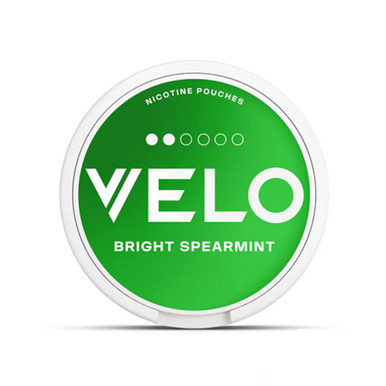
Towards the mint side. If the mint element is what holds your attention, Klint Avalanche Mint at £36.90 and Cuba Ninja Ice Cool at £39.90 are two emphatic mint listings currently available, and Edge Mint at £14.95 sits at a considerably lower price point in the same family. Within Velo itself, Velo Bright Spearmint is the softer, rounder mint at the same £4.19 as this can, while the two Velo peppermint listings named earlier take the sharper route.
Straight across, to another crossover. If what you actually like is the structure rather than either flavour — a fruit note with a mint spine under it — then the 77 VB Edition Mini Arctic Berry at £39.90 is the closest thing in the catalogue to this listing's own construction, and it is in stock. Killa Banana Ice at £33.50 does the same trick with a soft tropical fruit instead of a berry, which puts sweetness much further forward.
Deliberately sideways. Some people rotate towards contrast rather than similarity, on the theory that two similar cans blur into each other. For that, Fumi Fiery Mint at £27.90 sets a spice idea against a mint — again a flavour description and not a temperature claim — and within Velo, Velo Cherry Ice takes dark fruit on its own, Velo Lime Flame at a declared 8mg goes to citrus, and Velo Mango Flame goes tropical. All three are £4.19 and all three are available.
A caution about the prices in those paragraphs, because the spread is wide. Our pack-count field is empty across these listings, so we do not hold what each price covers and cannot calculate a per-can figure. A £39.90 line is not simply nine times a £4.19 line; very often it reflects a larger quantity. The individual listing and the checkout state what is included, and checking there before comparing two numbers takes seconds.
Nothing in this section is a suggestion to buy more than you came for. It is a map of the shelf, sorted by direction and priced as we price it.
This can within the Velo line
Twenty-one Velo listings sit together on the Velo shelf, every one at the same £4.19, which takes price out of the comparison and leaves flavour, declared figures and availability.
It is worth noting what that uniform price does and does not mean. It means the brand's cans are priced identically by us, so nothing in the range costs more because of its flavour or its declared figure. It does not mean the cans are interchangeable, and it does not mean a like-for-like comparison with another brand's price is possible, because our pack-count field is empty here as it is everywhere else and we therefore do not hold what any of these prices covers. Within Velo the comparison is at least consistent: whatever £4.19 buys, it buys the same thing across the shelf.
Among those, this is the only listing we hold with two flavour tags. The others are single-family cans: two peppermints at different ends of the declared range, a spearmint, a cherry, a citrus and a tropical. That makes this one the natural bridge in the range — the can somebody moves to when they like the mint listings but want fruit in the picture, or likes the fruit listings but wants a sharper spine under them. It is the widest-reaching can on the shelf in flavour terms, which is a structural observation about tags rather than a claim that it tastes better than its neighbours.
Keeping a can in the condition it left in
These are dry pouches and dry is how they are meant to stay. Two things spoil a tin: moisture and warmth.
Moisture comes from the air more often than from anything dramatic. A can left open in a bathroom, next to a kettle, in a kitchen near a sink, or in a car carrying wet coats will take some of it up, and the result is pouches that feel heavier and softer out of the ring and give up their flavour earlier than they should. Press the lid fully home every time rather than resting it on. Open tins with dry hands. Keep the can out of steam. If a single pouch has gone noticeably limp compared with its neighbours, that one belongs in a bin; the rest of the ring is usually unaffected.
Warmth mostly costs flavour, and on a can like this it costs the part that reaches you first, because the aromatic mint element is the most volatile thing in the tin. A glovebox in July, a windowsill in direct sun, a pocket pressed against a radiator, a bag in a hot car boot — all of them leave a tin duller than it should be, and none of it comes back. A drawer, a cupboard away from the hob, or an inside pocket of a bag is all that is needed.
On refrigeration: some people keep cans cold and prefer them that way, which is a preference and not something we need a view on. The caution is condensation. A tin repeatedly moved from a cold fridge into a warm room collects water on the metal, which lands you back in the moisture paragraph. If you do it, let the closed can reach room temperature before opening it.
We cannot tell you how long a can keeps. Best-before or expiry dating is printed by the manufacturer on the packaging and is not carried in our record, so any figure from us would be fabricated. Read the can. And the point that outranks all the others: keep tins where children and animals cannot reach them — a closed drawer or a high cupboard, not a coffee table, not a car door pocket, not a bag left open on the floor.
Choosing between 10mg, 14mg and 17mg
The three variants are identical in price at £4.19 and identical in name apart from the figure, so there is nothing in our listing that can decide between them for you, and we will not decide for you either. That refusal is the one thing a retailer genuinely must not do on a product like this, and it is not a stylistic choice on our part.
The useful things we can say are administrative rather than advisory. Confirm which variant is in your basket before paying, because identical pricing means a wrong selection produces a correct-looking total. If you keep more than one variant at home, read the lid figure rather than trusting which tin is nearest to hand. And if you are ordering several Velo cans together, bear in mind that the whole brand shelf is priced at £4.19, so the basket total tells you how many items you have and nothing whatever about which strengths they are.
Ordering, delivery and proving your age
The price listed is the price charged, and what that price covers is stated on the listing and confirmed at checkout rather than estimated here. Delivery options, costs and timings are presented during checkout, because that is where the terms that actually apply to your order are set out; a description page is the wrong place to promise a timescale we cannot guarantee.
Age verification is not a formality and not a box-ticking exercise. This is an 18+ product. Orders are placed on the basis that the buyer is aged 18 or over, and ID may be requested on delivery. A courier who asks and is not satisfied will not hand over the parcel. Buying on behalf of anyone under 18 is not something we will knowingly be part of, and no part of this page is addressed to anyone under that age or to anyone who does not already use nicotine.
Where this page sits, and where to go next
This listing appears in five places, which is more than most. It sits on the brand shelf with the other twenty Velo cans. It is filed on the strong shelf on the basis of its declared figures. It appears among the 148 listings on the mint shelf and among the 76 on the berry shelf, because two tags put it on two flavour categories. And it is in the full catalogue, which is the widest view we have.
If you browse by declared figure, the medium shelf and the extra-strong shelf sit either side of this one, and both are filing categories rather than rankings. If you browse by brand, the Pablo shelf and the Cuba shelf are two of the larger ones and hold several of the cans named on this page.
Questions we get about this can
Does "Icy" mean it feels cold?
No. Icy is a flavour name chosen by the manufacturer, one of a family of intensity words used across this category, and we print the name as given. It is not a claim that the pouch chills anything or produces any physical sensation of cold. As a naming convention it signals that a mint element sits alongside the fruit, which is consistent with the two flavour tags we hold, and that is as far as our reading of it goes.
Is this a berry can or a mint can?
Both tags are held against it, which tells you it was built at the crossing point of the two families rather than in the middle of either. What our data cannot tell you is the balance — which element leads, how strongly, or how either reads on its own — because we hold no tasting notes or intensity information for any listing. The printed can is the manufacturer's own account and is a better authority than this page.
Which of the three strengths should I get?
We cannot tell you, and we will not imply it through phrasing. A shop holding a table of label figures has no basis for judging what suits a particular person, and since all three variants cost £4.19 there is not even a price difference to point at. The figures are printed on the cans and listed above. Any genuine guidance needs a source qualified to give it, which a retailer is not.
How many pouches are in a can?
We do not hold that number. The pack-count field on this listing is empty, which also means we cannot tell you whether £4.19 buys one tin or several. Both are printed on the packaging and stated at checkout. We would rather leave an obvious gap on the page than fill it with an estimate that proves wrong when the parcel arrives at your door.
How does it compare with the Freezing Peppermint can?
On figures we can be exact: this listing declares 10mg, 14mg and 17mg, and that one declares 11mg, 14mg and 17mg, so two of the three match. On flavour we can say only that this can carries mint and berry tags while that one carries mint alone, which means this one was built as a crossover and that one was not. Beyond the tags, our record holds nothing comparative.
Can I use one at work?
That is your employer's rule to state, not ours. Site policies vary enormously between industries and sometimes between areas of one building, some address pouches explicitly and some do not, and we have no visibility into any of them. The written policy is the place to look, and whoever administers it is the person to ask where the wording is ambiguous. We would be guessing on someone else's behalf if we answered for them.
Can I take a tin abroad?
We cannot tell you. Rules on nicotine products differ sharply between countries and have changed in several places in recent years — some restrict sale, some import, some possession. We are a UK shop describing a UK listing and we do not track foreign law. Check the current position for the destination country and for the operator carrying you before travelling, rather than relying on anything on this page.
What do I do with a used pouch?
General waste, and the hollow well under the lid is there to hold it until you reach a bin. That is its entire purpose: press the spent pouch in, put the lid back, and empty the well when you next empty your pockets. Do not put them down sinks or drains and do not drop them outdoors. Left to accumulate they will stop the lid sitting flat, which is the usual prompt to clear it out.
My can tastes flatter than the last one. What happened?
Storage is the usual explanation. Warmth thins the aromatic element first, so a tin that has sat in a car, on a sunny sill or against a radiator often reads duller than one kept in a drawer. Moisture is the other cause and tends to make pouches feel heavier and fade sooner. Neither is reversible, and neither is something we can investigate for you, since we hold no batch information and do not test products.
Do the three variants taste the same as each other?
Our record cannot answer that. All three carry the same product name and the same two flavour tags, and we hold no comparative tasting information, no intensity scales and no testing of our own. The declared figures differ; whether anything else differs is not something we know, and we are not going to speculate in either direction to make the page more satisfying.
Why does this can appear on two different flavour shelves?
Because flavour shelves are built directly from flavour tags, and this listing holds two. A can tagged only mint appears on one shelf; this one holds mint and berry, so it is filed on both and turns up in either listing when you browse. It is a mechanical consequence of the tagging rather than a judgement about the product, and it is why a can like this is easier to stumble across than a single-tag one.
Is a can with two tags a compromise between the two flavours?
We have no basis for saying so. Two tags tell you the product was aimed at the overlap of two families rather than the middle of one; they say nothing about whether the result is balanced, whether one element dominates, or whether anything has been held back to accommodate the other. We hold no tasting notes, no intensity scales and no testing, so any answer we gave would be invention dressed as expertise.
Why is there no ingredient list on this page?
Because we do not publish ingredient information for any listing on this site and hold none in our product record. The packaging carries whatever the manufacturer is required to state, and that is where to read it. This is a deliberate limit on what these pages do rather than an oversight, and it applies equally to every can we sell.
Legal notice and compliance
This product is for adults aged 18 or over who already use nicotine. It is not sold to anyone under 18, and ID may be requested on delivery; a courier who is not satisfied will not complete the handover.
Nicotine is an addictive substance. Nothing elsewhere on this page qualifies that statement or should be read as softening it.
This product is not a licensed stop-smoking medicine and is not offered, described or intended as one. It is not intended for non-smokers, for anyone who does not currently use nicotine, for anyone under 18, or for anyone who is pregnant or breastfeeding. We make no health or medical claim of any kind, in any direction, and we give no dosage advice. Nothing on this page is an encouragement to anyone to begin using nicotine.
Keep cans out of the reach of children and animals. Questions about your own circumstances belong with a qualified professional rather than with a shop.
To finish
A two-tag crossover can at £4.19, declared at 10mg, 14mg and 17mg for the same money, currently in stock, and the only listing in the Velo range we hold with more than one flavour tag against it. Icy is a name on a lid rather than a description of anything, and the balance between the fruit and the mint is something the printed can can tell you and our record cannot.
If you want to look further in either direction, the berry listings and the mint listings are the two shelves this page belongs to, and the rest of the Velo range is one click away.
More from Velo

More strong pouches
More mint pouches
Where this sits
Velo Icy Berries Nicotine Pouches appears in these categories. Browse them, or jump to something close.
You might also like