
Home / Extra Strong / Iceberg Kiwi Strawberry Nicotine Pouches

Iceberg · 20mg–50mg
Read the full guide
Iceberg Kiwi Strawberry Nicotine Pouches
£39.90
✔ In stock — ready to ship
100% tobacco-free
Free over £20
Same-day dispatch
Secure checkout
The listing is Iceberg Kiwi Strawberry Nicotine Pouches, and the facts we hold against it are these. The price is £39.90. Two declared strengths are recorded, 20mg and 50mg, and the £39.90 covers either of them. Three flavour tags are attached: berry, strawberry and tropical. One product image is held. The stock flag reads out of stock at the time of writing.
Two things are absent and are worth stating up front rather than leaving to be discovered. We do not hold the pack arrangement — the field that tells us whether £39.90 buys a single can or a box of them is empty on this record. And we do not hold a pouch count per can. On this site the gap between a four-pound listing and a forty-pound one is almost always the number of cans in the box, so an absent pack figure is a real gap rather than a trivial one, and the listing page and checkout are where it gets answered.
The full guide to Iceberg Kiwi Strawberry Nicotine Pouches
5,109 words on how it eats, who it suits, how to serve it and what to put beside it.
Opening the record on this one
The other thing our record does not carry is the word kiwi. The product name has it; the flavour tags do not. Strawberry is tagged, berry is tagged, tropical is tagged, and the second half of the fruit pairing in the name is simply not represented in the data. That is a quirk of how this listing was recorded, and it means that on a shelf view this can will surface under strawberry and under tropical but never under a kiwi heading. We mention it so the filing does not look like a mistake.
Before anything else: this is an age-restricted nicotine product, sold to adults aged 18 or over who already use nicotine. The compliance section further down is part of the listing rather than an afterthought attached to it.
In the hand, the object is the standard press-lid tin. A shallow plastic cylinder, wider than it is deep, brand and flavour printed on the top, a catch compartment moulded into the lid. Whatever the pack arrangement turns out to be, one can is that.
How a fruit note gets built into a dry pouch
It is worth understanding what a flavour in this format actually is, because the mental model most people arrive with comes from drinks or confectionery and does not transfer cleanly. A pouch is not a liquid and it is not something you chew. That constrains what a flavour can do, and the constraints explain most of what surprises people about their first few cans.
The absence of a carrier changes everything
In a drink, flavour rides on liquid. In a confection, it rides on a chewed matrix that keeps releasing as it breaks down. A pouch has neither. It sits still in one place and the flavour comes out of it gradually, without carbonation to lift it, without temperature to sharpen or soften it, and without any mechanical action to renew it.
The consequence is that pouch flavours read flatter and steadier than their equivalents elsewhere. A fizzy fruit drink is bright and lively because the bubbles keep presenting the flavour afresh; the same fruit in a pouch arrives once and then recedes. People sometimes describe this as pouch flavours being weaker, which is not quite it — they are less animated. The information is all there, just delivered without punctuation.
What survives the format and what does not
Not every part of a fruit flavour translates equally. The broad, sweet body of a fruit comes across well. The aromatic top notes — the things you smell rather than taste, the parts that make a strawberry recognisably a strawberry rather than merely sweet and red — come across but fade first. Genuine acidity is the hardest thing to carry. A fruit that depends on sharpness for its identity loses more in translation than one that depends on sweetness.
That has a direct bearing here. Strawberry is a sweetness-led fruit with a modest aromatic signature, and it translates comparatively well. Kiwi is the opposite case: its identity leans on a green, tart, slightly astringent character, and that is exactly the part of a fruit that a dry format struggles to carry. A kiwi note in a pouch is therefore usually a stylised one, indicated rather than reproduced, and it is generally the quieter half of any pairing it appears in.
Why flavours are usually built in pairs
Two-fruit names are common in this category and the reason is structural rather than decorative. A single fruit in a flat format can read as one-dimensional, and a second fruit gives the flavour a shape — something to arrive first and something to sit behind it. In a pairing like this one, the sweeter and more robust fruit tends to lead and the sharper, more fragile one provides an edge and a colour.
Which of the two leads in this particular can is not something our record tells us, and the ordering in a product name is not a reliable guide. We are not going to guess at the balance and present the guess as a description. What can be said is that the pairing belongs to a well-established family, and the nearest comparisons we stock are Pablo Exclusive Strawberry Kiwi at £3.85 and XQS Strawberry Kiwi at £39.90, both of which name the same two fruits in the other order.
Where cooling fits into the construction
A cooling character is a separate layer that a maker may add on top of a fruit flavour, and it changes the whole reading when present. It sharpens the top of the flavour and tends to make fruit notes read as cleaner and more defined than they otherwise would. Makers who build one in usually say so in the product name.
This product name does not, and our record carries no cooling designation, so we cannot tell you whether there is any here. For the contrast, Denssi Strawberry Freeze at £39.90 and Velo Strawberry Ice at £4.19 both put the word in the title, which settles the question before you open either one.
A rough map of what translates
Laid out rather than described, the picture looks like this. The table is about flavour construction in general rather than about this can specifically, and it is offered as a way of reading the shelves rather than as a specification for any listing on them.
| Element of a flavour | How well it carries in a dry pouch | Practical consequence on a shelf |
|---|---|---|
| Broad sweetness | Carries well and lasts longest | Sweet-led fruits are the safest bet for a recognisable result |
| Aromatic top notes | Carry, but fade first | A flavour narrows over the life of a pouch rather than merely quietening |
| Genuine acidity | Hardest to carry | Sharp fruits are usually stylised rather than reproduced |
| Bitterness | Carries well | Why roasted and herbal directions survive the format intact |
| Cooling | Added separately, carries strongly | Dominates whatever it is layered onto; usually named in the title |
Reading down that middle column explains most of the mismatches people report between what a name promised and what a can delivered. It is rarely a question of a maker doing a poor job; more often it is a fruit whose identity lives in the one part of a flavour the format handles least well.
Why two cans with the same name taste different
Nothing standardises a flavour name across makers. Strawberry from one house and strawberry from another are two independent attempts at the same reference, and they can differ more than a shared word suggests — one leaning jammy and cooked, another leaning fresh and green, another leaning towards the confectionery version of the fruit rather than the fruit itself. 77 Strawberry at £39.90 and Fumi Strawberry at £27.90 both name the plain fruit and are made by different houses, which is the simplest way to see that spread on our own shelves.
The taste, described as taste
What follows is a description of flavour and aroma only. No claim of any other kind is being made in this section and none should be read into it.
A strawberry-led pairing sits in the sweet, low-bitterness, moderate-acidity part of the shelf. Against the mint family it has no cooling to speak of unless one has been added. Against the roasted and herbal directions it is a different world entirely — there is no bitterness in it to speak of. Against the confectionery directions it is usually more recognisably fruit and slightly less sugary, though that varies by maker.
The green half of the pairing, where it comes through, reads as a faint tartness and a slightly vegetal edge underneath the sweetness rather than as a distinct second flavour arriving separately. It is a modifier more than an ingredient in the tasting sense. People who like the pairing tend to say it stops the strawberry from becoming cloying; people who do not tend to say they cannot find the kiwi at all. Both experiences are commonly reported and we have no way of telling which will be yours.
Aroma on opening is fruit-forward and fairly bright, and it runs a little sweeter than the taste that follows — a normal pattern with fruit directions and not a defect. Over the life of a pouch the aromatic part thins first, leaving a plainer sweetness behind, so the flavour narrows rather than simply quietening. We hold no timing data for this listing and will not invent any.
The strawberry grouping on this site runs to nineteen listings, which is a manageable number to read in full if the fruit is what brought you here rather than the brand.
The pouch as a physical object
A nicotine pouch is a small soft sealed pouch placed in the mouth and left alone. It is not chewed and it is not swallowed. That holds across everything on this site.
Placement is at the front of the mouth, between the lip and the jaw, and the lip is the only thing keeping it there. It can be moved from side to side or shifted up and down, and most people do that more in their first week than afterwards. If it is uncomfortable wherever it is put, the sensible response is to take it out.
How long anybody keeps one in is too variable to average honestly. Reported times run from a handful of minutes to the better part of an hour, and the usual reason given for removing one is that the taste has gone. We set no duration and suggest none; the usage guidance printed on the can by Iceberg is what applies.
Used pouches go into the catch compartment moulded into the lid, which holds three or four before the lid stops sitting flat. From there they go into a general waste bin — not a sink, not a drain, not out of a window. The tin is plastic and goes with household recycling to whatever extent your local authority accepts that grade, which is a council-level question we cannot answer for a particular address.
Two small mechanical notes. The pouches lie flat in a ring around the base of the tin, which makes the first one slightly awkward to extract and every subsequent one easy, and an open can turned upside down empties the whole ring at once. And nothing sticks to anything, so no technique is required to separate them.
Carrying one about, and whose rules apply
This is the part of a product page where a lot of shops start making promises, so it is worth setting out what we will and will not say.
The physical facts, stated plainly
A can is small. It fits in a coat pocket, a bag or a glove box without effort and weighs very little. A pouch in place is visible as a slight fullness under the lip to somebody looking for it, and it alters the shape of one or two consonants for the first minute until you stop noticing. There is no device, nothing to charge, nothing to switch on and nothing that produces anything in the air around you.
Those are physical descriptions of an object. They are not an argument, they are not an invitation, and they should not be read as a suggestion about where anybody should have one in place.
Why we do not publish a list of acceptable settings
Customers do sometimes ask a shop to confirm that a product is fine to use in a particular kind of place — at work, on a train, in a pub, in a cinema, on a plane. We understand why the question gets asked and we are not going to answer it, for a reason that is practical as much as it is principled.
The rule in any given place belongs to whoever runs the place. An employer sets the rules for its premises and states them in its own policies. A venue sets its own and posts them or does not. A transport operator sets conditions of carriage that apply on its services and nowhere else. A landlord, a school, a hospital, a sports ground, an airline — each of these publishes rules that are theirs to write, that differ from one another, that change without telling us, and that vary between sites operated by the same organisation. A retailer telling you what is permitted in somebody else's building would be guessing about a document it has not read.
So the honest position is this: we do not know what the rules are where you are going, we do not hold that information in any form, and the people who do hold it are the ones who wrote it. Ask them, read the signage, or check the policy. That is not us dodging the question; it is the only answer that is reliably correct.
What a shop is actually in a position to tell you
It is a short list, and worth writing out so the boundary is clear. We can tell you what our record holds about a product: its brand, its price, its declared strengths, its flavour tags, its stock position and, when we have it, its pack arrangement. We can describe the format in general terms, because the format is the same across the catalogue. We can tell you how our own shelves are organised and how to get from one to another. And we can tell you the conditions that attach to buying from us — the age restriction, the verification, the delivery arrangements.
What we cannot tell you is anything that belongs to somebody else: what a manufacturer intends by a flavour word beyond the word itself, what is written in an employer's policy, what a venue permits, what a transport operator's conditions say, or what the law is in a country we do not sell into. The line between those two lists is not a matter of caution. It is simply the line between information we hold and information we do not, and a page that blurred it would be less useful rather than more, because you would have no way of telling which half you were reading.
Travel, which is a category of its own
Crossing a border adds a further layer, because rules on nicotine products differ between countries and some restrict things that are entirely ordinary here. Quantities, permissions and outright prohibitions all vary. We hold no information about the law in any jurisdiction other than as it applies to selling this product in the UK, and we are not equipped to advise anybody on what they may carry where. Official sources for the destination are the place to check, and checking before travelling is considerably easier than sorting it out afterwards.
The wider point
Discretion is a description of a format, not a permission and not a selling point we intend to lean on. A product being unobtrusive does not make it appropriate anywhere in particular, and a page that implied otherwise would be quietly encouraging people to ignore rules set by somebody with more standing to set them than a shop has. We would rather describe the object accurately and let everybody apply the rules that actually govern them.
Reading the two declared figures
The strengths recorded on this listing are 20mg and 50mg, both at £39.90. The milligram number is the nicotine content Iceberg declares for one pouch. We reproduce it exactly as supplied, do not measure it ourselves, and would treat the printed can as authoritative if it ever disagreed with this page.
The comparison available between them is arithmetic and nothing more: 50 is a larger number than 20. That compares two label declarations. It does not describe how anything will seem to any particular person, and it is not a suggestion about which variant to order. We hold no information about you and a shop that behaved as though it did would be overstepping.
It is also worth saying that a higher declared figure is not a better product. Shelves arranged in ascending order invite that inference and we would rather cut it off than let it stand by omission. Across the site, listings are filed into bands by their declared figures — the Extra Strong shelf holds ninety-eight, while the Strong grouping and the Medium Strength grouping collect the lower declarations. A listing sits on one band only, so those shelves never show the same product twice.
Where this sits among the Iceberg listings
The Iceberg shelf runs to forty listings, making it one of the wider brand ranges we carry, and this can is one line on it.
The siblings our record names are all at £39.90, the same as this can, which points to a flat house price rather than one that varies by flavour. Iceberg Berries is the nearest of them to this listing's own ground, with Iceberg Black Currant taking a darker single-berry route. Iceberg Apple Lemon Pineapple is a three-fruit build with real acidity in it, Iceberg Black Mint steps into the mint family, and Iceberg Arasaka and Iceberg Black carry names that disclose nothing about flavour, which is a habit of this brand's worth knowing before ordering one blind.
The caveat that applies to the whole set: all six siblings are flagged out of stock on our record at the time of writing, as is this listing. That is a range-wide position rather than a remark about any individual can, and it means the brand shelf may be considerably thinner in practice than its forty entries suggest. The brand shelf is still the reliable route to the rest of the range.
This listing also carries more flavour tags than most, which puts it on three separate flavour shelves. It appears in the berry grouping, which at seventy-six listings is one of the largest on the site, and in the tropical grouping at fifty-eight, as well as in the strawberry grouping mentioned earlier. Appearing on three shelves is a consequence of the tagging rather than a statement that the can is three things at once.
What people keep alongside it
Most people who use pouches regularly run two or three flavours rather than one, because a flavour met constantly stops registering. The useful principle is that the second can should be different rather than adjacent — two strawberry cans in rotation is two versions of the same afternoon.
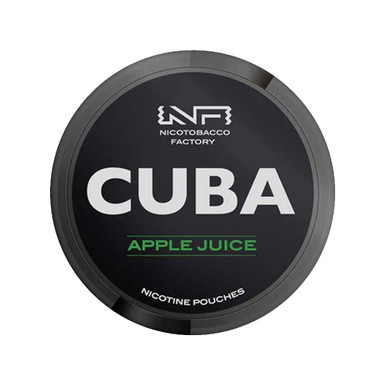
If more of the same is what you want, the strawberry shelf has nineteen entries and Killa Exclusive Strawberry Watermelon at £33.50 pairs the fruit with a different partner, which is a change of shape rather than a change of subject. Also close by is Iceberg Strawberry Banana Gum at £39.90, which keeps the strawberry and swaps the second fruit for something softer under a confectionery qualifier, and Edge Strawberry at £14.95, which strips the pairing back to the single fruit — both of those are currently marked out of stock. For a genuine contrast, Cuba Black Apple Juice at £39.90 is an orchard-fruit reading with more acidity than any berry can carries, which makes it a change of subject rather than a change of arrangement.
Brand browsing is the other route people take. The Pablo range is priced per can throughout, which makes it an inexpensive place to try something unfamiliar, while the Cuba brand page gathers listings priced the way this one is. None of this is a recommendation; it is a description of how customers tend to organise a shelf.
Keeping a can in condition
Two things change a can: heat and air. An unopened can is sealed and will keep in a cupboard or drawer for a long stretch without attention. Once opened, the contents begin a slow and entirely normal drift, and the flavour follows.
Seating the lid firmly between uses does more to slow that than anything else. A lid cannot seat properly over a full catch compartment, which is the practical reason for emptying it regularly — it is a storage measure, not a matter of tidiness.
Heat is the faster problem. A car in sun, a windowsill, a radiator shelf or a pocket left on something warm will do more to a can in an afternoon than a fortnight in a cool cupboard. Cool, dark and dry is the whole instruction. A fridge is unnecessary and adds condensation to the list of things that can go wrong, since a cold can opened in a warm room collects water inside it.
Where more than one can is in the house, the housekeeping worth adopting is to open the oldest first and put new arrivals at the back rather than the front. Cans carry no visible age once they are out of a box, so without some such habit the one that gets opened last is often the one that has been waiting longest, and it will taste like it. That is not a fault of the product; it is the ordinary result of a can sitting sealed but warm for months.
And the point that is not about the product's condition at all: keep a can out of reach of children and away from anybody it is not intended for. That is a condition of having it in the house rather than a tip.
What there is to choose here
One decision, and it is the strength: 20mg or 50mg, both at £39.90. Price does not separate them, and as set out above we are not going to steer it. The figures are declarations printed on labels and the relationship between them is arithmetic.
There is no pack-size decision to make, because no pack arrangement is recorded against this listing. Whether £39.90 buys one can or several is stated on the listing page and at checkout rather than here. That is an unsatisfying answer and it is the accurate one.
If the pairing is unfamiliar and you would rather meet it cheaply before committing, a single-can listing from another maker is the low-cost route, and everything we stock can be narrowed by shelf to find one.
Ordering, delivery and the door
The stock flag currently reads out of stock, so this listing cannot be ordered today. Flags move and it may read differently when you see it. Leading with that seemed fairer than letting somebody read to the bottom of the page and then discover it.
When it is available, £39.90 is the price for the declared strength selected, and delivery is by courier to a UK address with the timescales shown at checkout being the ones that apply.
Age verification is not a formality. This is sold to adults aged 18 or over only. Age may be checked when the order is placed, and the courier may ask for photographic identification before handing anything over. A delivery that cannot be verified will not be completed.
Routes away from this page
Because this listing carries three flavour tags, it has more doors leading off it than most. The berry grouping is the broadest of them at seventy-six listings, the tropical grouping sits at fifty-eight, and the strawberry grouping is the narrowest and therefore the quickest to read. The brand shelf is the route for anybody who came for Iceberg specifically, and the strength bands are for anybody sorting by declared figure.
If none of those is the right question, the full catalogue index holds everything. It is a long list, and working outward from a narrow shelf is almost always faster than working inward from the whole thing.
For somebody who arrived wanting this exact pairing and has found it unavailable, the shortest path is the two listings that name the same two fruits: the XQS reading of the pairing at £39.90 sits at the same price as this one, and the Pablo version at £3.85 is the low-cost way to meet the combination before committing to anything larger. Both are different makers' attempts at the same reference rather than substitutes for this can, which is worth remembering before treating either as a like-for-like replacement.
Questions we are asked
Why is kiwi missing from the flavour tags?
Because it is not in our record. The flavour field holds berry, strawberry and tropical, and the second fruit in the product name is not represented. That is how the listing was recorded rather than a statement about what is in the can. The practical effect is that it will not surface under a kiwi heading on a shelf view, and we would rather explain that than let it look like an error.
How many cans is £39.90 buying?
We do not hold that figure. The pack arrangement field is empty on this listing, and since prices on this site range from under four pounds for a single can to around forty for a box, the difference matters. We are not going to infer it from the price. The listing page and the checkout state what you are buying.
How many pouches are in a can?
Also not recorded. The field is absent from our data, and rather than publish a number based on what cans usually hold we would sooner tell you it is missing. The printed can carries it.
Which fruit leads, the strawberry or the kiwi?
We cannot tell you. Our record gives flavour tags rather than a tasting note, and the order of words in a product name is not a reliable guide to which note dominates. In this family the sweeter fruit usually leads and the sharper one sits behind it, but that is a general pattern rather than a fact about this can. The can is the authority.
Is there any cooling in it?
Our record does not say and the product name does not include a cooling word, which is suggestive but not conclusive. Makers who build a cooling character in usually name it, as several strawberry listings on this site do. Since we cannot confirm it either way, the packaging is where to check.
Why do the 20mg and 50mg cost the same?
Because that is what the record shows. Both are £39.90 and neither carries a premium. People often assume the higher declared figure costs more; on this listing it does not. Price is not a guide to the declared figure here and the declared figure is not a guide to price.
Can I use one at work or on public transport?
That is not a question we can answer and not one we will try to. The rules for a workplace belong to the employer and the rules on a service belong to the operator, they differ from one another, and they change without anybody telling a shop. Read the policy, look for the signage, or ask whoever runs the place. A retailer guessing about somebody else's rules would be doing you no favours.
Can I take these abroad?
We hold no information about the law in other countries and cannot advise on it. Rules on nicotine products differ between jurisdictions, and some restrict quantities or prohibit things that are unremarkable here. Official sources for the destination are the place to check, and checking before you travel is far simpler than dealing with it at a border.
How long does a pouch last?
There is no figure we can give honestly. The range people report is wide enough that any average would mislead rather than inform. Most take one out when the taste has faded, which is itself variable. We publish no duration and suggest none, and the guidance the manufacturer prints on the can is what should be followed.
When is it back in stock?
We do not know. Our record holds a stock flag, not a restock schedule, so any date would be invented. Checking the brand or flavour shelves periodically is more reliable than waiting on an estimate that does not exist.
Why does this listing appear on three different flavour shelves?
Because three flavour tags are recorded against it — berry, strawberry and tropical — and the shelves are built from the tags. A listing with one tag appears once; a listing with three appears three times. It does not mean the can is three flavours, only that the record describes it in three ways. The berry shelf at seventy-six listings and the tropical shelf at fifty-eight are both broad groupings, so this can is a small entry on two large shelves and a more prominent one on the narrower strawberry shelf.
Does the order of the fruits in the name mean anything?
Not reliably. Some makers name the dominant note first and some name the fruits in whatever order reads better on a lid. Two listings on this site name the same pairing in the opposite order to this one, which tells you how little weight the convention carries. If the balance between the two fruits matters to you, the can is where to look, because our record gives tags rather than a tasting note.
Where is it made?
We hold the brand name and no more. Country of origin, manufacturing arrangements and company details are not fields in our record, and we do not publish facts of that kind unless we hold them. Packaging is normally where that is declared.
Compliance and legal notice
This product is for adults aged 18 or over who already use nicotine. It is not sold to under-18s, and nothing on this page is addressed to anybody who does not already use nicotine.
Nicotine is an addictive substance.
This product is not a licensed stop-smoking medicine and no medicinal claim is made for it. It is not intended for non-smokers, non-nicotine-users, under-18s, or anyone who is pregnant or breastfeeding. Nothing on this page is medical advice; anybody with a question about their own circumstances should put it to a qualified professional rather than to a retailer.
Age may be verified when an order is placed, and photographic identification may be requested by the courier at delivery. Orders that cannot be verified will not be completed. Keep out of the reach of children and away from anyone the product is not intended for.
The short version
Iceberg Kiwi Strawberry is priced at £39.90, declared at either 20mg or 50mg for the same money, tagged as berry, strawberry and tropical but not as kiwi, and currently flagged out of stock. The pack arrangement and the pouch count are both missing from our record and belong to the listing page and the packaging. Flavour names describe taste; milligram figures describe labels; and where the rules of a place are concerned, the people who wrote them are the ones to ask.
More from Iceberg



More extra strong pouches



More berry pouches
Where this sits
Iceberg Kiwi Strawberry Nicotine Pouches appears in these categories. Browse them, or jump to something close.
You might also like