Killa · 16.5mg
Read the full guide
Killa Exclusive Strawberry Watermelon Nicotine Pouches
£33.50
✔ In stock — ready to ship
100% tobacco-free
Free over £20
Same-day dispatch
Secure checkout
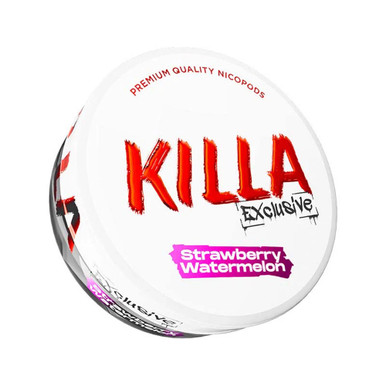
Killa Exclusive Strawberry Watermelon Nicotine Pouches appear on our catalogue at £33.50. The label carries one declared figure, 16.5mg, and the listing offers one variant at that figure and that price. There is no second size, no alternative strength and no multipack toggle attached to it. Our record shows the product as available as this page is written, and we hold a single photograph of the can.
Those are all the facts we have. Everything below is built from them, and where our record is silent the page says so rather than reaching for a plausible-sounding filler. There are two silences on this listing in particular, and both get a paragraph of their own further down instead of being quietly skipped.
The full guide to Killa Exclusive Strawberry Watermelon Nicotine Pouches
5,085 words on how it eats, who it suits, how to serve it and what to put beside it.
The listing, stated plainly before anything is added to it
Before the flavour, a word about the words on the can, because two of them are manufacturer naming and neither describes the product.
Killa is a trade name. It is what the company that makes the can has chosen to print on it, in exactly the way every other brand in the catalogue has a name printed on it. A trade name is not a specification, not an instruction and not a description of an effect, and this page does not read it as any of those things. We file the word where it belongs, as a brand, on the Killa shelf, which currently holds 31 listings.
Exclusive is a line name. It marks a sub-range inside the brand's own catalogue, which is a common way for manufacturers in this category to separate one run of cans from another. We hold nothing at all about what the company intends the word to mark — whether it points to a set of flavours, a packaging series or nothing beyond a label decision — so we will not explain it. It is printed on the can, which is why it is in the title here, and that is the extent of our knowledge.
Strawberry and watermelon, described as taste and aroma
Our classification holds three flavour terms for this can: berry, strawberry and watermelon. That is more terms than most listings carry, and it puts the can on three separate flavour shelves rather than one.
The strawberry side of a pairing like this, taken purely as taste, tends to be the rounder of the two. Strawberry as a flavour note is soft at the front, with a jammy weight in the middle and a faint green edge at the back that keeps it from being flat sugar. In aroma it is warm rather than bright — you meet it before you taste it, and it carries a slight cooked-fruit character even when nothing about the presentation is cooked.
Watermelon works differently. It is a thinner, wetter, more transparent note, with a high sweetness that arrives quickly and leaves quickly, and a faintly vegetal finish that is part of what makes real melon recognisable. On its own it can read as light to the point of being insubstantial. Paired with something heavier it does the opposite job: it lifts the front of the flavour and keeps the whole thing from settling into syrup.
Put together, strawberry and watermelon is a well-established pairing across the wider flavour world for exactly that reason. One supplies body, the other supplies lift. Which of the two leads in this particular can is not something we can tell you, because we hold no manufacturer tasting note and we do not write our own. What we can say is that both terms are in our data, so neither is incidental, and that berry sits alongside them as the broader family label.
That third term is worth a sentence. Berry on our shelves is a wide grouping — it gathers strawberry, blueberry, raspberry, blackcurrant and the various mixed-fruit constructions under one heading, and it exists so that someone browsing for that general character does not have to visit five narrow shelves. You will find this can on the berry shelf among 76 listings, on the narrower strawberry grouping of 19, and on our watermelon shelf, which holds 23.
One thing our flavour terms do not record: whether there is a cooling element in the can. Some fruit constructions carry one and some do not, and the name here does not signal it either way. We have no mint or ice term in the record for this product, so on our data this reads as fruit without an added cool note — but the absence of a tag is weaker evidence than a tag, and the can is the place that settles it.
The pouch, the portion, and what happens to it when you are finished
A pouch is a small soft sachet with a fabric-like outer. It is designed to be placed between the lip and the gum and left there. It is not chewed and it is not swallowed. That is the entire mechanic of the format, and anyone reading this page already knows it, but a product description that skipped it would be an odd one.
Portion sizes in this category are described in a rough vocabulary: slim portions are longer and flatter and lie along the gum line; mini portions are shorter and thicker, occupying less width; standard or regular portions sit between the two in both dimensions. The difference is a matter of where the bulk sits rather than of how much is in the pouch, and people tend to have a settled preference once they have tried both. Our record does not state which format this can uses. That is the first of the two silences mentioned at the top, and the label on the can resolves it immediately.
How long anyone keeps a pouch in is a personal pattern, not a rule, and we are not going to print an interval that would read as instruction. What can be said without dressing anything up is that people generally take one out when the flavour has gone rather than by a clock, and that the interval differs between individuals, between brands and between one day and the next.
Disposal is the part worth actual attention. A used pouch goes in a bin. It does not go down a sink, it does not go down a toilet, and it does not go out of a car window. The lid of the can is built to make that realistic: most cans in this format carry a shallow second compartment inside the lid, kept separate from the unused pouches below, and that compartment holds finished pouches until you reach somewhere to empty them. Empty it into a household bin, not into plumbing.
That small piece of design is the difference between the format being workable away from home and being a nuisance. The gap between finishing with a pouch and reaching a bin can be an hour, and the compartment covers it.
Two further notes belong on a product page because they describe how the format was designed rather than how anyone should behave with it. Pouches are used one at a time; the can is not arranged around anything else. And a pouch stays put once placed, which is why the format works while your hands are occupied — it needs nothing from you between putting it in and taking it out. Neither of those is guidance about consumption. They are descriptions of a design, in the same sense that describing a teabag as steeped rather than eaten describes a design.
16.5mg: what a declared figure is, and what it is not
The number on this label is 16.5mg, reproduced here exactly as our record holds it. This section is the longest on the page because the figure is the thing most often misread, and because reading it correctly is mostly a matter of knowing what kind of statement it is.
What the number is attached to
It is a specification published by the company that makes the product, printed on the packaging, in the same way that a thread count is printed on bedding or a wattage on a bulb. It belongs to the can. It does not belong to the person holding the can, it is not a grade, it is not a score out of anything, and it does not rank this product against any other product in any dimension except the one the number reports.
We reproduce it because it is printed on the can and because a listing that withheld it would be less useful than one that published it. We do not interpret it. We do not translate it into an expectation. We do not attach an adjective to it.
Our three bands, and what a band name reports
Our catalogue sorts products into three strength bands so that 385 listings can be narrowed to a browsable number. This can is filed on the Strong band, which holds 132 listings. Below it is the Medium band; above it is the Extra Strong band.
Those three names are filing labels and nothing more. They are ordered by the size of the declared figures inside them, in the way a size chart is ordered, and that ordering carries no other meaning. A can on the top band is not better built, better value, more desirable or more of anything worth having than a can on the bottom band. It carries a larger declared figure. That is the whole of what the band name reports.
We would ask that the bands are not read as a sequence to move along. There is nothing here to progress through, nothing to graduate from, and no version of this catalogue in which arriving at a larger number counts as having got somewhere. A shelf is a filter. If you already know roughly what you are after, it saves you scrolling; if you do not, the full catalogue without any strength filter applied is usually the better entry point, because flavour and brand are more useful axes for most people than a number is.
Why figures do not travel cleanly between brands
Different manufacturers arrive at their declared figures by their own methods and state them against their own reference points. The practical consequence is that a figure from one company's range does not map neatly onto a figure from another's. Two cans from two brands showing similar numbers are not, on that basis alone, equivalent products, and anyone treating the milligram figure as a universal unit is treating it as something it has never been.
Within a single brand the comparison is firmer, because at least the method behind the numbers is consistent. Every Killa can we list carries its own figure on its own product page, and those pages are where to read them. We are not going to state another listing's declared figure from this one.
The question we will not answer
The obvious question is whether 16.5mg is the right figure for the person reading. We cannot advise which strength suits anyone, and we are not going to attempt it. That is not a legal formality bolted onto the end of a section — it is a plain description of our position. We are a shop with a catalogue and a stock system. We do not know who is reading this page, and no retailer is in a position to make that judgement for an individual. Anyone with a question about their own use should put it to someone qualified to answer it.
Heat, air and time: keeping a can in the condition it arrived in
The second long section on this page is about storage, which sounds like a footnote and is in fact the single most common reason a can disappoints someone. A neglected can does not spoil dramatically. It goes quiet — the flavour thins, the pouches stiffen, and the last third of the can is noticeably worse than the first.
The lid is the seal
The most useful storage instruction is also the most obvious one: put the lid back on. The can is a sealed container and the lid is the seal. A can left open on a kitchen worktop overnight will have lost moisture by morning, and moisture is most of what makes a flavour present in this format. This accounts for more ruined cans than every other cause combined, and it costs nothing to avoid.
Warmth, and where a can should not live
Heat drives moisture out of a sealed container faster than anything else you are likely to subject a can to. The predictable offenders are a car dashboard in summer, a windowsill in direct sun, a coat pocket left on a radiator and a bag in a hot room. None of those will destroy a can immediately, but repeated heat cycling — warm all afternoon, cool all night, warm again — will dry it out over a week in a way that a stable cool cupboard will not.
A drawer, a cupboard away from an oven, or an inside bag pocket is enough. Nothing elaborate is required. The requirement is stability and shade, not cold.
The refrigerator question
Some people keep cans in a fridge, particularly in warm weather, and the practice is common enough to be worth mentioning. We hold no manufacturer guidance saying whether that is intended for this product, so it is described here as a thing people do and not as a recommendation from us. Any storage instruction printed on the can itself overrides anything written on this page, and that is true of every product we list.
A can that has already dried
If a can has been left open or cooked on a dashboard, the pouches will feel firmer and the flavour will be shorter. There is no way back from that. Adding moisture is not a fix and we would not suggest it. The realistic response is to treat the can as past its best and to store the next one better, which is an unglamorous answer but an honest one.
Dates, and the information we do not hold
Cans in this category carry date markings applied by the manufacturer, and those markings are the reference. Our catalogue does not hold date information at listing level, so we cannot tell you how long a particular can has left when it arrives. Buying at a rate that matches how quickly you actually get through a can, rather than stockpiling far ahead, is the practical way around that.
A can that travels
A can carried daily lives a harder life than one kept in a drawer, and it is worth being realistic about that. In a trouser pocket it is warmed by you for hours at a time; in a car it is warmed by the car; in a coat left in a hallway it is fine. None of that ruins anything quickly, but a can that has been carried for a fortnight will generally be drier than one bought on the same day and left in a cupboard. People who carry one and keep one at home tend to find the carried can goes first for that reason rather than by intention.
The other risk to a travelling can is mechanical. A lid that is clicked rather than screwed can be popped open by pressure in a packed bag, and a can that has spent an afternoon open in a rucksack is in the same state as one left open overnight on a worktop. We do not hold a note of which closure this particular can uses, and we would rather say that than read one off a photograph.
Where a can is kept in a household
Out of reach of children, and away from anyone the product is not intended for. That is a storage instruction rather than a compliance line, and it is the most important one in this section. It applies to the lid compartment too — a can left lying around with used pouches in the lid is exactly the can you do not want within reach of a child or an animal. Empty it into a bin when it fills.
Where this can falls inside the Killa range we list
We carry 31 listings under this brand, and every one of them is priced at £33.50, the same as this can. That flatness is genuinely useful to know, because it means that moving between cans inside this brand is purely a flavour decision. Nothing is saved or spent by choosing differently within the range.
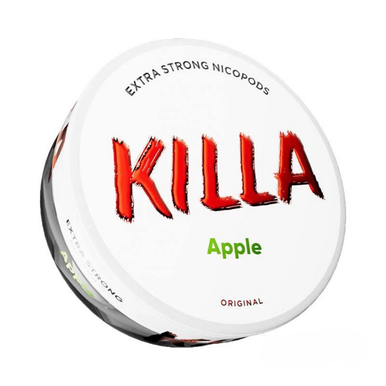
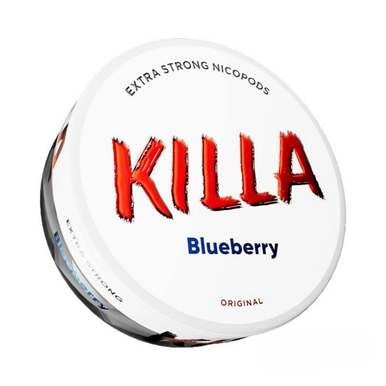
The fruit end of the range is where this can has its closest relatives. Killa Blueberry at £33.50 sits in the same broad berry family, though blueberry is a darker, skin-forward note where strawberry is softer. Killa Apple, also £33.50, is orchard fruit rather than berry — crisper and more acidic in character. Killa Banana Ice pairs a heavy, creamy fruit with a cooling element, which is a different construction from anything on this page.
Closest of all by name is Killa Strawberry Cheesecake at £33.50, which takes the strawberry note this can uses and puts it next to a dessert element instead of a melon one. If you like the strawberry side of this pairing and not the melon side, that is the obvious can to look at within the brand.
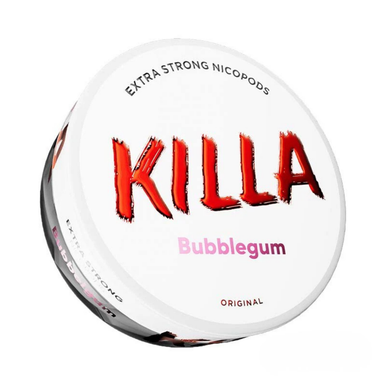
Away from fruit, the range widens considerably. Killa Bubblegum is the most confectionery-leaning name the brand puts on our shelves. Killa Cola is the brand's version of the cola note, which is spiced and slightly sharp rather than simply sweet. Killa Cappuccino is the only coffee-family can we hold from this brand and the furthest in character from a strawberry and watermelon pairing.
Cans people keep open beside this one
People who keep two cans on the go usually keep two that are unlike each other. A second can that tastes nearly like the first is a spare, not a variation, and the point of a rotation is contrast.
Staying inside strawberry, Cuba Ninja Strawberry at £39.90 and 77 Strawberry at the same price are both single-fruit constructions from other houses, and the difference between how two manufacturers build the same fruit is often larger than the difference between two fruits from one manufacturer. Fumi Strawberry at £27.90 is the cheapest of that group on our listings, and Denssi Strawberry Freeze at £39.90 adds a cold element to the same fruit, which changes the shape of it more than it changes the fruit.
There is also a direct counterpart from another brand: Pablo Exclusive Strawberry Watermelon, listed at £3.85, which pairs the identical two fruits under a different maker's name. The price gap between that listing and this one is large, and the likeliest explanation is a difference in what each listing actually contains, which is a matter for the two product pages and the basket rather than for a guess here.
Moving sideways in the berry family, Clew Blueberry at £39.90 swaps the soft red fruit for a darker one, and Elf Bar Blueberry Raspberry at £29.90 layers two berries together in the way this can layers two fruits. Nordic Spirit Max Foresty Berry at £4.49 and Velo Icy Berries at £4.19 are both mixed-berry constructions at the low end of our price range, and the second of those carries a cold element in its name where the first does not.
If you would rather browse than follow individual links, the Pablo shelf and the Cuba range are two of the wider brand groupings we run, and either will give you a spread to compare against this one.
What there is to decide on this listing
Very little, which is either a relief or a limitation depending on what you came for. One declared figure of 16.5mg, one price of £33.50, one variant. There is no size to select and no strength to switch between.
The limitation is that the usual adjustment is unavailable. On a multi-variant listing you can keep the flavour and move along the declared figures. Here the only way to change the figure is to change the product, which means the strength bands rather than this page. We are not going to point you in a direction along those bands, upward or downward, for the reasons set out earlier.
The pack count is the second silence on this listing. Our record has no value for how many cans £33.50 buys, and no value for how many pouches are in a can. That matters more than it might sound, because on this site a figure in that region sometimes covers a single can and sometimes a sleeve of several. Without the count we cannot calculate a per-can or per-pouch figure, and we are not going to infer one from a neighbouring product. The listing page and the basket at checkout are where that becomes visible, and it is worth looking before ordering rather than after.
Ordering, age checks and delivery
This is an age-restricted product and the process reflects that in more than one place.
The price on this listing is £33.50. Ordering follows the ordinary sequence: add to basket, review the basket, complete the checkout. Delivery options, costs and timescales appear at checkout rather than here, because they depend on the order and the address and any figure printed on a product page would be wrong for somebody.
Sales are to adults aged 18 or over. Age checks may be applied when the order is placed, and identification may be requested on delivery before a parcel is handed over. A courier refusing to release a parcel where age cannot be confirmed is the system working rather than a fault with the order. We will not knowingly supply anyone buying on behalf of someone under 18.
On availability: our record shows this listing as in stock at the time of writing, but a description written in advance is not a live feed. The listing itself is authoritative. If the two disagree, the listing is right.
How this page is filed, and how to find it again
Product pages are often reached sideways from a search engine, with no sense of what surrounds them, so here is the map.
This can is filed on five shelves, which is more than most. Its brand shelf holds the rest of the range. Its strength band holds the 132 listings sharing its bucket. And it appears on three flavour shelves — the broad berry grouping, the narrow strawberry one and the watermelon one — because our record carries all three terms for it.
Above the shelves sits the whole catalogue, which is the right starting point when you do not yet know which axis you want to browse along. Every brand shelf behaves the same way as this one's, so once the pattern is clear the entire site is navigable from any product page without going back to a search box.
Questions we are actually asked about this can
Does this taste more of strawberry or of watermelon?
We do not know, and we are not going to guess. Our record holds both terms with no weighting between them, and we do not publish tasting notes written in-house because they would be invention rather than information. What can be said is that the two fruits do different jobs in a pairing — strawberry supplies the body, watermelon supplies the lift — so a can carrying both is likely to be built around that contrast rather than around one fruit alone. The can itself is the only way to settle the balance.
Is there a cooling element in this one?
Our data holds no mint or ice term for this listing, only the three fruit terms, which suggests fruit without an added cold note. That is an inference from an absence, though, and an absent tag is weaker evidence than a present one. If a cooling element matters to you, the can and the listing are more reliable than this paragraph. Several fruit cans elsewhere in the catalogue carry an explicit cold term in the name, and those are unambiguous where this one is not.
How many pouches are in the can?
Not something we hold. The field is empty in our record and we are not going to estimate it from the price or from what a similar can contains. Cans in this format almost always carry a portion count printed on the label, and that printed figure is the reliable one. If the count is part of your decision, it is worth checking on the listing or the can before ordering rather than assuming a number that we have not published.
Does £33.50 buy one can?
We cannot tell you. There is no pack count in our record for this listing, so we do not know whether the price covers a single can or several. That is a genuine gap rather than an evasion — prices in that region on this site cover both arrangements depending on the product. The basket at checkout shows exactly what quantity is being purchased, and it is the place to confirm it before paying.
What does 16.5mg mean?
It is the strength figure the manufacturer declares for the product, printed on the label and reproduced on this listing. That is the full extent of what we are able to tell you about it. We do not interpret the number, we do not convert it into an expectation, and we do not compare it against figures from other companies, because different manufacturers arrive at their declared figures in their own ways and the numbers are not a shared unit.
Is 16.5mg high?
We file this can in the upper of our three bands, which is a statement about how our catalogue is organised and not a verdict on the product or an answer about any individual. Bands exist to make browsing possible. We cannot advise which strength suits anyone, and a shop attempting that would be well outside what a shop can responsibly do. Questions about your own use belong with someone qualified, not with a retailer.
What does "Exclusive" mean here?
It is the manufacturer's line name, and we hold no information about what the company intends it to designate. It might mark a flavour set, a packaging run or nothing more than a naming choice. We are not going to invent a meaning for a word simply because it appears on a can. The honest answer is that it is on the label, so it is in our title, and the reasoning behind it is not ours to state.
Why is the Pablo version so much cheaper?
We do not know, and the price difference is large enough that guessing would be irresponsible. Different listings on this site cover different quantities, and a pack count is exactly the field we are missing on this one. The most likely explanation is that the two listings contain different amounts, but that is reasoning rather than knowledge. Both product pages and the basket are where the quantities become concrete.
What is the compartment in the lid for?
Used pouches. Cans in this format typically have a shallow chamber built into the lid, separate from where the fresh pouches sit, and it exists to hold finished ones until you can reach a bin. Empty it into a household bin rather than a sink or a drain. It is a small feature and it is the one that makes carrying a can anywhere at all practical, since a used pouch otherwise has nowhere sensible to go.
How should I store it?
Lid on, somewhere cool, out of direct sun, and out of reach of children. Warmth and an open lid are the two things that dry a can out, and between them they explain most cans that go flat before they are finished. Any storage instruction printed on the can takes priority over this page. We do not hold shelf-life or date information at listing level, so the date marking on the can is the only reference for that.
Can you tell me who makes it or where it comes from?
No. We hold no origin or manufacturing information for this product and we will not infer any from the brand name, the line name or the packaging design. Anything you read elsewhere attributing an origin to this can on the basis of how it is named is reading something into the name that is not in it. The can and the manufacturer are the only reliable sources for that question.
Why is this can on three flavour shelves?
Because our record carries three flavour terms for it and each term files it somewhere. Berry is the broad family label, strawberry and watermelon are the two specific fruits named on the can. Most listings carry one or two terms, so three is unusual and reflects a pairing rather than a single note. The shelves are independent of one another, which means you can arrive at this page from a berry search, a strawberry search or a melon search without the catalogue treating any of those routes as the main one.
Is it in stock?
Our record shows it as available at the time of writing, but this description is prepared in advance and is not a live stock feed. The listing is the current position. Single-variant products can go unavailable with no alternative size to fall back on, so if the listing and this paragraph disagree, the listing is the one to believe.
Legal and compliance information for this listing
This product is sold only to adults aged 18 or over who already use nicotine. We do not sell to anyone under 18, and we will not knowingly supply a purchase made on behalf of someone under 18. Age checks may be applied at the point of order, and ID may be requested on delivery before a parcel is released.
Nicotine is an addictive substance.
This product is not a licensed stop-smoking medicine and it makes no medicinal claim of any kind. It is not intended for non-smokers, for anyone who does not already use nicotine, for under-18s, or for anyone who is pregnant or breastfeeding. Nothing on this page is medical advice, and nothing on it is a suggestion that anyone should use nicotine or should choose any particular declared figure. If you have a question about your own use, raise it with a qualified healthcare professional rather than with a shop.
Keep the product out of reach of children and away from animals.
To sum up
Killa Exclusive Strawberry Watermelon is a single-variant listing at £33.50 with a declared figure of 16.5mg, classified in our catalogue under berry, strawberry and watermelon, and filed on the Strong band. We do not hold a portion count, a pack count or a format designation for it, and this page has said so in each case rather than filling the gaps. The brand name and the line name are the manufacturer's own words and have been treated as nothing else. Everything beyond that is printed on the can.
More from Killa

More strong pouches
More berry pouches
Where this sits
Killa Exclusive Strawberry Watermelon Nicotine Pouches appears in these categories. Browse them, or jump to something close.
You might also like