Home / Medium Strength / 77 Rosemary Nicotine Pouches
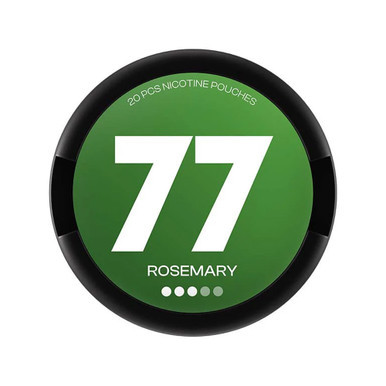
77 · 10.4mg
Read the full guide
77 Rosemary Nicotine Pouches
£39.90
✔ In stock — ready to ship
100% tobacco-free
Free over £20
Same-day dispatch
Secure checkout
77 Rosemary Nicotine Pouches are listed here at £39.90, in a single strength of 10.4mg. At the time this page was written the listing is out of stock, so what follows is a description of the product rather than an invitation to add one to a basket today. The stock line on the listing itself is the live one; this paragraph is not.
The name is the whole of the unusual thing about it. Almost every can in this shop is named after a fruit, a mint, a cola or a dessert. Rosemary is named after a kitchen herb, and it is the only thing on our shelves carrying that name. That puts it in a very small group of savoury and botanical flavours across a catalogue that otherwise leans hard on sweetness and cold. If you have arrived at this page because the name caught your eye as odd, that is a reasonable reaction, and the rest of this page is mostly about what the flavour actually does.
The full guide to 77 Rosemary Nicotine Pouches
5,063 words on how it eats, who it suits, how to serve it and what to put beside it.
The Rosemary can, and where it sits with us
Beyond the name, the facts are short. It is a 77 product, so it sits on the 77 brand page alongside the other twenty-eight listings we carry from them. Its 10.4mg figure files it on our Medium Strength shelf, which is the largest single strength band we run at one hundred and thirty-five listings. It carries no flavour-category placement in our system, because our flavour shelves are built around mint, berry, citrus, cola, coffee and the rest of the common families, and a herb does not belong to any of them. That absence is a filing quirk rather than a statement about the product.
Two things we are asked about and do not have: the number of cans in a pack, and any technical detail about how the product is built. Our record for this listing does not carry a cans-per-pack figure, so we will not print one, and we would rather say that plainly than guess at a number that would end up on an invoice. We also do not publish composition or technical information for any pouch we sell. What we can describe honestly is taste, the physical can, the number on the front, and how the thing compares to the other cans in the same part of the shop. That is what the rest of this page is.
Rosemary on the four axes: cool, sweet, sharp and bitter
The most useful way to describe any pouch flavour is to place it on a few axes rather than reach for adjectives. Four of them cover most of what people actually want to know before they commit to a tin: how cold it is, how sweet it is, how sharp it is, and how much bitterness sits underneath. Rosemary lands in an unusual corner of that space, and the short version is that it is low on three of the four.
Cool: low, and not the point
There is a faint lift in this flavour, the sort of light, airy freshness that comes with a green herb rather than the engineered cold of a mint can. It is not a freeze. It does not produce the sharp, glassy chill that people buy XQS Arctic Freeze for, and it is several streets away from the blunt cold of Klint Arctic Mint. If you put Rosemary next to White Fox Double Mint, the mint can would feel like a different category of object. Anyone shopping specifically for cold should ignore this listing entirely and go to the mint end of the shelf, where there are well over a hundred options and no shortage of very cold ones.
What little cooling there is arrives late rather than early, sitting behind the herb as a kind of clean finish. It is the difference between a flavour that is cold and a flavour that is merely fresh.
Sweet: present, but kept on a short leash
Rosemary has sweetness in it, which surprises people who expect a herb pouch to be bone dry in the wine sense. It is a restrained, almost honeyed sweetness that seems to exist mainly to stop the herb from being austere. It arrives in the first minute, peaks quite early, and then steps back and lets the green character run the rest of the pouch. Compared with the frank candy sweetness of something like UBBS Cherry at £19.95, or the soft-drink sugar of 77 Cola Ice, this is a fraction of the level. On a scale where a dessert can sits at the top, Rosemary is somewhere in the lower third.
That restraint is the single biggest reason people either take to this can quickly or bounce off it. If sweetness is the reason you buy a flavour, this is not the tin. If you have been finding the sweet cans cloying after twenty minutes, this is the opposite end of the same shelf.
Sharp: low, and unusually so
Sharpness — the tang, the acidity, the pucker — is the axis where Rosemary is furthest from the catalogue norm. Fruit pouches nearly all carry acid, because acid is what makes a berry read as a berry. Pablo Silver Edition Blue Raspberry at £39.90 is built on it. Fumi Blackcurrant at £27.90 leads with it. Rosemary has almost none. There is no citrus lift, no tartness, nothing that makes the mouth water in that reflexive way. The flavour is rounded rather than pointed.
The practical consequence is that it does not fade in the way a sharp flavour fades. Sharpness tends to go first and leave a flat sweetness behind. With the acid missing from the start, there is nothing to lose, and the profile stays roughly the same shape from beginning to end — it simply gets quieter.
Bitter: the axis this can actually uses
Here is the one place Rosemary scores high, and it is deliberate. Real rosemary is a resinous, slightly piney, faintly camphorous herb with a genuine bitter edge, and this flavour keeps that edge rather than sanding it off. There is a dry, green, almost woody bitterness running underneath the whole pouch, strongest in the middle stretch once the early sweetness has pulled back.
Bitterness is a difficult sell and most flavour houses avoid it. In this catalogue you meet it in coffee flavours and in some of the darker botanical cans, and rarely anywhere else. It is why Rosemary tends to appeal to people who already like the savoury corner of the shelf, and why it reads as strange to anyone arriving from the fruit aisle. There is no right answer here. It is a preference, and it is the flavour doing what its name promises rather than a fault in the can.
Aroma, for completeness: the tin smells green and slightly resinous when you open it, more like a herb jar than a sweet shop. On the breath afterwards it is faint and fades quickly, and it is a drier residue than a fruit or a mint leaves behind.
How a herb gets built into a dry pouch at all
It is worth spending some time on the mechanics of flavour in this format, because it explains why some cans in this shop taste convincing and others taste like an approximation. None of what follows is about what the product does to anyone; it is about how a flavour is put onto a dry white pouch and what that does to the taste over the twenty or forty minutes it is in.
Why dry is a hard place to put a flavour
A pouch is not a drink and not a sweet. There is no liquid carrying the flavour to you, and nothing melts. The flavour has to be carried on a dry material and then released gradually as the pouch takes on moisture in the mouth. That imposes two constraints that shape every flavour in this shop.
The first is that the release is a curve, not a level. Flavour comes off fastest at the start, when the pouch is going from dry to damp, and then tails away. Every can in this shop has that shape, and the differences between them are mostly differences in how steep the curve is and what is left at the bottom of it.
The second is that the format flatters some flavour families and punishes others. Cold reads well, because a cooling sensation is a physical effect rather than a taste and it survives the whole pouch. Sweetness reads well early. Sharp fruit reads well but decays visibly. Anything subtle, layered or slow — the things that make a herb interesting — has to fight for attention against a format that rewards the loud.
What rosemary in particular demands
Rosemary is a difficult flavour to render because it is not one note. In a kitchen, rosemary is pine resin, a green leafy note, a faint citrus edge in fresh sprigs, a camphorous top and a woody, slightly bitter base. Take away any two of those and you no longer have rosemary; you have a generic green flavour that could be almost anything.
What this can does, to its credit, is keep the resin and the bitterness. Those are the two notes most likely to be dropped, because they are the two least likely to be popular, and a flavour house chasing broad appeal would cut them first and lean on the green and the sweetness instead. The result here reads as a specific herb rather than as "herbal", and that is the achievement. Whether you want that achievement in your mouth for half an hour is a separate question and a personal one.
What the format does take away is the fresh-sprig brightness. Fresh rosemary has a lift to it that a dry pouch cannot reproduce, so what you get sits closer to dried rosemary than to a plant on a windowsill: deeper, woodier, less green. That is not a criticism so much as an honest description of the ceiling of the format.
The same problem in other cans on our shelves
You can see the same construction logic working elsewhere in the shop. 77 Cola Vanilla has to build two things that both live in the same warm, sweet register, which is why the vanilla reads as a rounding-off of the cola rather than as a separate flavour. SYX Apple Kiwi at £29.90 has the opposite problem: two sharp green fruits that can blur into each other unless one is pushed forward. 77 Apple Mint solves it by putting one flavour on the taste axis and the other on the cooling axis, so they occupy different territory and stay distinct. Rosemary, having only one flavour to build, spends the whole budget on making it specific. Different problems, different solutions, all in the same format.
The pouch itself, and the half hour it is in
The physical object is the standard modern slim white pouch: a small soft rectangle with rounded ends, dry to the touch out of the tin, softening within a minute or so of going in. It is the slim format rather than the fat old-fashioned portion, which is why it tucks in without much of a visible bulge.
Seating is a matter of personal habit and nobody needs instruction from a shop. Most people put a pouch under the top lip, off to one side rather than dead centre, and flatten it with the tongue so it lies along the gum line instead of bunching up. If it folds, taking it out and straightening it sorts it. People who use pouches already have their own way of doing this and it rarely changes.
How long a pouch stays in is decided mostly by the flavour curve, and Rosemary's curve is flatter than most. Sweet fruit cans have an obvious moment where the interest drops off a cliff; this one declines gently and keeps a thin green bitterness for longer than you might expect. In practice that tends to mean people leave it in a while — the twenty to forty minute range covers most habits, and some go longer simply because there is no sharp signal telling them to stop. We are not going to put a number on it, because that is not a shop's business and any figure we printed would be made up.
The lid is the most practically useful part of the whole object. The can has two compartments: the main well underneath holding the fresh pouches, and a shallow catch space in the lid with its own floor. Used pouches go into the catch, the lid clicks shut, and you carry them until there is a bin. It holds three or four comfortably; push past that and the lid stops seating flush, which you notice immediately. Emptying it when you empty your pockets is the habit that keeps the tin pleasant to open.
Disposal is dull and worth stating anyway. Used pouches go in general waste. Not down a sink, not out of a car window, not on a pavement. The empty tin is a small plastic pot and goes wherever your local authority takes that grade of plastic.
What 10.4mg is, read as a number on a tin
This listing carries one strength: 10.4mg. Customers use the milligram figure as the main sorting tool in a shop like this, so it is worth being precise about what that number is, because it is the most misread piece of information on any pouch can.
It is a content figure, printed by the manufacturer, describing how much is in the product. Brands state it per pouch or per gram according to their own convention, and those conventions genuinely differ from maker to maker. Two cans from two different companies showing the same number are therefore not automatically equivalent, and a bigger number on one brand's tin does not cleanly translate to a bigger number on another's. It is a label on packaging, not a league table.
Our shelves band those numbers so that the catalogue can be browsed at all. At 10.4mg this can sits in the medium band with one hundred and thirty-five other listings, which you can browse on the medium-strength listing. Above it we run a Strong shelf and then an Extra Strong shelf for the top of the range. Those bands are our filing system, applied so the shop is navigable. They are not a recommendation and not a ladder anyone is meant to climb.
What we will not do is tell you which number suits you. We do not know you, a shop is not the right source for that judgement, and any page that offers you one has stopped being a product description. The figures on our listings are taken from the manufacturer's own packaging and published as found. What you do with them is your own affair.
Rosemary's place in the 77 line-up we carry
Across the twenty-nine 77 listings in this shop, the range breaks into a few clear groups, and Rosemary belongs to none of them cleanly. There is a mint group, a fruit group, a cola group, a tea group, a dessert-leaning group and the smaller Ghost sub-line. Rosemary is the outlier: a single botanical listing with no siblings sharing its idea.
That has a practical consequence for anyone building an order. With most flavours you can find a near neighbour in the same range if your first choice is unavailable. With this one there is no substitute inside the brand. The closest thing in feel rather than in flavour is the tea end of the 77 catalogue, which shares the dry, low-sugar, slightly tannic character even though it tastes nothing like a herb. Everything else in the range is louder and sweeter.
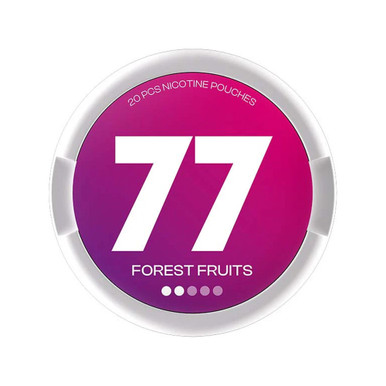
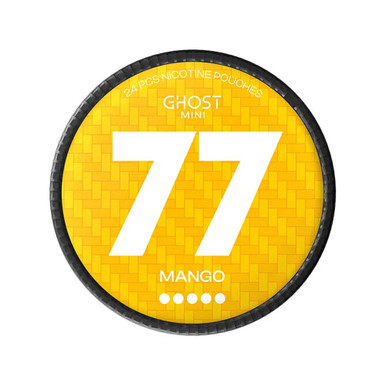
Within the brand, the cans that sit furthest from Rosemary are worth naming so the contrast is clear: 77 Forest Fruits is a full, jammy berry blend, and the Ghost Mini Mango can pairs a smaller pouch format with a sweet tropical profile. 77 Ghost Original Mini is the plainer member of that same smaller-format sub-line. All three are £39.90, the same as this listing, so the choice between them is entirely about what you want in your mouth rather than what you want to spend.
The cans people keep beside an odd one
Unusual flavours tend not to be bought alone. The common pattern is a tin of something unusual and a tin of something ordinary, on the reasonable basis that a strange flavour is better as a change of pace than as a sole option. If that is how you shop, a few sensible companions are worth naming, each for a specific reason.
For a straight cold contrast, Edge Spearmint at £14.95 is the cheapest clean mint in this part of the catalogue and is about as far from a herb pouch as you can get while staying green. Velo Bright Spearmint at £4.19 does a similar job on a single-can budget if you would rather not commit £39.90 to a second flavour.
For a sweet counterweight, Nordic Spirit Blueberry at £4.49 is soft and rounded, and the UBBS Cherry tin is the frank confectionery option at £19.95. For something sharper to reset the mouth between Rosemary pouches, the Fumi Blackcurrant can brings the acid that this flavour deliberately lacks.
If you want to stay in the drier, more grown-up half of the shelf while still changing flavour, the Cola Ice tin from 77 is sweet but not cloying, and the Klint Arctic Mint can at £36.90 is cold without being sugary. Outside the mint and fruit families, browsing the Cuba shelf or the Pablo range will turn up the other cans in this shop that lean savoury, dark or botanical rather than sweet.
Keeping an open tin in decent shape
Pouches are dry when they leave the can and they are happiest staying that way until they go in. The tin does most of the work; the rest is habit.
Keep the lid properly shut. A can left open on a desk for an afternoon will dry a little further and the flavour will be quieter for it, which matters more on a subtle flavour like this one than on a loud sweet can where there is plenty to lose. Heat is the other enemy. A glovebox in July, a windowsill in direct sun, a radiator shelf — all of these will flatten a herb flavour faster than they would flatten a mint, because the delicate resinous top notes are the first thing to go. A drawer, a bag pocket or a coat pocket is fine. A cupboard is fine. Nothing exotic is required.
People ask about the fridge. It is not necessary and it achieves very little. A cold can smells slightly quieter when you first open it and comes back to itself within a few minutes at room temperature. If you buy in volume and are storing tins you will not open for weeks, somewhere cool and dark is sensible. If you are working through one tin at normal speed, ordinary room storage is entirely adequate.
The other half of keeping a can pleasant is the catch lid. A lid full of used pouches will make the whole tin smell of yesterday, and on a green, resinous flavour that reads as stale much faster than it does on a sweet one. Empty it regularly. It takes three seconds and it is the single biggest difference between a tin that stays good to open and one that does not.
One strength, one price: what there actually is to choose
This is a short section, because there is very little to decide. This listing has a single variant: 10.4mg at £39.90. There is no second strength, no mini format, no multi-can option and no price difference to weigh. Whatever choosing there is happens between this can and a different can, not within this page.
That makes it unlike a good deal of the shop. Plenty of our listings run two or three strengths at the same price, which means the decision is purely about the number and not about the money. Others differ in price between formats. Here the listing is a single object at a single figure, and the only two questions are whether you want the flavour and whether it is in stock.
On stock: at the time of writing, it is not. If the listing still shows as unavailable when you reach it, the honest answer is that we cannot tell you when it will return, because we do not control the supply and we would rather say nothing than invent a date. Browsing the wider 77 catalogue is the practical move if you need something from the brand in the meantime.
Ordering, delivery and the age check
Buying works the same way here as on every listing in the shop. You add the can to the basket, you can mix it with anything else we sell in the same order, and it ships as one parcel. There is no restriction on combining brands, strengths or flavour families — a tin of this and a handful of mint cans from the same strength band travel together perfectly happily.
This is an age-restricted product and the age rules are not negotiable. We sell to over-18s only. Age verification forms part of the checkout process, and the courier may ask to see identification when the parcel is handed over. If nobody of eighteen or over is at the address to receive it and show ID, the parcel will not be left. That is the rule we operate, it applies to every nicotine product on the site without exception, and nobody at this end has the authority to wave it through.
On delivery times, costs and the current dispatch cut-off, the checkout pages carry the live figures and this page does not. We deliberately keep timings and postage costs off product descriptions, because a hard-coded delivery promise written months ago is worse than no promise at all. If you need a firm answer before ordering, the delivery information in the site's own pages is the authoritative version.
One thing worth flagging for anyone ordering from outside Great Britain or planning to travel with pouches: import rules and local restrictions on these products vary considerably between countries, and in some places they are prohibited outright. We cannot advise on any particular destination's rules, we do not hold that information, and checking it before you travel or order is genuinely your responsibility rather than something a shop can do for you.
Finding your way back here
Several routes lead to this page, which is useful if you want to compare before committing. The brand route is the 77 listings page, where all twenty-nine of our 77 products sit together and can be scanned in one go. The strength route is the Medium Strength shelf, which gathers every can we band at this level regardless of who makes it — that is the better route if the number matters more to you than the badge.
There is no flavour route to this can, because the herb does not fall into any of our flavour shelves. That is the one navigational oddity of this listing and it is worth knowing: if you are browsing by flavour you will simply never meet it. You will find it by brand, by strength, or by going through the full product listing and reading down.
If you are casting a wider net, the strength shelves above this one — Strong and Extra Strong — are the next places most people look, and the brand shelves for Pablo and Cuba carry the other large ranges in this shop.
Questions we get about this tin
Does it genuinely taste of rosemary, or is it a vague herb flavour?
It reads as rosemary specifically rather than as a generic green flavour. The resinous, slightly piney character and the woody bitter base are both present, which are the two notes that identify the herb. What it does not capture is the bright, fresh-sprig lift of the living plant — the profile sits closer to dried rosemary than to a cut stem. Whether that is what you want is personal, but it is not a flavour that could be mistaken for mint, basil or anything else green.
How many cans come in a pack?
We do not hold that figure for this listing. Our record for this product has no cans-per-pack value, and rather than guess at a number that would affect what you pay and what arrives, we would rather tell you we do not know. The listing page itself shows what is actually being sold at the price quoted, and that is the reliable source. If the quantity matters to your decision, treat the listing rather than this description as authoritative.
Is this a sweet flavour?
Mildly, and much less so than most of the catalogue. There is a restrained, faintly honeyed sweetness sitting under the herb, and it is there mostly to stop the flavour being austere rather than to be the point of the can. Anyone coming from confectionery flavours will find it noticeably dry. Anyone who has been finding sweet cans tiring will find it a relief. It is one of the drier tins on our shelves.
Is it cold?
No, not in the way the mint cans are cold. There is a light freshness that arrives towards the end of a pouch, but it is a green lift rather than a cooling effect, and nobody buying for cold would be satisfied by it. If cold is what you are after, the mint half of the shop is where to look, and the difference between this and a dedicated freeze can is enormous rather than marginal.
Which strength should I buy?
That is not a question we will answer, and you should be wary of any shop that does. This listing comes in one strength, 10.4mg, taken from the manufacturer's own packaging. We publish the figures we are given and band them so the catalogue can be browsed. We do not advise on which number suits any individual, because we do not know anything about you and it would not be appropriate for a retailer to make that call.
What is in it?
We do not publish composition or technical information for any product we sell, and that applies here as much as anywhere. The packaging that arrives with the can carries the manufacturer's own information, and that is the right place to read it. If you need detail beyond what is printed on the can, the manufacturer rather than the retailer is the source with the answers.
Is this in stock at the moment?
At the time this description was written, no. Stock moves and the live indicator on the listing itself is the accurate one, so trust that over this paragraph. We cannot give a restock date, because supply is not in our hands and an invented date would be worse than an honest blank. If you need something from the same brand now, the other 77 listings are the obvious place to look.
Can I mix this with other flavours in one order?
Yes, with no restrictions at all. Brands, strength bands and flavour families can be combined freely in a single basket and arrive in one parcel. Most orders that include an unusual flavour like this one also include something conventional, which is a sensible way to buy — a tin you are unsure about is a smaller risk when there is something familiar in the box alongside it.
How long does one pouch last?
The flavour curve is flatter than most, so there is no obvious moment where it drops off. It starts at its strongest, settles within a few minutes and then declines slowly, keeping a thin green bitterness for a good while. People's habits vary widely and we are not going to print a number as though it were a rule. The pouch does not become unpleasant with time; it simply gets quieter until there is not much left to notice.
What can I try if I like this and want something similar?
Honestly, there is no close match in this shop. Rosemary is the only botanical herb flavour we list, and nothing else is built on the same idea. The nearest relatives are in feel rather than in taste: the drier, less sugary cans, which is where the tea flavours in the 77 range and the darker options across other brands sit. Anyone who likes this specifically for the herb is, for now, out of luck for a direct alternative.
Will I be asked for ID when it is delivered?
Possibly, and you should expect it. Age verification happens at checkout, and the courier may additionally ask to see identification at the door. Somebody aged eighteen or over needs to be present to receive the parcel. If there is nobody to show ID, the delivery will not be completed. This applies to every nicotine product we sell and there are no exceptions made on request.
Why does this can not appear under any flavour category?
Our flavour shelves are built around the families that actually recur across the catalogue — mint, berry, citrus, cola, coffee, dessert and so on. A single herb flavour does not fit any of them and does not justify a shelf of its own for one listing. So it is reachable by brand or by strength but not by flavour. It is a quirk of how the shop is organised rather than anything meaningful about the product.
Legal and compliance information
This product contains nicotine. Nicotine is an addictive substance.
It is sold to adults aged 18 or over who already use nicotine products, and to nobody else. We do not sell to under-18s, age verification is part of our checkout, and identification may be requested by the courier when the parcel is delivered.
It is not a licensed stop-smoking medicine and is not intended for non-smokers, for anybody who does not already use nicotine, for under-18s, or for anyone pregnant or breastfeeding. We make no health, medical or therapeutic claim of any kind for this product, and nothing anywhere on this page should be read as one. If you have questions about nicotine and your own circumstances, a healthcare professional is the right person to ask, not an online shop.
The short version
77 Rosemary is a single-strength 10.4mg can at £39.90, currently out of stock, and it is the only herb flavour on our shelves. It is dry rather than sweet, rounded rather than sharp, barely cool, and it carries a real resinous bitterness that most of this catalogue works hard to avoid. That makes it a narrow flavour with a clear audience: people who already enjoy the savoury corner of the shelf and want something that does not taste like a sweet.
If that is not you, almost everything else on the 77 shelf is sweeter, colder or both, and there are one hundred and thirty-five cans in the same strength band to choose from. If it is you, this is the only tin in the shop doing this particular job.
More from 77
More medium strength pouches
More 77 pouches
Where this sits
77 Rosemary Nicotine Pouches appears in these categories. Browse them, or jump to something close.
You might also like