Home / Medium Strength / 77 Green Tea Nicotine Pouches
77 · 10.4mg
Read the full guide
77 Green Tea Nicotine Pouches
£39.90
✔ In stock — ready to ship
100% tobacco-free
Free over £20
Same-day dispatch
Secure checkout
This page describes 77 Green Tea Nicotine Pouches. The brand is 77. The product name, as the maker gives it, is Green Tea. The declared strength is 10.4mg and the price on this listing is £39.90.
Two things need saying before the description proper, because both affect how you should read it.
The full guide to 77 Green Tea Nicotine Pouches
5,004 words on how it eats, who it suits, how to serve it and what to put beside it.
77 Green Tea: the record we hold
The first is availability. This listing is currently marked out of stock. We keep the page up rather than pulling it, because the information on it remains true and because people arrive at a product page for reasons other than buying — checking what they had last time, working out what resembles it, deciding whether to wait. None of that requires a working basket. What it does require is that we do not imply availability we do not have, so the position is stated here at the top rather than discovered at checkout.
The second is the flavour record, which is empty. That sounds like a small data point and it is not, so it has a section of its own immediately below. In short: the product is called Green Tea, and our structured flavour field for it contains nothing at all. Both of those statements are true at once, and resolving the tension between them by guessing is exactly what this page is not going to do.
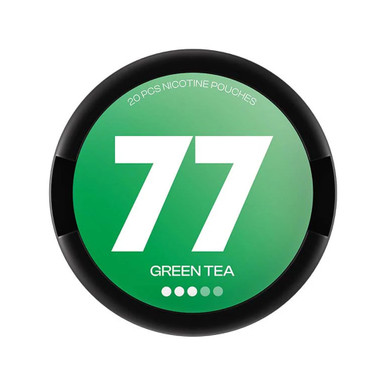
Beyond those two, our record carries brand, product name, price, declared strength and stock, and nothing else. No pouch count, no portion weight, no dimensions, no dates, no ingredient list, no manufacturing detail. Wherever this page needs one of those, it will say that we do not hold it. The can is a shallow round tin with a lid that lifts clear and presses back down, branding and the declared figure printed on top; its exact dimensions are on the packaging rather than in our data.
This is an age-restricted nicotine product for adults who already use nicotine. The required wording has its own section at the foot of the page.
A tea name on the lid and an empty flavour field
What the name says
The product is called Green Tea. That is the manufacturer's name for it, reproduced exactly, and it is the only flavour statement attached to this listing anywhere in our records. It is not nothing — a maker who calls a can Green Tea is telling you something — but it is a name rather than a described flavour, and the distinction matters when you are choosing between cans on a screen.
What our data says
Our flavour field for this listing is blank. On most listings that field carries one or two words — mint, grape, mango, blackcurrant — and those words are what build our flavour shelves. This one carries none.
The practical consequence is navigational and it is worth knowing: there is no flavour-shelf route to this can. A listing with mint recorded appears on the mint shelf; a listing with nothing recorded appears on no flavour shelf at all. If you tend to find products by flavour, you will not find this one that way, and you should note the brand page or the strength band instead. That is a real effect of a blank field rather than an oversight in the navigation, and we would rather explain it than let you hunt.
We have not been given a tasting note by the manufacturer either. So there is no quoted description to reproduce and nothing authoritative for us to pass on. What follows is a description of green tea as a flavour category, written so that someone choosing between cans has more to go on than two words — not a claim about what this particular can does.
Green tea described as a flavour category
Green tea is an unusual thing to find on a pouch shelf, because almost everything else in the catalogue is either a mint, a fruit or a confectionery idea, and green tea is none of those. Described purely as taste, it is a vegetal flavour — grassy and leafy rather than sweet or sharp. There is usually a faint sweetness at the front of it, very light, nothing like the sweetness of a fruit flavouring. Behind that there is commonly a dry, slightly astringent quality at the edges, which is the characteristic that makes tea taste like tea rather than like a plant in general. Some green tea flavourings carry a faintly floral note; some carry a nutty or toasted one; the category is broad.
What it is not, is cold. Where an iced or mint-forward can announces itself with a cool note before anything else, a tea flavour has no equivalent opening move. As aroma it tends to be quiet — open a tea-flavoured can next to a mint one and the mint will be doing most of the talking.
All of the above is a description of the category. What the can in front of you does within it is a matter for the can, and the packaging is where the maker's own description lives.
The format in detail: a pouch from can to bin
Since the flavour record on this listing gives us so little to work with, the format deserves the fuller treatment, and it is genuinely the part most worth understanding if the object itself is unfamiliar. Everything in this section applies to every pouch on this site, not only to this one.
A nicotine pouch is a small sealed pouch that goes in the mouth, tucked between the lip and the gum, and stays there. It is not chewed. It is not swallowed. It does not need anything doing to it while it is in place. That is the entire format, and no brand varies it.
Portion size, and the figures we do not have
We hold no portion data for this listing: no pouch weight, no length or width, no format designation such as the ones some makers print on their cans. We will not estimate any of those from the product name or from the price. The can carries whatever format information the manufacturer chooses to publish, and that is the source.
What can be said without reservation is that every pouch inside a given can is the same as every other pouch in that can. Whatever the first one you take out is like, the rest match it. So the one genuinely useful piece of advice about portion size is that you find out by opening the can, and no amount of reading beforehand substitutes for that.
Where the pouch actually sits
Most people place a pouch at the front of the mouth, under the top lip, where the lip itself holds it against the gum. Under the bottom lip works too and some people prefer it. Left side, right side and centre all work; the choice is a matter of what feels settled rather than of anything technical.
Once it is in, it stays where it is put. It does not migrate, it does not need holding, and it does not stop you talking, although the first few times it may feel more noticeable than it looks. If it is uncomfortable where it is, move it. If it is uncomfortable everywhere, take it out and throw it away — comfort is individual and there is nothing about the format that asks anyone to persist with a pouch that does not suit them.
Duration, and why we will not quote an average
The question people ask most about the format is how long a pouch stays in, and it is the question least suited to a single answer. The real range across people is enormous — a few minutes at one end, the better part of an hour at the other — and an average drawn across that range would describe almost nobody. Publishing one would be giving usage guidance dressed up as a statistic, which is not something a product page should do.
What we can report is the reason people most commonly give for taking one out, which is that the flavour has gone. Flavour in a pouch runs down gradually and then stops, much as it does in chewing gum, and for most people the end of the taste is what ends the pouch. The manufacturer's own guidance printed on the can is the guidance to follow. Ours is simply that there is no target, no minimum and nothing to be got right.
Eating, drinking and ordinary interruptions
Practical detail that rarely gets written down: a pouch is not compatible with eating, and most people take one out before a meal rather than working around it. Drinking is less absolute — plenty of people carry on with a hot or cold drink — but a pouch and a mouthful of liquid are not entirely independent of each other, and some find the flavour changes afterwards. There is no rule here and nothing that needs managing. It is mentioned because the question comes up and because the honest answer is that people simply do what suits them.
The catch lid, and what happens to a used pouch
Pouch tins of this pattern have a shallow catch compartment built into the lid, sealed off from the body of the can where the unused pouches sit. A used pouch goes in there when there is no bin to hand. It is a practical piece of design rather than a clever one, and its only real requirement is that it gets emptied — a full compartment stops the lid seating properly, and a lid that does not seat is the start of most of the problems described further down this page.
Disposal is general waste. A used pouch goes in a bin, not a sink, not a toilet, not out of a window. The tin is plastic and goes to household recycling as far as your local authority accepts that grade, which varies by council and is not something we can answer for a particular address.
The 10.4mg declaration
One declared strength appears on this listing: 10.4mg, at £39.90. The figure is the nicotine content declared by the manufacturer for each pouch, printed on the can, reproduced by us without alteration. It is a label value and this section explains what the value is. It is not advice and it contains no suggestion about which figure anyone ought to be looking at.
On the decimal, which people ask about: 10.4 is simply what the maker declares, and a declared figure is under no obligation to be round. The round numbers on other cans are not more precise or more official; they are rounder. Rounding this one to 10mg on our page would be editing a manufacturer's declaration, which is not ours to do.
Read as arithmetic, 10.4 is larger than 5.2 and smaller than 20 — both of which are figures that appear on other cans within this same brand. That ordering is genuine and it is a comparison between printed labels. It describes nothing that anyone experiences and we will not translate it into one.
Across brands, the caution is stronger. Makers declare these figures in different ways and against different portion formats, so the same number on two companies' cans is two independent declarations that happen to match. We publish each maker's figure as given, do not convert between them, and do not hold the technical detail that would let anyone convert honestly.
Our strength bands exist so that someone who already knows their figure can filter to it. This listing sits on the Medium Strength shelf, which holds 135 listings. The Strong shelf holds 132, and the Extra Strong shelf holds the higher declared figures. Three filing categories, no ranking, no ladder, no route anybody is being pointed along.
Practical questions when you are moving between cans
This section is for people who already use pouches and are coming to this listing from a different one — another brand, another flavour idea, another declared figure. It is a list of practical differences with no claim attached to any of them. It is not addressed to anybody who does not already use nicotine, and nothing in it is an invitation to start.
Read the figure again, every single time
The most common error when moving between cans is assuming the declared figure travels with the brand mark. It does not. Declared figures vary from listing to listing within this one range — this can is 10.4mg, and others wearing the same brand mark carry their own — which means two 77 cans can sit on completely different strength shelves of ours. The figure belongs to the listing, not to the brand, and it is printed on every product page for exactly that reason. Check it on the page you are looking at rather than carrying an assumption across from the last one.
Flavour categories do not transfer between makers
The second common error is treating a flavour word as a standard. It is not one. Two makers' mints are not the same mint; two makers' cherries are not the same cherry. Each company arrives at its own interpretation, and the shared word on the lid tells you which family you are in rather than what you will taste. On a listing like this one, where our flavour record is empty and the name is doing all the work, that caution applies twice over.
Cans differ as objects, in small ways
Tins vary between manufacturers in ways that only register once you are holding one. Lids seat with different amounts of pressure — some click positively, some are a quieter push fit. Catch compartments differ in depth, which changes how often they want emptying. The internal layout differs, and on a full can the first pouch can be awkward to lift out simply because there is no gap for a fingertip. None of that is a fault and none of it is worth thinking about beyond the first day.
The availability problem, which nobody expects
Worth naming because it is the practical issue people actually hit: settling on one specific can makes you dependent on that one listing staying in stock, and listings move. This page is itself the example — it is marked out of stock as this is written. People who keep two or three cans in rotation are less exposed to that than people who buy one thing repeatedly, which is a supply observation rather than a suggestion about consumption. If a particular listing matters to you, the time to notice it is available is while you are looking at it.
The questions we will not answer, and why
At this point people usually want to know how one can will compare with another in use, or which declared figure to choose. We do not answer either. We cannot describe effects, we will not recommend a strength to a person, and we give no medical, health or dosage advice of any kind. What we will do is put brand, flavour, declared figure and price side by side, which is what this page has done throughout. Beyond that comparison, the decision is not ours to help with.
Twenty-nine listings under one brand mark
The 77 shelf carries twenty-nine listings at the time of writing, and one fact makes browsing it simpler than most: every 77 listing linked from this page is £39.90. Price is not a variable within the brand, so the choice between its cans is about flavour and declared figure alone.
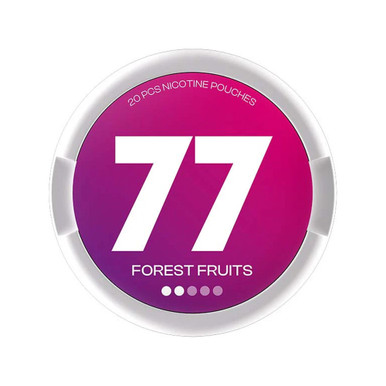
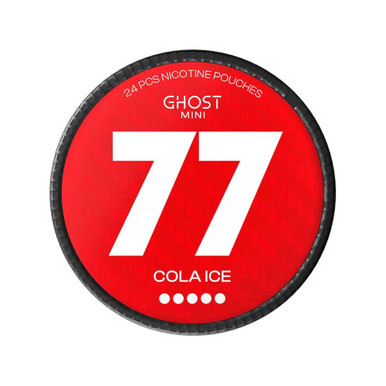
Where this can sits in that range is at the quiet end. Most of the brand's listings are mints, fruits or confectionery ideas; a tea name is an outlier among them. If you want to see what the mainstream of the range looks like, 77 Apple Mint at £39.90 is a named fruit with a mint behind it, which is about as close to a default as this brand gets. 77 Forest Fruits at £39.90 is the mixed-berry option, blended rather than single-fruit. On the confectionery side, 77 Cola Vanilla at £39.90 pairs cola with vanilla, while the Cola Ice listing at the same price takes cola cold instead.
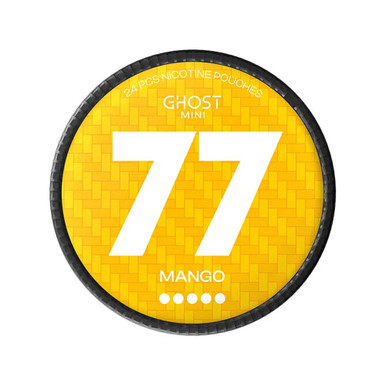
The range also runs a Mini format, carried by listings including 77 Ghost Mini Mango, £39.90, with mango recorded against it, and 77 Ghost Original Mini at the same price, whose flavour field is empty in the same way this one is. Each carries its own declared figure on its own page rather than inheriting this listing's, which is worth checking before treating either as a straight substitute. If the empty flavour field is the thing you are curious about, the Original Mini page deals with the same problem from a different angle — there, unlike here, the product name gives no flavour word at all.
Cans that go alongside a tea flavour
Almost nobody buys one listing repeatedly with nothing beside it; the usual arrangement is two or three in rotation. Since a tea flavour sits apart from most of the catalogue, what pairs with it is a slightly different question from usual — the contrast is already built in, so the second can does not have to work hard to provide one.
Fruit, for something with a front to it
Where a tea flavour is quiet, fruit listings announce themselves. Fumi Blackcurrant at £27.90 is a single dark fruit, deep and sweet rather than sharp. UBBS Cherry at £19.95 is another single named fruit at a lower listed price. SYX Apple Kiwi at £29.90 pairs two fruits instead of one, which gives a greener, sharper result than a dark berry does. Nordic Spirit Blueberry at £4.49 is the lowest-priced single fruit linked from this page, and Pablo Silver Edition Blue Raspberry at £39.90 is the confectionery reading of a berry rather than a literal one — the same price as this listing, a completely different proposition.
Mint, for the opposite register
If contrast is the point, mint provides the most of it. White Fox Double Mint at £34.90 is mint doubled rather than mint plain. Klint Arctic Mint at £36.90 and XQS Arctic Freeze at £39.90 both sit at the cold end of the mint range. Edge Spearmint at £14.95 and Velo Bright Spearmint at £4.19 take the spearmint reading instead, which is softer and sweeter than a frosted mint. Five cans, one flavour family, five prices — which is a decent illustration of why a flavour word alone is not enough to choose on.
If you would rather browse by maker than by flavour, the Pablo shelf and the Cuba shelf are the other two large single-brand ranges we keep, and the full catalogue is the widest view of everything on the site.
Looking after an opened can
Two things act on a pouch can: air and heat. Everything about storage follows from those.
How you tell a can has been kept badly is worth a line, because it is not always obvious from the outside. The signs people report are the contents feeling drier than they did, and the flavour reading flatter or thinner than it did on the first day out of a fresh can. Neither is dramatic and neither happens overnight. A can that has lived in a drawer since it arrived rarely shows either.
Air is the slow one. Each time the lid comes off, the contents meet room air; a lid pressed down until it seats limits that to a few seconds, and a lid resting on top does not limit it at all. Pouches that have dried out are nearly always a lid story rather than a manufacturing one. The most common reason a lid will not seat is a catch compartment that has not been emptied, so the two habits are really one habit.
None of which means a tin needs treating carefully. A can that goes back and forth between a warm pocket and a cool room several times a day is doing nothing unusual, and that describes most cans that get carried. There are only two genuine failure modes — a lid that never seats, and a can left somewhere hot for hours — and both are easy to avoid once you know what they are.
Heat is the fast one. A tin left on a dashboard, a sunlit windowsill, a shelf above a radiator or in a car boot in summer spends hours at temperatures nothing about the packaging is built for, and comes out noticeably different from one that has lived in a drawer. Cool, dry, out of direct sunlight is the whole instruction. Nothing needs buying and no special container is required.
On the fridge: some people keep unopened cans there. We do not hold this manufacturer's storage guidance, so we will neither recommend nor discourage it, and the can's own labelling takes precedence over this page. If you do, note that a cold tin opened in a warm room brings damp air in with it, which is why people generally let one come up to room temperature first.
On shelf life: we hold nothing. No best-before date, no date-code guidance, no keeping time for any listing. Whatever date marking the maker applies is on the packaging and that is the only source. We will not offer a rule of thumb, because a rule of thumb about a date is an invented date.
And the rule that outranks the rest: keep a can out of reach of children and animals. A closed drawer or cupboard is storage; a worktop, a bedside table or an open bag on the floor is not.
The single variant on this listing
There is one variant here and no decision to manufacture: 10.4mg at £39.90. No second declared figure, no second pack size.
Our record also holds no can count, so we cannot tell you whether that price buys a single tin or a multi-can pack, and we will not reason it out from the figure — that would be inventing a fact about what you are paying for. The listing states the unit and the basket restates it before payment. This matters most when comparing prices: £39.90 against £4.19 means very little until you know what each one contains.
If 10.4mg is not the figure you are after, this listing does not carry another, and the figures on other listings are printed on their own pages. The strength bands — Medium Strength, Strong and Extra Strong — are the fastest route across the whole site. We will not suggest which of them anybody should be looking at.
Ordering when the listing is unavailable
As this page is written the listing is marked out of stock, which means it cannot be added to an order. The stock indicator on the listing is the live answer and this paragraph is not; if you are reading some time after publication, trust the page above rather than a sentence written earlier. We do not hold a restock date and will not offer a guess in place of one. Nothing here should be read as a promise that it will return.
When a listing is orderable, buying works as it does across the site: it goes in the basket, and postage is applied at checkout according to the service you select rather than the can you chose.
Age verification is the part to read properly. These are 18+ products sold only to adults who already use nicotine. Checks may apply when the order is placed, and ID may be requested on delivery. A courier is entitled to ask and entitled to refuse the handover if nobody of age is there to receive the parcel, so if it is going to a workplace or a neighbour, make sure someone over 18 will be present. We will not knowingly fulfil an order placed on behalf of anyone under 18.
The routes that lead here
Two, and only two. By declared figure this listing sits on the Medium Strength band alongside 134 others. By maker it is one of the twenty-nine cans on the 77 brand page.
There is no third route, because there is no flavour shelf for a listing whose flavour field is empty. If you are the sort of shopper who navigates by flavour, this is the listing that will not turn up that way, and noting the brand page is the practical answer. From everything we stock you can reach either of the two routes above in a click.
Common questions, answered honestly
What does it taste of?
The maker calls it Green Tea, and that name is the only flavour statement attached to the listing — our own flavour field is empty and we have no tasting note from them. Described as a category, green tea is a vegetal flavour, grassy and leafy, usually with a light sweetness at the front and a dry, slightly astringent edge behind it. What this particular can does within that category is a matter for the can, and the packaging carries the maker's own description.
Why is the flavour field empty if the product is called Green Tea?
Because the name and the structured data field are two different things, and only one of them was populated. We could resolve the mismatch by typing "green tea" into the field ourselves, but that would be us authoring a manufacturer's flavour declaration, which is not ours to author. So the field stays empty, the page explains why, and you get the honest version.
Why can I not find it on a flavour page?
Because our flavour shelves are built from the flavour field, and this listing's field is blank. A can with mint recorded appears on the mint shelf; a can with nothing recorded appears on none. It is a direct consequence of the empty field rather than a gap in the navigation. The brand page and the strength band both carry this listing.
Does it contain tea?
We do not publish ingredient information for any listing and we do not hold it. Green Tea is the product name; it is not an ingredient statement, and we are not going to treat it as one. The packaging carries whatever the manufacturer declares about contents, and that is the place to read it.
How many pouches are in the can?
Not a figure we hold. Our record carries brand, name, price, declared strength, flavour and stock; a pouch count is not among those fields. The can itself is printed with the number. We will not publish an approximate figure, because an approximate pouch count is simply an invented one with a hedge attached.
How long do people keep a pouch in?
The honest answer is that the range across people is far too wide for an average to be useful — minutes at one end, most of an hour at the other. We will not publish a figure, because publishing one would amount to usage guidance. What we can report is the reason people usually give for taking one out, which is that the flavour has faded. The manufacturer's guidance on the can is the guidance that applies.
How does 10.4mg compare with the figure on another can?
As one printed figure against another, larger or smaller. That comparison is between two labels and it is the only one we can make. We cannot describe how either will be experienced, we cannot say which suits any individual, and we do not give that kind of guidance. The strength shelves on this site are a filing system for finding listings, not a scale that anyone is being encouraged to move along.
When will it be back?
We do not hold a restock date for this listing. Rather than give an estimate with nothing behind it, we would rather say plainly that we do not know. The stock indicator on the product page reflects the current state and changes when the state changes.
Is the price for one can?
Our data carries no can count for this listing, so we cannot answer that here. The listing page states the unit and the basket confirms it before payment, and both are better sources than anything we could work out from the price alone.
Can I take these abroad?
Rules on carrying these products across borders vary by country and change, and it is not something a product page can answer reliably for every destination. Check the rules for where you are going before you travel rather than relying on us.
Will you tell me which one to buy?
We will tell you what each listing carries — brand, flavour where we have it, declared figure, price — and how listings compare on those fields. We will not recommend a strength to a person and we give no medical, health or dosage advice. Everything on this page is product information rather than a recommendation about consumption.
Notices we are required to give
This is an 18+ product. We sell it only to adults who already use nicotine, and to nobody else.
Nicotine is an addictive substance. That applies to this listing exactly as it applies to every other nicotine product on this site.
This product is not a licensed stop-smoking medicine. It is not intended for non-smokers, for anyone who does not already use nicotine, for under-18s, or for anyone pregnant or breastfeeding. Nothing on this page should be read as a suggestion that anybody begin using nicotine.
ID may be requested on delivery. Age verification applies both to the order and to the handover, and a courier may refuse to complete a delivery where age cannot be confirmed. Store the can securely, out of reach of children and animals.
Closing note
77 Green Tea is a 10.4mg listing in the 77 range at £39.90, currently out of stock, carrying a flavour name in its title and nothing at all in its flavour field. That gap is the defining fact about this page and it has been stated rather than smoothed over. Where we hold information it is here; where we do not — pouch counts, portion sizes, ingredients, dates, restock timings — we have said so. The can itself outranks this page on every point.
More from 77
More medium strength pouches
More 77 pouches
Where this sits
77 Green Tea Nicotine Pouches appears in these categories. Browse them, or jump to something close.
You might also like