
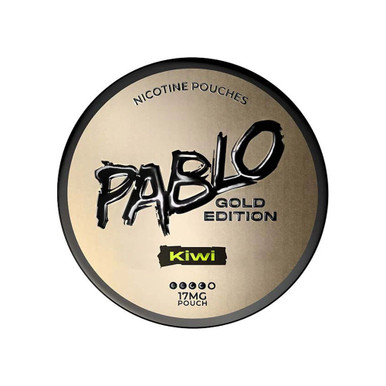
Pablo · 17mg
Read the full guide
Pablo Gold Edition Kiwi Nicotine Pouches
£19.95
✔ In stock — ready to ship
100% tobacco-free
Free over £20
Same-day dispatch
Secure checkout
Pablo Gold Edition Kiwi Nicotine Pouches are listed at £19.95 with one declared strength of 17mg, and the listing shows as in stock at the time of writing. One variant, one price, one image, one flavour tag — and it is the flavour tag that needs explaining first, because it does not match the name.
The name says Kiwi. The tag on our record says tropical. There is no kiwi tag on this listing and no kiwi shelf for it to sit on, which means the can turns up under our Tropical shelf with fifty-seven other listings and nowhere else on the flavour side. Whether kiwi is genuinely a tropical fruit is arguable — it grows on a temperate vine rather than in the tropics — but the tagging on these shelves follows a small set of flavour families rather than botany, and tropical is the family it has been dropped into. If you came looking for kiwi by name, the search box will find it faster than the flavour shelves will, and that is a quirk of our filing rather than anything about the can.
The full guide to Pablo Gold Edition Kiwi Nicotine Pouches
5,105 words on how it eats, who it suits, how to serve it and what to put beside it.
Gold Edition Kiwi, and the tag that does not say kiwi
The rest of the record is short. The declared 17mg files it under the Strong band, which is our biggest strength shelf at a hundred and thirty-two listings. It is a Pablo can and sits with all fifty-six Pablo listings on the brand page. And the pack configuration field is empty, which means we cannot tell you whether £19.95 buys one can or several — a point that matters enough to have a section of its own below.
What this page will not do is describe what is inside a pouch. We do not publish composition or technical detail about how any of these are put together; that is the manufacturer's to state on its own packaging. What a description can do is talk about how the flavour is built as a sensory thing, how the buying works, and what else is on the shelf. That is what follows.
How a recognisable flavour gets built in a dry pouch
This is worth a proper section because a pouch is an unpromising vehicle for flavour and yet the good ones are instantly identifiable. Everything here is about what the flavour does in the mouth over time. None of it is about what is in the pouch, which is not something we publish or are in a position to describe.
The constraints the format imposes
Three constraints shape every flavour in this format. There is no temperature — nothing is served hot or cold, so a flavour cannot borrow the chill of a drink or the warmth of a coffee. There is no carbonation, so anything whose real-world version is fizzy loses a large part of its signature. And there is no volume: a portion is small, it sits in one place, and the flavour arrives through a steady low release rather than in a mouthful. A flavour that depends on intensity does not survive the trip.
What the format does have is duration. A portion runs for a long time compared with anything you eat, which means a flavour can be built as a sequence — something that arrives, something that holds, something that trails off — in a way a sweet cannot.
The cues that make a flavour identifiable
In practice a recognisable flavour in this format tends to rest on two or three cues rather than on a faithful reproduction. A mint reads as mint through a cooling sensation and a sharp aromatic top note; get those two right and nobody queries it. A coffee reads as coffee through bitterness at the back and a roasted aroma, and if either is missing it reads as a caramel. A citrus needs acidity at the front. A red berry needs sweetness and a jammy body.
Kiwi is a harder case than any of those, because its real-world signature is largely textural — the seeds, the pulp, the wateriness — and none of that can be carried over. What is left to work with is the taste alone: a green, slightly tart, mildly floral sweetness. That is a narrow target, which is why kiwi cans differ from one another more than strawberry cans do.
The shape of a flavour over a portion
Most flavours in this format follow the same arc. There is a bright top end in the first minute, which is the part that announces what the flavour is. There is a body in the middle, which is where sweetness and any depth live, and which lasts longest. And there is a tail, where everything simplifies toward plain sweetness before fading out.
The interesting differences between cans are in the proportions. A can with a big top end and a short body reads as sharp and then disappointing. A can with no top end reads as vaguely sweet from the start. A can where the top note hands over cleanly to the body is the one that feels well made, and that handover is the thing worth paying attention to on any new flavour.
Where sweetness sits, and why it varies so much
Sweetness level is the single biggest difference between brands in this format, more than the flavour family itself. Some houses pitch everything high and sweet; others run noticeably drier. It is a house style rather than a flavour decision, which is why people who like one brand's fruit cans usually like most of them, and why moving to a different maker's version of the same fruit can be surprising.
Why two cans of the same fruit taste different
People are often surprised that two cans carrying the same fruit name are not interchangeable, and the explanation is usually one of three things rather than anything mysterious.
The first is which part of the fruit the flavour is aiming at. A strawberry can might be aiming at fresh fruit, at jam, or at a sweet — three quite different targets under one word. A green fruit like this one can be aimed at the ripe version or at the under-ripe, tart version, and those taste barely related.
The second is the presence or absence of a cooling element. A cold edge changes the perception of everything behind it, pushing a flavour toward crispness and away from sweetness, so the iced and non-iced versions of one fruit read as different flavours rather than as variations.
The third is the house sweetness level already mentioned. Put those three together and a single fruit name can cover half a dozen genuinely different cans, which is why the flavour shelves on this site are a starting point for browsing rather than a promise that everything on them tastes alike.
What a description like this one can and cannot settle
A written flavour description is useful for ruling things out and poor at ruling them in. It can tell you reliably that a can has no cooling in it, that its sweetness is moderate rather than high, that the tartness is mild, and that the flavour is a single fruit rather than a blend. Those are the facts that stop somebody ordering the wrong thing.
What it cannot do is tell you whether you will like it, because the vocabulary runs out long before the differences do. Two people reading "green, mildly tart, faintly floral" will picture different cans, and both will be somewhat right. That is an argument for treating any description, including this one, as a filter rather than a verdict.
And what this one actually tastes like
This can reads green rather than sweet-shop. The aroma on opening is light, a little floral, recognisably kiwi to anyone who has eaten one recently and slightly anonymous to anyone who has not. In the first minute there is a modest tart top note — nothing like a citrus, but enough to give the flavour an edge. The body underneath is a soft, green, mildly sweet fruit with a faint floral character, and the sweetness is moderate by the standards of this shelf rather than generous.
There is no cooling element in it. No mint, no frosted edge, nothing cold. On a shelf where tropical fruit is very often iced, that is a real distinction and it is worth knowing before you order — this is the warm, plain-fruit reading. The tail thins out into a light sweetness over several minutes and leaves very little on the breath, which makes it one of the quieter cans in the range.
Buying rhythm: one can, several cans, and what we cannot tell you
This is the section that matters most on this listing, and it opens with the problem rather than the advice.
The missing figure
Our record for this product carries no cans-per-pack number. The field is empty. So the first question anybody sensibly asks — is £19.95 a single can or a multi-can pack — is one we cannot answer from here, and we are not going to imply an answer by talking as though we knew.
The reason it is worth stating so plainly is that the prices on these shelves span a wide range and a good deal of that spread is pack size rather than the cans themselves. Elsewhere in the Pablo range, Exclusive-line listings are recorded at £3.85 and at least one Silver Edition listing is recorded at £39.90 for a ten-can pack. Between those two sits £19.95, which could reasonably be either a premium single tin or a small pack. The printed sleeve resolves it. We do not.
What a single-can rhythm looks like
For people who buy one can at a time, the rhythm is simple: a can lives in a pocket, it runs out, another is ordered. The advantage is that nothing sits around long enough to be affected by storage, and the flavour you get is always from a recently opened can. The disadvantage is that you are ordering often and paying delivery repeatedly, and there is a gap between running out and the next parcel arriving.
What a multi-can rhythm looks like
For people who buy several at once, the pattern is different: the pack lives in a cupboard or a drawer, one can is in circulation at a time, and the rest stay sealed until needed. The advantage is fewer orders and no gap. The disadvantage is that a pack bought ahead has to be stored properly — cans kept somewhere warm for two months are not the same cans they were — and that a flavour you turn out not to like is now a flavour you have a lot of.
How people actually reorder
The pattern we see described most often is neither of those in a pure form. People settle on a flavour they are happy to use constantly, buy that in whatever the largest sensible quantity is, and keep one or two single cans of something different alongside it for variety. That way the bulk purchase is of something known and the experiments are cheap.
If that is the approach, the natural companions for this can are the cheaper single listings rather than other large packs. Velo Tropical Mango at £4.19 is the cheapest tropical-tagged can we hold and is in stock, which makes it an inexpensive way to hear a different reading of the family. Within Pablo, the Exclusive-line cans at £3.85 fill the same role — Pablo Exclusive Bubblegum and Pablo Exclusive Banana Ice are both in stock and both about a fifth of this listing's price, though note they carry the line's own 50mg declared figure rather than this can's 17mg, which is a difference in the printed number and not a suggestion in either direction.
The arithmetic we can help with, and the arithmetic we cannot
Anybody buying regularly ends up doing sums, and it is worth being clear about which of them this page can support. We can give you the listed price of this can and of every can linked from it, because price is held consistently on our records. We can tell you which of them are available right now. Those two together let you compare what you would spend today across a set of options.
What we cannot give you is any per-can or per-portion figure for this listing, because we hold neither the pack count nor the portion count. So the sum most people actually want — what a week or a month costs — cannot be completed from this page. It can be completed from the can in your hand once you have read the printed count off it, and at that point the comparison with anything else on these shelves becomes a real one rather than a guess. We would rather say that than produce a plausible-looking number.
A note on delivery cadence
The practical rhythm of ordering is also a time question rather than only a money one. Every order carries a delivery wait and an age check at the door, which means somebody has to be in. People who order in small quantities do that more often, and the doorstep requirement is the part that catches them out — a parcel that cannot be handed over does not complete, whatever is in it. If being in for deliveries is awkward, fewer and larger orders are the practical answer, with the storage caveat below attached to them.
Keeping a spare, and the honest argument against it
The case for keeping a spare can is obvious: you do not run out. The case against is less obvious and worth hearing. A spare that lives in a bag or a car for months is exposed to heat and movement, and a can that has been through a summer in a glovebox is a worse can than one bought fresh. If you are going to keep a spare, keep it somewhere stable indoors rather than in the place where it would be most convenient. A drawer at home beats a door pocket every time.
Ordering ahead when something is unavailable
One further practical note on rhythm. Stock moves on these shelves and cans do go out. Among the tropical-adjacent listings here, Iceberg Apple Lemon Pineapple at £39.90 is currently unavailable — the page is live and readable, but nothing can be bought from it until it returns, so it should not be part of anybody's restock plan today. That is exactly the situation where having a second flavour you are happy with matters more than having a favourite.
The format in practice
The portion
A pouch is a small soft sachet that sits between the upper lip and the inside of the mouth, set off to one side. It is placed with a fingertip and then left alone. It should stay put without being held; a portion that keeps moving has usually been placed too far forward.
Duration
People keep a portion in for anything from ten minutes to an hour, and there is no correct figure. What is observable is that the flavour is at its most defined early and thins steadily, so the point at which a portion stops being interesting arrives well before the point at which it stops being a portion. How long anyone keeps one in is their own business, and we have nothing useful to add to it.
The lid and its compartment
These cans have two chambers. Unused portions sit in the well underneath; the lid has a shallow floor inside it that takes spent ones, so used and fresh travel separately until you find a bin. Three spent portions fit comfortably, four at a push, and at five the lid stops seating properly — which leaves the can open and dries out everything in it. Emptying the compartment routinely is the whole of the maintenance.
Disposal
Spent portions go in general waste, not down a sink and not into recycling. Keep them away from children and animals, which is the one part of this that genuinely matters rather than being housekeeping. The empty can is rigid plastic; your council's rules decide where that goes.
The declared figure, and what it is for
The number on this listing is 17mg. It is the manufacturer's declared strength, reproduced as given, and we use it to file the can onto a shelf. That is the whole of its function on this page.
It is not a quality rating and a higher number is not a better can. It is also not a number that travels between brands: makers state strength on different bases — per portion in some cases, per gram of contents in others — so two cans with the same printed figure need not represent the same quantity. We publish what is declared and decline to interpret it, which is why the comparisons in this description are about flavour, price and availability rather than about numbers.
Our three bands are Medium Strength, Strong, and Extra Strong, and they exist so you can browse within a region. They are not a sequence and they are not a progression. We cannot advise which figure suits anyone — we hold nothing that would make that anything other than a guess, and a shop is the wrong source for it. Anyone weighing that question against their own circumstances should ask a healthcare professional.
The Pablo lines, and what the names do not mean
Pablo runs to fifty-six listings here, divided into lines called Exclusive, Gold Edition and Silver Edition. Those are the maker's own range names. They do not rank, and nothing on our record would let us rank them if we wanted to. Gold is not above Silver, Exclusive is not a premium tier, and none of the three is a step up from another.
What differs between them, factually, is the declared figure, the recorded price and the pack configuration. Exclusive listings are recorded at £3.85 with a 50mg declared figure. Gold Edition listings, including this one, are recorded at £19.95 with 17mg. Silver Edition listings are recorded at £39.90 with 10mg, and at least one of those is a ten-can pack, which explains a price that would otherwise look odd beside £3.85. Three sets of facts, not three rungs.
Within Gold Edition itself, Gold Edition Blueberry Peach Ice is the closest sibling to this can on our record: the same £19.95, in stock, and a berry-and-stone-fruit blend with a cold edge where this one is a plain green fruit with none. If you want the same line and the same price with a completely different flavour structure, that is the one.
What else is on the tropical shelf
The tropical family is one of our larger ones at fifty-eight listings, and it is broader than the name suggests — it collects most of the fruit that is neither berry nor citrus, which is how a kiwi can ends up there. Here is what sits near this one, with a reason in each case.
The tropical cans proper
SYX Tropical at £29.90 is the straightforwardly named one, in stock, and a blended rather than single-fruit reading. Elf Bar Pineapple at £29.90 is a single-fruit can with far more acidity than this one and is available. Cuba Ninja Coconut at £39.90, also in stock, is the outlier of the group — coconut has almost no tartness at all, so it sits at the opposite end of the family from the sharp fruit. More of that house is on the Cuba brand shelf.
Other fruit worth putting next to a green one
Fumi Fiery Peach at £27.90 is in stock and is a soft, sweet stone fruit — a useful contrast because it is everything this can is not, sweetness-wise. Killa Apple at £33.50 is the nearest thing we stock to a green-fruit relative, available, and worth noting for one oddity: the title we hold is just brand and fruit, but the page address carries the words "extra strong", which suggests the maker files it higher than this can. We do not hold its declared figure, so its own listing is where to check rather than here.
Something with a cold edge, and something plain
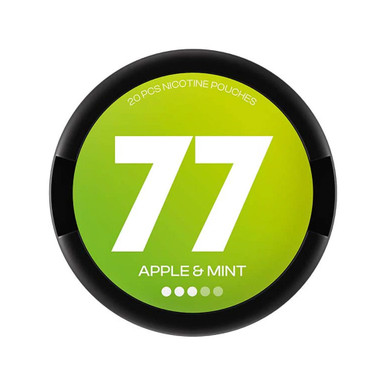
77 Apple Mint at £39.90 is in stock and puts a cooling element behind a green fruit, which is the obvious thing to try if you like this flavour family but want the cold version of it. Clew Blueberry at £39.90 is a clean break — dark fruit, no tropical character, in stock — and is the sort of can people keep as the alternate in a two-can rotation.
Staying inside the Pablo range
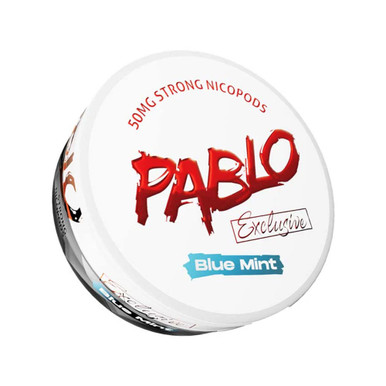
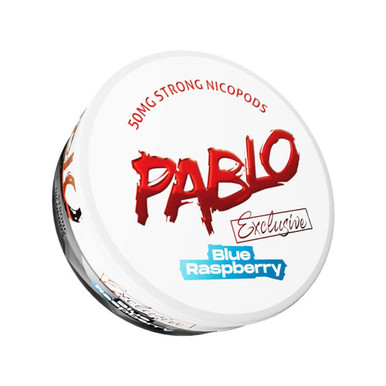
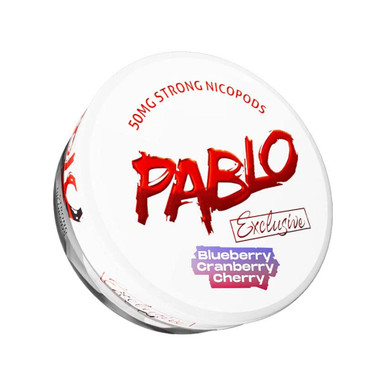
If you would rather not change house, the Exclusive line gives the widest flavour spread at one price. Pablo Exclusive Blue Raspberry is the sharp confected berry, the three-fruit Blueberry Cranberry Cherry can the busiest blend, Blueberry Peach Ice the iced stone-fruit reading, and Blue Mint the one with no fruit in it at all. All four are recorded at £3.85 and in stock, and all four carry the Exclusive line's 50mg figure rather than this can's.
Or browse rather than be pointed
The fifty-eight tropical-tagged cans are all in one place, the Strong shelf gives the same-band view across every flavour, and the whole catalogue sits behind one set of filters.
Storage, and the two things that actually spoil a can
Heat
Heat dulls a dry pouch and the change does not reverse. Dashboards, gloveboxes, radiators and sunny windowsills are the usual culprits. Cool, dry and out of direct sun is the entire instruction, and a drawer satisfies it.
A lid that was rested rather than closed
What these lose to open air is flavour. A can left ajar overnight is flatter the next morning, and a can whose lid has been nudged proud by being sat on is in the same position without looking it. Press the lid until it clicks and the problem does not arise.
Cold, since it comes up
There is no reason to refrigerate a can. Cold does nothing for a dry format, and moving a cold can into a warm room invites condensation inside it, which is the one kind of damp you want to avoid. Room temperature, out of the sun, beats the fridge.
Dates
We hold no best-before date for this listing and will not print one we do not have. The manufacturer marks a date on the packaging and that is the one to work to. For a can in regular use it rarely becomes relevant; for cans bought ahead and stored, it is the figure that matters.
What there is to choose on this listing
One variant: 17mg at £19.95. No second strength, no alternative pack size on the record, no multi-can option attached. So there is nothing to weigh up within the listing — the decision is simply whether this is the can you want.
If it is a different declared figure you are after, that is a different listing and the strength bands are the way to find it. If it is a different pack size, we cannot compare pack sizes for you here, because this listing does not state its own. And if it is kiwi specifically you want rather than this can, be aware that our flavour shelves have no kiwi category — the tropical shelf and the search box are the two routes, and neither will give you a tidy list of every kiwi can we hold.
Ordering, delivery and the age check
Add it from the listing page, where the live price and live stock position are confirmed. A description written on one day is being read on another, and the listing is the current position.
Age verification runs at checkout and orders that fail it do not ship. Identification may also be requested at the door, so someone aged 18 or over has to be present to take the parcel in; if there is nobody to show ID, the delivery does not complete. That is standard across every nicotine product on this site and is not specific to this can.
Finding this listing again
By brand, it is on the Pablo brand shelf. By declared figure, it sits with the hundred and thirty-two cans in the Strong band. By flavour, it is filed under tropical and nowhere else, so the flavour route is the tropical shelf rather than anything with kiwi in the name. The search box is the fastest route of the four if you already know what it is called.
Questions people ask about this can
Why is a kiwi can filed under tropical?
Because our flavour shelves work in families rather than by individual fruit, and there is no kiwi shelf to file it on. Kiwi is not really a tropical fruit botanically, but the tropical family is where our tagging puts the fruit that is neither berry nor citrus. It means the can is findable by family or by name, but not by fruit on the flavour shelves.
Does it taste like a real kiwi?
It reads green, mildly tart and slightly floral, which is the taste part of a kiwi. What it cannot reproduce is the texture — the pulp, the seeds, the wateriness — and a good deal of what people recognise as kiwi is textural. So: recognisable as kiwi in flavour, not a reproduction of eating one.
How many cans is £19.95?
We do not hold that figure. The pack-size field on our record is empty for this listing, so the honest answer is that £19.95 buys what the listing page shows and the count is printed on the sleeve. We will not estimate it — an estimate on a shop page stops being an estimate as soon as somebody plans around it.
Is there any cooling in it?
None. No mint element and no frosted edge, and nothing on our record suggests one. It is the plain-fruit reading. If you want the same sort of green fruit with a cold element over it, 77 Apple Mint is the nearest thing we stock and it is in stock.
How does it compare with the other Gold Edition cans?
On price and declared figure, it does not differ: the Gold Edition listings we hold are recorded at £19.95 with 17mg. What differs is flavour. The blueberry-and-peach one in the same line is sweeter and carries a cold element, which makes it structurally the opposite of this can at the same price.
Is Gold Edition better than the Exclusive or Silver lines?
No. They are the manufacturer's range names, not grades, and we hold nothing that would support ranking them. What genuinely differs is the declared figure, the price and the pack configuration. Reading "Gold" as a quality statement is reading more into the word than our record supports.
What does 17mg mean?
It is the strength declared by the manufacturer and printed as given, and it is what we use to file the can under Strong. It is not a score, and it is not reliably comparable with another brand's printed figure because makers state strength on different bases. We publish it and leave it there deliberately.
How many portions does a can hold?
Not a figure we hold. Counts vary between makers and between formats within a single maker, so borrowing a number from another brand is unreliable. It is printed on the can.
Is it worth buying several at once?
That depends entirely on whether you already know you like it, and it is not a question we can answer for you. What we can say is that a can kept somewhere stable indoors holds its condition far better than one carried around for months, so buying ahead only makes sense if the spares get stored sensibly rather than left in a car.
Can I use it at work or take it abroad?
We cannot tell you. Employers set their own policies, transport operators and venues publish their own conditions, and some countries restrict these products entirely regardless of their being sold legally here. Ask your employer about the workplace and check the destination's rules before travelling. A shop's guess would be worth nothing to you.
Is everything on this page in stock?
No — one listing mentioned above, the Iceberg apple, lemon and pineapple can, was flagged unavailable when this was written. Everything else linked here was in stock at that moment. Stock changes in both directions and each listing page carries its own live position, which is the one to trust.
Does a new can behave differently from one that is nearly finished?
Slightly, in one respect: the lid. A new can is stiff and often wants a thumbnail under the rim for the first opening, and it loosens over the life of the can until a nearly empty one is noticeably easier to open. That is normal rather than a fault, but it makes the nearly empty can the one most likely to work open in a bag, so it is worth a deliberate press to check it has seated. The flavour itself should not drift over the life of a can that has been kept shut and kept cool.
Why does this page say so little about what is in the pouch?
Because we do not publish composition or technical detail about any product on this site, and we are not in a position to describe it accurately even if we wanted to. What the manufacturer chooses to state is printed on the packaging, which is the appropriate place for it and the only source worth relying on. What we can usefully describe is the object, the taste as a taste, the price, the declared figure as a figure, and what else sits nearby on the shelf.
Are there ratings or reviews on the listing?
We do not collect or publish them for this product, so there is nothing to show and nothing for us to summarise. What you get is the record: name, brand, price, declared strength, flavour tag, stock position and one image.
Compliance, in full
This product contains nicotine. Nicotine is an addictive substance.
It is sold to over-18s only, and only to adults who already use nicotine products. Age checks run at checkout, and identification may be requested by the courier on delivery, so an adult needs to be in to receive the parcel.
This product is not a licensed stop-smoking medicine and is not intended for non-smokers, for anyone who does not already use nicotine, for under-18s, or for anyone pregnant or breastfeeding. Nothing on this page is a health, medical or therapeutic claim, nothing here is an encouragement to anyone to begin using nicotine, and nothing here is advice about which strength to use. Questions about nicotine and your own circumstances belong with a healthcare professional.
The short version
Gold Edition Kiwi is a single-variant listing at £19.95 with a declared 17mg, in stock at the time of writing, tagged tropical rather than kiwi because we run no kiwi shelf. Our record holds no pack count and no portion count, so neither appears above and neither has been guessed at.
The flavour is a green, mildly tart, faintly floral fruit with moderate sweetness and no cooling element at all — a quieter can than most of what sits around it. It belongs to one of three Pablo lines, which are families rather than grades. If that reads right, the listing page holds the live price and stock; if you would rather look across the family first, the tropical shelf is where this one and its neighbours all sit.
More from Pablo
More strong pouches

More tropical pouches
Where this sits
Pablo Gold Edition Kiwi Nicotine Pouches appears in these categories. Browse them, or jump to something close.
You might also like