
Cuba · 16mg
Read the full guide
Cuba White Grape Nicotine Pouches
£39.90
✔ In stock — ready to ship
100% tobacco-free
Free over £20
Same-day dispatch
Secure checkout
Cuba White Grape Nicotine Pouches, listed here at £39.90, one declared strength of 16mg, one variant at that figure, grape recorded as the flavour, and showing in stock as this is written. That is our complete product record and it is the only source of factual claims on this page.
Anything below that is not one of those six items is either a description of how the format works, a comparison against another can we genuinely stock, or a statement that we do not hold something. The last category turns up more often than it does on most shop pages, and that is deliberate rather than lazy.
The full guide to Cuba White Grape Nicotine Pouches
6,421 words on how it eats, who it suits, how to serve it and what to put beside it.
The can on this page
Cuba is the manufacturer's name for the brand. We print it because it is on the lid. It is not an origin statement and we publish no origin information for anything we sell.
This is an adult nicotine product and the compliance notices have their own section near the foot of the page.
How the pouch is used
The format first, because it is common to everything on the site and it is quicker to set out once than to allude to repeatedly.
A pouch is a small sealed unit. It goes in the mouth, between the lip and the gum line, and stays there. It is not chewed and it is not swallowed. Nothing is lit and nothing is inhaled. That is a description of the object's behaviour, carrying no claim in any direction.
The routine settles into: lid off, one pouch out, lid firmly back on before anything else happens. It sits at the front of the mouth, most often under the upper lip, held in place by the lip itself, and it does not wander. Shifting it across is normal and unremarkable. If it is uncomfortable in every position, taking it out is the reasonable response — comfort is individual and no part of this format asks anyone to persist.
Duration varies too widely between people for an average to be honest. Reported practice runs from a few minutes to the better part of an hour, and the usual reason for stopping is that the taste has run out. We publish no time and advise no time; the manufacturer's own printed usage wording on the can is the guidance that applies.
Used pouches go in a bin. The catch compartment under the lid is a temporary holding place for when no bin is within reach, not a destination, and it wants emptying well before it fills, because a full compartment stops the lid seating and a lid that does not seat is behind most complaints about any can. Nothing goes down a sink or a drain. The can is a plastic tin, and whether your council takes that plastic at the kerbside varies by local authority and is not something we can answer for a postcode.
We hold no pouch dimensions or format designation for this listing, so we will not be telling you whether these are slim or regular. The can carries that if the manufacturer prints it. Every pouch inside a given can matches every other, so the first is representative of the remainder and there is nothing to sort through or select between once the lid is off.
The tin itself, and carrying one about
The container gets far less attention than the thing inside it and is the part you actually handle every time. Described here as an object, because an object is all we can speak to.
It is a small round tin of moulded plastic, wider across than it is deep, with a lid that presses onto the rim rather than screwing down. It comes off under a thumb and goes back under a press, and the sound it makes doing either is a soft click that carries further in a silent room than most people expect. That click is the loudest thing about the whole format, and it is worth knowing about before you find out in a meeting.
In a pocket the tin behaves itself. It is round, it has no corner to snag, and it takes being sat on in a coat pocket without deforming. What it does not take is being dropped on a hard floor with the lid off, which redistributes the contents across the room and is nobody's favourite two minutes of the day. In a bag it wants a pocket to itself rather than the main compartment, where it will eventually meet a set of keys and work its own lid loose.
Everything printed on the outside is the manufacturer's doing rather than ours. Whatever they choose to state there — the brand, the product name, the declared figure, their own usage wording, any date they mark — is on the tin and travels with the tin, which a web page does not. We transcribe the parts of that we hold in our record and we leave alone the parts we do not, which is why this page keeps arriving at the same sentence from different directions: the tin is the document, and where the tin and this page disagree, the tin is right.
One tin is one tin, and we hold no can count for this listing, so whether £39.90 brings a single one of these objects or several of them is a question the parcel answers rather than this paragraph. The object itself is the same object either way.
Grape, as a taste and a smell
Our flavour classification for this listing is grape, and grape is an unusually interesting word to find on a lid, because it points at two quite different things depending on who is reading it.
One reading is the fruit: a table grape, which is mildly sweet, watery, with a thin tartness and not a great deal of aromatic punch. The other reading is the flavour convention — the deep purple grape idea familiar from sweets and soft drinks, which is considerably more perfumed, much sweeter, and does not taste especially like a grape you would eat. Those two are far apart, and almost everything anyone tastes in a grape-flavoured product sits somewhere on the line between them.
Described as taste and aroma only: what comes off this open can reads as grape immediately, landing towards the sweeter and more perfumed end of that line rather than the watery table-grape end. There is a floral quality to grape that people notice more in a pouch than in a drink — a slightly perfumed note sitting above the sweetness. Underneath it there is a mild tartness which keeps the sweetness from going flat. It is not a cooling flavour; nothing in our record indicates an ice or frost character, so if coldness is what you want, this is not where it is.
Our grape shelf holds only 14 listings, which makes it one of the smaller flavour groupings on the site — considerably smaller than the mint or berry shelves. Grape is a flavour with a firm following and not a broad one, which is precisely why the shelf is short.
That short shelf has one practical consequence worth flagging before you go further. If grape is what you want, you are choosing from fourteen listings rather than from the 148 on the mint shelf or the 76 on the berry one, and the range of prices within those fourteen is wide. It also means that if a particular grape listing is unavailable, the alternatives inside the flavour are limited in a way they would not be in a larger family. That is not a reason to avoid the flavour; it is a reason to know the shelf, which takes about two minutes to read end to end.
How a fruit gets to be recognisable in a pouch
The second thing worth going into properly on this page is the question of recognition: why a small dry object held still in your mouth ends up reading unambiguously as grape rather than as generic sweetness.
The necessary caveat first. We do not hold the formulation for this or any can, we have no access to how any of it is put together, and nothing in this section describes contents, construction or chemistry. This is about what a taster perceives, which is the end of the process a customer actually occupies.
Recognition runs on a few cues, not on accuracy
People do not identify a flavour by matching it against the real thing. They match it against their memory of the flavour, which is usually a memory of a flavoured product rather than of the fruit. This is why grape is such a clear case: most adults' reference point for grape flavour was formed by sweets and drinks, not by a bowl of grapes, and a pouch that tasted precisely like a table grape would probably be described as not tasting much of grape at all.
What that means practically is that a recognisable fruit flavour is built to hit a small number of cues rather than to be an accurate reproduction. For grape, the cues are the sweetness level, that faintly floral top note, and the particular kind of mild tartness underneath. Get those three and recognition is instant. Miss the floral note and the same sweetness reads as generic.
A pouch has no texture to help it
Every other way you have met grape came with something else attached. A grape has skin and juice. A soft drink has cold and bubbles. A sweet has chew and dissolution. All of those contribute to recognition without anyone noticing that they are doing so.
A pouch has none of them. It is dry, it is still, it is at the temperature of your mouth, and it does not change. Everything therefore rests on the flavour itself, with nothing else to lean on. That is why a pouch flavour can feel simultaneously very recognisable and slightly flatter than the same flavour elsewhere — the recognition survives the transfer intact, while the supporting cast does not come with it.
Which is why grape cans so often carry a cold note
You will notice, looking at the grape cans on our shelves, how many of them have ice or a cooling word somewhere in the name. Elf Bar Grape Ice at £29.90, Killa's grape ice can at £33.50 and Pablo Gold Edition Grape Ice at £19.95 all do it. Whatever the reason a manufacturer chooses, the effect for a taster is that a cooling sensation replaces some of the missing texture with a physical event of its own.
Which you prefer is genuinely a preference and not a quality question. A plain grape can gives you the flavour on its own terms. A grape-and-ice can gives you the flavour plus a sensation. This listing, by our record, is the former — and Velo Purple Grape at £4.19 is the other grape can we hold without a cooling word in the name, at an extremely different price.
The lid is the weakest evidence you have
Everything in this section leads to one practical conclusion, which is that a product name is a poor guide to a flavour and people rely on it far more than it deserves. Names exist to distinguish a manufacturer's cans from each other and to sell them. They are not written to a standard, no two companies use the same vocabulary, and nothing obliges a can called after a fruit to sit anywhere in particular on sweetness or sharpness.
The single word we hold in our flavour field — grape — is a classification for shelving, not a description. It puts this can on a shelf with thirteen others so that somebody looking for that family can find them. It does not promise that any two of the fourteen taste alike, and anybody who has worked through a flavour shelf will tell you they do not.
The honest advice that follows is dull: treat the name as a starting point that narrows the field, and treat your own notes on cans you have actually had as the real evidence. It is the only source of information about your own preferences that is not somebody's marketing.
Why two grape cans still taste different
Even between two cans that sit at the same place on the plain-versus-cold question, there is room for real difference, because the three cues above can each be dialled independently. A can with more of the floral note and less sweetness reads as a more grown-up version of the same idea. One with the sweetness pushed further forward reads closer to the confectionery end. Neither is more correct. It does mean that liking one grape pouch is not a reliable predictor of liking another, which is a slightly inconvenient thing for a shop to admit and is nonetheless true.
The 16mg figure
The 16mg here is the nicotine content declared by the manufacturer for a pouch, transcribed from their labelling without adjustment. We have not tested it and we do not round it. If a physical can disagrees with this page, the can is correct and we would like to be told.
The figure orders cans declared on the same basis, within one manufacturer's line, and does not transfer between manufacturers, who declare against different formats by different conventions. Two cans showing the same number from two companies are not thereby equivalent. We publish each company's figure beside each company's product and we do not convert between them, because an honest conversion would need detail we do not have.
Our shelves file by declared band as a navigation aid. This listing sits in the Strong band, 132 listings at present, alongside a Medium Strength band and an Extra Strong band. Drawers, not rungs. We will not tell you that 16mg is right or suitable for you; we know nothing about you and no shop is in a position to advise on that.
What there is to choose on this listing
One variant, 16mg at £39.90, so no selector and nothing to configure. The decision is binary: this can, or not this can.
Our record does not carry a can count. That means we cannot tell you whether £39.90 covers a single tin or more than one, and we are not going to work it out backwards from the price, because a plausible inference presented as a fact is still an invention. The contents stated at checkout and the packaging that arrives are the dependable answers, and where either disagrees with what we have published, we will correct the record.
What £39.90 looks like next to the rest of the shelf
Headline figures across this catalogue run from a little over four pounds to the high thirties, which is close to a tenfold spread on objects that look broadly alike in a photograph. It is worth setting out where this listing falls inside that, with the caveat from further down still standing: a headline figure is not a unit cost and we cannot turn one into the other for you.
| Price on our shelf | Listings at that figure near this one |
|---|---|
| £4.19 | the Velo grape listing |
| £14.95 | the Edge mint can |
| £19.95 | the Pablo Gold Edition can |
| £27.90 | the Fumi lime listing |
| £29.90 | Elf Bar's grape can |
| £33.50 | the Killa grape listing |
| £39.90 | this can, Cuba's other grape listing, the Clew blueberry can, Denssi's blueberry freeze and the mango can from 77 |
Two things fall out of that table. The first is that £39.90 is a cluster rather than a top rung — several unrelated manufacturers land on the same figure, which more often means the figure describes a similar sort of package than a similar sort of product. The second is that the cheap end and the dear end of the list are almost certainly not selling the same quantity of goods, so reading £4.19 against £39.90 as a straight comparison is comparing two numbers that are not measuring the same thing.
Inside one brand the question disappears altogether. Every listing on the Cuba shelf carries the same £39.90, so moving between flavours in that range costs nothing and cannot be a value decision at all. Across brands it is the reverse: Pablo's own brand page and the wider index of everything we list will show figures spread across the entire range above, and none of them can be ranked against each other honestly without the packaging in front of you.
The use of a table like that is narrow and genuine: it tells you what a single order will cost, which is the number that actually leaves your account on the day. Anything past that — value, cost per pouch, whether one can is dearer than another in any meaningful sense — needs figures this page does not carry and is not going to invent.
How people actually buy this, and how often
The pattern of buying is worth a section of its own, because it is the thing that determines what you spend over a year far more than the price on any single listing does.
The single-or-multiple question we cannot answer
Start with the honest gap, since it sits right in the middle of this subject. Pouches are sold in this market both as single tins and as multi-can rolls, and the difference matters enormously to how you plan a reorder. Our record holds no can count for this listing, so we cannot tell you which this is. We will not guess from the price, we will not infer from the brand, and we will not borrow a number from a listing that looks similar. What arrives in the parcel and what the checkout page states are the answers, and everything below is written to be useful either way.
The two reorder habits
Broadly, people fall into one of two patterns. The first is reactive: the can runs out, they order, and there is a gap of a few days in between. The second is anticipatory: they order the next one while the current one still has a good deal left in it, so there is never a gap. Neither is better and we have no interest in pushing anybody towards either. We mention the distinction only because the reactive pattern produces more small orders and therefore more postage, which is the practical difference between them.
The argument against buying a large stock
There is a genuine drawback to buying a great many cans at once and it is not a financial one. A can that sits unopened is fine indefinitely within whatever date the manufacturer prints, but a can that is open and used slowly loses flavour over time, and a large collection of open cans means several of them are going quiet in a drawer. If a big order means you end up with five things open at once, you will get less out of most of them than you would have from buying fewer, more often.
The related point is flavour fatigue in reverse. People who buy six of one thing frequently discover around can three that they are tired of it, which is a poor position to be in with three still to go. Buying breadth rather than depth is the way most experienced customers handle that, and the section below on what else we hold is written with exactly that in mind.
Keeping a spare, and what a spare is for
A spare can is inventory management rather than anything else. It exists so that a delivery delay does not become a problem and so that a reorder can be made at a convenient moment rather than an urgent one. That is the entirety of its purpose and it is not a suggestion about how much anyone should be getting through — how much you use is your business and we have no view on it.
The sensible way to hold a spare, if you hold one, is unopened and somewhere cool and dark, with the open can being the only one in circulation. That way the spare is in the condition it arrived in when you get to it.
The arithmetic you cannot do from this page
People comparing pouches across brands almost always want a cost-per-can or cost-per-pouch figure, because headline prices on this market range from a few pounds to the high thirties and a headline price on its own tells you very little. It is a sensible thing to want.
It is also arithmetic we cannot do for you here, and it is worth being explicit about why rather than leaving you to wonder. Working it out needs two numbers we do not hold for this listing: how many cans the price covers, and how many pouches are in a can. Without either of them, £39.90 cannot be reduced to a unit cost, and a comparison against a £4.19 listing elsewhere on our shelves is not a like-for-like comparison at all. Anyone presenting those two prices as directly comparable is comparing two numbers rather than two products.
What you can do, once a can is in front of you and the packaging has given you those figures, is the arithmetic for yourself — and it is worth doing once for each listing you buy regularly, because the ranking by unit cost frequently differs from the ranking by headline price. We would rather hand you the method and the missing pieces than publish a number we made up.
When a listing goes out of stock
Stock moves, and any individual listing can be unavailable for a period. We cannot promise a restock date for one, because that depends on supply we do not control, and a date we then missed would be worse than no date at all. The product page is always the live answer.
The practical consequence for a reorder habit is that relying on one specific listing being available on the day you need it is a fragile arrangement, particularly on a shelf as short as the grape one. People who reorder reactively and only ever buy one thing are the ones most likely to find themselves stuck. Knowing a second can you are content with, before you need it, is the whole of the answer, and it costs nothing to work out in advance.
Combining an order
Most multi-can orders here are about postage rather than about flavour. If you are going to combine, the useful principle is that the second can should be something you already know or something deliberately unlike the first — two unfamiliar cans in the same parcel means that if the parcel disappoints, you have learned very little. At £39.90 a can, that is not a cheap lesson.
Ordering, delivery and age checks
Age verification runs at checkout before the order can complete. On delivery, the courier may ask to see identification, and if nobody aged 18 or over is there to produce it, the parcel is not handed over and goes back. Ordering to an address where an adult will actually be in, with something photographic to hand, is what avoids a wasted attempt. Plan on being asked.
Beyond that it is ordinary: the can goes into the basket at £39.90, the address and verification steps are completed, and it is picked from stock and dispatched. Availability is live on the listing, and while this one shows in stock as the page is written, the listing is the current answer rather than this paragraph.
Where this can falls in the Cuba range
The Cuba group on our shelves runs to 47 listings, split into named lines of which White is one, and every Cuba listing we hold is £39.90. A choice between two Cuba cans is therefore a flavour choice with no price attached to it, which is a simpler decision than most of the shelf offers.
The direct counterpart is Cuba Black Grape, the same flavour word under the brand's other main line at the same price. We are not going to tell you what distinguishes the two lines, because our record holds the line names and nothing about the difference between them, and a confident paragraph on an unverified distinction helps nobody.
Elsewhere in the brand, Cuba Black Blueberry and Cuba Black Cherry cover soft berry and dark stone fruit respectively, Cuba Black Apple Juice the orchard end, and Cuba Black Banana Hit the most distinctive name in the group. Away from fruit, the Black cola can and Cuba Black Cold Dry are the two significant departures, at the same £39.90.
What sits alongside a grape can
Since the grape shelf is only 14 listings deep, variety for a grape drinker usually means going outside the flavour rather than within it.
Staying in grape, the options and their prices are set out above in the flavour section — the two ice-named cans from Elf Bar and Killa, the Pablo one, and the Velo one at £4.19, which is by a very long way the cheapest grape can we carry and the low-cost route to a second can in the same family.
For a real change, berry is the nearest neighbouring family and the best-stocked alternative. Clew Blueberry at £39.90 keeps a single berry plain, and Denssi Blueberry Freeze at the same price runs a cold note through one. Further out, the 77 Ghost Mini mango can at £39.90 takes the tropical route, and for something that shares nothing at all with a sweet purple fruit, Fumi Fiery Lime at £27.90 goes citrus and Edge Mint at £14.95 goes cooling. Those last two are the furthest from where you are now and therefore the least likely to blur into the grape after a fortnight.
If you would rather browse than filter, the whole catalogue is viewable in one place, and the Pablo range is the other substantial brand grouping if you are comparing across manufacturers rather than within one.
Looking after the can
Keep the lid pressed down properly every time — the lid is the whole of the storage system and a half-seated lid overnight is the most common fault on any can. Keep it out of direct sun and away from heat: a car in summer, a windowsill, a radiator shelf and the cupboard above a cooker are all poor choices, while a drawer, a cupboard, a bag pocket or a bedside table are all fine. A refrigerator is unnecessary and we do not suggest it, since a cold tin brought into a warm room collects condensation.
Empty the catch compartment regularly, because a full one stops the lid sitting flat and then causes the first problem repeatedly. Keep the can where children and animals cannot reach it — a closed drawer or a high shelf rather than a coffee table. We publish no shelf life because we hold none; any date printed on the packaging is the manufacturer's and is the one that counts.
What our record holds, and what it leaves blank
A good deal of this page has been spent saying that we do not hold something, so it is fairer to show you the shape of the record once than to keep announcing holes in it one at a time.
What we hold for this listing is a title, a brand name, a price, a declared strength figure, a flavour word, a variant list, a stock flag and one photograph. Eight fields, and that is the whole of it.
What we do not hold, for this listing or for anything else we sell: a can count, a pouch count, pouch dimensions, a format designation, an ingredient list, a country, a manufacturing date, a shelf life, or any account of what separates one of a brand's named lines from another. Those are not fields we have chosen to leave empty on this page in particular. They are fields we do not keep at all, for any listing, which is why the same gaps turn up wherever you go on the site.
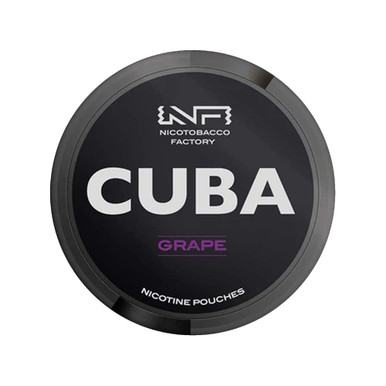
The photograph deserves its own sentence. There is one image on this listing, it is of the can, and its job is to let you recognise the object. It is not a warranty about the artwork on the tin that arrives, since manufacturers change print runs without telling retailers, and it is not evidence of anything at all about the contents.
Set out plainly like that, the gaps become useful rather than irritating. If a decision of yours turns on one of the figures in the second list, you know before ordering that the answer lives on the packaging and not here, and you can ask us in advance rather than discover it when the parcel lands. A shop that filled those fields with plausible-looking values would read a great deal better and would be worth a great deal less.
Finding your way back here
Three routes. By declared figure, among the 132 listings in the Strong band. By manufacturer, inside the 47-listing Cuba range. By flavour, among the 14 grape listings, which is short enough to read in one go and is usually the fastest route of the three for exactly that reason.
Questions we get about this can
Is the price for one can or a roll of them?
We do not hold a can count for this listing, so we cannot tell you from our data, and we are not going to deduce it from the price. What we can confirm is the figure we charge, £39.90, and that there is a single variant. The contents shown at checkout and the packaging that arrives are the reliable answers. We would rather state the gap plainly than publish a confident guess that turns out to be wrong when the parcel lands.
Does it taste like real grapes?
It reads towards the sweeter, more perfumed grape idea familiar from flavoured products rather than the watery character of a table grape. That is how most grape flavouring across this market behaves, and it is what makes it instantly recognisable. Beyond describing the general character we are not going to go further, because we hold no formulation and a detailed tasting note would be us writing beyond our evidence.
Is there a cooling version of this?
Not of this listing, which has one variant only. There are grape cans elsewhere on our shelves with cooling words in their names — the Elf Bar grape ice can at £29.90 is one. They are separate products from separate manufacturers with their own declared figures, not cold versions of this one, and their flavours are their own.
Why is the grape shelf so small?
Because grape is a flavour with a committed following rather than a broad one, and manufacturers stock accordingly. Fourteen listings against 132 in the Strong band tells you where grape sits in the market. The practical upshot for you is that the grape shelf is short enough to read end to end in a couple of minutes, which is not true of the larger flavour groupings.
How many pouches are in the can?
A figure we do not hold and therefore will not print. Counts vary across this market, and taking a number from a similar-looking product would be fabricating a specification for something people use to make a buying decision. Where the manufacturer states a count it is on the can. If what is printed there contradicts anything on our site, tell us and the record gets corrected.
What is in the pouch?
We publish no ingredient list and will not reconstruct one from inference. Whatever the manufacturer declares is on the packaging and that declaration is the authoritative source. If you need certainty about a particular substance before buying, read the can's own statement or approach the manufacturer, rather than relying on what a retailer has typed.
How is this different from the Black version?
They are two listings carrying the same flavour word under two line names from one brand, both at £39.90. Our record does not describe what separates the lines, so we are not going to characterise it. The Black line's grape page carries its own record and comparing the two directly will tell you more than a summary from us would.
Should I buy several cans at once?
That is your decision and we are not going to steer it. The trade-offs are worth knowing: multiple cans in one order usually saves postage, while opened cans lose flavour over time, so a large number open at once means several are going quiet in a drawer. Buying an unfamiliar can singly is also the cheaper way to find out whether you want it, even though it does not look cheaper on the order page.
Can I stock up and keep them for months?
An unopened can kept cool and dark is fine up to whatever date the manufacturer prints on it, and that date is the one to work to since we publish none of our own. The thing that does not keep well is an open can, which loses flavour gradually. If you are holding several, keeping them sealed until each one is actually needed is the sensible approach.
Is 16mg the strongest you sell?
No. We file cans into three declared bands and this listing sits in the middle one of the three by name; the Extra Strong band holds listings with higher declared figures. That is a statement about how numbers are filed on our shelves and not a recommendation about where anyone should be. We do not advise on strength.
Can I work out the price per pouch?
Not from this page, because that sum needs two figures we do not hold — how many cans £39.90 covers and how many pouches are in a can. Comparing our headline prices across brands without those numbers is comparing prices rather than products. Once the packaging gives you both figures you can do it yourself, and it is worth doing once for anything you buy regularly, since the order by unit cost often differs from the order by headline price.
Do the pouches all taste the same within one can?
Within a single can, every pouch is the same as every other, so the first one is representative of the rest. What we cannot speak to is variation between one can and another or between production runs, because we do not test stock and hold no data on it. If a can seems markedly unlike a previous one of the same listing, that is worth raising with us and with the manufacturer rather than something we can account for from here.
Will the courier want to see identification?
They may, and it is best to assume so. This is an age-restricted product sold only to over-18s, and if nobody aged 18 or over is present to produce identification when asked, the parcel will not be left and will go back. Having something photographic within reach at the delivery address is the simplest way to avoid a second attempt and the delay that comes with it.
Why is one grape can £4.19 and this one £39.90?
Because the two are very unlikely to be selling the same quantity of goods, and because each manufacturer sets its own prices. Our record holds a figure for each listing and nothing whatever that would explain the distance between them. The cheapest grape listing we carry and this one are both grape by our flavour field, and that is as far as the comparison can honestly be taken from this page. What each figure actually buys is stated on the packaging and at checkout.
Is the White line cheaper than the Black line?
No. Every Cuba listing we hold sits at £39.90, White and Black alike, so there is no economy line and no premium one inside the brand. The cola can in the Black line costs exactly what this grape can costs. Whatever the two line names are meant to signify, price is not it, and our record does not describe the distinction any further than the names themselves do.
The lid will not press down flat — what has gone wrong?
Almost always the catch compartment underneath is full and the spent pouches in it are holding the lid off its seat. Empty it and the lid seats again. If it is already empty and the lid still will not sit, something has deformed, which is usually heat and occasionally a drop onto a hard floor, and a tin that will not close is not one to keep carrying about. If it arrived in that state, tell us rather than putting up with it.
Do you stock grape in a smaller pouch?
We hold no format designation for any grape listing, so we cannot tell you which of the fourteen on the grape grouping are slim, regular or anything else. Some manufacturers put the word in the product name and some do not, and reading a format off a name is guessing with extra steps. Where a can states its own format, the maker has printed it there, and that is the only place we would rely on.
Does the strength band tell me anything about the flavour?
Nothing at all, and it is not meant to. The Strong grouping is filed purely on declared figures and takes no account of taste, so mint cans, fruit cans and everything else sit in it side by side. If flavour is what you are shopping on, the flavour shelves are the route to take, and the bands are only useful once you already know which figure you buy. We keep the two filing systems apart deliberately, because running them together would imply a relationship between a number and a taste that does not exist.
Notices for this product
Nicotine is an addictive substance.
This product is sold only to adults aged 18 or over who already use nicotine. We do not sell to under-18s, and no part of this page is written for anyone who is not already a nicotine user.
It is not a licensed stop-smoking medicine and no medicinal claim is made for it here. It is not intended for non-smokers, for anyone who does not already use nicotine, for under-18s, or for anyone pregnant or breastfeeding.
Age verification applies at the point of purchase and identification may be requested on delivery. Keep the can out of the reach of children and animals.
Last word
Cuba White Grape as the record holds it: £39.90, 16mg declared, grape as the flavour, one variant, in stock at the time of writing, filed on its strength band, the brand page and the 14-listing grape shelf. Two things this page could not tell you — how many cans £39.90 buys, and what is inside the pouch — are both answered by the packaging rather than by us, and we would rather point you there than fill the space with something that sounds like an answer.
More from Cuba
More strong pouches

More grape pouches

Where this sits
Cuba White Grape Nicotine Pouches appears in these categories. Browse them, or jump to something close.
You might also like