Home / Extra Strong / Cuba Black Ice Spearmint Nicotine Pouches
Cuba · 43mg
Read the full guide
Cuba Black Ice Spearmint Nicotine Pouches
£39.90
✔ In stock — ready to ship
100% tobacco-free
Free over £20
Same-day dispatch
Secure checkout
Start with the thing that matters most before anything else on this page is of any use to you. Cuba Black Ice Spearmint Nicotine Pouches are not in stock at the time of writing. The listing carries the product, the price and the specification, but it is not currently available to add to a basket. The listing page itself holds the live position — if that has changed since this description was written, the page will reflect it and this paragraph will not. Read the page, not the paragraph, for availability.
Everything else about the listing is straightforward. The price when available is £39.90. There is a single declared strength, 43mg. The flavour is classified in our catalogue as mint, which places it on the mint flavour shelf with 147 other listings. Those four facts are the whole of our product record, and everything on this page is either a description of the object, a comparison against other cans on our own shelves, or a plain statement that a piece of information is not held.
The full guide to Cuba Black Ice Spearmint Nicotine Pouches
4,939 words on how it eats, who it suits, how to serve it and what to put beside it.
Ice Spearmint: the can, and its current availability
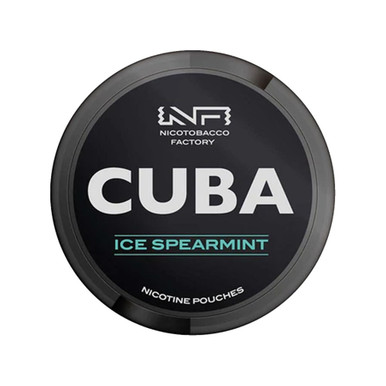
The can is the standard pouch tin: a shallow plastic cylinder, press-on lid, pouches laid flat in a single ring inside. Brand, flavour name and strength figure printed on the lid top. In a drawer of several cans that lid top is the only surface anyone reads, which is why the strength is printed there.
The name is worth taking apart, because it is doing more work than most. Cuba is the brand. Black is the line within the brand. Ice and Spearmint are both flavour descriptors, and they describe different things — one a character, one a variety of mint. Note what none of those words tells you: where this is made. We hold no manufacturing information, company detail or country of origin for this listing, we will not guess at any, and the brand name is not a declaration of origin. The manufacturer's labelling on the can is the authoritative source for anything of that kind.
We do not publish a pouch count, a pouch weight, can dimensions or a format designation for this product, because our record carries none of them. Where a field is empty, this page says so rather than estimating from a photograph.
The usual note before the rest: this is an age-restricted nicotine product sold to adults aged 18 or over who already use nicotine. The full compliance wording has its own section at the foot of the page.
Two words on the lid, and what each one means as a taste
"Ice Spearmint" is a stacked descriptor, and reading it properly tells you most of what a flavour name can tell anyone.
Spearmint names a variety of mint. Within the mint family, spearmint is the sweeter, rounder, greener reading — the flavour most people associate with chewing gum and mint sauce rather than with peppermint's sharper, more medicinal character. It is the softer end of mint. On its own, without any other descriptor attached, a spearmint can would read as sweet-ish and herbal rather than cold.
Ice names a character rather than a variety. Across this market, "ice" on a lid consistently signals a cooling quality laid over whatever else is in the name. It appears on fruit cans, on mint cans and on everything between, which is a useful piece of shelf literacy in itself: when you see "ice" you can expect the cool reading, and when you do not see it you generally should not.
Put together, the name points at a spearmint with the cool turned up over the top of it — the rounder, greener mint variety rather than the medicinal one, with a cold character running across it. That is what the words on the lid say. What the flavour actually delivers is the subject of the next section, which takes it apart properly.
Cool, sweet, sharp, bitter: reading this can on four axes
Adjectives about flavour are cheap and mostly interchangeable, which is why they are useless for choosing between two cans. Four axes do better, because each one can be described honestly and compared between products. Everything in this section is about taste and aroma and nothing else. None of it is a claim of any kind about the product.
Cool: high, and leading
This is the defining axis for this can and the first thing anyone would notice. The cooling character is the front of the flavour, not a note sitting behind the mint. The word on the lid is not decorative — a can with "ice" in the name that did not read cold would be badly named, and this one is not. If you are comparing mint cans and cool is the axis you sort on, this one sits at the high end of it.
The practical consequence is that the cool dominates the first impression and the spearmint arrives slightly behind it. People who prefer the herbal side of mint to the cold side sometimes find that ordering frustrating; people who buy mint cans specifically for the cold reading find it exactly right. Neither is a better preference and we have no basis for guessing which you are.
Sweet: moderate, and coming from the spearmint
Spearmint carries more sweetness than peppermint does, and that sweetness is present here. It is not a confectionery sweetness and it is not the front of the flavour — the cool is. What it does is round the edges off. A cold mint with no sweetness at all reads as austere and slightly harsh; the spearmint side of this name is what stops that happening. On a scale from bone-dry to sugary, this sits in the middle, closer to dry than to sweet.
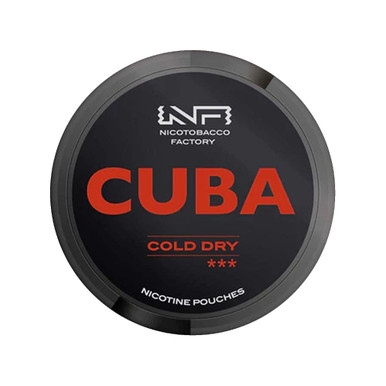
This is the axis on which it differs most clearly from the other cold mint in its own line. Cuba Black Cold Dry at £39.90 announces dryness in its name where this one announces a mint variety, and that is the distinction between the two: same brand, same line, same price, same declared strength, different position on the sweetness axis.
Sharp: low to moderate
Sharpness in the sense of acidity — the tang you get from a fruit — is largely absent, as it is from most mint cans. What mint can have instead is a kind of bite that reads as sharpness without being acidic, and there is some of that here, coming from the cool rather than from the mint. It is the difference between a cool that feels smooth and one that feels pointed. This leans slightly toward the pointed, though nowhere near the extreme end of what is available on the mint shelf.
Bitter: low
Spearmint is the mint variety least inclined toward bitterness, and there is little to report here. Where a bitter edge shows up in mint cans it is usually at the end, once the sweetness has gone and the cool has faded, and it tends to be a herbal dryness rather than a true bitterness. Expect a small amount of that at the tail end and nothing much at the start.
How the four readings move over a single pouch
The four axes describe a sequence rather than a fixed state, and the sequence for a cold mint can is fairly consistent. The cool arrives first and strongest. The spearmint sweetness comes up behind it and holds while the cool is still present. The cool then recedes faster than the sweetness does, leaving a period where the can reads more like a plain spearmint than an ice one. At the end, both thin out and what is left is a dry herbal note with a little of that late bitterness.
Knowing that is useful for one specific purpose: comparing cans fairly. Judging this against Klint Arctic Mint at £36.90 or Denssi Cold Mint at £39.90 on the first twenty seconds will tell you which has the strongest opening cool and nothing else. Comparing them at the same point in their run is the only comparison that means anything. That is a note about how to compare two products, not guidance about how to use one.
The format, in practice
A nicotine pouch goes between the lip and the gum and stays there. It is not chewed, not sucked, not swallowed. That is the entire format and it is the same across every brand on this site.
Lid off, one pouch out, lid back on. Most people place it under the top lip, some under the bottom, and the lip holds it — there is no adhesive and nothing to fasten. It stays put until moved, including while talking. If it sits uncomfortably in one position you can move it; if it is uncomfortable everywhere, taking it out is the right answer, and nothing about the format requires anyone to persist with one that does not suit them.
How long people keep one in ranges from a few minutes to the better part of an hour, and any average we printed would misrepresent most of that range. The usual reason for taking one out is that the flavour has finished — with a cold mint that tends to be a two-stage fade, as described above, so the point at which someone calls it finished varies more than it does with a fruit can. We do not set a duration and we will not infer one. Whatever usage guidance the manufacturer prints on the can is the guidance that applies.
The lid carries a catch compartment — a shallow chamber under the top for used pouches, separate from where the fresh ones sit. It is useful when there is no bin nearby and it is the single commonest cause of a can going dry, because a compartment packed with six or seven used pouches holds the lid proud of the rim and a lid that is not flat leaves the can effectively open. Empty it whenever you pass a bin. Used pouches go in general waste, never down a sink or a toilet; the can is plastic and goes with household recycling to whatever extent your council accepts it, which varies by authority and is not something we can answer for an individual address.
On pouch size: our record holds no format designation for this listing, so we are not going to state whether these are slim, regular or anything else. The can states what the manufacturer says about its own product. What we can say is that every pouch within a can is the same as every other — there is no assortment inside a tin.
How a named flavour reads in a dry pouch — and the limits of what we can say
People ask a version of this question constantly: how does a pouch end up tasting of spearmint, or of cola, or of coffee? It deserves a straight answer, and the straight answer has two parts. The first part is what we cannot tell you. The second is what can genuinely be observed from the outside, which turns out to be more than you might expect.
What we cannot tell you, and will not. We do not hold composition information for this or any product on this site. We do not publish ingredient lists. We will not describe how a flavour is produced, what carries it, or what happens to it once a pouch is in use. That last one is not coyness — it is the line between describing a product and making claims about it, and we stay on the right side of it deliberately. The can carries the manufacturer's own declarations, printed under their legal responsibility, and that is the authoritative source for every one of those questions. A paraphrase of a legal declaration written by a shop is worth less than the declaration itself, so we do not write one.
What can be observed: a flavour name is a target, not a measurement. "Spearmint" on a lid tells you what the flavour is aiming at. It does not tell you how close it lands, and different brands land in different places while using the same word. This is the most practically useful thing anyone can know about flavour names on this market. Two cans both labelled spearmint from two manufacturers will not taste identical, and neither of them is mislabelled — the name marks a target and the products distribute around it. Clew Cool Mint at £39.90 and 77 Apple Mint at £39.90 are both mint-shelf cans at the same money as this one, and all three read differently despite sharing a category tag.
Stacked descriptors narrow the target. A one-word flavour name is a wide target; a two-word name is narrower. "Mint" could be anything on the family. "Spearmint" fixes the variety. "Ice Spearmint" fixes the variety and adds a character. Each word you add removes some of the range the name could cover, which is why longer flavour names are generally more informative than shorter ones and why a can called simply "Mint" tells you least of all. Reading names this way is the cheapest shelf skill available and it costs nothing to learn.
A dry pouch presents flavour in a sequence, not all at once. This is observable without knowing anything about composition. The flavour of a pouch is not a constant — it arrives, develops and fades, and different elements of a stacked name peak at different points in that run, as the four-axis section above describes. That sequencing is why two cans can taste similar at the start and quite different in the middle, and it is why "what does it taste like" is genuinely an incomplete question. The better question is "what does it taste like when".
Flavour families cluster, and the clusters are visible on the shelf. Look at the 148 listings on our mint shelf and the names sort themselves into groups without any effort: the plain mints, the spearmints, the cold-named ones with "ice", "arctic", "frost" or "storm" in the title, and the hybrids where mint is paired with a fruit. Those groupings are real and they predict taste more reliably than any single adjective a shop could write. Elf Bar Cool Storm at £29.90 belongs to the cold-named group by its name alone; Edge Mint at £14.95 belongs to the plain group by the same logic.
Where the name stops helping. Names do not tell you intensity, they do not tell you longevity, and they do not tell you how a given can will sit with you. We hold no data on any of those three and we are not going to estimate them. Taste is individual, and the honest position for a retailer is that the flavour name plus a category tag is the limit of what we can tell you before you have tried it.
43mg, read as a figure
This listing declares a single strength: 43mg. There is no second variant and no alternative price — one figure, one price of £39.90.
The number is the manufacturer's declaration in milligrams, reproduced exactly as given. We do not convert it or restate it, and we do not explain what it does, because that is pharmacology and this is a product listing. Its use here is comparative: it lets you place one can against another in a sorted list.
Our catalogue sorts into three bands — medium for the lower declared figures, strong in the middle, and extra strong at the top with 98 listings on it currently. At 43mg this can is filed in the extra strong band and sits well inside it rather than at its lower boundary. That is a description of where a number falls in a sorted list. It is not advice, it does not say the figure suits anybody, and we will not tell any reader which band to buy from — that judgement needs information about a person that a shop does not have.
While it is unavailable: the nearest things on our shelves
Since this can cannot currently be bought, the most useful thing this page can do is point at what is comparable. None of the following is a recommendation; they are listings that share a flavour family, a price point or a position in the strength range.
Closest on flavour: Klint Arctic Mint at £36.90 is a cold-named mint from another brand at slightly under this price. Denssi Cold Mint at £39.90 is the same idea at exactly this price. Clew Cool Mint, also £39.90, takes the cool-mint reading without a variety named alongside it. Between the three you have the cold end of the mint shelf covered at close to the same money.
Closest within the brand: Cuba Black Cold Dry is the other can in this line whose name points at cold rather than at fruit, and it is £39.90 at 43mg like everything else in the line. If staying inside the Black range matters more than matching the spearmint precisely, that is the one to look at.
Cheaper, in the same family: Edge Mint at £14.95 and Elf Bar Cool Storm at £29.90 are both mint-family cans at materially less money. We do not know why the prices differ — we hold no cost or supply information from manufacturers and will not invent an explanation. A price difference between two listings is information about the prices and nothing more.
Away from mint entirely: Fumi Dark Spice at £27.90 sits in the dark spiced family, Maggie Original Jamaican Cherry Tonic Wine at £39.90 in a cherry-and-tonic-wine reading, Killa Banana Ice at £33.50 in fruit-with-cool, and Pablo Exclusive Banana Ice at £3.85 in the same territory at the low end of our price range. They are listed here because people whose usual can is unavailable often use the gap to try something unlike it.
The Black line, and where a cold mint fits in it
The Cuba brand page carries 47 listings. The Black line within it runs on a fixed pattern: 43mg declared across the line, £39.90 across the line, flavour as the only variable.
Within that line the flavours split roughly into the fruit cans and the cold cans. The fruit side is the larger group — Apple Juice for orchard fruit, Cherry for stone fruit, Blueberry for berry, Banana Hit for the soft sweet end, and Cola for the soft-drink reading. The cold side is smaller, and this can and Cold Dry are its two entries.
Because price and declared strength do not move within the line, a choice between any two Black cans is purely a flavour choice. That is unusual enough on a pouch shelf to be worth pointing out, and it makes the line easy to move around in — something that matters particularly when a specific flavour is out of stock and you want the nearest thing under the same lid.
Keeping a can as it came
None of this is a claim about the product. It is about protecting something that costs £39.90.
The lid is the entire seal — no foil, no inner membrane, just a lid on a rim. Nearly every complaint about a can drying out traces back to that rim: a catch compartment holding the lid proud, a pouch caught under the edge, or a lid pushed on at an angle. Checking the lid sits flat each time you close it removes most of the risk at no cost.
Heat is the other cause. Dashboards, windowsills and radiator tops cycle a can between warm and cool repeatedly, moving moisture out of the pouches onto the underside of the lid and back in unevenly. Room temperature out of direct sunlight prevents it — a drawer or a cupboard shelf is enough.
On the fridge: we hold no manufacturer storage guidance for this product, so we neither recommend refrigeration nor advise against it. The practical point is that moving a can repeatedly between cold and warm creates condensation inside the lid each time. Consistency beats movement whichever temperature you pick.
If you keep a stack, new cans at the back and take from the front, so the oldest opens next. And every can stays out of reach of children and pets without exception — a pouch tin is small, it rattles, and it reads as a container of sweets to anyone who cannot read the label.
One specification, and what that leaves to decide
There is one declared strength on this listing, 43mg, and one price, £39.90. No second strength, no alternative pack size — the cans-per-pack field in our record is empty, so we publish no can count and will not estimate one.
With the listing currently unavailable, the decision in front of anyone reading this is not which version to buy but whether to wait or to move sideways. We cannot advise on that either, but we can tell you where to look. The mint shelf and its 148 listings is the widest view. The Cuba shelf and its 47 keeps the brand and the price fixed. The strength band pages sort everything by declared figure. Live prices and live stock are on the shelves, and a shelf is always more current than a paragraph.
Buying, restocks, delivery and age checks
When available, the can goes in the basket at £39.90 and checkout proceeds as it does across the site. At the time of writing it is not available, and the basket will not accept an out-of-stock listing. The listing page carries the live position, so it is the page to check rather than this paragraph.
We cannot give restock dates. We do not publish them, we do not hold reliable supply information, and a date invented to be helpful would simply be wrong. If a listing returns, it returns on its own page — that is the only place the answer will be accurate.
Age verification applies to every order containing a product like this one and it is not a formality. We sell to adults aged 18 or over only. An age check runs at checkout and ID may be requested on delivery. If the courier asks and no adult at the address can produce identification, the delivery will not be completed and the parcel is returned. That is the most common reason an order of this kind fails, and having ID to hand on the delivery day prevents it.
Delivery timescales, carriers and postage costs sit in our delivery information rather than on a product page, since they apply across the site and change independently of any single listing.
Finding this listing and what surrounds it
Three shelves lead here. This can sits on the extra strong band page among 98 listings, on the mint flavour page among 148, and on the Cuba brand page among 47. If you are waiting on a restock, the brand page is the practical one to keep an eye on, since it shows current availability across the whole line at a glance.
Above those sit the broader entry points: the full catalogue in one list, and the two lower strength bands — strong and medium — for listings with lower declared figures. The Pablo brand page is worth knowing separately because Pablo pricing runs on a very different scale from Cuba's, as the £3.85 listing mentioned earlier illustrates.
Common questions about this can
When will it be back in stock?
We do not know and we will not guess. We hold no reliable restock information for this listing and a date offered to be helpful would just be a date that turned out to be wrong. The listing page carries the live availability, so that page is the accurate answer at any given moment. If you need something now rather than later, the mint shelf is the widest set of alternatives in the same flavour family.
What is the difference between spearmint and ordinary mint?
Spearmint names a variety within the mint family — the sweeter, rounder, greener reading, as opposed to peppermint's sharper and more medicinal character. A can labelled simply "mint" gives you no variety information at all, which is why it is the least informative name on the shelf. Here, "spearmint" fixes the variety and "ice" adds a cooling character over the top of it.
Does "ice" mean it is cold?
It signals a cooling character in the flavour, which is consistent across this market — "ice", "arctic", "frost" and similar words on a lid all point the same way. It has nothing to do with the temperature of the can or how it is stored. Cans without one of those words in the name generally do not read as cold, which makes this one of the more reliable pieces of shelf shorthand available.
Is Cuba Black made in Cuba?
We hold no origin information for this listing and cannot tell you. Cuba is a brand name and Black is the line name within it; neither word is a declaration of where a product is made. We are not going to estimate manufacturing location, company or country. If it matters to you, the manufacturer's labelling printed on the can is where such a declaration would appear and is the authoritative source for it.
How many pouches are in a can?
We do not publish a count, because our record does not hold one. Rather than count pouches in a photograph and present the result as a fact, we are telling you the field is empty. Pouch weight, can dimensions and format designation are all in the same position. The printed can carries the manufacturer's own declarations and is the place to read any of them.
Where does 43mg sit among your listings?
It places this can in the extra strong band, which currently holds 98 listings, well inside the band rather than at its lower edge. That is a sorting statement. We do not describe what a strength does, we do not compare strengths on any basis other than the printed figure, and we will not say whether a number is suitable for a particular person.
Which strength should I buy?
We cannot answer that. A strength recommendation is a judgement about an individual, and we hold nothing that would let us make one responsibly. What we can provide is the data — every listing prints its declared figure and the three band pages sort the whole catalogue by it, so the comparison is available to you directly.
Is there a milder Ice Spearmint?
Not on this listing, which carries 43mg and no alternative. Whether such a product exists elsewhere is outside what our record covers. Within our range, a mint-family can outside the top band can be found through the strength shelves — Edge Mint at £14.95 is one mint listing at a very different price and position in the range.
How long does the flavour last in one pouch?
We cannot give a figure that would be true for you. The spread across people is very wide and an average would misrepresent most readers. What can be said is the shape rather than the duration: with a cold mint the cool typically recedes before the sweetness does, so there is a middle period that reads more like plain spearmint than like an ice can. Where anyone draws the line at "finished" is individual.
Why do you not describe what is in it?
Because we do not hold that information and would be guessing. We publish name, brand, flavour classification, declared strength, price and stock status — that is the complete list of what our record contains. Ingredient and technical information is declared by the manufacturer on the can under their own responsibility, which makes the can the authoritative source. Our paraphrase of it would carry none of that authority.
Can I be notified when it returns?
Any notification options available appear on the listing page itself rather than here, and they change independently of this description. Checking the listing, or the Cuba brand page which shows availability across the whole range at once, is the most reliable way to catch a return.
If I cannot get this, what is closest?
On flavour, the cold-named mints from other brands are the nearest: Klint Arctic Mint at £36.90 and Denssi Cold Mint at £39.90. On brand and price, Cuba Black Cold Dry keeps everything fixed except the exact flavour reading. Taste is individual and we cannot tell you which will suit you — those are simply the listings that share the most attributes with this one.
Compliance and legal information
Nicotine is an addictive substance.
This product is sold to adults aged 18 or over who already use nicotine, and on no other basis. We do not sell to anyone under 18. An age check runs at checkout and ID may be requested on delivery; if it is requested and no adult at the address can produce it, the delivery will not be completed.
Cuba Black Ice Spearmint Nicotine Pouches are not a licensed stop-smoking medicine and are not authorised or intended for any such purpose. This product is not intended for non-smokers, for anyone who does not already use nicotine, for anyone under the age of 18, or for anyone who is pregnant or breastfeeding. Nothing on this page is medical advice, and nothing on it should be read as encouragement to begin using nicotine or as a recommendation of any strength for any person.
Keep this product out of reach of children and pets. Every product fact on this page — name, brand, price, declared strength, flavour classification and stock status — is taken from our product record for this listing. Where the record holds nothing, the page says so rather than estimating. The can and the manufacturer's labelling printed on it are the authoritative source for anything appearing on the packaging.
Closing note
Cuba Black Ice Spearmint is a cold-led spearmint: cool high and leading, sweetness moderate and coming from the spearmint side, sharpness modest, bitterness slight and late. One declared strength of 43mg, one price of £39.90, and currently not in stock — the listing page holds the live position. It is filed on the extra strong band, the mint shelf and the Cuba brand page, and because its line fixes both price and declared figure, the other cold can under the same lid is the shortest move available if you want to stay in the range. Everything we hold about this product is on this page; everything we do not hold, we have said we do not hold.
More from Cuba
More extra strong pouches
More mint pouches
Where this sits
Cuba Black Ice Spearmint Nicotine Pouches appears in these categories. Browse them, or jump to something close.
You might also like