Home / Medium Strength / ZYN Violet Licorice Nicotine Pouches
ZYN · 6mg–11mg · 5-can pack
Read the full guide
ZYN Violet Licorice Nicotine Pouches
£19.99
✔ In stock — ready to ship
100% tobacco-free
Free over £20
Same-day dispatch
Secure checkout
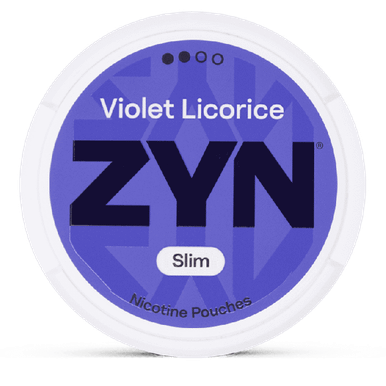
ZYN Violet Licorice Nicotine Pouches are listed at £19.99 for five cans, with three declared strengths on the record — 6mg, 9mg and 11mg — all three at the same price. The listing is out of stock at the time of writing, so nothing here can be ordered today. One image, one flavour tag, three rungs.
That single flavour tag is the problem with this listing, and it is better dealt with in the opening paragraphs than buried halfway down. The tag on our record reads mint. The name reads Violet Licorice. Neither violet nor licorice is a mint, and no ordinary reading of either word gets you to the mint family. The tag and the name are telling you different things.
The full guide to ZYN Violet Licorice Nicotine Pouches
5,008 words on how it eats, who it suits, how to serve it and what to put beside it.
Violet Licorice: the listing, and a tag that does not match the name
The consequence is visible on our shelves. Because of that tag, this can is filed on our Mint shelf among a hundred and forty-seven other listings, nearly all of which are actual mint cans. Somebody filtering for mint will find this one in the results, and somebody filtering for a dark, anise-leaning flavour will not find it at all. That is a filing error in effect if not in intention, and we would rather tell you about it plainly than let you discover it after a purchase.
We are not going to resolve the contradiction by picking a side, because we have no basis for doing so. We could delete the tag, or replace it with something that matches the name, but either action would mean overwriting supplied data with our own assumption — and a shop's guess dressed up as a record is worse than a visible inconsistency that we have flagged. What we can tell you is exactly what each source says, which we have now done. The can itself carries the manufacturer's own description, and it is the authority on what is in it.
The rest of the record files without argument. The three declared figures put the listing on our Medium Strength shelf, which at a hundred and thirty-five listings is the busiest strength band we run. As a ZYN can it sits with twenty-one others on the ZYN brand page.
Violet and licorice, described as tastes
Two unusual flavours in one name, and both of them are the kind people have firm opinions about. It is worth taking them separately before considering what they do together.
Licorice is a root flavour, and its character is sweetness with a dark, slightly bitter edge underneath. The dominant note is anise — the same family of taste that fennel and star anise occupy — which is why people who dislike licorice often describe it as tasting medicinal, and why people who like it describe the same quality as depth. It is heavier on the palate than fruit flavours, and it lingers longer than almost anything else in this format. There is also a salty register that some licorice preparations carry and others do not, and our record gives no indication whatever of which direction this one takes.
Violet is the floral half, and floral flavours are the most polarising things on any shelf. Violet is perfumed rather than fruity: sweet, powdery, and closer to a scent than to a food. It is the taste of the retro violet-flavoured confectionery that most people in Britain have encountered at some point, and the reaction to it divides almost perfectly down the middle. Nobody is neutral on violet in the way they can be neutral on a plain berry.
Together, the two are a considered pairing rather than an arbitrary one. Floral perfume over an anise-and-root base gives a flavour with a top and a bottom to it — something that changes across the life of a portion rather than sitting flat. The floral element is the lighter and more volatile of the two, so it tends to lead on the opening and fade first, leaving the darker licorice character underneath for the rest. That is a structure you rarely get from a fruit can.
On aroma, expect the floral to dominate on opening. Perfumed notes carry on the air much better than root notes do, and a violet aroma is the sort that is noticed across a room. If aroma matters to you — and the section below on carrying a can covers why it sometimes does — this is not a subtle can.
All of which comes with the limit stated at the top. The only flavour data on our record says mint, and it contradicts the name. Everything written above describes what violet and licorice taste like as flavours, not a reading of a specification for this can, because we do not hold one and we are not going to invent one to fill the silence.
What people keep alongside a can like this one
Almost nobody uses one flavour exclusively, and a divisive flavour needs a companion more than an agreeable one does. That is the substance of this section: not that variety is nice, but that a strong, unusual, long-lingering flavour is harder to use as a sole can than a plain one, and people who buy them generally build a rotation around them from the start.
Why this can in particular wants a partner
Three reasons, all practical. The first is that licorice lingers; the taste stays with you after a portion is out, longer than a fruit or mint flavour does, and that makes back-to-back portions of it blur into one another. The second is that the floral element is intense, and intense flavours tire faster than mild ones — the fifth portion of something perfumed rarely registers the way the first did. The third is simply that five cans is a lot of a flavour you might turn out to dislike, and having something else in the drawer is the obvious hedge.
Within the brand
The cleanest contrast in the range is a plain mint. ZYN Cool Mint X at £19.99 has nothing floral or sweet about it, and its cold, clean character is about as far from a perfumed root flavour as the brand's shelf goes. It is also available, which this listing is not.
For fruit contrast, the brand's berry cans do different jobs. ZYN Blackcurrant Forest brings tartness, which is the quality licorice most lacks. ZYN Black Cherry is the closer relative than it first appears — cherry carries a bitter back note that has something in common with the dark end of licorice, so it reads as a step sideways rather than a jump. ZYN Citrus is the sharpest option, all acidity and no sweetness to speak of. ZYN Blueberry Mint splits the difference with fruit over a cold base.
The genuine outlier of the range, and the one most worth knowing about here, is ZYN Coffee Mini. Roasted, bitter, entirely unsweet and in a smaller portion, it is the only can in the brand's range that operates in the same dark register as licorice while tasting nothing like it. People who like unusual flavours tend to own both. All of these are £19.99 and all are currently available.
Across the rest of our shelves
The mint cans are the standard contrast and they come in several temperatures. Klint Arctic Mint at £36.90 is the cold end — a can built around cold rather than around mint sweetness. White Fox Double Mint at £34.90 layers mint types for something more complex than a single note. SYX Cool Mint at £29.90 sits in the middle ground. For something softer, Edge Spearmint at £14.95 is the sweet herbal end of the mint family, and Velo Bright Spearmint at £4.19 is a single-can listing, which makes it the cheapest way to add a second flavour to a drawer without committing to another multi-pack.
If what you want alongside an unusual flavour is another unusual flavour, two on our shelves qualify. Fumi Dark Spice at £27.90 works in warm, spiced territory — a different kind of depth from licorice but recognisably in the same part of the map. UBBS Cola Ice at £19.95 is a confectionery flavour with a cold edge, and cola shares more with licorice than most people expect, both being sweet dark flavours with a root character underneath.
For plain fruit, 77 Apple Mint at £39.90 gives orchard crispness with a mint edge, Nordic Spirit Frosty Berry at £4.49 is a cold berry in a single can, and Pablo Silver Edition Blueberry Peach Ice at £39.90 stacks two fruits and a cold element together. All of those are in stock at the time of writing, which this listing is not.
How a rotation of three usually settles
The common pattern, for anyone who keeps more than one can on the go, is one flavour that does most of the work, one that is the opposite of it, and one oddity. A perfumed root flavour is almost always the oddity rather than the workhorse, because intense flavours are the ones people reach for deliberately rather than by default.
The practical implication is about quantity rather than taste. If a can like this is going to be the third of three in your rotation, five cans of it is a long supply, and the arithmetic that makes a multi-pack sensible for a default flavour works differently for an occasional one. That is an observation about how packs get used, not a recommendation about how much of anything anybody should have.
Carrying one, and whose rules apply where
This section covers two different things that get confused with one another: what the format is physically like to carry and use around other people, and the question of where use is permitted. The first we can describe. The second we cannot, and the distinction matters.
What the format is like to carry
The can is roughly the diameter of a large coin and about as deep as a short stack of them. A jacket or coat pocket takes one and you forget it is there. A front trouser pocket works and prints a visible disc through thinner fabric. A back pocket works but is the position most likely to nudge the lid proud when you sit down, which has consequences for the contents covered in the storage section below. A shirt pocket is a poor choice — the can is heavy for its size and tips out when you lean. Bags are where cans get damaged, because a can loose among keys has its lid worked at the rim until the fit loosens.
Discretion, as a practical matter
A slim portion under the upper lip is not visible to anyone not looking for it, and after the first minute it is not noticeable to the person using it either. Talking is unaffected. The one moment that reads to an observer is the first thirty seconds, when the natural instinct is to test a new portion with the tongue.
The can is the less discreet half. Opening one makes a small but distinct click, and on a strongly aromatic flavour — which, on the name, this is — the aroma carries. A violet-led scent is the sort that is noticed across a small room, and that is worth knowing if your handling happens in shared spaces. None of this is about concealment. It is about not imposing a perfumed aroma on people who did not ask for it, which is ordinary courtesy rather than anything more complicated.
Whose rules these are
People ask us where they may and may not use these, and the honest answer is that we are not the right source and will not pretend to be.
Venues set their own rules. Employers set their own rules, and they differ enormously between workplaces and sometimes between sites of the same employer. Transport operators set their own rules, as do airlines, schools, hospitals, sports grounds and every other kind of organisation that has cause to have a policy. Those rules are theirs to write, theirs to state, and theirs to change, and none of them are ours to interpret on their behalf.
What that means in practice is straightforward. If you want to know whether something is permitted somewhere, ask whoever runs the place, read the policy they publish, or check with the operator directly. Do not treat anything on a shop's product page as permission, because it is not permission and we are not in a position to grant any. A retailer telling you what an employer allows would be guessing about someone else's rules, and getting that wrong has consequences for you rather than for us.
The same applies to anywhere you are taking a can across a border. Countries differ in how they treat these products, some considerably, and the rules of the place you are going are the ones that count. We sell within the UK and we do not advise on the regulations of anywhere else.
The courtesy question
One small practical point that belongs here rather than in the storage section. A used portion should go into the lid compartment or a bin, never left on a surface, in an ashtray, in a glass or anywhere somebody else has to deal with it. The compartment in the lid exists precisely so that there is always somewhere to put one, and it holds three or four comfortably. Beyond that it stops the lid seating, which is a problem for the can rather than for anyone else, but the courtesy point stands on its own.
The format, for anyone who has not used this style
The portion is a slim rectangle with rounded ends, noticeably longer and narrower than the older round style. It goes under the upper lip and beds into the channel between lip and gum along its length, which means it fills a shallow strip rather than making a bulge in one spot. Portions of this style are dry to the touch, which is a handling characteristic — they come out of the can cleanly and leave nothing on your fingers.
Placement takes a second or two and settles into habit quickly. Most people find one side and stay there. Some alternate through the day. Moving a portion mid-use does it no harm and briefly refreshes the taste, which is why people who do it tend to do it once, around the point where the flavour has flattened.
How long a portion stays in varies so much between people that any figure quoted as typical would mislead. The consistent part is the arc: most present early, settling onto a plateau, fading over a long tail. On a flavour with a volatile floral element over a heavier base, the opening and the plateau are noticeably different from each other — the perfume fades before the root does — so this is a can where the taste at the end is not the taste at the beginning. Where anyone draws the line in that fade is personal, and we have no view on it.
Judging a flavour this divisive fairly
A polarising flavour is the one people are most likely to misjudge, and usually on the first portion out of a fresh can. That first portion is not representative. A newly opened can has had the longest undisturbed period for its aroma to concentrate, so the smell on first opening is the strongest it will ever be, and the first portion reads louder than the ones that follow. On a perfumed flavour that difference is more pronounced than on a plain one, because the volatile floral element is exactly what has been concentrating. Somebody who finds violet soapy will find the first portion the most soapy it gets.
The fairer test is the third or fourth portion, by which point the can has settled into what it will be for the rest of its life. It is also worth judging a layered flavour across a whole portion rather than in the first minute, because a can with a light top and a heavy base is two different tastes over its arc and the opening is only half the story.
The other thing that distorts a first impression is what came before it. A portion of anything perfumed straight after a cold mint will read strangely, because the cold flattens the palate and the floral note arrives into it at a disadvantage. Leaving a gap, or coming to it after something plain, gives a truer picture of what the can is actually doing.
Three declared figures, read as printed numbers
The record carries 6mg, 9mg and 11mg, all at £19.99 for five cans. Those are declarations by the manufacturer, printed on the can and carried into our record unchanged. They are not ratings, not scores, not ranks, and not measurements of anything a person will experience. We publish them because they are printed there and because people filter by them.
| Declared strength | Price | Cans per pack | Availability |
|---|---|---|---|
| 6mg | £19.99 | 5 | Out of stock |
| 9mg | £19.99 | 5 | Out of stock |
| 11mg | £19.99 | 5 | Out of stock |
Three things that ladder does not tell you. It says nothing about flavour intensity, because strength and flavour are set independently — all three rungs are the same flavour at the same price, and the printed figure will not tell you how sweet or how perfumed the taste is. It does not let you compare across brands with any precision, because manufacturers arrive at their declarations by their own methods and a figure is strictly comparable only within a range. And it does not tell you which rung suits you.
On that last point we are unequivocal: we cannot advise which strength suits anyone. We do not know you, we hold nothing that would let us judge, and a retail page is not a place where that judgement can responsibly be made. A higher figure is not a better can and a lower one is not a lesser product. Anyone with questions about their own nicotine use should put them to a healthcare professional rather than to a shop. Above the medium band on our shelves sit the Strong listings and then the Extra Strong shelf, and a can moves between those bands on its declared figure alone.
Where this sits in the brand's range
The twenty-two ZYN listings on our shelves group into a large mint block, a berry block, a few single-fruit cans and two or three deliberate oddities. This is one of the oddities, and within that small group it is the most unusual: a floral-and-root flavour is a long way from anything else the brand has on our shelves, with the coffee can being the only other listing that operates outside the mint-and-fruit conventions at all.
Two structural facts. The pricing is flat — every ZYN listing on our record is £19.99 whatever the flavour or figure — so price carries no information about which to choose. And the ladders are uneven across the range, from a single declared figure on some flavours to four on others. Three rungs, as here, is about the middle.
It is also worth repeating in this context that the mint tag on this listing means it files with the brand's mint cans on our flavour shelf rather than with its oddities. If you are browsing the range by flavour and this can turns up among the mints, that is why.
Storage, and keeping a can in condition
The lid first, because it accounts for more disappointing cans than everything else combined. The join between lid and body is an interference fit rather than a gasket: it is either properly seated or it is not, with very little in between, and an unseated lid does not look unseated. The tell is resistance on opening. A can that comes open more easily than you expected has been standing ajar since last time, and everything in it has been meeting open air for however long that was. Press until it clicks and confirm by feel.
Heat next. Drawers, cupboards, bedside tables and inside pockets are all fine. Cars in summer, windowsills, radiator shelves and bags left in the sun are all avoidable. Warmth dries the contents and takes the top off a flavour first, and on a can with a volatile floral element that is precisely the layer that would go — leaving the heavier root character behind and losing the part that made the flavour distinctive. A cooked can is not dangerous and is not spoiled in any meaningful sense. It is duller than it was, permanently, and nothing brings it back.
Cold is much less of a concern. A fridge does no harm, though nothing about the format requires it; if you keep cans cold, take one out a few minutes before using a portion, because cold mutes flavour and people have written off perfectly good cans that had simply not warmed up. Freezing achieves nothing.
Cans stack flat, which is the tidy way to keep several in a drawer, and a stack makes it obvious how many are left. On dates: check the can. We hold no batch or date information on our listings and will not estimate any, because an estimate on that is worthless. Keep cans well out of reach of children and animals, which is the one item in this section that is not a matter of preference.
Choosing between the rungs, and the pack size
Three declared figures, one price, one pack size. The only variable within the listing is the number printed on the can, and that is a choice we cannot help with for the reasons set out above.
On pack size there is no choice at all: five cans, or nothing. Our catalogue mixes single-can listings and multi-can packs without flagging the difference prominently, which is why several of the cheaper listings mentioned on this page are not actually cheaper per can — they are simply smaller purchases. At £19.99 for five, this listing works out a shade under £4.00 a can, and that is the number to carry into any comparison. Everything we stock can be filtered by brand, flavour and declared strength together, which is the quickest way to see what exists at each combination — bearing in mind, for this listing, the flavour tag problem described at the top.
Buying, delivery and age verification
This listing is out of stock, so it cannot be ordered today. When it returns, it returns on this product page, which is the page to check. We do not publish restock dates and we will not guess at one, because a guessed date is worse than no answer at all.
Everything we sell is 18+ and age-restricted. Age is confirmed at checkout and it is not a step we are able to waive. ID may be requested on delivery, and a driver who is not satisfied is entitled to decline to hand the parcel over. We do not sell to anyone under 18 under any arrangement.
Delivery windows, charges, returns and the status of an individual order are covered by our delivery and returns information rather than by a description page, because that information is kept current in a way a page like this is not. What this page holds is the record: £19.99, five cans, three declared figures, currently unavailable.
Where to go from here
Three shelves carry this can, though one of them carries it for the wrong reason. The brand's twenty-two listings are the most useful next step, because they hold the range this can belongs to and the available alternatives within it. The medium band holds the largest share of the catalogue. And the mint shelf holds a hundred and forty-eight listings, of which this one is arguably not a member.
Across brands, the Pablo range and the Cuba listings are two of the largest we carry, and both hold flavours outside the usual mint-and-berry conventions, which is the obvious place to look if unusual flavours are what brought you to this page.
Questions about this listing
Why is a licorice flavour on your mint shelf?
Because the flavour tag on our record says mint, and our shelves are built from those tags. The name says Violet Licorice and neither of those is a mint, so the tag and the name disagree. We have flagged it rather than quietly rewriting the record, because replacing supplied data with our own assumption would be worse than an inconsistency you can see. The can carries the manufacturer's own description.
So does it taste of mint or not?
We do not know, and we are not going to pick an answer to make this page tidier. The name points at a floral-and-root flavour. The tag points at mint. One of them is wrong and we cannot tell you which. If the flavour direction matters to you — and with a flavour this distinctive it probably does — the can is the only reliable source.
What does licorice taste like in this format?
Sweet with a dark, slightly bitter edge underneath, carrying an anise character from the same family of tastes as fennel. It is heavier than fruit flavours and lingers longer than most things in this format. Some licorice preparations carry a salty register as well, and our record gives no indication of which direction this one takes.
Is violet really a flavour people like?
It divides opinion about as evenly as any flavour can. Violet is perfumed and powdery rather than fruity — closer to a scent than to a food — and people tend to either enjoy that quality or find it soapy. There is very little middle ground, which is worth knowing before committing to a five-can pack.
Which of the three strengths should I buy?
We cannot tell you, and that is a real answer rather than a polite one. We do not know you, we hold nothing that would support the judgement, and a shop is not the right source for it. The figures are published because they are printed on the cans. A higher number does not indicate a better product.
Am I allowed to use one at work or on a train?
That is not ours to answer. Employers, venues and transport operators write their own rules and those rules are theirs to state and to change. Ask whoever runs the place, or read the policy they publish. Nothing on a retailer's page is permission, and we are not in a position to grant any.
When will it be back in stock?
We do not know and we do not publish estimates. This product page is where a change in availability would appear. If you want something today, the alternatives linked above each state their own position on their own listings, and most of them are currently available.
How many pouches are in a can?
We do not hold that figure. Our record has cans per pack — five — and nothing on portions per can, which is printed on the packaging. It is the most common question we cannot answer from our own data, and we would rather say so than publish an estimate.
Is the aroma noticeable to other people?
On a strongly perfumed flavour, yes, more than on a mint. Floral notes carry on the air better than most, and an opened can is likely to be noticed by anyone nearby. That is a consideration about courtesy in shared spaces rather than a problem with the product.
Is five cans too many of a flavour this unusual?
Possibly, and it is worth thinking about beforehand. Intense flavours tend to be the occasional can in a rotation rather than the everyday one, and five cans of an occasional flavour is a long supply. Several of the single-can listings mentioned on this page are a far cheaper way to find out whether an unusual flavour suits you.
Will it taste the same at the end of a portion as at the start?
Probably not, and that is a feature of the flavour's structure rather than a fault. The floral element is the lighter and more volatile of the two halves, so it tends to lead the opening and fade first, leaving the heavier root character for the rest. A can with layers behaves that way; a single-note can does not.
I tried one and hated it. Was that a fair test?
Possibly not, if it was the first portion from a freshly opened can. That one reads louder than the rest, and on a perfumed flavour the difference is noticeable. What came before it matters too — anything strongly cold flattens the palate and puts a floral note at a disadvantage. The third or fourth portion, taken after something plain, is a truer test. If you still dislike it after that, you dislike it, and violet divides opinion for good reason.
What do I do with a used pouch?
General waste, or the compartment in the lid until you reach a bin. Three or four fit; beyond that the lid stops seating, which leaves the can effectively open. Nothing goes down a sink, nothing is left on a surface for somebody else to deal with, and nothing is left where a child or an animal could reach it.
The compliance section
This product is sold to adults aged 18+ who already use nicotine, and on that basis alone.
Nicotine is an addictive substance.
It is not a licensed stop-smoking medicine and is not intended for non-smokers, for anyone who does not already use nicotine, for under-18s, or for anyone pregnant or breastfeeding. Nothing written on this page is a health claim, a medical claim, or any suggestion that a person should take up nicotine use.
Age is verified at checkout and ID may be requested on delivery. Store cans out of reach of children and animals. Questions about your own nicotine use belong with a healthcare professional rather than with a retailer, and questions about where use is permitted belong with whoever sets the rules for that place.
To close
ZYN Violet Licorice is a five-can listing at £19.99, offered at 6mg, 9mg and 11mg for the same price, and currently unavailable. Its flavour tag says mint while its name says violet and licorice, and rather than resolve that by guessing we have left the record as it stands and told you about the discrepancy. The name points at a perfumed floral top over a dark, anise-leaning base — a structure that changes across a portion rather than sitting flat, and a flavour people tend to have a firm view on either way. When the listing returns, it will return here.
More from ZYN
More medium strength pouches
More mint pouches
Where this sits
ZYN Violet Licorice Nicotine Pouches appears in these categories. Browse them, or jump to something close.
You might also like