Home / Medium Strength / XQS Raspberry Blackcurrant Nicotine Pouches
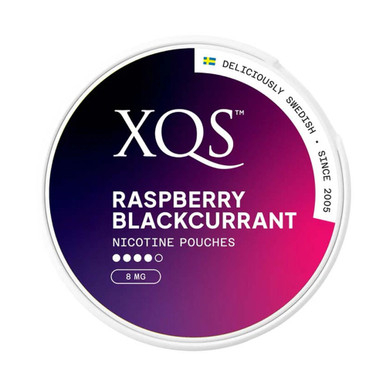
XQS · 8mg–10mg · 10-can pack
Read the full guide
XQS Raspberry Blackcurrant Nicotine Pouches
£39.90
✔ In stock — ready to ship
100% tobacco-free
Free over £20
Same-day dispatch
Secure checkout
XQS Raspberry Blackcurrant is sold here as a pack of ten cans at £39.90, in two declared strengths — 8mg and 10mg — priced identically. It is in stock as this description is written, though stock is the one fact on this page that can change without anybody rewriting a word, so the product page above is what you should trust on the day.
Two fruits in the name, one price, one pack size, two label figures. That is the shape of the listing. It is a roll rather than a single can, which is worth registering early: a large part of our shelf is sold one can at a time for a few pounds, and if that is the kind of purchase you had in mind, this is not the page for it.
The full guide to XQS Raspberry Blackcurrant Nicotine Pouches
4,870 words on how it eats, who it suits, how to serve it and what to put beside it.
Opening the listing: XQS Raspberry Blackcurrant
By label figure both variants sit on our medium band, which holds a hundred and thirty-five cans. The brand's fourteen listings sit together on the XQS page, and by flavour the can is filed on the berry shelf — seventy-six cans, and the subject of an honest caveat a little further down this page.
Raspberry and blackcurrant as a pairing
These two fruits are a long-established combination in British confectionery and soft drinks, and the reason is that they are complementary rather than similar. Raspberry is the lighter of the two: bright, slightly floral, with a sweetness that reads as jammy rather than syrupy and a gentle tartness at the edges. Blackcurrant is darker, denser and considerably more acidic — the note that gives a drink its depth and its pucker, and the one that does most of the work if you taste them side by side.
Put together, the usual result is that blackcurrant provides the body and raspberry provides the top. In a dry pouch, that layering tends to arrive in the opposite order to how it settles: the brighter raspberry note is generally the first thing you notice, and the heavier blackcurrant note fills in underneath it over a minute or two and then dominates the later part. That is a general account of how sharp and dark notes behave in this format rather than a specification of this particular recipe, and it should be read with that caveat attached.
Neither fruit here is the fresh-off-the-bush version. Confectionery raspberry and confectionery blackcurrant are both rounder and sweeter than the actual fruit, and flavoured pouches generally aim at the confectionery reference because it survives a format with no juice, no temperature and no texture to help it along. If you were expecting something that tastes of a hedgerow, adjust downward toward something that tastes of a sweet.
The aroma from an opened can is modest. Dry pouches are much quieter to the nose than most people anticipate, and this one will not fill a room.
We publish no sweetness score, no tartness rating and no intensity number, because we do not generate any. There is no panel behind this description. What we hold is the name, the flavour heading, the declared figures, the pack size and the price — and we would rather set out that short list honestly than pad it with numbers that came from nowhere.
What our records actually say about the flavour
The product name gives you two fruits. Our catalogue gives you one word: berry. That single tag is the entire flavour classification we hold against this can. There is no raspberry heading attached to it and no blackcurrant heading attached to it — just the family name.
That matters more than it sounds, because the tag is what our filters run on. Seventy-six cans share it, and the same word covers strawberry cans, blueberry cans, raspberry cans and blackcurrant cans without distinguishing between them. 77 Strawberry, at £39.90 and in stock, sits on that shelf under exactly the same single heading as this can. So does SYX Blueberry at £29.90. Those three cans taste of three different things, and our catalogue holds nothing whatsoever that would let us tell you how they differ. The shelf groups them; it does not describe them.
The practical upshot is that if you are hunting for a specific berry rather than berries in general, the shelf filter will not get you there and the product names will. That is a limitation in our data and we would rather name it than let you discover it by browsing seventy-six cans that all look equally relevant.
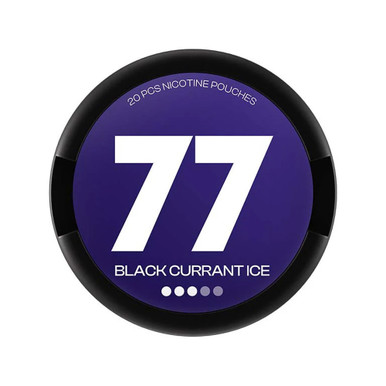
It cuts the other way too. Fumi Blackcurrant at £27.90 and ZYN Blackcurrant Forest at £19.99 both name the darker of this can's two fruits and both are in stock, but neither is distinguished from any other berry can in our system. If blackcurrant specifically is what you are after, reading names across the shelf is the reliable method, and our filters are not.
Getting one in and leaving it alone
The mechanics are common to every pouch on this site. A sealed portion goes between the lip and the gum and stays put. There is nothing to ignite, nothing to charge, nothing to refill and no button. Once it is in position, the entire operating procedure is to leave it there.
Placement takes one or two attempts and then stops being a thing you think about. The usual position is under the upper lip and off to one side, seated far enough back that the lip itself is not pushing it forward. A pouch that will not settle is almost always sitting too far forward, and moving it back solves it.
How long anyone keeps one in is entirely individual and we are not going to put a number on it. Some people remove one after ten minutes; others leave it much longer. Nothing about the pouch signals that it is finished. Suggesting a duration would be advice about your own use of nicotine, and that is not a shop's place.
Used pouches go in a bin, in general waste — not down a sink, not out of a window, not into a hedgerow. That is the whole of the disposal question, and it is worth stating plainly because the alternative behaviour is unpleasant for everybody else.
Two things worth knowing about how the flavour behaves while a pouch is in place. Hot drinks tend to flatten a fruit note temporarily — a mouthful of tea or coffee will knock a berry flavour back for a minute or so, after which it generally returns. Cold drinks do it far less. Neither is a fault; it is ordinary behaviour of taste and it happens with every flavoured pouch on this site.
The other is that a pouch taken from a freshly opened can usually reads more forward than one taken from a can that has been open a fortnight with the lid sitting loose. With a single can that difference barely has time to show itself. With ten cans, worked through over months, it has plenty of time, which is the practical argument for closing the lid properly rather than a theoretical one.
The can itself, considered as an object
It is easy to treat the can as packaging and move on, but it is a designed object that you will handle several times a day for weeks, and it is worth a proper look — particularly when you are buying ten of them at once.
XQS uses the two-compartment arrangement that has become standard across the format. The body of the can holds the unused pouches in a single well. The lid is not a simple cap: moulded into it is a shallow secondary compartment, separated from the main well, and that is where a used pouch goes when there is no bin within reach. Lift the lid, drop the used one into the top, close it, carry on. It is a small piece of design that solves a genuinely awkward problem, and it is the single most useful feature of the format's packaging.
That compartment holds a few used pouches rather than many, and it has one failure mode: leaving it full. A catch lid that has been loaded for a week is thoroughly unpleasant to open, and it is far and away the most common complaint anybody makes about pouch cans. The discipline is to empty it at the first bin you pass rather than the last. Treat it as a holding bay with a short lease, not as a place things live.
The lid latches rather than resting. That matters more than it sounds: a latching lid means the can can go into a bag sideways or upside down without redistributing its contents through your belongings. It also means the can makes an audible click when it closes, which is a reasonable way of confirming it is actually shut without looking at it.
On size, the can is a flat cylinder — wide and shallow rather than tall — which is why it sits comfortably in a coat pocket, a jeans pocket, a bag pocket or a glovebox without creating a bulge. The shape is doing something specific: a flat disc distributes its thickness across a wide area, so it reads as much smaller in a pocket than a tall container of the same volume would.
Construction is rigid plastic. It will survive being sat on in a back pocket and being at the bottom of a bag under a laptop, which is not true of every container of comparable size. When a can is finished, the plastic goes wherever your local authority directs plastic — and with a ten-pack you will be doing that ten times, so it is worth knowing which bin it belongs in at your address.
On portion count, we have to be straight with you: our catalogue does not record how many pouches are in each can of this listing. It records the pack as ten cans and stops there. The figure is printed on the can itself, and that is the authoritative source. We could make a confident-sounding guess based on what is typical of the format, and we are not going to, because a number invented on a product page has a way of ending up in somebody's arithmetic.
What ten cans looks like as an object is worth one line: it arrives as a column, usually sleeved, roughly the height of a paperback stood on its end. It is not something you carry around. The normal arrangement is that the sleeve stays at home and one can travels.
A few smaller observations about living with the object, none of them dramatic, all of them things people notice in the second week rather than the first.
The lid is designed to be opened one-handed, and with practice it is — thumb under the rim, push, and it hinges rather than coming away entirely. A lid that comes off completely is a lid that gets put down on a table and left there, so hinging is the better design even though it makes the can very slightly thicker.
Cans stack. That sounds trivial until you are ten cans deep and looking for somewhere to keep them: the flat cylinder shape means they sit on each other without sliding, which is why they are sold as a column in the first place. A drawer takes a stack of nine perfectly well.
The label carries the information that matters — the flavour name, the brand, and the declared figure — printed on the lid and the side rather than only on an outer wrapper that gets thrown away. That is worth something when you have more than one flavour open at once, because two cans of similar colour in a bag are otherwise indistinguishable by feel.
Cans are not airtight in any meaningful engineering sense, and nobody claims they are. They are well-sealed enough that a closed can keeps its contents in good order in a drawer, and not so sealed that leaving the lid ajar overnight is harmless. The practical rule is the simple one: close it properly, every time, and the can looks after itself.
Finally, the thing nobody mentions: cans are quiet. There is no click of a lighter, no rattle of a box, nothing that announces itself across a room. That is a description of the object rather than an invitation to use it anywhere in particular — where you may use it is a matter for whoever owns the building or runs the service you are in, and not a question this page can answer.
The ladder of figures, and what a number on a lid is worth
This listing offers 8mg or 10mg. Both cost £39.90 for ten cans. Those figures are the declared nicotine content per pouch as the manufacturer states it, and being precise about what that means is more useful than anything else we could write here.
A declared figure is label information. It is a number printed by a manufacturer according to their own measurement and declaration conventions, recorded by us and displayed to you unchanged. That is the beginning and the end of what it is.
Three things it is not. It is not a dose — nothing about it prescribes or implies an amount anybody should use. It is not a description of an effect, and we do not describe effects. And it is not reliably comparable across brands: two cans from two different makers showing the same number are two labels that agree, which is not the same as two products that behave identically. We report labels. We do not certify equivalences between them.
Arranged across our shelves, the figures form a ladder, and it is worth understanding it as navigation rather than as a ranking. The medium band holds this can and a hundred and thirty-four others. Above it, the strong band and then the extra-strong band hold cans with progressively higher declared figures. The bands exist so that somebody who already knows the range they are looking in can get there in one click. They are not a staircase anybody is invited to climb, and a can further up the ladder is not a better can — it is a can with a larger number on the lid, which is a statement about printing, not about quality.
Within this listing the gap between the two options is two milligrams, and we are not going to characterise what that gap amounts to in use, because doing so would be a claim about how nicotine affects a person. We do not make claims of that kind in either direction.
We cannot advise you on which strength suits you. Not here, not by email, not if you ring up and press the point. Choosing a nicotine strength is a decision about your own use of an addictive substance, and it is not one a retailer is able or permitted to make for anybody. Any shop that offers to do it for you is telling you something about the shop.
What we will do — and it is genuinely the useful thing — is publish the declared figure on every can we sell, in the listing and on the shelf pages, so that whatever you decide, you decide it looking at the actual numbers rather than at adjectives. Our job stops at making the information visible.
One last observation on figures, offered as information and nothing more: XQS as a brand is not evenly spread across the ladder. Most of its cans sit in the same band as this one. That is a fact about how the range is assembled, not a recommendation about where anybody should be shopping.
Where it stands in the XQS line-up
Fourteen XQS cans are on the brand's shelf here, and all of them are £39.90. A uniform price across a whole range is unusual on this site, and it has a useful consequence: within XQS, cost cannot be a tiebreaker, so you are choosing purely on flavour and declared figure.
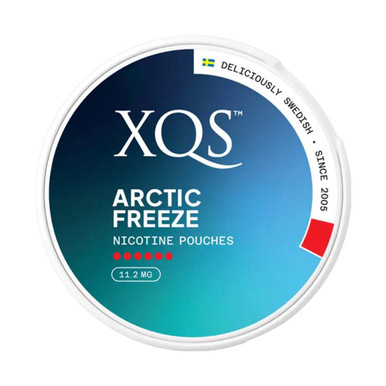
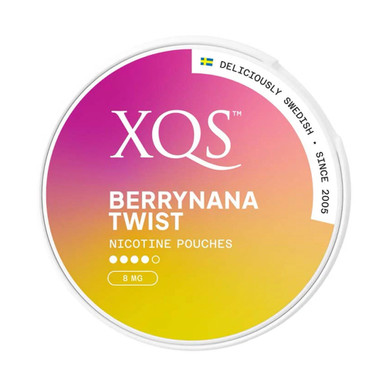
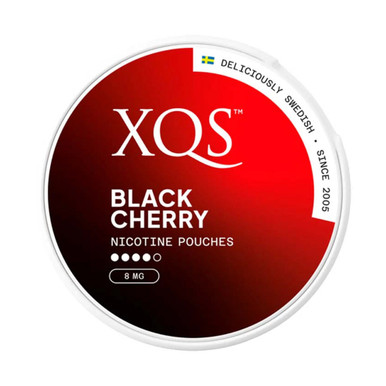
This can sits squarely on the fruit side of the range, and it is one of two listings there with a berry direction. The other is XQS Berrynana Twist, also listed at 8mg and 10mg and also in stock, which takes the berry family somewhere sweeter and more blended. If the darker, sharper half of this can is what appeals, XQS Black Cherry at a single declared figure of 8mg is the nearest thing in the brand to that depth without the raspberry lift.
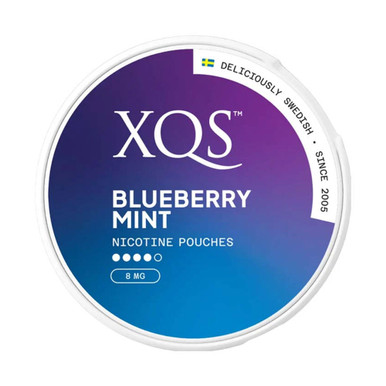
XQS Blueberry Mint, at 8mg and 10mg, is the listing that straddles the two halves of the range — a berry note with a mint element attached — and it is the obvious next stop for anybody who likes fruit but wants something cooler alongside it. XQS Citrus Cooling does the same manoeuvre with citrus in place of berry.
Further from this can, XQS Arctic Freeze is a straight mint listing recorded at a single figure of 11.2mg, which places it above this one on the label, and XQS Cola Lime at 8mg is the range's genuine outlier — neither mint nor fruit, and the only cola note the brand has on our shelves.
Which of those suits anybody is not a question we can answer, because it depends entirely on what a person likes and we have no way of knowing that. Setting the range out clearly is the most we can usefully do.
Cans people keep alongside this one
Ten cans is a long run of one flavour, and plenty of people who buy in rolls keep a second, cheaper can open at the same time so that there is somewhere else to go. A few worth knowing about, with their prices and their availability, because both matter.
Staying inside the berry family: Nordic Spirit Blueberry at £4.49 and Velo Strawberry Ice at £4.19 are both in stock and both single cans, which makes them a cheap way to have something different open without committing to another roll. Pablo Silver Edition Blue Raspberry at £39.90 is in stock and approaches the raspberry side of this can from a different brand entirely.
Three berry listings are worth mentioning with a warning attached, because they are currently unavailable. Edge Strawberry at £14.95 is out of stock; so is Klint Blueberry at £36.90; so is Rush Berry Ice Pro at £19.99. All three pages are readable and none of them is buyable today. They are linked here because they are genuinely relevant neighbours and because a page that is currently unavailable will tell you when that changes — not because we are hoping you will not notice.
If you would rather browse than be pointed anywhere, the full catalogue is one link away, and the two largest brand ranges we run — Pablo and Cuba — will give you a far broader spread of flavour directions and declared figures than any single brand page can.
Keeping the pack in good order
Dry pouches are undemanding to store, which is much of the appeal. Lid closed, ordinary room temperature, out of direct sunlight. That is the whole specification.
Heat is the one thing worth going out of your way to avoid. A dashboard in summer, a windowsill, the shelf above a radiator — sustained warmth is unkind to a flavoured product over time. This is a point about flavour holding its character, not a point about safety, and we are not making a point about safety in either direction.
With ten cans the sensible pattern is one in circulation and nine put away somewhere cool, dry and dark, rather than the whole sleeve travelling about. Unopened and properly closed is where flavour keeps best, and a roll bought today may still be getting used in several months' time.
Refrigeration comes up as a question. There is no requirement and we make no recommendation. If you do it, the practical effect is that the pouches come out cold, which suits some people and not others.
Keep the pack out of reach of children and away from pets, as with anything in the house intended for adults only. A sleeve of ten cans is conspicuous on a worktop; a cupboard is a better home for it.
Deciding between the options
The only decision on this listing is 8mg or 10mg, and since both are £39.90 for ten cans, price cannot help you make it. That removes the one variable a retailer can legitimately comment on, which leaves us with very little to say and no honest way to say more.
There is no smaller pack of this flavour. If ten cans is more than you want of something you have not tasted, the answer is not on this page — it is on the single-can listings linked above, several of which sit in the same berry territory for under five pounds and will answer the flavour question for a fraction of the outlay.
On the figures themselves, the numbers are printed on the page and on the lid, and the choice between them is yours. We are not going to nudge it.
It is worth noticing what this listing does not offer, since absence is information too. There is no mixed pack, no trial size, no three-can option and no subscription. Ten cans of one flavour at one declared figure is the entire shape of what is on sale here, and a page that pretended otherwise would only waste your time at checkout.
Ordering, delivery and proof of age
Checkout works as you would expect. £39.90 buys ten cans at whichever declared figure you select.
This is an age-restricted product and we sell it to adults aged 18 or over only. Age verification is built into the order process, and ID may be requested on delivery — a courier is entitled to refuse to hand the parcel over if the person answering the door cannot produce it. It is worth arranging for somebody who can to be there.
We deliver to UK addresses. Current timings, carriers and charges appear at checkout, which knows today's arrangements in a way that a description written in advance cannot.
If a pack arrives damaged or the wrong thing turns up, get in touch rather than making do. We would sooner sort it out. A crushed sleeve with intact cans inside is cosmetic and usually not worth anybody's time; a split can or a wrong declared figure on the lid is not, and we want to hear about the second kind.
Finding this listing again
Three routes lead back here: the medium band by declared figure, the XQS brand page, and the berry flavour shelf. The brand page is the quickest of the three, since fourteen listings can be read through in under a minute, whereas the berry shelf runs to seventy-six cans and — as set out above — will not distinguish this one from any other berry can for you.
For wider browsing, the shelves by declared strength sit above this one and are linked throughout this page, and the shelf filters stack, so a combination like "berry, in stock" cuts a long list down to something readable in one sitting.
Questions we get about this can
Which of the two fruits leads?
Our catalogue does not record proportions or which note is dominant, so we cannot give you a ratio. On the general behaviour of the format, a brighter sharp note like raspberry usually registers earlier and a darker, denser note like blackcurrant fills in behind it and lasts longer. Take that as a description of how these kinds of flavours tend to be ordered, not as a specification of this recipe.
Why is it only tagged "berry"?
Because that is the only flavour heading our catalogue holds against it. We do not run separate raspberry or blackcurrant headings on this listing, so the shelf filter groups it with seventy-five other cans and tells you nothing finer. We would rather point out that gap than let you browse a long shelf assuming it means more than it does.
How many pouches per can?
We do not hold that figure for this listing and we are not going to estimate it. Our data records the pack as ten cans and nothing more granular. The number is printed on the can itself, which is the authoritative source, and a guess from us would be worth less than the label.
What is the difference between 8mg and 10mg here?
Two milligrams on the declared figure and nothing else our catalogue records — identical flavour, identical pack of ten, identical £39.90. We will not describe what that difference amounts to in use, because that would be a claim about how nicotine affects a person, and we do not make those.
Which should I choose?
We cannot tell you and we will not guess. Selecting a nicotine strength is a decision about your own use of an addictive substance, and no retailer is in a position to make it on your behalf. Both figures are shown on this page and printed on the can so that you are choosing with the real information in front of you.
Can I buy a single can?
Not of this flavour. XQS Raspberry Blackcurrant is listed only as a ten-can pack at £39.90, and there is no single-can option recorded for it. Several cheaper single cans in the same berry family are linked from this page if you want to test the direction before committing to a roll.
Can I mix the two strengths in one pack?
No. You select one declared figure and the whole pack of ten is that figure. There is no mixed roll. Buying both would mean buying two packs, which is twenty cans and a substantial outlay for what amounts to a comparison.
How does it compare to the Fumi or ZYN blackcurrant cans?
Our catalogue cannot tell you, and neither can we. All three carry berry-family headings and different brand names, at £39.90, £27.90 and £19.99 respectively, and nothing in our data separates them on taste. Anybody claiming to know the relationship between two cans that share a single tag is filling in a blank rather than reporting a fact.
Where is it made?
We do not hold that information and will not invent it. Whatever the manufacturer declares about origin is printed on the can, and that is the source to trust. Anything we said here would be a guess wearing the clothes of a fact.
Why are some of the cans you have linked unavailable?
Because they are genuinely the closest neighbours by flavour, and hiding them would give you a less accurate picture of the shelf. Edge Strawberry, Klint Blueberry and Rush Berry Ice Pro are all out of stock at the time of writing. Their pages remain readable and will show current availability, which is more use than pretending they do not exist.
Is the 10mg better value since it costs the same?
No, and that framing is worth resisting. Both options are £39.90 for ten cans, so a larger declared figure at the same price is not more of something desirable being handed over for free — it is a different number on a label. Value on this listing is identical either way, and the choice between the two figures has nothing to do with money.
How long will a ten-can pack last?
That depends entirely on how much you use, which we have no way of knowing and would not guess at. What we can say is that a roll is bought by people solving a supply problem rather than a taste problem, and it will typically be in use over a stretch of months rather than weeks. That is the reason the storage advice above is worth following rather than skipping.
Does the catch compartment need cleaning?
Emptying it is the main thing, and doing it promptly rather than eventually. Beyond that a rinse and a proper dry is all any can wants if you feel the need. It is a holding bay for used pouches on the way to a bin, and treating it as anything more permanent is what makes cans unpleasant.
The compliance section
This is an age-restricted nicotine product sold to adults. We sell it only to customers who are 18+ and who already use nicotine. It is not sold to anyone under that age, and it is not offered or marketed to people who do not already use nicotine products.
Nicotine is an addictive substance. We state that plainly here rather than tucking it into small print, and it applies to this listing exactly as it applies to every comparable product on this site.
This product is not a licensed stop-smoking medicine and is not offered, described or intended as one. It is not intended for non-smokers, non-nicotine-users, under-18s, or anyone who is pregnant or breastfeeding. We make no health, medical or cessation claim about it in any direction whatsoever.
Age verification forms part of checkout and ID may be requested on delivery; a courier may decline to hand over an order if nobody present is able to show it. Keep the product out of reach of children.
Where that leaves things
XQS Raspberry Blackcurrant is ten cans for £39.90 at either 8mg or 10mg, tasting of a bright raspberry note over a darker blackcurrant one, in a well-made can with a catch lid that does its job — and filed in our system under a single word, "berry", that tells you considerably less than the name on the lid does.
It is a purchase sized for somebody who already knows this is the direction they want. If you are not yet in that position, the cheap single cans linked above will settle the question for a couple of pounds, and the wider berry shelf is there to browse while you make your mind up.
More from XQS
More medium strength pouches
More berry pouches
Where this sits
XQS Raspberry Blackcurrant Nicotine Pouches appears in these categories. Browse them, or jump to something close.
You might also like