Home / Medium Strength / XQS Citrus Cooling Nicotine Pouches
XQS · 8mg–10mg · 10-can pack
Read the full guide
XQS Citrus Cooling Nicotine Pouches
£39.90
✔ In stock — ready to ship
100% tobacco-free
Free over £20
Same-day dispatch
Secure checkout
This is the listing page for XQS Citrus Cooling Nicotine Pouches. The brand is XQS, the product name is Citrus Cooling, and the listed price is £39.90. The pack quantity is recorded: 10 cans. Two strengths are declared under the name, 8mg and 10mg, both at the same price. The listing is marked in stock as this is written, and two flavour tags are filed against it, mint and citrus. One product image sits in our system.
That is the whole of the data. What follows is a description of the object, a comparison with the other cans on the shelves this one belongs to, and — where a question runs past what we know — a plain statement that we do not hold the answer. We do not publish ingredient lists, we do not explain what goes on inside a pouch, and nothing on this page is a statement about anyone's wellbeing in any direction.
The full guide to XQS Citrus Cooling Nicotine Pouches
4,956 words on how it eats, who it suits, how to serve it and what to put beside it.
Citrus Cooling, and what our record holds
A word on the name before anything else. Cooling is a flavour name. It points at where the taste sits — the cold end of the mint spectrum, in the way a menu calls a drink iced — and it is the manufacturer's own word for a flavour rather than a description of anything the product does. We describe taste and aroma on these pages and we stop there.
This is an age-restricted product for adults aged 18 or over who already use nicotine. The full wording sits in its own section towards the end, and nothing above it is written for anybody else.
The milligram figure: what it tells you, and what it does not
This listing declares two figures, 8mg and 10mg, so it is a reasonable page on which to set out exactly what we think a number on a lid is worth. This is the longest section here for that reason, and almost all of it is about the limits of the information rather than the information itself.
What it is
It is what the manufacturer prints on the can. That is the entire honest description. It comes to us as a field in a product record, we publish it unchanged, and we do not adjust, round or interpret it. When we write 8mg on this page, we mean that the figure 8mg is what the product declares — no more than that.
What it is useful for
Two things, both practical. First, it identifies a can. Where a single flavour name covers two variants, as it does here, the printed figure on the lid is the only thing that distinguishes one tin from the other once both are in the same drawer and being read from above. That is a genuinely useful function and it is why the figure is on the lid at all.
Second, it determines shelving. Our catalogue is sorted into strength bands, and both declared figures on this listing put it on the medium band, which at 135 listings is the largest of the three. Above it in our filing sit the strong shelf and the extra strong shelf. A can lands on a band purely because of the number it prints, and nothing else about it is considered.
What it does not tell you
Rather more, and this is the part worth reading carefully.
It does not tell you how one brand's can compares with another brand's can. Two products printing the same figure are two products printing the same figure; we can tell you they sit on the same shelf here, and we are not going to extend that into any statement about how they compare in use, because we are not in a position to make one.
It does not tell you anything about the flavour. A number on a lid has no relationship to whether a can tastes of citrus, cherry or cola, and people occasionally assume some connection exists between the figure and the intensity of the taste. Our record gives no basis for that, so we will not claim it.
It does not tell you which can is the better product. There is no ranking implied by a larger number, and our band names — medium, strong, extra strong — are shelf labels rather than a ladder anyone is supposed to climb. We use those words because they are the conventional names for the ranges and because customers search with them, not because we are describing a progression.
And above all, it does not tell you which strength is right for you, and neither can we. We do not know you. That question is about a particular person rather than about a product, and any retailer answering it would be well outside what a retailer can properly do. We will print the declared figures accurately and say which shelf they sit on. The decision past that point is not ours to take part in.
Why we keep saying this
Because the shape of a shop encourages the opposite reading. Sorting products into bands called medium, strong and extra strong puts them in an apparent order, and an apparent order invites people to read it as a recommendation. It is not one. It is filing, and filing has to put things in some sequence or it is not filing. The section you are reading exists to say plainly that the sequence carries no advice in it.
How the bands themselves are drawn
Since the bands come up repeatedly on this page, it is fair to explain what they are. They are our own shelving categories. Every listing in the catalogue has a declared figure attached to it, those figures are sorted into ranges, and the ranges are given the conventional names the category uses. That is the whole mechanism. There is no assessment involved, nobody tastes anything, and no product is placed by judgement.
The consequence worth understanding is that two cans on the same band may print figures that are not identical, and two cans printing similar figures from different manufacturers may still end up on the same shelf. The band tells you roughly where a printed number falls in the spread of printed numbers across our catalogue. It does not tell you anything finer than that, and it would be a mistake to treat a band boundary as a meaningful line rather than as the edge of a filing bucket.
It is also worth saying that the band a can sits on can change if a manufacturer changes what it prints. The listing is always the current position, and this description is not.
The one place the two figures matter practically
If you buy both variants of this flavour — and people do, because the price is identical — label them or separate them. The tins are the same, the flavour name on the lid is the same, and the only difference visible from above is the printed figure. A pack of ten cans of one and a pack of ten of the other, stacked in a cupboard, is a straightforward way to lose track of which is which.
Citrus and cold, as a taste
Both of our flavour tags are accurate here, which is not something we can say on every page. Mint and citrus are both in the name and both on the record.
The citrus is the front of the flavour. It is not a single named fruit — this is not specifically a lemon can or an orange one — but a general citrus character with the sharpness those fruits share: a clean acidity, a slight bitterness of the sort that comes off peel rather than juice, and only a modest amount of sweetness carrying it. If you have met a citrus flavour that reads as sherbet or as a soft orange squash, this is not that. It sits at the drier, sharper end.
The cold mint sits under it rather than beside it. Citrus and cold mint are a natural pairing for the same reason lemon works in iced water: the acidity and the cold register belong to the same idea, so neither one fights the other for the front of the taste. Where a heavy sweet mint would flatten a citrus note into something generic, a cold clean one gives it a floor to stand on.
The aroma from an open tin runs high and sharp, more peel than pith, and it is noticeable when a bag is opened. Across the life of a pouch the sharp top of the citrus goes first, the drier bitterness behind it lasts longer, and the cold mint register is what remains at the end. That means, as with several two-part cans, the thing tastes slightly different at the start and the finish.
Two qualifications. This is our description as a shop that stocks the can, not a specification, and taste is personal enough that yours may land differently. And the only hard facts in the paragraphs above are the two tags themselves — mint and citrus — because those come out of the record rather than out of a description. The citrus shelf holds 25 listings, one of the smaller flavour groupings we run, while the mint shelf at 148 is comfortably the largest.
The format, in detail
The second thing worth proper space on this page is the format itself, because it is the part people ask about most and the part that a product photograph conveys worst.
The can
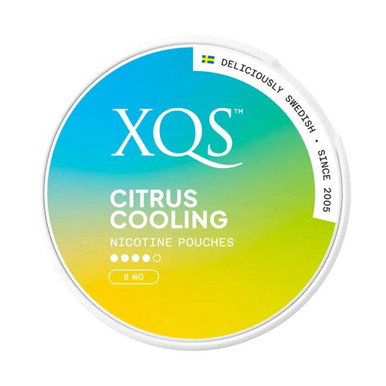
A shallow round tin, roughly the footprint of a small jar lid. The lid lifts clear of the body and presses back down onto it; there is no hinge and no screw thread. The lid face carries the brand, the flavour name and the declared figure. Our record holds a single image of it, so the shop page shows one photograph rather than a gallery — worth saying, so nobody goes looking for a second angle that does not exist.
In a jacket or bag pocket the tin carries well. In a front trouser pocket it is noticeable, because the shape is rigid and does not give. People who carry one daily tend to settle on a single fixed location for it, which has the useful side effect that the can does not get left on tables.
The pouch, and what "portion" means here
Inside, the pouches sit in a ring, flat and evenly spaced. One is a small soft rectangle with rounded corners — white, dry to the touch rather than damp, with edges that are rounded rather than sharp. It is light enough that you stop registering its weight in the hand almost at once.
How many are in the tin is not something our record states, and we will not estimate it. Pouch weight and tin dimensions are the same: printed on the packaging, absent from our data, and not worth a shop inventing. What we can state, because it is in the record, is that the price of £39.90 covers ten cans.
The word people use for a single pouch is a portion, and it is worth being clear that the word describes the object rather than a measurement anyone has made for you. A portion is one pouch out of the tin. Our record does not hold a weight for it, does not hold a size in millimetres, and does not hold a count for the can, so every dimension of the phrase "portion size" on this page is something you will read off the packaging rather than off our system. What we can describe is the shape in the hand: small, flat, soft-edged and consistent from one pouch to the next within a can.
How it sits
A pouch goes under the upper lip and stays where it is put. The common first impression is of slightly more bulk than expected, and that impression fades over the first minute or two as the pouch takes the shape of the space around it. After that most people stop thinking about it entirely.
Speaking with one seated is not difficult and takes no practice. Whether it is visible to anyone else depends on the individual and on how animated they are; some people find it completely unnoticeable and others are aware of it for the first few minutes. Drinking with one in is a matter of preference — some do, some take it out first — and the same goes for eating. Those are habits, not instructions, and we are not going to present them as instructions.
How long people keep one in
This is the question with the least satisfying answer on the whole page, and the honest response is that there is no single figure. People describe anything from about ten minutes at one end to the better part of an hour at the other. The same person varies from one occasion to another without giving it any thought.
What is more consistent than the clock is the flavour arc. The taste arrives quickly, holds for a stretch, and then thins until what remains is a background note rather than a flavour — on this can, a faint cold register after the citrus has gone. Most people change a pouch at that point, not because a rule says so but because a pouch with nothing left in it is not doing the thing it was picked up for. Anyone quoting you a precise duration is guessing on your behalf.
Taking it out, and the lid well
Removal is a matter of hooking the pouch with a fingertip. The used one goes into the well in the underside of the lid — a shallow hollow with a raised lip, which exists for exactly this purpose and takes several before it needs emptying. That single feature is what makes the format practical on a train, in a car, or anywhere else with no bin to hand.
The well is not long-term storage. Tip it into general waste every few days. Used pouches do not go down a sink, into a plant pot or out of a window, and they should be kept away from children and animals with the same care as the unused ones — arguably more, since they are the ones most often left on a surface.
Where this can sits in the XQS range
We stock fourteen XQS listings, six of which are direct flavour siblings of this one. The brand holds almost everything constant across its range — the tin, the format and the £39.90 listed price — so the flavour is effectively the only variable when you move between them.
| Can | Character | Relation to this one |
|---|---|---|
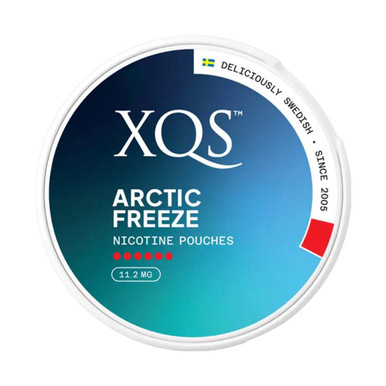
| Arctic Freeze | Plain, cold, unsweetened mint | This one with the citrus removed |
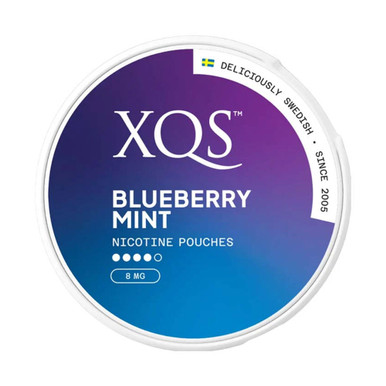
| Blueberry Mint | Dark berry over cold mint | Same construction, softer fruit |
| Cola Lime | Spiced cola cut with lime | Shares the sharp edge, loses the cold |
| Fizzy Peach | Sweet-shop peach with a tang | Much sweeter, no cold layer |
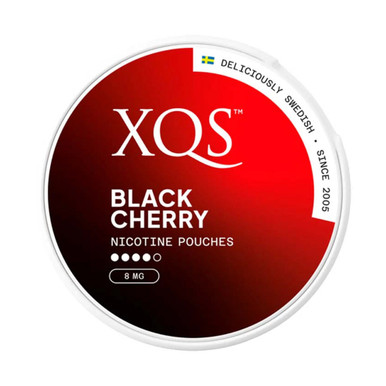
| Black Cherry | Deep, slightly bitter dark cherry | Fruit-led and dark |
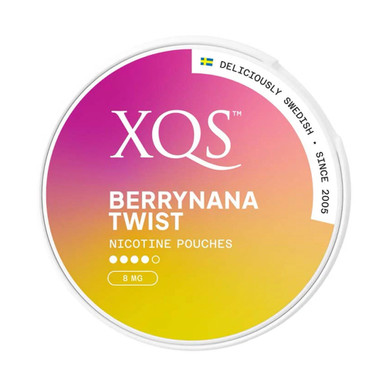
| Berrynana Twist | Dark berry with a banana note | Furthest in style from this can |
Read across, the range divides into a cold group and a fruit group. This can is the sharpest member of the cold group — XQS Arctic Freeze at £39.90 is the plainest, and this one is the same idea with an acidic note laid over the top. XQS Blueberry Mint, also £39.90 and in stock, is built the same way with a soft dark fruit instead of a sharp one, and it is the can that bridges the two halves of the range.
On the fruit side, XQS Black Cherry at £39.90 is deep and slightly bitter with no cold register at all, XQS Fizzy Peach at the same price is the sweetest can the brand makes, and XQS Berrynana Twist carries a banana note that divides people sharply. XQS Cola Lime sits slightly apart from both groups: it shares the citrus edge you get here, in the form of lime, but sets it against a dark spiced cola rather than a cold base. All six are marked in stock at the time of writing, and the full line-up is on the XQS brand shelf.
One point of housekeeping about a link above: the address for the Arctic Freeze page keeps an older spelling of the word, which is why it may look wrong. The listing has been left that way on purpose so that existing bookmarks and links continue to work; the can itself is spelled properly.
Cans people keep alongside this one
Two or three tins in rotation is the usual pattern, because any flavour becomes less distinct the more of it you have and a second can with a different character resets that. With a sharp citrus-and-cold can, there are two sensible directions to go.
Staying cold
If the cold register is the reason this can appeals, the plain mints are the obvious neighbours. Klint Arctic Mint at £36.90 is cold and unadorned; White Fox Double Mint at £34.90 layers two mint characters and reads a little broader; SYX Cool Mint at £29.90 is the gentler of the three. All are available as this is written.
For a softer and rounder mint instead of a cold one, Edge Spearmint at £14.95 moves into spearmint territory, which reads as a different flavour rather than a lighter version of the same thing.
Keeping the sharpness, changing the fruit
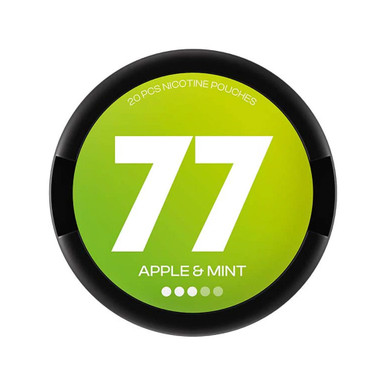
Velo Orange Ice at £4.19 is the closest thing in the catalogue to a named-fruit version of what this can does in general terms, and it is in stock. 77 Apple Mint at £39.90 swaps the citrus for a crisp green apple over the same sort of cold base, which keeps the acidity but changes the fruit entirely. Nordic Spirit Frosty Berry at £4.49 does the berry version of the same construction.
Going busier, Pablo Silver Edition Blueberry Peach Ice at £39.90 stacks two fruits over a cold layer rather than one, and the wider Pablo shelf holds more cans built that way.
A complete change
If the point of the second tin is contrast rather than similarity, the useful move is out of the cold family altogether. Fumi Dark Spice at £27.90 is about as far from a sharp citrus as the shop goes — dark, warm-toned and not sweet — and UBBS Cola Ice at £19.95 is the cola-and-cold combination at a considerably lower listed price than the XQS equivalent. The Cuba shelf collects more of the darker, less obviously cold flavours for anyone working in that direction. Cuba there is the brand name printed on the tin, not a statement about where anything is made — we do not hold origin data for any listing.
On the prices in that list
They run from £4.19 to £39.90 and that spread should not be read as a quality difference. Our pack-quantity field is filled in on this listing — ten cans — but it is empty on a great many others, which means we frequently cannot tell you whether a price covers one tin or several. A £4 listing beside a £40 one is far more likely to be a difference of quantity than anything else. Check what a listing actually includes before setting two prices side by side.
How a rotation tends to settle
Two tins is the arrangement that works with the least effort, and the split between them usually follows the shape of a day rather than any plan — one can indoors, the other out, or one early and the other later. Three tins starts to be a bag rather than a pocket, and at that point the third normally lives at home and comes into circulation when one of the working two runs out.
Where a pairing stops working, the cause is almost always that the two cans were too close to begin with. A sharp citrus-and-cold can beside a plain cold mint is a narrower gap than it looks, because the cold register is common to both and it is the part that lasts longest in each. Widening the gap does more for a stale rotation than adding a fourth flavour to the pile.
Looking after a ten-can pack
With ten cans, most of what you have bought is sitting still, and storage is mostly about the nine you are not using.
Keep unopened tins somewhere cool, dry and out of direct sun — a cupboard or a drawer rather than a windowsill or a shelf over a radiator. Heat is the condition most likely to change how a pouch behaves and how the flavour reads, and the everyday worst case is a car in summer, where a glovebox or a dashboard gets considerably hotter than people assume.
Keep the tin in use properly closed. The lid is built to seat firmly and should be pressed home; a can left ajar in a bag dries out and collects whatever else is in there. Some people keep unopened tins in a fridge. Our record holds no manufacturer storage instruction for this product, so we will neither recommend nor discourage that — anything official would be printed on the packaging, and the packaging outranks this page.
The non-negotiable point: ten cans is a large quantity of an age-restricted product to have in a house. Store the pack, the working tin and the used pouches out of reach of children and animals.
What is actually being chosen here
Three decisions, no more. Which flavour, which of the two declared figures, and how many packs.
On flavour, the sections above are our whole contribution. On quantity, our data helps for once: ten cans per pack is recorded rather than missing, so the arithmetic is available. On the declared figure, we have said it at length already and will say it once more here because this is where people expect a recommendation and will not get one — we cannot tell you which suits you, and the band names on this site are shelving rather than advice. The full catalogue is browsable across flavour, brand and strength band at once if none of the XQS range is right.
Ordering, delivery and proof of age
Orders are placed through the site as normal. The price on the listing is the figure we hold — £39.90 here, for either declared strength — and prices are revised from time to time, so the listing is authoritative and this description is not.
Age verification applies. This product is sold only to people aged 18 or over, checks are carried out when the order is placed, and photographic ID may be requested by the courier at the door. Whoever takes the parcel in needs to be able to produce it. A courier who cannot verify age will not hand it over, and that is the system doing its job.
If a pack arrives damaged, or is not what you selected, contact us rather than the manufacturer. Stock status changes without notice and each listing carries its own current position.
Routes onward from this page
Two flavour routes lead out of here, because this can carries two tags: the 25 citrus listings if the sharpness is what brought you, and the 148 mint listings if the cold register is. By brand, the fourteen XQS listings hold every sibling named above. By strength band, both variants sit with 135 others on the medium shelf, with the strong and extra strong shelves filed above it.
Questions we are asked about this can
Is the 10mg version an upgrade on the 8mg?
No, and we would push back on the framing. They are two numbers printed on two lids, sold at the same price in the same pack size with the same flavour. Neither is an improvement on the other, our shelves are not a ladder, and which is appropriate for any individual is not something a shop can determine or should suggest.
Which citrus fruit is it?
Our record does not specify one, and the product name does not either — it says citrus rather than lemon, lime or orange. Our description of the taste is a general citrus character with a peel-like sharpness rather than a single identifiable fruit. If you need it narrower than that, the packaging is the place to look.
How many cans and how many pouches?
Ten cans for £39.90, because that figure is in our record. The number of pouches inside each can is not, so we will not print one — it is stated on the packaging and that is where to read it.
Does "Cooling" describe a sensation?
It is a flavour name, describing where the taste sits on the mint spectrum, and it is the manufacturer's own word. We describe taste and aroma on these pages. We are not making a claim about what the product does, and nothing on this page should be read as one.
Can I compare the milligram figure with a different brand?
As two label figures, yes — they are what each manufacturer prints. As a guide to how two products compare in use, no, and we are not going to offer that comparison. What we can tell you is which shelf each one sits on within our own filing, which is a fact about our categories rather than about the products.
Is this too sharp if I normally use plain mint cans?
That is a matter of taste and only you can judge it. What we can say descriptively is that the citrus here is dry and peel-like rather than sweet, so it reads as an addition to a cold mint rather than as a departure from it. The Arctic Freeze can in the same range is the same idea without the citrus, if a comparison helps.
Where is it made?
We do not hold that information and we will not guess at it. Our product record carries name, brand, price, declared strengths, pack quantity, stock status and flavour tags. Origin is not one of those fields, and where it is declared at all it would be on the packaging.
How long should I keep a pouch in?
There is no correct answer and we are not going to invent one. The range people describe runs from roughly ten minutes to the better part of an hour and varies by person and by occasion. The practical marker most people use is the flavour thinning out to nothing, which is an observation rather than an instruction.
Can I use these on a flight or at work?
That is for the airline or the employer to say, not us. Policies on nicotine products vary widely between organisations and are changed without reference to a retailer. The written policy, the conditions of carriage or the conditions of entry are the reliable sources. Rules on carrying nicotine products between countries are likewise a matter for the relevant customs authority.
Are all the cans linked on this page available?
Every product linked from this page is marked in stock as this description is written, which is not always the case on our pages — where a comparison can is unavailable we say so rather than sending you to a page you cannot order from. Stock moves constantly, though, so the listing itself is always the live record.
Does the flavour hold up across a whole ten-can pack?
We cannot measure that for you, and we are not going to claim consistency we have not verified. What people generally report about any flavour bought in quantity is that the taste becomes less noticeable the more continuously it is used, which is a matter of familiarity rather than the product changing — and it is the reason most people keep a second can of something different on the go rather than running one flavour end to end.
Is there a best-before date on the can?
Our record does not hold a date or a shelf-life figure for this listing, so we cannot quote one. Any date printed on the product is on the packaging and should be read there. The storage notes above are about keeping a tin in reasonable condition generally, and they are not a substitute for whatever the packaging states.
Do you publish customer ratings?
We do not. There are no reviews, star ratings or testimonials on our product pages, so there is nothing of that kind to show you here. What is on this page comes from the product record or from a plain description of the format, and the gaps are labelled as gaps.
Why are there only two strengths?
Because two are what the listing declares. Some products in the catalogue carry one figure, some carry several. We publish what the record holds and do not fill in the rest, so if you are looking for a figure that is not listed here, it is not one we stock under this name.
Age restriction and required notice
This product is sold only to adults aged 18 or over who already use nicotine. Nothing on this page is addressed to anyone who does not, and nothing here encourages anybody to begin.
Nicotine is an addictive substance.
This is not a licensed stop-smoking medicine and it is not offered, described or intended as one. It is not intended for non-smokers, for anyone who does not already use nicotine, for under-18s, or for anyone who is pregnant or breastfeeding. Questions about your own nicotine use belong with a qualified healthcare professional, not with a retailer.
Age verification applies to this purchase. Photographic ID may be requested when the order is placed and again by the courier on delivery. Keep this product, and used pouches, out of the reach of children and animals.
In brief
XQS Citrus Cooling is a ten-can pack at £39.90, declared in 8mg and 10mg, in stock as this is written, and tagged accurately as both mint and citrus. The taste is a dry, peel-sharp citrus over a clean cold mint, with the citrus fading first and the cold register lasting longest. On the XQS shelf it is the sharpest member of the brand's cold group, with Arctic Freeze as the plain version of the same idea.
What we cannot tell you: how many pouches are in a can, which citrus fruit the flavour is built around, where it is made, which of the two declared figures is right for you, and whether a given employer or operator permits it. Five gaps, honestly marked, and we would rather leave them open than close them with something invented.
More from XQS
More medium strength pouches
More mint pouches
Where this sits
XQS Citrus Cooling Nicotine Pouches appears in these categories. Browse them, or jump to something close.
You might also like