Killa · 16.5mg
Read the full guide
Killa Pineapple Nicotine Pouches
£33.50
✔ In stock — ready to ship
100% tobacco-free
Free over £20
Same-day dispatch
Secure checkout
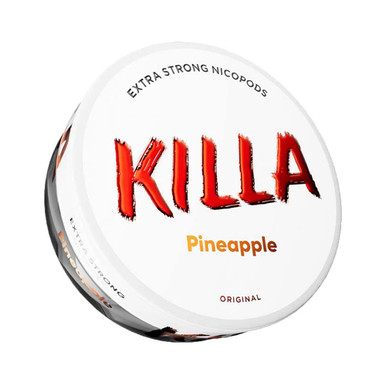
This page belongs to Killa Pineapple Nicotine Pouches. The brand recorded against it is Killa, the product name as we list it is Pineapple, and the price we display is £33.50. One strength figure is declared, 16.5mg, and because there is only one, that figure is both the top and the bottom of the range we hold for this product. Our record marks the can in stock at the time of writing. There is a single product image attached rather than a gallery, and the flavour tag our system applies is tropical. That is the whole of it. Nothing else about this can exists in our data.
One absence is worth naming immediately, because it changes how the price reads. Our record carries no cans-per-pack figure for this product. The field is empty. We therefore cannot tell you whether £33.50 buys one can or a multi-can roll, and we are not going to work it out backwards from what other products cost, because that would be a guess wearing the clothes of a fact. If the quantity matters to your decision — and at this price it reasonably might — the product packaging and the basket page are the places that will settle it, not this paragraph.
The full guide to Killa Pineapple Nicotine Pouches
5,251 words on how it eats, who it suits, how to serve it and what to put beside it.
Killa Pineapple: what this listing actually holds
Everything that follows is built from those recorded facts, from comparison against other cans on the same shelves, or from an open admission that we do not know something. There is no fourth source. We do not publish ingredient lists, we do not describe what happens after a pouch is in place, and we make no statement about anybody's wellbeing in either direction — not a favourable one, not an unfavourable one. Where an obvious question would require us to invent an answer, the answer here is that we do not hold the information. That reads as less helpful than a confident sentence would. It is the only version worth putting on a page.
This is an adult nicotine product. It is listed on the basis that the person reading and buying is 18 or over and already uses nicotine. The full wording sits in its own section at the foot of the page, and nothing above it is addressed to anyone else.
The words on the lid are the manufacturer's, not our assessment
Two pieces of naming attach to this can and both are louder than anything we would write ourselves. The brand is Killa. The web address of this page carries the phrase extra strong. Neither of those is a description we have arrived at, tested or endorsed. A brand name is a trademark — a word chosen for a label, filed at a registry, printed on a lid. A range descriptor is a manufacturer's way of separating one line from another in its own catalogue. We reproduce both because reproducing them is how you find the product you were looking for, and for no other reason.
It is worth saying what that naming is not. It is not a rating we have applied. It is not a measure of anything. It is not a suggestion that this can is a better purchase than a can named more quietly, and it is not an invitation to treat the label as something to test yourself against. A pouch is not an achievement and a number on a lid is not a score. We have no view on what anyone should be using, we are not qualified to form one, and we would not publish it if we had.
Our own filing adds a wrinkle worth showing you rather than smoothing over. The listing name contains that range phrase, but our shelf placement puts this can on our Strong shelf, which holds 132 products, and not on the shelf named after the phrase in the URL. Those are two different labelling systems — one belonging to the manufacturer, one belonging to our catalogue — and they do not always agree. We are not going to reconcile them by guessing which one is correct. The honest thing is to show you both, say plainly that they differ, and stop there.
Pineapple, described as a taste and a smell
Pineapple is a flavour with a recognisable shape, and most of what people mean by it falls into two quite different readings. There is the fresh reading: sharp, watery, distinctly acidic at the front, with a green-edged note underneath that stops the sweetness closing over. And there is the preserved reading: rounder, syrupy, with the acid softened and the sugar brought forward, the way tinned fruit tastes against the same fruit cut fresh. Flavourings in this format tend to sit somewhere on the line between those two rather than at either end.
The aroma on opening a can of a tropical-named product is usually the clearest single impression you get, and it is worth a moment before anything else happens. Pineapple carries a bright, slightly resinous top note — a faint pine-and-citrus quality that is where the fruit got its English name in the first place. Under that there is a heavier, almost creamy sweetness, which is the part that reads as tinned rather than fresh. Whether a given can leans bright or leans heavy is not something we can tell you from a product record. We have not built a tasting panel, we do not have one, and inventing its findings would be the easiest and least excusable thing on this page.
On the tongue, fruit flavourings in pouches generally behave differently from fruit itself. The sweetness tends to arrive first and most strongly, then flatten out, while whatever sharpness is present persists longer than the sweetness does. That is a general observation about flavoured products of this kind and not a description of this particular can, which we have not tasted and will not pretend to have tasted. What we can say with confidence is the narrow thing: the product is named Pineapple, and the flavouring is built to read as pineapple.
Our flavour tag says tropical, which is broader than the name
The tag in our system for this product is tropical. That is not a contradiction — pineapple sits comfortably inside tropical — but it is less specific than the product name, and the difference matters when you are browsing. The tropical grouping holds 58 products, and those 58 span mango, coconut, passion fruit, mixed-fruit blends and anything else a supplier has filed under the same heading. If you came to this page looking specifically for pineapple, the tropical shelf will show you a great deal that is not pineapple. There is no pineapple-only shelf in our catalogue, so the broad tag is the closest route we have.
The practical consequence is simple. Use the flavour shelf to see the neighbourhood, and use the product names to find the fruit. If you want a direct comparison against another can named for this fruit alone, Elf Bar's pineapple listing at £29.90 is the only other one we carry, and the £3.60 gap between the two is real money on a single purchase — though, as always, a price comparison without a quantity on both sides is not a complete one, and our record does not give us the quantity on either.
The physical object, and what handling one involves
Whatever is printed on the lid, the thing you are buying is a small round tin with a ring of soft rectangular pouches inside it. Everything in this section is about that object.
Size and how one sits
Pouches in this category are made in a range of sizes, and the practical difference between a standard-format pouch and a slim or mini one is how much of it you notice. A pouch is placed between the gum and the upper lip, usually towards the side rather than dead centre, and left there. A larger pouch fills more of that space and is more likely to show as a slight change in the line of the lip; a smaller one does less of both. Our record does not state a format size for this product, so we are not going to assert one. The can itself will say, and the first pouch out of it will tell you more than any sentence we could write.
Most people find that positioning is a small skill rather than a single correct answer. Some settle a pouch flat against the gum, some tuck it further back, some move it between sides. There is no right method that we are in a position to teach, and we are not going to imply that there is one.
How long people keep one in
Habits vary widely, and the range is genuinely wide rather than politely wide. Some people take a pouch out after ten minutes; others leave one in place for the better part of an hour. Flavour is usually the thing that decides it — flavouring releases fastest at the start and tails off, so the point at which a pouch stops being interesting arrives at different times for different people and different flavours. We are not going to publish a recommended duration. A recommendation about how long to keep a nicotine product in your mouth is, functionally, dosage advice, and that is not ours to give in any form, however casually it might be phrased.
The lid and the catch well
Cans in this format almost always have a two-part lid: the lid proper, and a hollow compartment in the top that acts as a catch well for used pouches. That compartment exists because a used pouch has nowhere convenient to go when you are not standing next to a bin. It is for temporary holding, not storage. Left full for days it will make the whole can unpleasant to open, and it takes up the space that the lid needs in order to seat properly.
Empty it whenever you pass a bin. A used pouch goes in general waste, wrapped if you would rather, and never down a sink or a drain and never on the ground. Keep the whole can away from children and from pets — a tin of small soft objects is exactly the sort of thing a dog will investigate, and this is a nicotine product.
16.5mg, read as a number printed on a lid
The figure declared for this product is 16.5mg. Here is what that is and, more usefully, what it is not.
It is a per-pouch figure declared by the manufacturer and reproduced by us. It is a label statement. It is the number you should quote if you are comparing this listing against another listing, because it is the only number either listing gives you. That is the complete list of things the figure is good for.
It is not a strength rating in any sense you could act on. Manufacturers do not all declare on the same basis, and two cans printed with the same number can be describing subtly different measurements. It is not a measure of how anything will feel, because that is not a property of a number on a tin. And it is emphatically not a ranking, a tier or a level. A higher figure is a higher figure. It is not better, not more advanced, not a sign of anything, and not a destination. We say that plainly because the naming on products in this part of the catalogue can imply a ladder, and a ladder implies climbing it.
We cannot advise which strength suits anyone. That is not modesty and it is not a legal hedge bolted on at the end of a sales pitch — it is the actual position. Suitability for a person is a question about that person, and we know nothing about anyone reading this. We do not ask, we would not act on the answer, and any shop that tells you otherwise is guessing at your expense. What we can do is show you how our filing works, which is the next section, and let you read the numbers yourself.
How this can sits against the others on the same shelves
This is the part of the page worth the most of your time, so it gets the most room. The question behind it is a reasonable one: if I am looking at 16.5mg here, what does that mean relative to everything else you sell? The honest answer has several parts, and the first part is a limitation.
What we can and cannot compare
Our record for this page carries the declared figure for this product and no other. We do not hold a table of every other can's milligram figure on this page, and we are not going to reproduce numbers from memory or from the internet and present them as ours. So a sentence of the form "this is stronger than X and weaker than Y" is not one we can write honestly, and you should be wary of any product page that writes it without showing its working.
What we do hold is our own shelf placement, which is a coarse sort applied across the catalogue. This can is filed on the Strong shelf. There is also a shelf for products we have filed as Extra Strong and one for those filed as Medium Strength. Those three groupings are filters on declared numbers, arranged so you can browse a band rather than read every listing. They are a sorting convenience. They are not advice, they are not a progression, and the order in which they appear in a navigation menu carries no implication that anyone should move between them.
What is genuinely comparable: price
Price is the one field where we hold real figures for everything, so it is the comparison we can actually make. At £33.50 this can sits in the upper-middle of what we charge. Several cans we stock are priced higher: Cuba Ninja Coconut at £39.90, the Clew blueberry can, also £39.90, 77's apple and mint listing at the same £39.90, Denssi Blueberry Freeze at £39.90 and Iceberg's apple, lemon and pineapple blend at £39.90 are all above it. Several sit below: the SYX tropical can at £29.90, Fumi Fiery Peach at £27.90 and Pablo's Gold Edition blueberry and peach ice at £19.95.
Now the caveat that makes the whole list less useful than it looks, and which we would rather state than bury. Those are listing prices, and our records do not consistently carry a cans-per-pack figure — ours is empty for this product. A £4.19 listing such as Velo's tropical mango can and a £39.90 listing are almost certainly not describing the same quantity of goods, and treating that eightfold price gap as a value judgement would be straightforwardly wrong. Compare prices only when you can see the quantity on both sides. Where you cannot, the price tells you what leaves your account and nothing more.
What is not comparable at all
Flavour is not comparable across brands in any measurable way, and we will not rank flavourings. Two cans both named for the same fruit can taste quite different, and neither is correct. Format is not comparable from our data either, because we do not record pouch size consistently. And nothing about how a product performs for a person is comparable, because that is not a product property and not something a shop can know.
What is left, after all that subtraction, is a short and honest list: the declared figure, the price, the flavour name, the brand, and our shelf placement. Those five things are what a comparison between two of our listings can be built from. It is less than a confident page would offer you. It is what we actually have.
Condition: dry pouches, damp pouches, heat and a can worth opening
The second thing worth going into properly is the state a can arrives in and the state it stays in, because this is the area where the difference between a good purchase and a disappointing one is usually made after the money has changed hands rather than before.
Dry and moist are two different products, not two conditions
Pouches are manufactured at different moisture levels, and this is a deliberate design choice rather than an accident of storage. Drier pouches feel firmer in the fingers and take longer to settle; moister ones feel softer and yield sooner. Neither is a defect and neither is superior. A can that feels drier than the last one you bought may simply be a different product built to a different specification, or a different production run of the same one. Our record does not state a moisture specification for this product, so we cannot tell you in advance which end of that range this can sits at.
What we can tell you is how to read what you have. A pouch that is uniformly firm straight from a freshly opened, well-sealed can is probably built that way. A pouch that is hard, brittle at the edges, or noticeably lighter than the others in the same ring, from a can that has been open for weeks, has more likely dried out. The distinction is not always obvious and we are not going to pretend it is.
Air is the main thing that changes a can
The single largest influence on a can's condition over time is how much air has got at it. Flavourings are volatile, which is precisely why you can smell a can when you open it, and what you can smell is leaving. A tin left with the lid resting on top rather than pressed down will lose its aroma faster than one properly closed, and pouches left exposed will stiffen. There is no reversing either. Press the lid until it seats. If the can is going into a bag with keys and a wallet, check it has seated, because a knock can lift a lid that was only balanced.
Heat and light
Heat is the second influence and it is a straightforwardly bad one for flavouring. A car dashboard in July, a sunny windowsill, the shelf above a radiator and a coat pocket pressed against a heater are all worse places for a tin than a drawer, a cupboard, a bag pocket or a bedside table. Direct sunlight compounds it. None of this is dramatic over an afternoon; it accumulates over weeks, and the way it shows up is as a can that tastes flatter than the one before it from an identical order.
The fridge question, answered honestly
Some people keep tins refrigerated and some do not, and this comes up often enough to deserve a direct answer. We have no instruction to give. Storage guidance for a product is the manufacturer's to issue and ours not to invent, and the can is where you should look for it. The only thing we will offer is a general observation that applies to almost anything flavoured: consistency beats cycling. Whatever you choose, a can that stays in one environment tends to hold its condition better than one moved repeatedly between a cold fridge and a warm room.
Rotation, dates and the catch well
If you keep more than one tin, use the older one first. It is obvious and almost nobody does it, which is why a drawer ends up with a flat can at the back that gets opened last and blamed on the brand. On dates: check the packaging. If there is a best-before marking it is printed on the can, our record carries no date information at all, and we are not going to estimate a shelf life. And empty the catch well regularly — a lid full of used pouches will not seat, and a lid that does not seat is the air problem described above, self-inflicted.
Where this falls among the Killa cans we carry
We list 31 products under this brand, and the full brand shelf is the quickest way to see them together. Within that set, this can is one of the fruit-named listings at £33.50, which is the price most of the range shares.
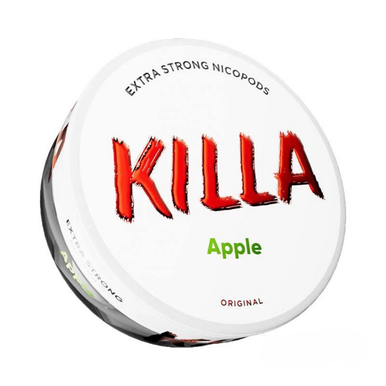
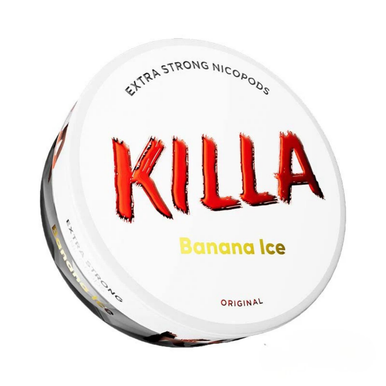
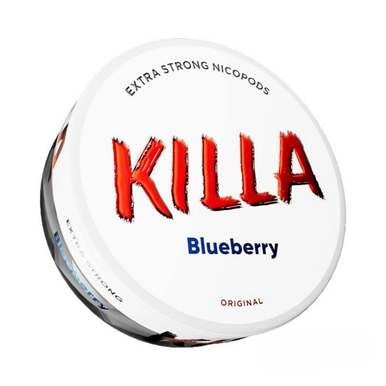
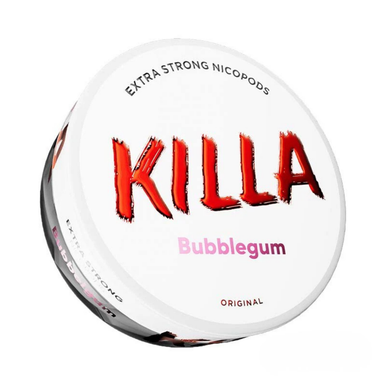
The range spreads across flavour families rather than strengths, at least in what we stock. On the orchard-fruit side there is the brand's apple can at £33.50. On the soft and sweet side, Killa Banana Ice pairs a banana flavouring with a cooling note, and the bubblegum listing is the confectionery-flavoured entry, priced identically. The blueberry can covers the berry end. Away from fruit entirely, the cappuccino flavour is the coffee-leaning one and Killa's cola listing is the soft-drink one — both, again, £33.50.
Since almost every one of those is the same price, price is not a way of choosing between them. Flavour name is the only differentiator our data offers within this brand, and flavour name is a name rather than a specification. That is a genuinely unsatisfying answer to "which one should I get" and it is the accurate one.
What people keep alongside a can like this
People who use one flavour steadily often keep a second can of something quite different, on the simple basis that a single flavour becomes background noise faster than two do. We have no data on that and make no claim about it; it is just a pattern shops see. If you are choosing a second can for contrast rather than similarity, the useful axis is to move away from the fruit family rather than within it.
Staying tropical but shifting the fruit, the Velo mango listing at £4.19 is the cheapest route to a different tropical note and SYX's tropical can is a mixed-fruit take at £29.90. Moving to berry instead, Clew's blueberry can at £39.90 and the Denssi blueberry with a freeze note are two different treatments of the same fruit, one plain and one cooled. For a stone-fruit contrast, Fumi's peach can at £27.90 sits a long way from pineapple on flavour while staying in fruit.
Keeping the fruit but adding an edge to it, the Iceberg apple, lemon and pineapple blend is the one listing we carry that keeps this fruit while pairing it with a sharp citrus and an orchard fruit, at £39.90. It is the closest thing on our shelves to a variation on this can rather than a departure from it.
For a complete change of direction, mint is the usual second can, and the 77 apple and mint listing at £39.90 splits the difference between fruit and mint rather than abandoning fruit entirely. The Cuba coconut can is the one that stays tropical while tasting nothing like a pineapple, also at £39.90.
Deciding between what this page actually offers
There is less to decide here than a page of this length might imply, and saying so is more useful than manufacturing options.
The listing carries a single variant: 16.5mg at £33.50. There is no second strength on this product, no alternative pack size and no bundle. The only choices available on this page are whether to buy it and how many to buy. If you were hoping to step between strengths within the same flavour, this listing does not offer that, and no amount of scrolling will produce it.
If you are comparing across products rather than within this one, the method is the same every time and it is short. Read the declared figure on each listing and treat it as label information. Check whether either listing states a quantity, because a price without a quantity is not a comparison. Treat the flavour name as a name. And then make the decision yourself, because the final step is the one we cannot take for you and would not take for you if we could.
Ordering, dispatch and the age check
The buying part is unremarkable. The can goes into the basket at £33.50, you check out, the order is dispatched. Our record marks this product in stock at the time of writing, though stock is live and any listing can change between you reading a page and placing an order — that is the ordinary position for any shop and not a caveat specific to this one.
The part that is not unremarkable is age verification, and it belongs in plain sight rather than in small print. This is an 18+ product, sold to adults who already use nicotine. Age checks apply when you order, and ID may be requested on delivery. If the person at the door cannot produce it, the courier is entitled to take the parcel away again. That is not obstruction; a check that cannot fail is not a check.
Two practical consequences follow. Have ID to hand if a delivery is expected, and do not arrange for the parcel to be left in a porch, with a neighbour or in a safe place, because nobody is verified in that scenario. And do not order on behalf of anyone under 18 — a sentence that looks like boilerplate and is not.
Routes into this page from elsewhere on the site
Three shelves carry this can and each is a different way in. The strength grouping it is filed under holds 132 products, the brand grouping holds 31, and the flavour grouping holds 58. Which is most useful depends entirely on how you shop — by declared figure, by brand you already know, or by flavour word.
Above all of those sits the full catalogue, which is every product we stock on one page, with the brand and flavour shelves branching off it. Other brand shelves work the same way as this one: the Pablo shelf and the Cuba shelf are two of the larger ones and are worth a look if you already recognise those names. There is no correct path through the site and no reason for us to prefer one over another.
Questions we can answer, and several we cannot
How many pouches are in the can?
Our record does not hold a pouch count for this product, so we are not going to state one. The count is printed on the packaging. We would rather say we do not know than publish a number that turns out to be wrong for the version of the can that reaches you, and estimating from the price or from what other brands do would be a guess presented as information. This is one of several fields our supplier data simply does not populate.
Does £33.50 buy one can or more than one?
We cannot tell you from our record, because the cans-per-pack field for this product is empty. That is an unsatisfying answer to an important question and we are giving it rather than inventing a better one. The basket page and the product packaging will both resolve it. Until one of them does, treat the price as the amount that leaves your account and not as a per-can figure.
Why is a pineapple can filed under tropical rather than pineapple?
Because tropical is the tag our catalogue applies and there is no pineapple-specific shelf in it. The tag is broader than the product name rather than in conflict with it. The practical effect is that browsing the tropical shelf will show you 58 products, most of which are not pineapple. If you want pineapple specifically, read product names rather than relying on the shelf.
Which strength should I pick?
We cannot answer that, and it is not a question we will approach from any angle. Suitability is a matter about a person, we know nothing about you, and we are not qualified to advise on it. This listing offers one figure, 16.5mg, and no alternative. If you want to see how our catalogue is sorted by declared number, the strength shelves do that sorting and nothing more.
Is 16.5mg a lot?
We are not going to characterise it. It is the figure the manufacturer declares and we reproduce, and describing it as a lot or a little would be us commenting on how it might affect a person, which is exactly the thing we do not do. Use it as a label figure for comparison against other label figures, and note that different manufacturers do not always declare on the same basis.
Is the range with the bolder name meant to be worked up to?
No, and we would push back on the framing of the question. Product naming is a marketing decision made by a manufacturer, not a sequence, a grade or a target. There is no progression built into our catalogue and none implied by the order in which shelves appear in a menu. Nothing about a product name means anyone should be moving anywhere.
How long should I keep a pouch in?
People vary from a few minutes to the better part of an hour, and we will not publish a recommended figure. A recommendation on duration is a form of dosage advice and that is outside what a shop can responsibly say. What we can note is that flavour releases fastest at the start and tails off, which is why the answer is so different for different people.
What is the hollow section in the lid for?
It is a catch well for used pouches, present so that a used pouch has somewhere to go when a bin is not nearby. It is temporary holding rather than storage. Empty it whenever you pass a bin — left full, it stops the lid seating properly, which lets air at the pouches, and it makes the can unpleasant to open.
How should a used pouch be disposed of?
General waste, wrapped if you prefer. Not down a sink, not down a drain, not on the ground and not in a food-waste bin. Keep used pouches, and the can itself, away from children and animals. This is an age-restricted product and a used pouch is still one.
Will this taste like another brand's pineapple?
Probably not identically, and we cannot tell you how the difference will run. Flavourings are proprietary and two products carrying the same fruit name are routinely built to different profiles. The only other listing we carry named for this fruit on its own is from Elf Bar at £29.90, with one further can that includes it in a blend, and the only honest thing we can say about either comparison is that the same fruit appears in the name.
Does the can carry a use-by date?
Check the packaging. If a best-before or use-by marking exists it is printed on the can. Our record carries no date information whatsoever for this product, so we can neither confirm that a date is present nor estimate a shelf life. We would rather tell you where to look than produce a number.
Is it in stock at the moment?
Our record marks it in stock at the time this page was written, and there is a single product image attached to the listing. Stock is live and changes, so the basket page is the authority rather than this paragraph. If the listing has gone out of stock since, the site will say so at the point you try to add it.
The legal and compliance notice for this listing
This product is for adults aged 18 or over who already use nicotine. It is not sold to anybody else and it is not directed at anybody else.
Nicotine is an addictive substance.
This product is not a licensed stop-smoking medicine. It is not intended for non-smokers, for people who do not already use nicotine, for anyone under 18, or for anyone who is pregnant or breastfeeding. Nothing on this page is medical advice, and we do not give guidance on suitability for any person or any condition.
ID may be requested on delivery. Age verification applies to this order, and a parcel may be refused or returned if proof of age cannot be provided at the door.
Keep out of reach of children and animals.
To close
Killa Pineapple is a single-flavour can listed at £33.50 with one declared figure of 16.5mg, marked in stock, tagged tropical, carrying one product image, and — the point worth repeating because it is the one most likely to affect a purchase — with no cans-per-pack figure in our record at all. Those are the facts we hold. The rest of this page has been the physical object, the shelves around it, the honest limits of any comparison we could draw, and a fairly long list of things we are not in a position to tell you.
More from Killa
More strong pouches
More tropical pouches
Where this sits
Killa Pineapple Nicotine Pouches appears in these categories. Browse them, or jump to something close.
You might also like