Home / Medium Strength / Pablo Silver Edition Pineapple Nicotine Pouches
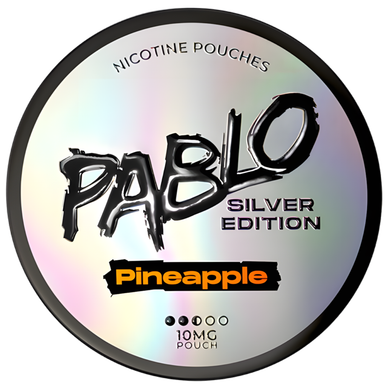
Pablo · 10mg · 10-can pack
Read the full guide
Pablo Silver Edition Pineapple Nicotine Pouches
£39.90
✔ In stock — ready to ship
100% tobacco-free
Free over £20
Same-day dispatch
Secure checkout
Pablo Silver Edition Pineapple Nicotine Pouches is a ten-can listing at £39.90, carrying one declared strength: 10mg. Our record files the flavour under a single word, tropical, and shows the listing as available at the time this page was written. That is the whole of what we hold. Everything below is assembled from those facts, from comparisons with other cans on our own shelves, and from plain admissions wherever our record runs out. Where we do not know something, this page says so rather than filling the gap with a guess that would read well and mean nothing.
This is an adult nicotine product. We sell it only to people aged 18 or over who already use nicotine, and the full wording for that sits in its own section further down. Nothing written here is intended to persuade anyone to consume anything, and nothing here is a recommendation to use nicotine.
The full guide to Pablo Silver Edition Pineapple Nicotine Pouches
5,224 words on how it eats, who it suits, how to serve it and what to put beside it.
What is actually in this listing
Ten cans for £39.90 works out at £3.99 a can. We have done that division ourselves so the listing can be set beside the single-can products elsewhere on the site; the figure that leaves your account is £39.90, and our record carries no smaller quantity of this particular product. A pouch count per can is not something our data holds, so we will not state one. It is printed on the tin, and the tin outranks this page on every question of that sort.
One point on the name before anything else. Silver Edition is Pablo's own naming for a group of its products. It is not a grade, not a rank, and not a quality tier that we can verify or that means anything measurable. The same goes for the other words Pablo puts on its ranges — Exclusive, Gold Edition, X. They distinguish one group of cans from another in the manufacturer's catalogue and nothing more. Read them as labels, not as scores.
Pineapple as a taste, and what our record says instead
Start with the discrepancy, because it is real and there is no sense hiding it. The product name says Pineapple. Our flavour field says tropical. Those are not in conflict, but they are not the same thing either: tropical is the bucket our shelves sort the listing into, and pineapple is the word Pablo prints on the can. We hold no separate tasting note, no flavour breakdown and no ingredient list beyond that single category word. So the description that follows is a description of pineapple as a flavour in general, written so you know roughly what territory the can occupies, and not a transcript of anything the manufacturer has told us.
Pineapple as a flavour has two distinct halves and most products lean towards one of them. There is fresh pineapple — sharp, acidic, slightly green at the edges, with a faintly resinous, almost woody note behind the sweetness that comes from the skin and core rather than the flesh. And there is tinned or candied pineapple — rounder, much sweeter, syrupy, with the acidity softened right down and the woody edge more or less gone. Confectionery flavourings tend towards the second reading because it is easier to build and easier to like, but plenty of products aim for the first.
Which of the two this can leans towards is not recorded in our data. We are not going to invent it. What we can say is that pineapple in any reading is a loud, bright, unmistakable fruit. It does not sit quietly in the background the way a berry or a melon can. It has a distinct top note that arrives immediately and a sweetness underneath that lasts. If you lift the lid on a pineapple product you will know what it is without reading the label, which is not true of every fruit in the category.
The aroma is the part most people notice first. Pineapple smells sweet and sharp at once — the sugar and the acid arrive together rather than in sequence — with a faint tang that reads as slightly fermented at the far edge, which is simply what ripe pineapple smells like. It carries further out of an open tin than a mint aroma does. That is worth knowing if you tend to open a can in a shared room.
Our record does not say whether this can carries a cooling element. The name contains no ice word, unlike a good many cans on our shelves, and we are not going to read one in from the fact that other tropical products have one. If there is a cool note in it, the tin will say so. If there is not, the flavour is the fruit on its own terms.
The can in the hand
Since this listing arrives as ten identical tins, the tin itself is worth more than the usual paragraph. What follows is about the object — its lid, its compartment, its shape and where it fits — because that is the part of a pouch product people handle dozens of times a week and almost never read a word about.
The lid and how it behaves
The standard nicotine pouch can is a low plastic cylinder with a lid that lifts clear of the body and presses back down onto a lip. It is not a screw thread. You pull it, it comes off, you press it back and it seats with a small click or a dull compression depending on how warm the plastic is. Cold plastic seats harder and louder; a tin that has been in a warm room goes back together more softly.
That friction fit is the part that changes over a can's life. A brand new tin is usually tight enough that you need two hands, or one hand and a thumbnail under the rim. After a week of opening and closing, the fit eases and most people can work it one-handed with a thumb. After the can is empty and has been reused for paperclips for six months, the lid is loose enough to fall off in a bag. None of that is a defect; it is what a press-fit plastic lid does.
Brand and flavour are printed on the lid face, which matters more than it sounds when you have several tins in a drawer and are looking down at them. Pablo prints the declared figure somewhere on the tin as well — the exact placement is the manufacturer's decision and varies across ranges, so we will not tell you which face to look at. Turn it over and read it.
The catch compartment
Above the main chamber, inside the lid, most cans of this type carry a shallow second compartment. It exists for used pouches. You lift the lid, the compartment is the recess in it, and a used pouch goes in there rather than in a pocket or on a table edge. This is the single most useful piece of design on the object and the one most often ignored.
Practically, it holds three or four before the lid stops sitting flat on the body. Once it stops sitting flat, the tin stops being pocketable, so the compartment wants emptying considerably more often than most people bother to empty it. Used pouches are general waste. They belong in a bin, not down a sink, not down a drain, and not out of a car window.
Whether this specific can carries that compartment is not a field in our record. Nearly all cans of this format do, but we are describing a convention rather than reading a spec sheet, and if you need certainty before you buy, the manufacturer's own imagery on the tin is the thing to go by.
Pocket, bag, drawer, car
The format's whole practical argument is that the tin is small and self-contained. A standard can disappears into a coat pocket without a visible outline, sits flat in the inside pocket of a jacket, and fits the small change pocket of a pair of jeans at a squeeze rather than comfortably. In a bag it will migrate to the bottom and end up under everything, which is why a good many people keep one in a fixed side pocket instead.
Car door bins and centre consoles are where a lot of tins live, and that is the one place we would gently push back on for a reason that has nothing to do with the product and everything to do with physics: a car interior in summer gets far hotter than a room, and heat is the main enemy of anything with a flavour in it. More on that in the storage section.
Keep tins out of reach of children and away from pets, in the same way you would with anything else in the house that is for adults only. That is not a health statement of any kind; it is basic sense about an age-restricted product that happens to come in a container a child could open.
Ten tins arriving at once
A ten-can order is a different object from a single tin. It arrives as a block — ten identical cans in a sleeve or a box, depending on how the manufacturer has packed that batch — and it is a storage decision as much as a purchase. Nine of them are going to sit somewhere for a while, and where they sit determines what condition they are in when their turn comes.
The practical approach most people land on is to break one out and leave the other nine together in whatever they arrived in, somewhere indoors, cool and dark. Splitting the block across a house, a car and a work bag means nine cans experiencing nine different climates, and it also means losing track of how many are left. Keep the block whole and take from it.
There is also a plain arithmetic point to make about buying ten of one flavour. It is ten cans of pineapple. If you are not certain you want that much of one taste, the sensible move is to buy a single can of something from the Pablo shelf first, live with it for a week, and come back. Nobody at this end benefits from you owning nine tins you have gone off.
The 10mg figure, read as a label
Pablo declares this can at 10mg and that is the only figure on the listing. There is no 6mg version, no 20mg version and no variant selector — one strength, one price, one product.
What that number is: a figure the manufacturer prints, declaring a nicotine content per pouch. What it is not: a score, a grade, a rating, a difficulty setting or a thing to work up through. A can with a higher printed number is not a better can, a more serious can or a can for a more experienced person. It is a different can with a different number on it, and the number is information for someone who already uses nicotine and already knows what they are reading.
We cannot advise which strength suits anyone. We hold nothing about you that would make such advice meaningful, and a shop steering a customer towards a particular nicotine figure is a shop doing something it has no business doing. The figure is printed, the product page states it, and the decision is not ours to make or to influence.
On our shelves, 10mg puts this listing in the Medium Strength band, which currently collects 135 listings. Above it we keep the Strong band and the Extra Strong band. Those bands are a filtering convenience — a way of narrowing 385-odd products down to something browsable — and not a statement about equivalence between the cans inside any one of them. A band is a shelf, not a verdict.
One filing oddity worth naming: the Pablo range spans more than one of those bands. This listing sits in Medium at 10mg while other Pablo listings carry considerably higher declared figures and sit further up. So "Pablo" on our shelves is not shorthand for any particular number. Read each listing's own figure.
The same-band shelf, and what a comparison is honestly worth
The obvious question for anyone standing in front of this listing is how it compares with the other cans we sell at the same sort of declared figure. That is a fair question and it deserves a fair answer, which starts with an admission about the limits of what we can compare.
What our data lets us compare, and what it does not
Our record for this listing carries this listing's declared strength. It does not carry the declared strengths of the other listings we link to from here. So when we set this can beside another can, we are comparing the things we actually hold — price, flavour category, brand, pack size where we have it, and stock — and not making a claim that the two cans carry the same number. If matching declared figures matters to you, the number on each product page is the number to read, and the tin is the number that counts.
There is a second limit, and it is the one that catches people out on price. We know this listing is ten cans for £39.90. We do not hold pack sizes for most of the neighbouring listings, so their prices cannot be divided into a per-can figure without opening each page. A £4.19 listing and a £39.90 listing are not necessarily a hundredfold difference in value; they are very likely a single tin and a box of ten. Where a page below is a single-tin price we will say so only if our record actually supports it, and where it does not, we will say that too.
The tropical neighbours
The closest comparison by flavour rather than by price is Nordic Spirit Tropical Mix at £4.49, which sits in the same tropical category and is in stock. A mix is by definition a blend rather than a single fruit, so it is a broader, less pointed taste than a straight pineapple — useful if you want the tropical territory without one fruit dominating it. Our tropical shelf holds 58 listings in total, and you can work through the rest of them on our tropical listings page rather than taking our word for which three are worth looking at.
Staying in fruit but moving away from tropical, SYX Apple Kiwi at £29.90 is in stock and pairs a common orchard fruit with a sharper green one, which lands somewhere adjacent to pineapple's acidity without the syrupy side. Fumi Green Apple at £27.90, also in stock, is the tart single-fruit option — apple in its sharp reading rather than its sweet one.
The same-price neighbours
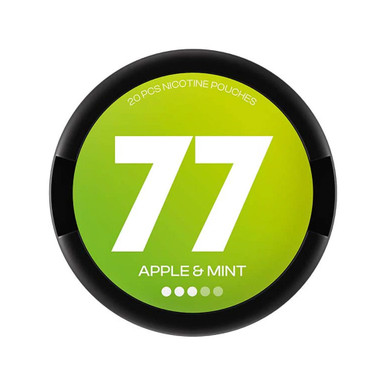
Several listings sit at exactly £39.90, which makes them the most directly comparable things on the shelf if price is your constraint. XQS Fizzy Peach is in stock at that figure and takes the stone-fruit route with a carbonated-sweet character rather than a fruit-acid one. Cuba Black Apple Juice, in stock at £39.90, reads as pressed juice rather than whole fruit — rounder and sweeter than a green apple flavour. And 77 Apple Mint, also in stock at £39.90, is the one that crosses the line into mint, which is a genuinely different proposition from anything above.
Within Pablo itself, the Silver Edition Blueberry Peach Ice can is the direct sibling at the same £39.90 and is in stock. It is the same range, the same price structure, and a completely different flavour family — berry and stone fruit with a cool note named on the can, where this one names no cool note at all.
Two on that list you cannot buy today
Two of the neighbouring listings our record links from this page are out of stock at the time of writing, and we would rather tell you that here than let you find out at the basket. Klint Apple Mint at £36.90 is unavailable. Pouch Nurdz Peach Blue Razz at £19.99 is unavailable as well — and in fact every Pouch Nurdz listing in our catalogue is currently out of stock, so that whole brand is browsing only for now. Both pages are still worth a look if you want to see what the flavour is, but neither can be bought today and we cannot tell you when either returns.
There is also Velo Peach Ice at £4.19, which is in stock and is the cheapest listing on the comparison set — almost certainly because it is a single tin rather than a box, though as said above, our record does not carry its pack size and we are not going to assert one.
Pablo's shelf, and where this can falls on it
The Pablo range on our shelves runs to 56 listings, which makes it one of the larger single-brand groups we carry. Six of its cans are linked from this page and the rest are on the brand shelf. The range is organised by Pablo into named editions, and those names are the main thing to understand when navigating it.
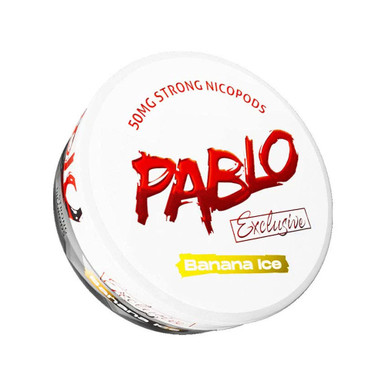
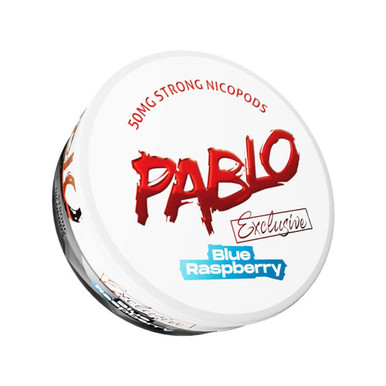
The Exclusive group is where most of the brand's fruit work sits and where the single-tin pricing lives. Pablo Exclusive Banana Ice at £3.85, in stock, is the soft-fruit option with a cool note in the name. Pablo Exclusive Blue Raspberry at the same £3.85 and also in stock is the confectionery reading of raspberry rather than the fresh-fruit one — a sweet-shop flavour, closer in construction to this pineapple than a tart berry would be.
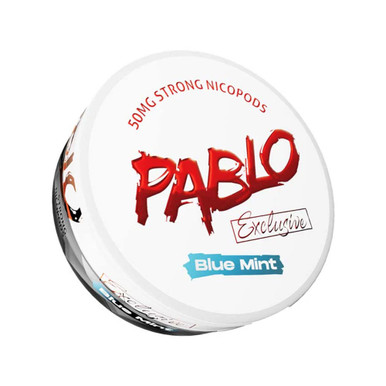
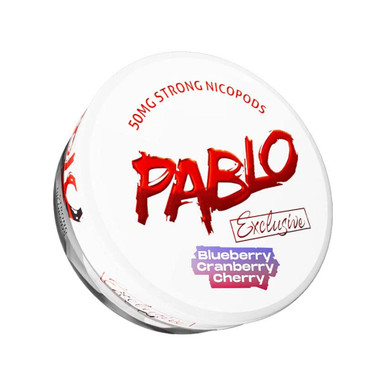
For anyone who wants more than one fruit in the tin, Pablo Exclusive Blueberry Cranberry Cherry at £3.85 stacks three of them, and Pablo Exclusive Blueberry Peach Ice at £3.85 pairs berry with stone fruit and names a cool element. Both are in stock. On the mint side of the brand, Pablo Exclusive Blue Mint at £3.85 is in stock and is the obvious thing to keep in the house if you want the second tin to have nothing whatsoever in common with the first.
And then there is Pablo Exclusive Bubblegum at £3.85, in stock, which is worth naming because it is the clearest example of Pablo's confectionery end — a flavour that makes no pretence of being a fruit and is straightforwardly a sweet-shop taste. If the syrupy, candied reading of pineapple is what appeals to you here, that is the corner of the range to look at next.
What people keep alongside a can like this
Most people who buy pouches at all keep more than one flavour going, for the simple reason that a single taste gets monotonous long before ten tins run out. The usual pattern is one fruit and one mint, or one sweet and one sharp, so that there is somewhere else to go.
Against a sweet tropical fruit, the natural second tin is something cold and unsweet. The mint shelf is the biggest flavour group we keep and is the obvious place to look for a contrast. Against a sharp tropical fruit, a rounder, sweeter can works better as a companion — the Cuba apple juice reading mentioned above, or a berry.
If you would rather browse by brand than by flavour, the Cuba shelf is the other large single-brand group on the site and is a reasonable second stop after Pablo. And if you want no filter at all, everything we stock is one page and is the honest answer for anyone who would rather scan the whole catalogue than be steered through six suggestions.
Keeping a can in condition
Storage for this format is unglamorous and almost entirely common sense, but the ten-can pack makes it worth setting out properly, because nine tins are going to be stored for some time.
Cool, dry and dark is the whole instruction. An indoor cupboard, a drawer, a shelf away from a window. Heat is the main thing that degrades a flavoured product in a sealed plastic tin, and the two places that get hottest in most people's lives are a car in summer and a windowsill in the afternoon. A tin left on a dashboard for an afternoon is not a safety problem; it is a flavour problem, and it is avoidable.
Leave the nine unopened tins in whatever packaging they arrived in. The outer sleeve or box does a small amount of work keeping light off them and keeping them together, and there is no reason to unwrap tins you are not using yet. Press the lid fully home on the one that is open — a lid that is sitting proud is a tin that is drying out or picking up whatever else is in the drawer.
We have no basis for recommending refrigeration and do not recommend it. Some people do refrigerate pouch tins; we hold no data on whether that helps, hurts or does nothing at all for this product, so we are not going to have an opinion. The manufacturer's printed guidance on the tin is the guidance that applies.
As for how long an opened tin stays good — nobody can give you a figure that means anything. It depends on how often the lid comes off, how warm the tin gets and how long it sits between uses. There is a printed date on the can and that is the reference point that actually exists. Anything else would be us making up a number.
One strength, one pack size — what there is to choose
This is a short section because there is genuinely very little to choose here, and padding it out would be dishonest.
The listing has one declared strength, 10mg, and one price, £39.90, for ten cans. There is no variant selector, no smaller box and no alternative figure. The only decision in front of you is whether you want ten tins of this flavour, and the only real input to that decision is whether you already know you like pineapple.
If you do not, the single-tin listings on the Pablo shelf at £3.85 exist precisely for that situation, even though they are different flavours. Buying one tin of something to learn how a brand builds a flavour is a cheaper experiment than buying ten tins of something specific. If you do already know, the ten-can box at £3.99 a tin is the cheaper way to hold that flavour, and that is the entire argument for it.
Ordering, delivery and the age check
Age confirmation happens at checkout and is not optional. Orders may be verified before they leave us. Photographic ID may be requested by the courier at the point of delivery, and if there is no adult present to receive the parcel and show it, there is no delivery — the parcel goes back.
We do not sell to anyone under 18 under any circumstances, and we do not sell to anyone buying on behalf of someone under 18. That is not a formality on this site; it is the condition on which the shop operates.
On availability: this listing shows as in stock as this page is written, but stock moves, and the live figure on the product page is the one to trust over anything written into body copy weeks earlier. Where a linked page is unavailable we have flagged it above, but those flags are a snapshot too.
Finding this page again
Three shelves carry this listing, and any of the three will bring you back to it. It sits in the Medium Strength band with 134 other listings, on the Pablo brand shelf with 55 others, and in the tropical flavour group with 57 others. Those three shelves are linked from elsewhere on this page rather than repeated here, and between them they are how almost everyone arrives at a product like this — either by brand, by strength band, or by what they feel like tasting.
If none of those is how you think about it, the full catalogue page is the blunt instrument, and there is nothing wrong with using it. A lot of people find things faster by scanning a long list than by narrowing through filters.
What our record does not hold
Set out plainly, so it is in one place: we do not hold the pouch count per tin, the pouch format or size designation, whether the pouches are dry or moist, the weight of a pouch, the ingredient list, the country of origin, the manufacturing arrangement, any flavour note beyond the single word tropical, or any date information. We also do not hold the declared strengths of most of the products this page links to.
All of that is either printed on the tin and its outer packaging or available from the manufacturer. None of it is something we are willing to reconstruct from a brand name and a product title, because a plausible invention is worse than an admission.
Questions people actually ask
How many pouches are in a can?
Not in our data, so we will not state a number. Our record holds the price, the single declared strength, the flavour category, the brand, the ten-can pack size and the stock status. Pouch counts per tin are not among those fields. The figure is printed on the can itself and on its outer packaging, which is where it belongs and where it will be accurate for the batch you actually receive.
Is the £39.90 for one can or for ten?
For ten. This is a ten-can listing and £39.90 is the total for the box, which is £3.99 a tin. That division is ours, done so the listing can be compared with single-tin products; the amount charged at checkout is £39.90. There is no single-can version of this particular product in our record.
Does it actually taste of pineapple, or just generically tropical?
We cannot tell you, because our record files the flavour only as tropical and carries no tasting note. The product name says Pineapple and that is Pablo's own naming. What this page has given you is a description of pineapple as a flavour family so you know the territory, clearly marked as general rather than specific. The tin's own description is the thing to read.
Is there a cooling element in it?
Our record does not say, and the product name carries no ice or frost word — which is notable, because a great many cans on our shelves do carry one and this does not. We are not going to infer a cool note from the category. If it matters to your choice, the manufacturer's description on the packaging will settle it.
Are these slim or regular pouches?
We do not hold a format designation for this listing and will not guess at one. Pouches across the category come in more than one size and shape, and the difference is noticeable in practice. Whatever size these are, every pouch in a given tin matches every other pouch in that tin — there is no mixture inside a single can.
What does 10mg mean and is it a lot?
It is the manufacturer's declared nicotine content per pouch, printed by Pablo. Whether it is "a lot" is not a question we can answer for you, because the answer depends entirely on the person asking and we hold nothing about you. We will not describe a figure as gentle, strong, suitable or otherwise, and we will not suggest working up or down. The number is on the can; the judgement is yours.
Why is it filed under Medium Strength when Pablo makes much higher figures?
Because a listing sits on the strength shelf its own declared figure puts it on, not the shelf its brand mostly occupies. Pablo's range spans more than one band on our site. This listing declares 10mg, so it sits in the Medium band. That is a fact about our filing system rather than about the brand, and where band and tin appear to disagree, the tin is the manufacturer's declaration and it is the one that counts.
Can I buy a mixed box of Silver Edition flavours?
Not as a single listing. Each ten-can listing is ten of one flavour. If you want variety you would order more than one listing, or pick up single tins from the Exclusive side of the brand at £3.85 each. We hold no mixed-flavour box for this range in our record and are not going to imply one exists.
How should I store the nine tins I am not using?
Indoors, cool, dry and dark, left in the packaging they arrived in, kept together rather than distributed around a house and a car. Away from heat and direct sun in particular, and out of reach of children and pets. That is general housekeeping for a plastic tin with a flavour in it, and it is not advice of any other kind. We do not recommend a fridge because we have no basis for doing so.
Where is it made?
We do not publish that. Origin and manufacturing details are not in our record for this listing and we are not going to reconstruct them from a brand name. They appear on the packaging alongside importer information, which is the proper and accurate place for them.
Can I recycle the tins?
They are plastic, so household plastics recycling to whatever extent your local authority accepts that grade — which differs by council and is not something we can resolve for a particular postcode. Used pouches themselves are general waste and belong in a bin rather than a sink or a drain. A ten-can order leaves you with ten empty tins in the end, and a fair number of people keep one or two for screws, guitar picks and other small things.
The linked pages I clicked say out of stock. Why link them at all?
Because a page you cannot buy from today is still the best description of that flavour we have, and because stock returns. What we will not do is send you to one without warning, which is why the unavailable listings are marked as such above rather than blended in with the rest. We cannot tell you when anything comes back; we do not hold restock dates.
The compliance section
We sell this product only to adults aged 18 or over who already use nicotine, and to nobody else. Age confirmation is required at checkout, orders may be verified before dispatch, and photographic ID may be requested by the courier on delivery. No adult present to receive it means no delivery.
Nicotine is an addictive substance. That statement belongs in plain sight on a page like this one rather than in small type at the bottom of a footer.
This product is not a licensed stop-smoking medicine and is not offered, described or intended as one anywhere on this site. It is not intended for non-smokers, for anyone who does not already use nicotine, for under-18s, or for anyone who is pregnant or breastfeeding. We make no health, medical or safety claim about it in any direction whatsoever. If you have a question about nicotine and your own circumstances, a pharmacist or a doctor is the right person to ask — we run a shop and hold no expertise of that kind.
Closing note
Pablo Silver Edition Pineapple is a ten-can box at £39.90, £3.99 a tin, carrying one declared figure of 10mg and filed on our shelves under a single flavour word: tropical. The name says pineapple; our record does not go further than the category, and this page has said so rather than dressing up a guess as a tasting note. It sits in the Medium band, on a 56-listing brand shelf whose named editions are manufacturer labels and not quality grades, and among 58 tropical products that are a click away. Where our data stops — pouch counts, format, origin, dates, the strengths of neighbouring cans — the honest answer is that we do not hold it, and the tin in your hand outranks anything written here.
More from Pablo
More medium strength pouches
More tropical pouches
Where this sits
Pablo Silver Edition Pineapple Nicotine Pouches appears in these categories. Browse them, or jump to something close.
You might also like