Home / Medium Strength / Nordic Spirit Sweet Mint Nicotine Pouches
Nordic Spirit · 6mg–11mg
Read the full guide
Nordic Spirit Sweet Mint Nicotine Pouches
£4.49
✔ In stock — ready to ship
100% tobacco-free
Free over £20
Same-day dispatch
Secure checkout
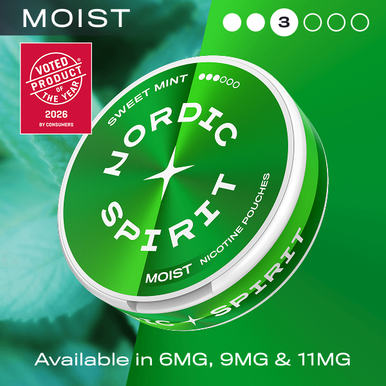
This is the listing for Nordic Spirit Sweet Mint Nicotine Pouches, priced at £4.49. Three declared strengths sit behind it — 6mg, 9mg and 11mg — and every variant is £4.49, so which figure you choose has no effect on what you pay. Our catalogue holds a single flavour tag against the can: mint. It is in stock at the time of writing and there is one photograph on the listing.
That short list is the entirety of our factual record. Everything after it is one of three things — a description of the object, a comparison with cans that are genuinely on our shelves, or a plain statement that we do not hold something. There are a number of the third kind and we have not disguised any of them. A page that answers every conceivable question is usually a page that has started inventing.
The full guide to Nordic Spirit Sweet Mint Nicotine Pouches
4,928 words on how it eats, who it suits, how to serve it and what to put beside it.
Sweet Mint, and what our record actually says
On the brand name, since it invites a reading it cannot support: "Nordic" is part of a name. It carries no information about where this can or its contents were made. We hold no country-of-origin data for anything we sell and we publish no origin claims anywhere on this site.
And the standing point: an adult nicotine product, sold only to people aged 18 or over who already use nicotine. The full wording sits in its own section at the foot of the page.
What "Sweet Mint" is putting in the foreground
The name is doing something specific, and it is worth reading carefully rather than skipping past as a generic mint label.
Nearly every mint flavouring carries some degree of rounding sweetness, because mint with nothing behind it reads as bare and slightly severe. The usual arrangement is that the sweetness supports and the mint leads. What a can named Sweet Mint is signalling is that the arrangement has been reversed, or at least levelled — the sweetness is being presented as a feature of the flavour rather than as scaffolding behind it. The mint is still there, obviously, but it is being offered as a rounded, softened mint rather than a bare or a cold one.
Described as taste and aroma only, that means a mint that reads full and smooth across the mouth rather than concentrated and sharp at the front of it, with the sweet element present as part of the flavour rather than as an aftertaste sitting behind it. The aroma from an open tin is the same character in the air above the pouches, briefly, and it stops when the lid goes back on. A closed tin gives you nothing, which is true of every can of this kind.
What we are not going to do is put a number on any of it. There is no sweetness scale in this category, no cooling index and no intensity rating. Anything presented as one, anywhere, is an opinion with a number attached to make it look like a measurement. We have not run a tasting panel on this can and we are not going to write as though we had.
Against the brand's other mints, honestly
This brand lists Sweet Mint, Spearmint and Frosty Mint, and in our catalogue all three carry exactly the same single tag: mint. Our data does not distinguish them by so much as a word. The only thing in our records that separates one from the others is the name printed on the lid, and it is better to say that outright than to let three product pages imply three documented flavour profiles.
The names do point at real differences. A frost-named mint is built so the cooling sensation leads and the mint character sits beneath it — a genuinely different construction, and the furthest of the three from this one. Spearmint names a different mint altogether: the green, herbal, softer mint rather than the sharp cold one.
And here is the part most product pages would rather not write. Spearmint is already the naturally sweeter of the two common mints. So Sweet Mint and Spearmint are closer to each other than either is to a frost, and a meaningful part of what separates those two is which quality the name chooses to put in front — the herb in one case, the roundness in the other. That is a real difference in emphasis and it is not nothing. But it is narrower than three distinct names on three distinct cans would suggest, and where a distinction lives mostly in the naming, we will say so rather than invent a tasting note to widen the gap. One can of each is the only test that settles it, and that includes testing it against this paragraph.
How a flavour gets built into a dry pouch at all
This is the question underneath every flavour name on the site and it is rarely addressed, so it is worth a proper section — with one boundary stated up front. We are not going to describe composition. We do not hold ingredient information for anything we sell, we do not publish it, and it is the manufacturer's material to state on their own packaging. What follows is about flavour as a perceptual problem, not as a recipe.
The constraint the format imposes
A dry pouch is an unusual vehicle for a flavour. There is no liquid carrying it, no heat, no steam, and none of the aroma-through-the-nose that does most of the work in food and drink. What is left is a small object sitting still in one place, releasing its character slowly and in one spot rather than across the whole mouth at once.
That constraint shapes which flavours work well in the format and which do not, and it is the reason the category is dominated by mints and simple fruits rather than by complicated or subtle flavours. A mint survives the format because mint is recognisable from very little — it is one of the few flavour families almost everyone can identify instantly and incompletely. A fruit works if it has a distinctive edge. A flavour that depends on aroma, or on temperature, or on several elements arriving together, has a much harder time of it.
Leading and supporting
Any flavour with more than one element in it has an order of arrival, and that order is the thing a flavour name is usually describing. A can named for a fruit with a cool element behind it is telling you the fruit leads. A can named for frost with a mint behind it is telling you the cool leads. A can named Sweet Mint is telling you the sweetness is not merely support.
This is more useful than it sounds, because the order of arrival is also the order of departure. The leading element is generally the one you notice first and the supporting one is generally what remains at the end, as the lead thins out. That is why people describe a fruit-and-mint pouch as finishing cool, and why a mint-led pouch tends to finish as a faint version of itself rather than as something different. Again: a description of how layered flavours behave, not a measurement of this can.
Why single notes and blends differ in kind
A single-note flavour — one mint, one fruit — reads consistently from the first minute to the last, thinning rather than changing. A blend reads as a moving target, because its elements do not fade at the same rate, and what you have at the end is a different balance from what you had at the start.
Neither is better. They suit different preferences and that is all. It does explain a common experience, though: someone who finds a blend "changes too much" and someone who finds a single note "goes flat" are describing the same property from opposite sides. Within this brand, the mints are the single notes and the berry blends are the moving targets, which is a more useful way to choose between them than the flavour names alone.
What the name can and cannot tell you
Flavour names in this category are doing an enormous amount of work, because they are frequently the only descriptive information attached to a listing — on a category page of 148 mints, the name is almost the whole of what distinguishes one tile from another. They are marketing copy written by manufacturers, not standardised descriptors, and two makers can use the same word to mean noticeably different things.
So: read names as signals of intent rather than as specifications. They will reliably tell you which broad family a can belongs to and which element is meant to lead. They will not tell you how sweet, how cool or how intense anything is, and no amount of reading will substitute for opening one.
The tin and the pouch, in use
A pouch sits in the mouth between the lip and the gum, usually under the top lip. It is not chewed and it is not swallowed. It stays put once placed, held by the lip and the gum line, and can be moved across with the tongue if it is not comfortable where it is. If it is uncomfortable everywhere, taking it out is the sensible response.
How long people keep one in runs from a few minutes to the better part of an hour, which is too wide a range for an average to be of any use. Most take one out when the flavour has gone. We set no time, recommend none, and hold no manufacturer usage guidance in our data — the printed can carries its own and that is what to follow.
The tin is the standard shallow round one with a friction-fit lid: light pull off, light push back on, with a dull click when the rim seats properly. The lid carries the brand, the flavour name and the declared figure, readable without opening anything, which matters when three figures exist and you may have more than one tin about. Under the lid is a catch compartment for used pouches — genuinely useful, smaller than people expect, and best emptied before it fills, since a lid that will not sit flat is nearly always a full compartment rather than a damaged tin. Used pouches go to general household waste. The tin is plastic and kerbside acceptance of that plastic varies by council.
We hold no pouch count, no pouch dimensions and no format designation for this listing, so we state none of them. The printed can has its own numbers and they are the ones to trust over anything repeated second-hand.
6mg, 9mg and 11mg as label information
The declared figure is the nicotine content the manufacturer states per pouch and prints on the packaging. It is label information, reproduced from our product record without interpretation.
All three figures place this can on the Medium Strength shelf, currently 135 listings, which sits alongside the Strong shelf and the Extra Strong shelf. Those are our navigation labels — a way of grouping cans by declared figure so a large catalogue can be browsed — and they carry no recommendation.
Across makers the comparison is looser than it looks, because each manufacturer sets and prints its own figure. The same number on two brands' cans is two separate label statements rather than one shared measurement.
We cannot advise which of the three suits anyone. Not by any criterion, not from anything you could tell us, and not by implication — we will not call 6mg an entry point or 11mg a destination, because that is a recommendation dressed as a description. Three numbers, one price, and the choice belongs to the person making it.
Buying this over time, rather than once
Everything above concerns choosing a can. This part is about the less-discussed business of buying the same thing repeatedly, which is what most people reading a page like this are actually doing.
The arithmetic you cannot do
Start with an admission, because it undermines the obvious approach. Our product data holds no pouch count for this listing. It also holds no cans-per-pack value — the field is empty. So the two numbers you would need in order to work out how long a purchase lasts, and what it costs you per pouch, are both absent from our record.
We will not fill them in. We will not tell you this is a single tin and we will not tell you it is a multi-can roll, because we do not hold it, and this is exactly the sort of detail people assume is obvious and then get wrong. The listing at checkout and the product photograph are where to confirm quantity. If they leave it ambiguous, ask before ordering.
The same gap is why the prices quoted further down this page cannot be compared directly. A price difference between two listings is not a per-can difference until you know what each listing contains. We would rather say that repeatedly than let a £4.49 sit next to a £39.90 and imply a comparison neither figure supports.
Why people end up with two tins
The most common habit in this category is keeping an unopened can behind the one in use, and the reason is a design fact rather than a preference. A tin has no window. You cannot see how much is left without taking the lid off, weight in the hand tells you almost nothing, and consequently the moment anyone discovers a can is empty is invariably the moment they wanted something from it.
A second tin also solves the variety question at the same time. Two cans open at once, alternated, keep both flavours readable in a way that one flavour used continuously does not. So the spare is not really about stock levels; it is about having somewhere to put the second choice. At a flat £4.49 across this brand, the cheapest way to arrange that is another can from the same range.
Two ordering patterns, neither of which we recommend
Repeat orders here fall into two shapes. Some people order when they notice they are low, which means ordering at roughly the point the current tin runs out and accepting a gap while the parcel travels. Others order on a rhythm — the same order at the same interval, sized to overshoot slightly, so there is always something in the cupboard.
The second is less stressful and costs more up front. Which suits you is a question about your own habits and your own budget, and it is not one we are going to answer. A retailer advising a customer on how often to buy is a retailer with a thumb on the scale, and we would rather be useful about the mechanics and silent about the frequency.
The one practical observation worth making is about stock rather than about you. Availability across a catalogue this size moves constantly, and if you are attached to one specific flavour rather than content with the family, the rhythm approach insulates you from that better than noticing-and-reordering does. That is an argument about supply, not an argument about consumption.
What the flat price does to all of this
Every Nordic Spirit listing we hold a price for is £4.49. A range priced identically end to end is unusual, and it changes the shape of a repeat order: there is no cost reason to stay loyal to one flavour and no cost penalty for changing, so a reorder becomes purely a question of what you want next. It also means the total of a basket is trivially easy to work out in your head, which removes the commonest reason for abandoning one — reaching the total and finding it is not the number you expected.
Neither point is a reason to buy anything. They are observations about how a flat price behaves, included because across this catalogue that pricing is rare enough to be worth explaining.
Mixing an order
No penalty, no extra step. Different makers, different flavours and different declared figures go in one basket and ship together, and the age check applies to the order as a whole rather than to each line on it. An order of six different cans is no more complicated at checkout than an order of one.
The rest of the Nordic Spirit range
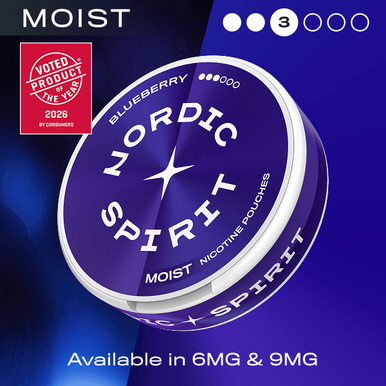
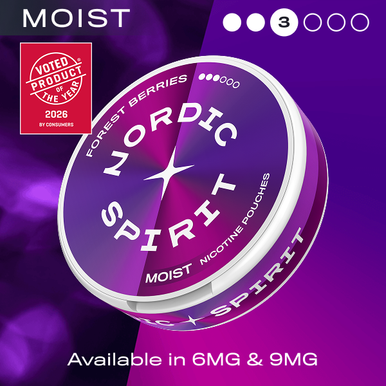
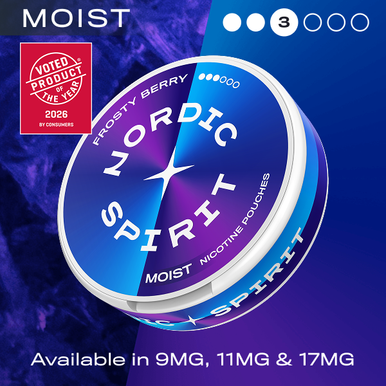
Fourteen listings, all £4.49 where we hold a price. On the fruit side: Blueberry as a single fruit at the round, soft end; Forest Berries as a blend; Frosty Berry as a berry with a cool element put in front of it; and Max Foresty Berry, a blend under the brand's Max naming. The spelling on that last one is the manufacturer's and we reproduce product names as given rather than correcting them, since a tidied name is one that no longer matches the box.
"Max" is worth a sentence, since it appears twice in the range. It is the manufacturer's naming convention for a can with a higher declared figure than the standard line. It is a label and not a rating — it does not mean better, does not mean more advanced, and does not describe flavour. There is no progression built into this range and we are not going to describe one.
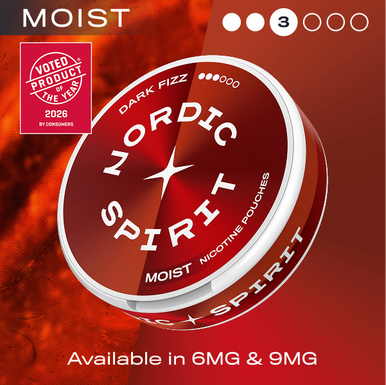
The outlier is Dark Fizz, which belongs to neither the mint nor the fruit side and carries no flavour tag we can put a family name to. It is £4.49 and in stock like the rest. The brand page shows all fourteen at once, which at this size is a short read.
Cans from other makers that sit near this one
If you want another mint that reads differently rather than similarly, the cold-named cans are the clearest contrast: Klint Arctic Mint at £36.90, SYX Cool Mint at £29.90 and XQS Arctic Freeze at £39.90, all in stock, all putting the cool element in the lead where this can does not.
White Fox Double Mint at £34.90 is doing something else again, since doubling implies a combination rather than a position on one axis. For the herbal mint rather than the sweet one, Velo Bright Spearmint at £4.19 and Edge Spearmint at £14.95 are the two on our shelves, both in stock, and the Velo is the closest thing here to a like-for-like price comparison with this listing.
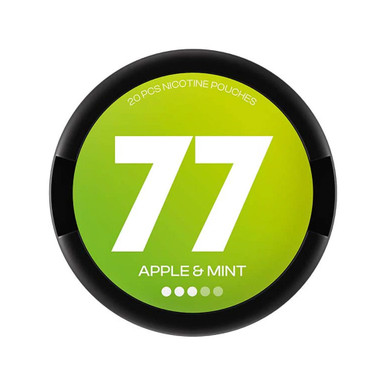
77 Apple Mint at £39.90 takes the middle route by pairing mint with a fruit. And for a complete change of family there are Fumi Dark Spice at £27.90, UBBS Cola Ice at £19.95 and Pablo Silver Edition Blueberry Peach Ice at £39.90 — all in stock, and all subject to the quantity caveat above before you read anything into those prices.
A note on the tin as an object
The can gets treated as packaging and it is worth a few lines of its own, because it is the part of the purchase you handle every day and the differences between one maker's tin and another's are the ones you actually notice.
Inside the main body the pouches lie flat in a ring around the wall with the centre left open. That arrangement is close to universal in this category and it exists so every pouch is reachable with one finger rather than dug out from under others. It is also why a half-used tin rattles faintly and a full one does not, and it is the reason there is dead space in the middle of what looks like a solidly packed can.
There is no window anywhere on the tin, which sounds trivial and drives more behaviour than any other feature — it is the whole reason for the second-tin habit described above. The lid is a press fit rather than a thread, which makes it fast to open one-handed and also means it will pop if squeezed hard in the wrong place; a tight trouser pocket sat on for an hour manages it regularly. That is not a defect, it is what a friction fit does, and a coat pocket or a bag is the practical answer. Two tins stack stably; three slide. We do not sell or stock a case, holder or any accessory of that sort, so this is a description of the object rather than a route to an upsell.
Keeping a tin in condition
Lid on properly after every pouch. The contents meet the air whenever the tin is open, and a can left open is the main reason one tastes different at the end than it did at the start.
Cool, dry, out of direct sun. A drawer, a shelf, a bag. Not a dashboard in July, not a windowsill, not above a radiator. Heat is the second thing that changes a tin over time.
On refrigeration we get asked regularly and cannot settle it — some people do, some do not, and we hold no manufacturer storage instructions in our data, so the can's own printed guidance is the guidance. What is beyond argument is that a tin kept shut, cool and dry is in better shape at the end than one that is not.
Keep it away from children and from anyone it is not intended for. With an age-restricted product that is basic sense rather than storage advice, and it applies to a tin on a worktop as much as to one in a cupboard.
Choosing between the three, and confirming what you are buying
Three declared figures, one price, no cost consequence. The decision rests only on which printed figure you want and we are not going to influence it, including by the order in which we happen to list them.
On quantity, see the section above: the cans-per-pack field is empty for this listing and we are not going to guess at it. Confirm it on the product page and the photograph before ordering.
If you would rather browse by declared figure than by flavour, the 135 cans on the medium shelf is where this band sits, with the two shelves above it linked earlier.
Ordering, delivery and age verification
The can goes in the basket at £4.49 with your chosen figure, and the order is subject to age verification because everything we sell is age-restricted. That check is not waived for small orders or for returning customers.
You must be 18 or over to order. ID may be requested on delivery and the courier may decline to hand the parcel over if the check cannot be completed. That is the courier following the rules rather than a fault with your order.
Stock moves daily. Everything linked from this page was in stock when it was written, but the live listing is always the accurate source and a description page is a snapshot of one moment.
Getting back to this listing
Three reliable routes. By maker, through the Nordic Spirit brand page, which is the quickest at fourteen listings. By declared figure, through the medium shelf. By flavour, through the mint category, which at 148 listings is the largest flavour shelf we run and therefore the slowest of the three unless you already know the maker.
From the top, everything we stock is the whole catalogue in one place. If you browse by maker as a matter of habit, the Pablo brand page and the Cuba brand page are two of the deeper single-brand shelves here and make an instructive contrast with a fourteen-can range priced identically throughout.
Sweet Mint: questions that come up
How sweet is it, actually?
We cannot quantify it and we are not going to try. The name tells you sweetness is being presented as a feature rather than left in the background, and that is a genuine signal about how the flavour is arranged. It is not a measurement. There is no sweetness scale in this category and nobody here has scored this can against anything. If the degree matters to you, one tin answers the question and no description will.
Is Sweet Mint just the brand's Spearmint under another name?
No, but they are closer to one another than either is to a frost-named mint, because spearmint is already the sweeter of the two common mints. Our catalogue gives both the identical tag, the identical declared figures and the identical price, so our data does not separate them at all — only the names do. Where the difference between two cans lives largely in what they are called, we would rather say so than invent a distinction.
Why does the flavour tag only say "mint"?
Because a tag is a shelving category, not a description. Its job is to file this listing on the mint shelf with the other 147 cans so that browsing finds it, and it is deliberately broad for that reason. The name on the lid is the more specific source of the two, and where the tag is all our data holds, we say so plainly rather than presenting it as a tasting note.
How many pouches are in a can?
We do not hold that figure for this listing or any other in the brand. It is absent from our product data so we do not publish it. The printed can carries its own count and that is the number to rely on. Publishing an unverified count would be worse than the gap, because numbers copied between sites become almost impossible to correct later.
Do the three strengths cost different amounts?
No. 6mg, 9mg and 11mg are all £4.49, as is every Nordic Spirit listing we hold a price for. The declared figure has no bearing on price within this brand. Prices across the wider catalogue range from a little over £4 to around £40, but that reflects different makers and, in all likelihood, different quantities per listing rather than strength.
Which strength should I get?
We cannot tell you, and we will not imply an answer. Recommending a nicotine strength for an individual is not something a retailer is qualified or permitted to do. The figures are printed on the listing so you can read them and decide for yourself. Treat any site that offers you a personalised strength recommendation from a two-question form with appropriate scepticism.
Does "Nordic" mean it is made in Scandinavia?
It means the brand is called Nordic Spirit. We hold no country-of-origin information for anything on this site and publish none. Inferring a manufacturing location from a brand name is a common mistake and still a mistake.
Is this a single can or a pack of several?
Our record does not say. The cans-per-pack field is empty for this listing, so we will not assert either. Check the product page at checkout and the listing photograph, bearing in mind that a photograph of one tin is not evidence of quantity — single-can images are routinely used for multi-can listings across this industry. If it is still unclear, ask us before ordering rather than after.
What does the listing photograph tell me?
That you have the right brand and the right flavour name, and roughly what the tin looks like. Not much beyond that. An image without a reference object beside it has no scale, so it cannot tell you the diameter of the can or the size of the pouches, and as above it does not settle quantity either.
How long should I keep a pouch in?
We do not set a time. In practice people range from a few minutes to most of an hour, and most take one out once the flavour has faded. Whatever usage guidance the manufacturer prints on the can is the guidance to follow. We hold none in our data and are not going to invent a figure that sounds authoritative purely by being specific.
Do you publish ingredients or technical detail?
No. No ingredient lists, no composition, no weights or dimensions, no technical specification and no explanation of how any of it works. That material belongs to the manufacturer and appears on their packaging. Our pages carry only what is in our catalogue: name, brand, price, declared strengths, flavour tag, stock position and images.
Can I order this with cans from other brands?
Yes, and most orders do exactly that. This can, the Klint arctic mint and anything else in the catalogue go in one basket and ship together. Mixing makers, flavours or declared figures adds no step at checkout and the age verification applies to the order as a whole.
Is it in stock?
It was when this description was written, as was everything linked from it. Availability changes daily across a catalogue this size. The live product page is correct; this page is a snapshot, and where the two disagree the live page wins.
The notices we are obliged to carry
This product contains nicotine and is sold only to adults aged 18 or over who already use nicotine.
Nicotine is an addictive substance.
It is not a licensed stop-smoking medicine and is not presented as one. It is not intended for non-smokers, for anyone who does not already use nicotine, for anyone under 18, or for anyone who is pregnant or breastfeeding. Nothing on this page is an encouragement to begin using nicotine, and nothing on it is medical advice.
ID may be requested on delivery, and the courier may decline to complete the handover if proof of age cannot be provided. Any health question relating to nicotine use belongs with a qualified professional rather than with a shop.
The short of it
Nordic Spirit Sweet Mint is a £4.49 listing carrying 6mg, 9mg and 11mg at that one price, tagged simply as mint, shelved under Medium Strength, and in stock at the time of writing. The name puts the rounding sweetness in the foreground where a frost-named can puts the cool element there. Our data gives the brand's three mints an identical tag, so that naming is the only distinction our record supports, and we have said so rather than writing around it. We hold no pouch count and no cans-per-pack figure and have invented neither.
For mints from other makers, the 148-listing mint shelf is the full set, though going in by brand is faster. For the rest of this range at the same flat price, all fourteen Nordic Spirit cans sit together on one page.
More from Nordic Spirit
More medium strength pouches
More mint pouches
Where this sits
Nordic Spirit Sweet Mint Nicotine Pouches appears in these categories. Browse them, or jump to something close.
You might also like