Home / Medium Strength / XQS Tropical Nicotine Pouches
XQS · 8mg–10mg · 10-can pack
Read the full guide
XQS Tropical Nicotine Pouches
£39.90
✔ In stock — ready to ship
100% tobacco-free
Free over £20
Same-day dispatch
Secure checkout
XQS Tropical Nicotine Pouches are in stock and orderable at the time of writing. Unusually for this brand's pages on our site, there are two versions to choose between rather than one, and they are priced identically.
The practical consequence of that table is worth stating out loud: the choice between the two variants costs nothing. There is no premium attached to the higher figure and no saving attached to the lower one, so price cannot be used as a tiebreaker and the decision rests entirely on what a declared figure means to you — which, as the strength section below sets out at length, is not something a shop can work out on your behalf.
The full guide to XQS Tropical Nicotine Pouches
4,965 words on how it eats, who it suits, how to serve it and what to put beside it.
XQS Tropical: two cans under one listing
| Declared strength | Price | Pack quantity on our record |
|---|---|---|
| 8mg | £39.90 | 10 cans |
| 10mg | £39.90 | 10 cans |
The flavour record holds one entry: tropical. On this listing, unlike the brand's mint cans, the tag and the name on the lid agree with each other, which is a small but genuine improvement in the quality of information we can give you. What the word covers is a separate question, dealt with next.
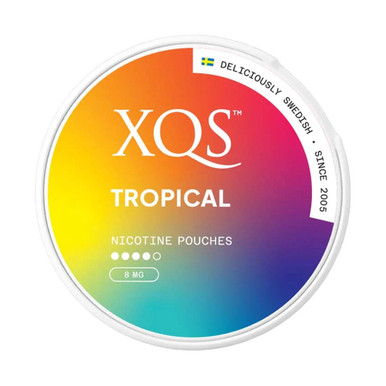
The tin is the standard shallow round one used across most of this catalogue: a rigid cylinder with a friction-fit lid, printing on the top face giving brand, flavour name and figure, a recess moulded into the underside of the lid, and the portions laid flat in a ring inside. We hold one photograph against the listing, so what you see on the product page is the can and nothing more elaborate.
This is an age-restricted nicotine product for adults aged 18 or over who already use nicotine. The full compliance statement is set out near the end of this page.
What "tropical" means as a taste, and what it does not tell you
Tropical is a family word rather than a fruit. It covers a recognisable cluster in flavour terms — pineapple, mango, passion fruit, guava, papaya and their relatives — and a can labelled tropical is generally built from some combination of that cluster rather than from one of them alone. That is the conventional meaning of the term in the trade. It is not a reading of our record, and we cannot tell you which fruits are represented in this particular can, in what proportion, or which one leads, because our catalogue holds the single word tropical and nothing beneath it.
Described as taste and aroma within those limits: the tropical family reads sweet and full rather than sharp and narrow. The aroma tends towards the ripe end — soft, round, slightly perfumed, closer to the smell of cut fruit than of citrus peel. On the palate the family is characterised by body: a broad sweetness that sits across the tongue rather than cutting through it, usually with a faint tartness underneath it to stop the sweetness becoming flat. Passion fruit contributes most of the tartness in a typical blend, pineapple most of the brightness, mango most of the weight. Which of those is doing the work here is not something our data records.
What tropical is not, as a family, is cool. Mint-family flavours carry a cool character as part of their basic signature; fruit families generally do not, unless a manufacturer has specifically built one in and said so in the name. Nothing in the name or the tag on this can indicates a cold element, so the honest expectation is a warm-reading sweet fruit rather than a chilled one. If a cold note is what you are after alongside a fruit, the neighbours section below points at several cans whose names declare one.
There are no scale readings available for any of this. No manufacturer in this category publishes sweetness, tartness or intensity figures, our record holds none, and any page that assigns a tropical can a score out of ten has invented it. The name, the tag and the general meaning of the word are the whole of what can honestly be said.
The figures on the two lids
The declared strengths on this listing are 8mg and 10mg. Both are label figures published by the manufacturer, and both variants sit on our Medium Strength shelf, which holds 135 listings and is the largest strength band we keep by a wide margin. Above it are Strong and Extra Strong, and those three shelves together exist so that several hundred listings can be narrowed into something a person can actually read.
The bands are a filing system. They are not a ladder, not a ranking and not a sequence anybody is expected to move along. Nothing on this page suggests that the 10mg can is better, more serious or more worth having than the 8mg one; the difference between them is two digits printed on a lid, and a bigger number on a lid is a bigger number on a lid and nothing else.
We cannot advise which of the two suits you, and we will not pretend otherwise. A shop has no basis on which to make that judgement about an individual. What we can tell you is what a declared figure does and does not do. It allows a rough comparison between cans that publish their figures the same way. It does not measure experience, it does not translate cleanly between brands, and it takes no account of pouch size, pouch weight or how dry or moist the portion is — all of which differ between manufacturers and none of which appears in the number. Two cans both marked 8mg from two different houses are not equivalent in any precise sense, and the label will not tell you which way the difference runs.
If you already use nicotine, you will have your own working sense of what a declared figure means in practice for the formats you use. That is the only useful input to this decision, and it is not one that exists on our side of the counter.
A format that does not announce itself
The defining practical characteristic of a pouch tin is that using one is not an event. There is no equipment, nothing to assemble, nothing to charge, nothing to hold, nothing to put down and pick up again, and nothing produced into the air around you. A portion is taken from a tin, placed under the upper lip, and then simply left there. That is the entire operation, and it is over in a couple of seconds.
The object in a pocket
The tin is a shallow rigid disc, roughly the footprint of a small jar lid and flatter than most people expect before handling one. It goes in a coat pocket, a trouser pocket, a bag pocket or a glove compartment without creating a bulge worth noticing. The lid is a friction fit rather than a thread, which makes it a one-handed open — and also means a tin loose in a bag among keys and coins can be persuaded open by pressure, so a pocket or a dedicated bag compartment is the better home.
The ten-can pack quantity on our record changes the calculation somewhat. Ten tins is not a pocket quantity by any reading; it is a drawer or a cupboard purchase, and the working pattern for anybody buying at this quantity is one tin carried and nine kept somewhere cool, closed and out of reach of children and anybody under 18.
The portion, and what it does once it is in
XQS uses a slim, dry portion — a narrow rectangle with rounded ends rather than a squat oval, and not wet to the touch. It is laid flat under the upper lip along the ridge, long edge horizontal, and it is placed rather than pushed. Once seated it needs no holding, no moving and no chewing, and the general experience of people who use the format daily is that leaving it entirely alone is what keeps it where it was put. Fiddling is what dislodges one.
The first half minute is the part you are conscious of, while a dry portion beds in against the lip. If it has gone in at an angle it will make that known immediately, and resetting it then is easier than putting up with it. After that the format's defining quality is that there is nothing to do and nothing to attend to.
How long a portion stays in varies widely. The commonly reported range runs from about fifteen minutes to roughly an hour, with a substantial tail either side — some people take one out after five minutes and some leave one well past the hour. That is a description of what people report rather than a recommendation, and there is no correct figure inside it. What is mechanically true of any flavoured product of this type is that its character is most distinct early and tails off, which tends to settle the duration question for most people within a week of using a format.
Talking is unaffected in practice. Drinking is fine, with hot drinks the thing people say changes the experience most and cold drinks the least. A full meal is the situation most likely to shift or damage a portion, which is why most habitual users take one out beforehand.
Flavour is not a discretion variable
People occasionally assume a fruit can is somehow more conspicuous than a mint one. In practical terms it is not. The format produces nothing into the air in either case, and the aroma that matters is the one that comes off an opened tin — which is present for a few seconds while the lid is up and gone once it is closed. A tropical can and a mint can are equally unremarkable once the lid is back on. Choose on flavour, not on some imagined difference in how noticeable one is.
Travelling with a tin
Packing is straightforward in itself: rigid tins survive a bag better than most things and there is nothing fragile about them. What is not straightforward, and what we are not going to guess at, is what any given carrier, country, border or operator permits. Rules on nicotine products vary by jurisdiction and by carrier, they change, and they are published by the people who wrote them. Check the airline's conditions of carriage, the operator's terms, and the destination's own rules on import. A retailer's page is the worst possible source for that information and we would rather say so than offer you a confident paragraph we cannot stand behind.
Venue and workplace rules belong to whoever wrote them
The same applies closer to home. We are regularly asked whether these are permitted in offices, on trains, in gyms, in hospitals, on customer sites, in stadiums and in restaurants. We will not answer it. Those policies are set by the employer, the venue, the operator or the site owner; they differ from one to the next; they are revised without anyone informing the shops that sell the product; and plenty of them cover nicotine products as a whole category regardless of what shape the product takes. The people who can give you a correct answer are the people who wrote the policy — your own employer's conduct rules, the site induction, the terms of entry printed at the door. Ask them. Treat any answer from a retailer, this page included, as worth nothing by comparison.
Ending a portion when there is no bin
The recess under the lid is the format's answer to the awkward part. A used portion goes into the shallow catch compartment, the lid goes back on, and it gets emptied into the next bin you pass. It is designed to hold one or two rather than a collection, and a tin in which several have accumulated over days is an unpleasant thing to open. Ordinary household waste is where a used portion belongs; the tin itself, once finished, is a rigid container and goes wherever your council says rigid containers go.
The XQS range on our shelves, and where this can falls in it
We carry fourteen XQS listings, collected on the brand page. Read across them and the first thing to notice is that the pricing is flat: effectively everything we hold from this house sits at £39.90, and as this listing demonstrates, even a higher declared figure does not attract a premium. A range priced that way cannot be read as a good-better-best sequence. It can only be read as a spread of flavours, which is a more useful thing to read anyway.
The fruit group, which is where this can lives
Tropical is one of several fruit-forward listings and it is the broadest of them, since it names a family rather than a single fruit. The nearest neighbour inside the brand is XQS Fizzy Peach at £39.90, which narrows to one stone fruit and adds a carbonated-sweet character rather than a ripe one — a different construction from a straightforward tropical blend, and currently in stock. Black Cherry, £39.90 is the dark and sweet corner of the range, heavier and less bright than a tropical reading. Berrynana Twist at £39.90 is the most compound flavour the brand offers on our shelves, running berry and banana characters together, and it is the closest thing in the range to Tropical's approach of blending rather than isolating.
The cold and mint group
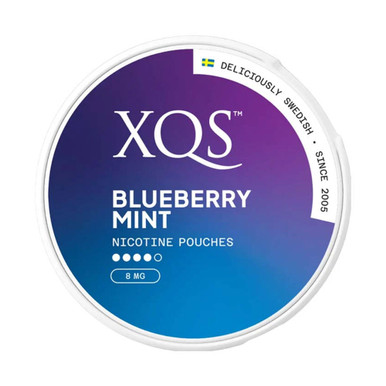
This is the half of the range furthest from this can. Arctic Freeze, £39.90 is the frost-forward entry, where a cold character leads and everything else sits behind it. The brand's two mint cans take the herbal route instead and are filed under a single generic mint tag in our catalogue, which means our data cannot distinguish one from the other however clearly their lids do. Blueberry Mint at £39.90 is the crossover between the two halves of the range, building a dark fruit onto a cool base, and it is the natural can to look at if you want a fruit that keeps some chill in it.
The bridge and the soft-drink corner
Citrus Cooling, £39.90 is the listing that sits deliberately between the fruit and the cold sides: a citrus character with a cool element declared in the name. It is the obvious next stop for somebody who likes fruit but finds a warm-reading tropical blend too soft. Cola Lime at £39.90 is the soft-drink entry and the one furthest from everything else in the line, combining a cola character with a sharp citrus. Every XQS listing named in this section is in stock as this page is written.
Reading a flat-priced range against a tiered one
If you want to see how differently a range can be structured, the Pablo shelf and the Cuba shelf are the two largest brand pages we keep and both spread across several price points rather than sitting on one. Comparing the three brand pages side by side tells you more about how this market is priced than any individual product page can, and it makes clear that price in this category tracks pack quantity and brand positioning far more than it tracks anything about a flavour.
Fruit cans from other houses worth knowing about
Outside the brand, the tropical and orchard-fruit end of our shelves is well populated, and the useful comparisons are the ones where something specific differs.
For the same flavour family at a fraction of the outlay, Nordic Spirit Tropical Mix at £4.49 is the cheapest way on this site to find out whether a tropical blend suits you at all before committing to a ten-can pack. Velo Peach Ice, £4.19 is the other single-can option in the fruit area and declares a cold note in its name, which makes it a cheap test of the warm-against-chilled question raised earlier.
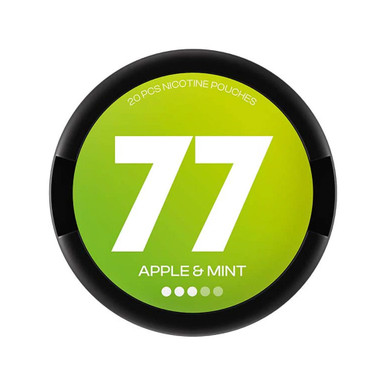
Moving up in price, SYX Apple Kiwi at £29.90 pairs an orchard fruit with a green one and is a genuinely different construction from a tropical blend. Fumi Green Apple, £27.90 goes the other way and isolates a single sharp fruit, which is the cleanest contrast available to a family blend. Cuba Black Apple Juice at £39.90 is the same idea again at this listing's own price point, sweet and juice-like with no cool element filed against it. 77 Apple Mint, £39.90 sets a sharp orchard fruit against a cool base, and Pablo Silver Edition Blueberry Peach Ice at £39.90 combines a berry and a stone fruit with a cold note — the most layered of the alternatives here. All of those are in stock.
Why people keep a second can beside this one
A single flavour used exclusively becomes background within a fortnight for most people, and a family blend is no more immune to that than a single note. The commonest arrangement among people who buy at pack quantity is therefore one pack of the known thing plus one tin of something deliberately unlike it, alternated rather than mixed. The contrast that works best is usually structural rather than small: a warm sweet fruit against a cool or a sharp one, rather than one tropical blend against another.
Practically, that means the cheap cans are the useful ones to keep beside a pack. A four-pound tin sitting in a drawer as the alternative costs almost nothing and does the job of stopping a forty-pound pack going stale on you halfway through. Within this brand, the crossover listings mentioned above are the equivalent move at the same price point. There is no right pairing and this is not advice about consumption — it is an observation about how people who buy in quantity tend to organise what they have bought.
Two nearby listings you cannot buy at the moment
Two cans that sit close to this one in our catalogue are currently unavailable, and linking them without saying so would be unhelpful. Klint Apple Mint, listed at £36.90, is out of stock; its page is live and it is a reasonable one to note for later if the fruit-with-mint construction is what you are after. Pouch Nurdz Peach Blue Razz at £19.99 is also unavailable, and it is the sweet-confectionery reading of a fruit can rather than a ripe-fruit one. Both product pages carry the live stock position, so check there rather than relying on this paragraph if you are reading it some time later.
Keeping the cans in condition
Ten tins is enough that storage stops being a detail. The principles are unexciting and they work.
- Lids closed between portions. An open tin left on a desk loses its aromatic top note faster than anything else will take it, and on a fruit can that top note is most of what you notice.
- Cool, dark, dry. A drawer or a cupboard beats a windowsill, a dashboard or a shelf above a radiator. Heat is what flattens a flavour, and a bathroom is the wrong room for a dry product.
- Leave the sealed ones sealed. There is nothing to gain by opening all ten early and something to lose.
- Do not use a fridge. For a dry portion there is no benefit, and moving a tin between cold and warm invites condensation, which is the one thing a dry product genuinely does not want.
- Out of reach. Wherever nine tins live, it must be out of the reach of children and of anyone under 18.
The date printed on the can by the manufacturer is the only date information that exists for these. We do not publish production or batch dates on our listings and could not give you one if you asked for it.
Choosing between the two variants, and whether ten cans is the right size of purchase
Two decisions face you on this listing and they are independent of each other.
The first is 8mg against 10mg. As established, the price is identical, so there is no financial angle. There is also no advice we can give, and this is the point in the page where it is worth saying so for the third time rather than letting silence imply something. We do not know which figure is appropriate for any individual, we are not permitted to guess, and we would be making it up if we did. What we can do is describe the two options accurately: two cans, same flavour record, same tin, same price, two digits apart on the lid, both filed on the same medium shelf.
The second decision is about quantity. Ten cans of one flavour is a real commitment, and a family-blend flavour like this one is precisely the sort of thing worth meeting once before meeting it ten times, because a tropical blend is a construction rather than a single note and constructions vary enormously between manufacturers. The single-can listings mentioned above exist for exactly that purpose: under five pounds buys a test of the family, and forty pounds buys a decision. Doing those in the wrong order is how a cupboard ends up with nine tins nobody is reaching for.
There is no requirement to keep an order inside one brand, one flavour family or one strength band. A common and sensible basket is one pack of something known plus a cheap single tin of something being tried.
Ordering, delivery and the age check
The listing is live and both variants are available as this is written, so ordering works in the ordinary way. Stock moves; the product page always carries the current position and this page does not, so where the two disagree the product page is correct.
Every order is subject to age verification. This is an 18+ product, checks are applied at ordering, and ID may be requested on delivery. A courier is entitled to refuse to hand over a parcel where age cannot be established, and the parcel returning undelivered is the normal consequence of that rather than an unusual one. The commonest cause of a failed handover is a delivery arranged to an address where nobody able to prove their age will be present.
On returns, an age-restricted consumable cannot be taken back into stock once it has left us, so a pack purchase should be approached as a decision rather than a trial. Damaged or incorrect deliveries are an entirely different matter and are normal to raise with us.
Where this page sits on the site
Four routes lead here. By declared figure, both variants file under the medium band and its 135 listings. By house, this is one of fourteen on the XQS page. By flavour, it belongs to our tropical shelf, which currently runs to 58 listings and is the right page to browse if the family rather than this specific can is what interests you. And the complete shop listing holds everything we carry in one place, which is the honest starting point when you have not yet narrowed anything down.
Questions we get asked
Which fruits are in it?
We do not hold that information. Our record carries the single flavour tag tropical and nothing beneath it, so we cannot tell you whether the blend leads on pineapple, mango, passion fruit or something else, or in what proportions. The word conventionally covers that cluster of fruits as a family, which is the most we can honestly say. The manufacturer's own packaging is the thing to read if the detail matters to you.
Is there a cold note in it?
Nothing in the name or in our flavour record indicates one. Cans that are built with a cold element generally declare it in the name — several are linked above and do exactly that — and this one does not. The honest expectation is therefore a warm-reading sweet fruit rather than a chilled one, though that is a reading of the name and tag rather than a tasting note from a can we have opened.
Why do the 8mg and 10mg cost the same?
Because the brand prices flat across its range on our shelves, and that extends to the two variants of this listing. There is no premium on the higher figure. It means price cannot serve as a tiebreaker between the two, which some people find helpful and others find unhelpful, but it is what the listing says.
Which one should I order?
We cannot tell you and will not guess. There is no figure this page can identify as right for any individual, the strength shelves are a filing device rather than a ranking, and a retailer has no basis for that judgement. If you already use nicotine you will have your own sense of what a declared figure means in practice; that is the only input that counts here and it is not one we have.
How many tins come for £39.90?
Ten, on both variants, according to the pack quantity on our record. That brings the per-tin figure well below most single cans on the site and simultaneously makes it a commitment to one flavour ten times over. Both halves of that are worth weighing.
How many portions are in one tin?
We do not hold a per-tin portion count for this listing, only the pack quantity, so we cannot give a number and are not going to estimate one. The manufacturer prints what it prints on the can. It is a genuine gap in our record and it matters when you are comparing a pack price here against a single-tin price elsewhere on the site.
How long do people keep a portion in?
The commonly reported spread runs from roughly fifteen minutes to about an hour, with plenty of people on either side of it. There is no correct figure within that range, we are not proposing one, and the numbers describe habit rather than instruction.
What is the recess under the lid for?
Used portions, when no bin is to hand. Lift the lid, drop the used one into the shallow compartment, close the tin, empty it at the next bin. It is deliberately shallow and is not intended to accumulate several over days.
Is everything linked on this page available?
Not quite. Two nearby listings are currently out of stock and are flagged where they appear: the Klint apple-and-mint can at £36.90 and the Pouch Nurdz peach and blue raspberry can at £19.99. Everything else linked here was in stock when this was written, and the individual product pages carry the live position.
Where is it made?
We do not hold that information and are not going to invent it. Our record carries brand, product name, price, declared figures, flavour tag, pack quantity and stock position — and that is the complete extent of what we can state as fact. Countries, factories, founding dates and company histories are not on it.
What is actually in the pouch?
We do not publish composition detail for the cans we list and will not summarise a manufacturer's formulation from memory. What is printed on the physical can and its packaging is the manufacturer's own information and is the thing to consult before buying.
Is a fruit can sweeter than a mint one?
As flavour families, fruit constructions generally carry more evident sweetness than mint ones, and mint ones carry a cool character that fruit ones usually do not unless it has been deliberately built in. That is a statement about how the two families are conventionally built, not a measurement of these particular cans. Our record holds no sweetness figure for anything we sell, nobody in this category publishes one, and a page that quotes you a number for it has made it up.
Does a tropical can taste the same from one brand to the next?
Usually not. Tropical is a family name rather than a recipe, so two houses can both label a can tropical and be selling two quite different blends — one leaning on pineapple brightness, another on mango weight. Our catalogue tag is the same single word for both, so it will not separate them for you either. The only reliable way to find out is to try one, which is the argument for a cheap single tin rather than a pack when something is unfamiliar.
Can I buy just one tin of this?
Not on this listing. Our record shows a pack quantity of ten cans against both variants, and there is no single-tin version of it. If a single tin is what you want, the lower-priced cans linked earlier on this page are where the single-can end of our catalogue sits, though they are other brands and other flavours rather than this one in a smaller quantity.
Will you tell me when something comes back into stock?
We do not publish restock dates. We are frequently not given firm ones, and a date on a page that then slips is worse than no date at all. The product page for any unavailable can is where its position will change when it changes.
The non-negotiable part
- This is an 18+ product, sold to adults who already use nicotine and to nobody else. We never suggest that anyone who does not already use nicotine should begin.
- Nicotine is an addictive substance.
- It is not a licensed stop-smoking medicine and is not offered, described or intended as one. It is not intended for non-smokers, for anyone who does not already use nicotine, for under-18s, or for anyone who is pregnant or breastfeeding.
- We make no health, medical or therapeutic claim of any kind about this product, in any direction.
- Orders are age-verified and ID may be requested on delivery. A courier may decline to complete a delivery where age cannot be established.
- Keep it stored out of the reach of children and of anyone under 18.
The short version
XQS Tropical is a ten-can pack at £39.90, available in 8mg and 10mg at the same price, carrying a single flavour tag of tropical that names a family rather than a fruit. The tin is small, rigid and quiet; the catch compartment under the lid is worth using; the storage rules are dull and effective; and the question of where you may use it belongs to whoever wrote the rule, not to us. If you would rather survey the field first, the tropical shelf is the widest view of this family and everything we stock is the widest view there is.
More from XQS
More medium strength pouches
More tropical pouches

Where this sits
XQS Tropical Nicotine Pouches appears in these categories. Browse them, or jump to something close.
You might also like