
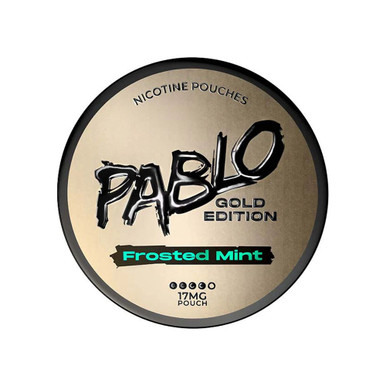
Pablo · 17mg
Read the full guide
Pablo Gold Edition Frosted Mint Nicotine Pouches
£19.95
✔ In stock — ready to ship
100% tobacco-free
Free over £20
Same-day dispatch
Secure checkout
Pablo Gold Edition Frosted Mint Nicotine Pouches sit in our catalogue at £19.95, with a single declared strength of 17mg, one variant at that figure, one flavour tag reading mint, and an available stock flag as of writing. The cans-per-pack value on the record is blank, meaning the field is empty rather than set to one. That is every piece of product data we hold, and it fits comfortably in a sentence.
A page this long built on a record that short only works if it is clear about what each part of it is. Statements of fact come from the record. Descriptions of the object, the flavour family and how the format behaves are observations from people who stock the product, and they are offered as observations. Gaps are declared as gaps. Nothing here is filled in by inference from what a name suggests or from what would be convenient to say.
The full guide to Pablo Gold Edition Frosted Mint Nicotine Pouches
4,955 words on how it eats, who it suits, how to serve it and what to put beside it.
Opening on the product: six fields and a name
Two parts of the name need handling before anything else. Gold Edition is the manufacturer's own line name. It is recorded by us as part of a product title, it is not a grade issued by anybody, and we hold no information whatsoever that would let us position it above or below another line on quality. Where a page elsewhere treats a word like that as a promise, it is doing so without evidence, and we would rather not. Frosted Mint is the flavour half, and unlike some names in this category it is internally consistent with our data: it names a plant, our single tag reads mint, and the qualifier in front of it points at a cold character rather than at a second ingredient.
The listing is filed on three shelves. It appears in the strong band, currently 132 listings deep, on the Pablo brand page alongside 56 entries, and on the mint shelf, the widest flavour grouping we keep at 148 listings.
Sold to adults aged 18 or over who already use nicotine. The full wording closes the page.
The taste and the aroma, described as such
Mint is not one flavour and treating it as one is the reason people end up disappointed by cans they had no reason to expect anything specific from. The family covers at least three recognisable registers. There is peppermint, which reads clear, sharp and slightly sweet, with the cooling arriving early and sitting high in the mouth. There is spearmint, softer and greener, more herbal and rounder, with less bite and a longer, gentler finish. And there is the wintergreen register, distinct from both, with a medicinal edge that people either look for specifically or avoid entirely.
The word frosted in this name is a qualifier rather than a fourth register. It points at the cold end of the family: a mint where the cooling is foregrounded and the herb sits behind it, rather than a green, leafy mint where the plant leads and the cooling follows. Read that way, the expected character is a clean cold arrival, a mint note that is closer to the clear peppermint end than to the grassy spearmint end, and a finish that thins from the cold first and the herb second. The aroma from a freshly opened tin is thin and bright rather than full — cold aromas carry less body than sweet or fruity ones, which is a property of the family and not a shortcoming of the can.
Now the part that a product page is normally reluctant to print. Our record holds one flavour tag for this listing, and it holds the same single tag for other cold cans in the same line at the same price and the same declared figure. On the fields we actually have, those cans are indistinguishable. We are not going to invent a tasting difference to justify the existence of two names, and if you are trying to choose between them on the strength of our descriptions, you should understand that our descriptions are readings of names, not measurements. Where a can carries a second tag — a fruit alongside the mint, for instance — that is a difference we can point to in the data. Where it does not, the difference we could honestly report is zero.
The general caveat applies as well. Flavour impressions vary between people and between tins, and everything in this section except the single word mint is judgement rather than record. We publish no ingredient list and no flavour specification, because we hold neither.
Carrying one, using one, and whose rules apply
This section is about the format as a thing you have on you rather than as a thing on a shelf, and it ends with the most important practical point on the page, which is that the rules about where this can be used are not ours to state.
What the format is like to have with you
The tin is small, round and flat — the sort of object that goes in a coat pocket, a bag pocket or a desk drawer without being noticed as luggage. There is nothing to charge, nothing to switch on, nothing to refill and no separate part to carry alongside it. The tin is the entire kit, and when it is closed it is a sealed-looking disc with a printed lid. That is the whole of the hardware question.
In use, the pouch is seated under the upper lip and stays there without being held, adjusted or attended to. It is dry to handle, it makes no sound, and it produces nothing visible. Most people find that after the first minute or two they are not conscious of it, and that other people in the room have no particular reason to notice. We are describing the physical facts of the format rather than recommending it as a way of being unobtrusive, and there is a difference between the two that matters.
Two practical notes about carrying one, both of which come up often. The first is that a tin in a trouser pocket spends the day being warmed and pressed, which is the least kind environment you can give it short of a dashboard; a bag or a jacket pocket is better, and a drawer is better still. The second is that a tin is round and flat, which means it slides. Left loose in a bag it ends up under everything else, and left on a car seat it travels. A fixed pocket that it lives in is a small habit that saves a surprising amount of searching.
The rules are set by whoever owns the room
Here is the part we are firm about. We do not tell anybody where they may or may not use a product bought from this site, and any page that does is overreaching.
An employer sets the rules for its own premises. A venue sets the rules for its own building. A train operator, an airline, a coach company, a hospital, a school, a stadium and a restaurant each set their own, and those rules differ from one to the next, change over time, and are frequently more specific than the general law. Some places publish a policy covering products of this kind explicitly; some fold it into a broader policy; some have nothing written down and expect you to ask. In every one of those cases the authority is the organisation whose space it is, not a retailer's product description written months earlier.
The same goes for travelling with a tin. Carriage rules, customs allowances and country-by-country restrictions on age-restricted products vary considerably, and they are set by carriers and by governments. We do not publish guidance on any of it, because to do so we would have to be tracking rules in jurisdictions we have no visibility of, and getting it wrong would be worse than saying nothing. Check with the carrier and with the destination's own rules before you travel.
The one rule that is ours
Ours is simple and it is not negotiable: this is an 18+ product, sold to adults who already use nicotine, with an age check at checkout. Beyond our own door, the rules belong to whoever owns the space you are standing in.
The tin, the pouch and what happens to it afterwards
The physical object is the standard shallow round tin of this category, with a lift-off lid seating onto an internal lip. The lid face carries the brand, the line, the flavour and the declared figure, which is useful once several tins share a drawer and you are reading tops rather than picking each one up.
Inside, the pouches lie flat in a ring. The lid's underside is hollowed into a shallow well with a rim around it, and that well is the catch compartment for used pouches — the feature that makes the format workable when no bin is within reach. It takes several before it needs emptying.
How many pouches the tin contains is not something our record holds. That number is printed on the packaging, and a figure invented here would only compete with a printed one. The same applies to the weight of an individual pouch and the tin's diameter. Where the packaging states something and our data does not, the packaging is the authority and we defer to it without argument.
Duration varies too widely for us to publish a number, and a number published by a shop reads as an instruction regardless of how it is worded. The honest span runs from roughly ten minutes at one end to the better part of an hour at the other, with the same person moving around inside that range across a single day. The taste is not constant across the time either: it arrives, holds, and then thins out, and with a cold-led can the cooling edge is usually the part noticed softening first.
Removal is a fingertip job. The used pouch goes into the lid well, and the well's contents go into general waste when it fills — not a sink, not a drain, not a plant pot, not out of a window. Spent pouches are small, pale and easy to lose track of on a desk or a worktop, which is the practical reason for keeping the tin closed and out of reach of children and pets when it is not in a hand.
Reading the number on the lid
The declared strength is 17mg. That value is printed by the manufacturer on the packaging and supplied to us, and we reproduce it exactly as given. It is a label declaration and nothing else: not a score, not a rating, not a grade, not a measure of how well made the tin is. A can printed with a larger number is not a better can and is not an upgraded version of one printed with a smaller number.
Because this brand attracts the framing, we will state the obvious directly. A higher figure is not an achievement, not a milestone and not a destination. Retail catalogues sort numbers in order because sorting has to happen; a sort order is an administrative convenience and implies nothing about what any individual should do.
What the number does not describe is most of what people want to know. It says nothing about taste, nothing about how moist a pouch is, nothing about portion size, and nothing about how this tin relates to a differently branded tin printed with the same value. Two cans from two manufacturers showing identical figures remain two entirely separate products. Reading across brands on the number alone is the most common mistake made when moving between lines on our shelves, and our record contains no comparative field of any kind that would help — so when two figures appear side by side on this site, that is two printed numbers next to each other and nothing more.
Our bands exist so the catalogue can be browsed. There is a medium shelf, the 132-listing strong shelf holding this can, and an extra strong shelf above it. Placement follows the declared figure and nothing else. We cannot advise which strength suits anyone — we do not know who is reading, we hold nothing about any individual, and a product page is not where that belongs. The full spread of declared figures across the catalogue is visible on the main index.
How a recognisable flavour gets built into a dry pouch
This section is about the general problem rather than about this specific tin, and it is here because understanding it explains a lot of the disappointment people report with cans across the whole category, including cans that are doing nothing wrong.
The format sets the terms
A pouch is dry, small and sits in one place for a long time. Every flavour in this category has to work inside those constraints, and they are unforgiving ones. A taste that is delightful for four seconds may be tiresome after twenty minutes. A taste that needs a big first impression has nowhere to put it. And because nothing is heated and nothing is mixed, a flavour cannot be rebuilt mid-use — what is there at the start is what there is.
The practical consequence is that flavours in this format tend to be constructed for endurance rather than for impact. They are built to be recognisable immediately, tolerable for a long stretch, and to fade rather than to collapse. That is why a great many cans across every brand we carry read as slightly simpler than the thing they are named after: simplicity survives twenty minutes better than complexity does.
Why mint is the family that works best here
Mint dominates this category — 148 listings on our mint shelf against 20 on our narrowest flavour grouping — and the reason is structural rather than a matter of fashion. A mint note carries two separate things at once: a taste and a temperature impression. Those two components fade at different rates, which gives a mint can a longer usable life than a flavour that only has a taste to offer. When the herb note has thinned, the cold impression is often still there, and the can still reads as something rather than as nothing.
That is also why so many fruit cans in this category carry a cold element in the name. Pairing a fruit with cold gives the fruit something to lean on once its own note has thinned. A fruit can with no cold element has to survive the whole stretch on the fruit alone, which is a harder job and is why those cans tend to read as sweeter and simpler than the fruit they are named after.
Sweetness is the other variable people underestimate, and it behaves oddly over a long stretch. A level of sweetness that reads as pleasant in the first minute can read as cloying by the tenth, simply because it has not changed while everything around it has. That is one reason cold cans tend to be built with a restrained sweetness rather than a generous one, and it is also why a can that seems underwhelming on first impression sometimes turns out to be the one still worth having twenty minutes later. First impressions and long impressions are genuinely different judgements, and a shelf full of cans judged only on the first would look nothing like a shelf judged on the second.
Aroma and taste are two different questions
People often judge a can by opening it and taking a sniff, which is an understandable habit and a misleading one. What reaches you from an open tin is not what registers in the mouth over twenty minutes; the two are related but they are not the same measurement. Cold-led cans in particular tend to smell thinner than they taste, because the cooling impression barely registers as an aroma at all and the herb note is doing all the work on that front.
We should be explicit about one boundary here. We do not publish ingredient lists, we do not describe what a pouch is made of, and nothing in this section is a technical account of anything. It is a description of how tastes behave in this format, drawn from handling a great many cans, and none of it comes out of a specification because we do not hold one.
Where this sits on the Pablo shelf
Pablo is one of the bigger names we stock, and the brand page gathers all 56 listings. The range reaches us divided into lines, of which Gold Edition is one, and a line is best read as a family grouping. We hold no manufacturer documentation explaining what distinguishes one line from another, so we are not going to characterise the intent behind any of them.
One thing the listings do show plainly is a price difference we cannot account for. This tin is £19.95. Every Pablo sibling our record offers here is from the Exclusive line and is priced at £3.85, while the Gold Edition Blueberry Peach Ice listing matches this one at £19.95 and is in stock. Because the cans-per-pack field is empty across all of them, we cannot tell you whether that gap is about quantity, tin size, or simply different pricing between lines. We would rather publish the blank than an explanation we cannot support.
Among the Exclusive listings our record offers, the flavour spread is wide. Blue Mint at £3.85 is the cold one, Banana Ice at the same price sets a soft fruit against a cold element, Blue Raspberry is a bright berry in the confectionery register, the three-fruit Blueberry Cranberry Cherry can uses the cranberry to supply tartness, Blueberry Peach Ice puts two fruits under a cold layer, and Bubblegum is a sweet-shop flavour rather than a fruit at all. All six are marked in stock. Their declared figures are not held in the record behind this page, so each one's own page is where to read them.
What else to keep in the drawer
Rotation is the norm in this category for a straightforward reason: any single taste becomes less distinct with continuous use, and a second tin of a different character resets that. A second tin of something similar does not, which is why the useful advice is about difference rather than about quality.
Staying inside the cold family, Clew Cool Mint and Denssi Cold Mint are both £39.90 and both in stock — two plain cold mints from different houses, and putting them side by side is the clearest demonstration of how much of a can's character comes from the manufacturer rather than from the flavour word on the lid. Elf Bar Cool Storm at £29.90, in stock, names weather instead of a plant, which is the same naming convention this can's qualifier belongs to. Cuba Ninja Ice Cool at £39.90 is in stock and comes from one of the larger ranges we carry; the Cuba brand page collects the rest of it.
For genuine contrast rather than a near-match, three cans are worth naming. Fumi Fiery Mint at £27.90, in stock, sets a warm word against a cold one in its name, which makes it the most interesting comparison on this list. Killa Banana Ice at £33.50, in stock, inverts the structure entirely — a soft fruit with cold over the top, rather than cold with a herb behind it. And the 77 VB Edition Mini in arctic berry at £39.90, also in stock, differs as an object as well as a taste, since it is sold as a smaller-format tin.
On price, the spread across the cans named here runs from Edge Mint at £14.95, in stock, up to the £39.90 listings. That spread is worth knowing if variety at a controlled cost is the aim, but it is not a quality ranking and we are not presenting it as one. A more expensive tin is not a better tin, in the same way that a bigger printed figure is not a better figure. Every listing named on this page was marked in stock in our record at the time of writing, which will not always be true and is worth stating when it is.
Keeping a tin in good order
The lid is a press fit rather than a seal, because it has to open and close repeatedly and those two design goals pull against each other. Moisture leaves a pouch over time and does not come back, so a tin left with its lid resting crooked will read duller and shorter a fortnight later than it did on the day it arrived. Closing it properly, right around the rim, is the whole of the remedy.
Warmth acts faster than dryness. A tin left in a hot car, in a pocket hanging against a radiator, or on top of a laptop that has been running all afternoon will change, and cooling it down afterwards does not undo it. Sunlight through a window counts, even on a cold day. Cool, dark, dry and closed is the entire specification, and a drawer meets it.
We hold no expiry date, batch date or best-before value for this listing, so whatever the manufacturer prints on the can governs. With several tins in hand, work through the oldest first and keep the others sealed. On refrigeration we hold no guidance and take no position; the only practical note is that a cold tin brought into a warm room collects condensation on the outside and is better left to reach room temperature before opening. Empty the catch well regularly rather than letting spent pouches sit above the fresh ones.
What the listing actually offers
One variant: 17mg at £19.95. No second declared figure, no larger tin, no bundle. A different number means a different listing rather than a different selection on this page.
On quantity, the empty cans-per-pack field is a genuine absence and we are not going to reason from price to units. The packaging states what the package contains and the basket states what the order contains; this page is not in a position to do either. The remaining decision is how many to buy at once, which is mostly a storage question and is covered above.
Checkout, the courier and the age check
The tin goes into the basket at the listed price, the checkout collects a delivery address, and an age check runs as part of it. Nothing is sold to anyone under 18 and the check is not skipped for small orders.
ID may be requested on delivery. Where it is requested and no adult at the address can produce it, the parcel will not be handed over. Think about that in advance if the delivery address is a workplace or anywhere a parcel might be taken in by someone else.
Current timings and courier arrangements live on the checkout pages rather than here, deliberately, because a delivery promise written into product copy is stale within weeks and then misleads people. The stock flag quoted throughout is the position at the time of writing and can change without this page changing, which is equally true of every listing in the full catalogue.
Getting back to this page
Three shelves lead here. The Pablo range is the most direct if brand is what you track, with all 56 listings grouped by line. The mint grouping is the largest at 148 entries and therefore the slowest to work through, but it is the right route if cold is the thing you are after rather than a particular maker.
The third is the strong band, which gathers 132 listings from every brand and flavour family whose declared figure falls in that range, with medium below and extra strong above, all three organised the same way. If none of those matches how you browse, everything we stock sits on a single index that can be filtered down.
Questions this can gets asked
What is the difference between this and the other cold can in the same line?
On our data, nothing. Same price, same declared figure, same single mint tag, same three shelves. The names differ and the record does not, and we are not going to write a tasting comparison we have no basis for. If a difference exists it is on the cans rather than in our system, and the brand page is where to see the names side by side.
Is this peppermint or spearmint?
Our record does not say — the tag is simply mint, which is a family rather than a species. Our reading of the name is that the qualifier points at the cold end of the family, which in practice tends to mean something closer to a clear peppermint than to a soft green spearmint. That is a reading of a word, offered as one, and the can in your hand is the only authority that settles it.
Can I use one at work?
That is your employer's decision and not ours. Workplaces set their own policies, they vary widely, and they are frequently more specific than anything in general law. The same applies to venues, transport operators and any other premises with an owner. We sell the product to adults; we do not issue permissions about where it may be used, and we would be wrong to try.
Does "Gold Edition" mean it is better?
Nothing we hold supports that. It is the manufacturer's own name for a line, stored by us as part of the title. It confers no grade, and the fact that this line lists at a different price from another Pablo line is not evidence either way, because we cannot tell you what quantity either price covers.
Is 17mg high?
It is the figure the manufacturer declares, and it places the listing on our strong shelf. We will not characterise it beyond that, because describing a number as high or low edges toward advising a person, and we cannot advise which strength suits anyone. It is label information about a product.
How many pouches are in a tin?
We do not hold that count. It is printed on the packaging and absent from our record, so a number here would be a guess arguing with a printed fact. The can also answers the weight of each pouch, which we likewise do not hold.
Why is this £19.95 when other Pablo cans are £3.85?
We cannot tell you. The cans-per-pack field is blank on this listing and on those, so our record contains nothing that would explain the gap — it could be quantity, tin size or line pricing. Publishing the blank is more useful than publishing a guess dressed as an answer.
How long does the cold last in one pouch?
We hold no figure and will not estimate one. What is generally true of cold-led cans is that the cooling impression and the herb note fade at different rates rather than together, so the point at which a can stops reading as anything is usually later than the point at which it stops reading as mint. How long either takes is not something we measure.
Can I take a tin abroad?
Check with the carrier and with the destination's own rules. Carriage conditions, customs allowances and national restrictions on age-restricted products differ by country and by operator, they change, and we do not track them. Anything we published on it would be out of date or wrong somewhere, which is worse than pointing you at the authority.
Does a tin go off?
Our record holds no dating of any kind, so whatever is printed on the can is what governs. What we can describe is the handling effect: an open tin kept warm, loose-lidded or in sunlight will generally read duller and shorter than it did on day one. Closed, cool and dark is the whole maintenance routine, and an unopened tin is considerably more forgiving than an open one.
What do I do with a used pouch away from a bin?
Put it in the well under the lid, which exists for that and holds several. When the well is full, its contents go into general waste — not a sink, not a drain, not the ground. Keep the tin closed when it is not in use, and out of reach of children and pets.
Is it in stock?
It was marked available when this page was written, and so was every other listing named on it. Stock changes without pages changing, so the listing itself is always the live answer.
Required wording in full
Nicotine is an addictive substance.
Pablo Gold Edition Frosted Mint Nicotine Pouches are sold only to adults aged 18 or over who already use nicotine. An age check runs at checkout, nothing is sold to anyone under 18, and ID may be requested on delivery. If it is requested and no adult at the address can produce it, the parcel will not be handed over.
This product is not a licensed stop-smoking medicine and is not offered, described or intended as one. It is not intended for non-smokers, for anyone who does not already use nicotine, for anyone under 18, or for anyone pregnant or breastfeeding. Nothing on this page is medical advice, and nothing on it should be read as a suggestion that any person begin using nicotine or choose any particular declared figure.
Keep the tin closed and out of reach of children and pets, and put used pouches in general waste. Every product fact above — name, brand, price, declared strength, flavour tag and stock state — comes from our own record for this listing. The manufacturer's labelling is the authority for anything printed on the packaging, and where our record holds nothing we have said so.
The short version
Frosted Mint is a cold-led mint can filed under a single mint tag, listed at £19.95 with one declared figure of 17mg, sitting on the strong band, the Pablo brand page and the large mint shelf, and marked available as this was written. The line name belongs to the manufacturer and carries no meaning we can stand behind. Where our record can separate this from a neighbour we have shown how, and where it cannot — which includes the other same-tag cold can in the line — we have said so rather than filling the space with a comparison we would have had to invent.
More from Pablo
More strong pouches
More mint pouches
Where this sits
Pablo Gold Edition Frosted Mint Nicotine Pouches appears in these categories. Browse them, or jump to something close.
You might also like