
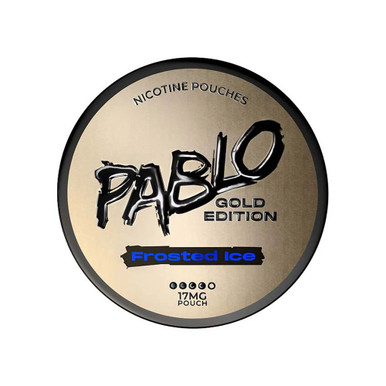
Pablo · 17mg
Read the full guide
Pablo Gold Edition Frosted Ice Nicotine Pouches
£19.95
✔ In stock — ready to ship
100% tobacco-free
Free over £20
Same-day dispatch
Secure checkout
Pablo Gold Edition Frosted Ice Nicotine Pouches are listed here at £19.95 with one declared strength of 17mg, one variant at that figure and price, a single flavour tag reading mint, and a stock flag set to available at the time this was written. The cans-per-pack field on the record is blank. That is the whole of it. Six fields and an empty seventh.
A page of this length built on six fields needs to be honest about what the rest of it is made of, so here is the arrangement. Where a sentence states a fact about the product, that fact comes from the record and nowhere else. Where a sentence describes the object or the flavour family, it is a description from people who stock the tin, offered as a description and not as a specification. And where we do not hold something, the page says so instead of reaching for a plausible substitute. You will find that third kind more often than is usual in product copy, including on the question of what separates this can from its closest relatives.
The full guide to Pablo Gold Edition Frosted Ice Nicotine Pouches
4,964 words on how it eats, who it suits, how to serve it and what to put beside it.
What our record holds against this tin
The name is worth unpicking straight away. Gold Edition is the manufacturer's own name for a line within the Pablo range. It is not a grade awarded by anyone, it is not a claim we are making, and our record treats it as part of a product title rather than as a tier. We hold no data that would let us say a Gold Edition tin is built better than any other tin, and we are not going to imply it by tone. Frosted Ice is the flavour half of the name, and both of its words point at temperature rather than at an ingredient — which sets up a small discrepancy discussed further down, because the only flavour tag we hold for this listing is mint.
Three shelves carry this listing: the strong band at 132 listings, the Pablo brand page at 56, and the mint shelf, which at 148 entries is the widest flavour grouping on the site. Those are the routes people arrive by and the routes back.
Sold to adults aged 18 or over who already use nicotine. The complete wording is at the foot of the page.
The tin as an object, and the pouch in use
The physical article is a shallow round tin with a lift-off lid that presses back onto an internal lip. It is the shape the whole category has settled on, and there is nothing unusual about this one. The lid face is where the information lives — brand, line, flavour and declared figure — and that matters in a practical way rather than a decorative one, because once three or four tins share a drawer you identify them by reading the tops rather than by picking each one up and turning it over.
Inside, the pouches lie flat in a ring around the base. The underside of the lid is a shallow hollow with a rim, and that hollow is the catch compartment: somewhere to put a used pouch when there is no bin within reach. It takes several before it needs emptying, which is the single design feature that makes the format workable on a train, in a passenger seat or partway round a supermarket.
We cannot tell you how many pouches the tin holds. That count is printed on the packaging and our record does not carry it, so a number from us would be a guess standing next to a printed fact and arguing with it. The same applies to the mass of an individual pouch and the outside diameter of the tin. Whatever the can states, the can wins.
On the pouch itself: it is a small soft rectangle with rounded corners, light enough to disappear inside a closed hand, and slim rather than bulky. Portion sizes do vary across this category — some lines are built noticeably narrower than others, and a few are sold specifically as a smaller format — but our record does not state where this one falls on that scale, so we are not going to place it. Handling one out of the tin tells you more in two seconds than a sentence from us could, and that is not evasion, it is the actual situation.
A pouch is seated under the upper lip and then left there. The common experience is that a fresh one feels larger than it looked in the ring and that the sensation settles within a minute or two as it takes the shape of the space available. From that point it is unremarkable to hold in place, and people carry on talking and drinking with one seated. Eating with one in is a matter of individual preference; some do, some take it out first, and we are not going to convert a preference into guidance.
Duration is the question we get asked most and the one we will not answer with a number. The genuine spread runs from around ten minutes to the better part of an hour, and the same person moves around inside that range across a day. Nor is the taste steady across the time: it arrives, holds through a middle stretch, then thins to something closer to a background impression. With a cold-led can the thinning is often noticed as the cooling edge softening first, with what remains of the mint reading flatter behind it. Removal is a fingertip job, the used pouch goes in the lid well, and the contents of the well go into general waste when it fills — not a sink, not a drain, not the ground.
Frosted Ice taken strictly as taste and aroma
Start with the discrepancy, because ignoring it would make everything after it less trustworthy. The name is Frosted Ice. Neither of those words names a plant, a fruit or a flavour; both describe a temperature. The single tag our record files against the listing is mint. So the name promises cold and the data says mint, and the two are not the same statement. Our reading of that is straightforward: this is a cold-forward can filed in the mint family, where the cold sensation is the headline and the mint is the family it belongs to rather than the thing the name is advertising. That is a reading, not a fact, and we would rather set it out as one.
What a cold-led mint tends to be like, described as taste: the first impression is the cooling rather than the herb, arriving quickly and sitting broadly across the mouth instead of concentrating anywhere. The mint underneath it reads clean and slightly sweet rather than green and leafy — closer to the character of a clear peppermint than to the grassier, softer register of a spearmint. The aroma off a freshly opened tin is thin and sharp rather than rich, which is typical of this end of the flavour family and is not a shortcoming; a cold aroma has less body to it by nature.
Here is the part we have to be honest about, and it is unusual for a product page to say it. Our record does not hold anything that would let us distinguish this can, on taste, from other cold cans in the same line carrying the same single mint tag, the same declared figure and the same price. Where the names of two such cans differ by one word, the difference in our data is exactly nil. We are not going to invent a tasting distinction to justify two listings existing, and if you are trying to choose between cold cans in this range on the strength of our descriptions, you should know that the descriptions are readings of names rather than readings of laboratory data. The genuine differences, if they are there, are on the cans and in the tasting, not in our record.
Where a real distinction does exist in the data, we will say so. A can filed with a second flavour tag alongside mint — a fruit, for instance — is a different proposition in our record and not just in its name, because two tags describe something the single-tag cans do not. That is the honest line between a difference we can evidence and a difference we cannot.
The Pablo shelf, and where this can falls on it
Pablo is one of the larger names we carry, with 56 listings gathered on the brand page. The range arrives to us split into lines — Gold Edition among them — and a line name is best understood as a family label. We do not hold specification data explaining what a manufacturer intends a line to signify, so anything we said about the philosophy behind one would be invention.
What the listings actually show
What we can do is read our own catalogue honestly, and two patterns stand out. The first is price. This can is £19.95, and the Gold Edition Blueberry Peach Ice listing is the same £19.95 and in stock, which is the pattern you would expect within a line. Meanwhile every Pablo sibling our record offers from the Exclusive line is £3.85. That is a wide gap and we cannot account for it. The cans-per-pack field is empty on this listing and on those, so we hold nothing that would tell you whether the gap reflects quantity, tin size or simply different pricing between lines. Saying the record is silent is the only accurate thing available.
The second pattern is that a line does not predict a flavour. Within the Exclusive listings our record offers, Blue Mint is the cold one at £3.85, Banana Ice at the same price sets a soft creamy fruit against a cold element, Blue Raspberry is a bright sweet berry, the Blueberry Cranberry Cherry can puts three fruits together with the cranberry supplying the tartness, Blueberry Peach Ice pairs two fruits with a cold layer, and Bubblegum is not a fruit can at all. All six are marked in stock, all six are £3.85, and their declared figures are not held in this record — each page states its own.
Who each of them suits, as far as we can say
We can speak about flavour character and nothing else, so that is the axis. If cold is the thing you are actually after, the cold-led cans are the relevant part of the range and a fruit-led one will disappoint you regardless of how good it is. If you want a fruit with cold over the top rather than cold with a herb underneath, the ice-suffixed fruit listings above are that arrangement. If you want fruit with no cold in it at all, the plain berry listings are where to look. None of that is advice about a person; it is a description of what the names and tags point at, which is the only information we hold.
What we will not do is rank the lines. We have no basis for saying Gold Edition is better or worse than any other Pablo line, and the difference in listed price is not evidence of quality because we cannot even tell you what quantity each price covers. Anyone who tells you otherwise on a retail page is guessing in a confident voice.
17mg as printed information
The declared strength on this listing is 17mg, and it is a figure the manufacturer prints on the packaging and supplies to us. We reproduce it exactly. It is a label value: not a rating, not a score, not a grade, and not a measure of anything about the quality of the tin. A can with a higher number printed on it is not a superior product and is not a later version of a lower one.
It is worth being direct, because this brand attracts the framing: a bigger figure is not an accomplishment and is not something to progress toward. Catalogues sort numbers in ascending order because sorting has to happen, and this one is no exception, but a sort order is a filing decision and implies no direction of travel for any individual.
The number also describes very little. It says nothing about taste, nothing about how damp a pouch is, nothing about portion size, and nothing about how a tin compares with a different brand's tin bearing the same value. Two cans with the same printed figure from two manufacturers are still two separate products. Our record holds no comparative data at all, so when this site sets two figures beside each other it is setting two printed numbers beside each other and claiming nothing about what the difference means for anyone.
On bands: medium, strong and extra strong are shelves we sort listings onto according to the figure the manufacturer declared. This can sits on the middle one of those three, which is a fact about our filing system and not a description of an experience. We cannot advise which strength suits anyone. We do not know who is reading, we hold nothing about any individual, and a shop page is not where that conversation belongs. The spread of declared figures across the whole catalogue is visible on the main index if you want to see the range in one place.
How people actually buy this, and how often
This section is about purchasing rhythm rather than about the product, and it exists because "how many should I order" is a genuine question with a genuinely practical answer, unlike most of the questions a product page pretends to answer.
One tin against several
The honest starting point is that we cannot tell you what £19.95 buys in units, because the cans-per-pack field is empty. What the record shows is a price and a product, and the basket is where the quantity becomes concrete. That limitation shapes everything else in this section, so treat what follows as a description of patterns rather than a calculation.
The pattern we see in this category is that people rarely stay on a single flavour indefinitely. A tin gets bought, used, and somewhere before it runs out the same flavour starts reading as less distinct than it did at the start — not because anything has changed in the tin, but because continuous exposure to any one taste flattens it. That is why rotation is the norm rather than the exception, and why a second tin of something different is generally more useful than a second tin of the same thing.
Reordering, and the gap people misjudge
The mistake worth naming is leaving the reorder until the tin is empty. Delivery takes as long as it takes, and the checkout pages hold the current position on timings rather than this page, which would be out of date within a week of publication if it quoted anything. Ordering with some of the current tin still in hand removes the problem entirely, and it costs nothing to do.
There is a second version of the same mistake, which is ordering in a hurry and buying whatever is nearest to hand on the shelf rather than what was actually wanted. Cans in this catalogue range from under fifteen pounds to around forty, and the differences between them are real differences of flavour family, brand and format rather than differences of rank. A rushed basket tends to produce a drawer full of near-identical cold tins, which is the opposite of what rotation is for.
A spare unopened tin in a drawer is the other approach, and the storage section below covers what an unopened tin wants from the place you keep it — which is very little, provided it is cool, dark and closed. An unopened tin is the more forgiving of the two states by some distance, which is the practical argument for buying slightly ahead rather than slightly behind.
Rotation without overspending
If a second tin is going in the basket anyway, the sensible version is one that is genuinely different rather than a near-neighbour of this one. Price varies widely across the cans we stock, and the spread is worth knowing: Edge Mint at £14.95 is the least expensive cold tin named anywhere on this page and is in stock, while Klint Avalanche Mint at £36.90 and Cuba Ninja Ice Cool at £39.90 sit toward the top of it. Both of those are in stock too. None of that is a value judgement — a higher price is not evidence of a better tin any more than a higher declared figure is — but if the object of the exercise is variety at a controlled cost, the spread is the relevant fact.
Cold cans elsewhere on our shelves
The mint shelf is the largest flavour grouping we hold, at 148 listings, which means there is a great deal of cold on this site and a fair amount of variation inside it. Four cans are worth naming because each does something a little different with the same broad idea.
Clew Cool Mint at £39.90, in stock, is a plain cold mint with no second element in the name at all. Denssi Cold Mint at the same £39.90, also in stock, is the same arrangement from a different house, and having two of those side by side is the clearest way to see how much of a can's character comes from the manufacturer rather than from the flavour word. Elf Bar Cool Storm at £29.90 is in stock and names weather rather than a herb, which puts it in the same naming tradition as this can. Fumi Fiery Mint at £27.90, in stock, is the odd one of the four, because the name sets a warm word against a cold one.
Two cans are worth naming as deliberate contrasts rather than as matches. Killa Banana Ice at £33.50, in stock, is a soft fruit with a cold layer over it rather than cold with a herb behind it, and that is a structurally different thing to have in rotation. The 77 VB Edition Mini in arctic berry at £39.90, also in stock, is a berry with a cold element and, as the name says, a smaller-format tin — so it differs as an object as well as a taste.
It is worth saying what those four cans have in common besides the cold, because it is the thing our data cannot see. Each comes from a different manufacturer, and a manufacturer's house character — how sweet the base of a flavour reads, how quickly the cooling arrives, how long the taste holds before thinning — travels across that manufacturer's whole range more consistently than any single flavour word does. That is why two cans labelled with the same flavour from two different houses can read as more different from each other than two differently labelled cans from the same house. We hold nothing in the record that quantifies any of it, which is precisely why buying a second tin from a different brand tends to produce more variety than buying a second flavour from the same one.
Every listing named on this page is marked in stock in our record as it was written, which is not always the case on this site and is worth saying when it is true. Stock flags change without pages changing, so the listing itself is always the live position.
Keeping a tin usable
Three things act on an open tin: air, warmth and time. The lid is a press fit rather than a seal, because it has to open and close many times a day, and those two requirements do not both get satisfied. Moisture leaves a pouch over time and never returns, so a tin left with the lid sitting crooked will read duller and shorter a fortnight later than it did on arrival. Closing it properly, all the way round, is the whole of the fix.
Warmth does the damage faster. A tin on a dashboard, in a pocket hung by a radiator, or resting on a laptop that has been running all afternoon gets warm enough to change how the contents behave, and a cooled-down tin does not return to where it started. Sunlight through glass counts too. Cool, dark, dry and closed covers all of it — a drawer is sufficient and nothing more elaborate is needed.
We hold no expiry date, batch date or best-before value for this listing, so whatever the manufacturer prints on the can is the authority. With several tins in a drawer, work through the oldest first. On refrigeration we hold no manufacturer guidance and therefore take no position, except to note that a cold tin carried into a warm room collects condensation on the outside and is better opened once it has come up to room temperature. Keep every tin closed and out of reach of children and pets, and keep the catch well emptied rather than letting spent pouches sit above the fresh ones.
What is actually on offer here
One variant: 17mg at £19.95. No second declared figure, no alternative tin size, no bundle attached to this record. If you want a different number you are looking at a different listing rather than at a dropdown on this one.
On quantity, the blank cans-per-pack field is a real absence rather than a value of one, and we are not going to work backwards from the price to a unit count. The packaging states what is in the package and the checkout states what is in the basket. Those are the two authorities and this page is neither of them.
Checkout, delivery and the age check
The tin goes into the basket at the listed price, checkout takes a delivery address, and an age check runs as part of that process. We do not sell to anyone under 18 and the check is not waived for small orders.
ID may be requested on delivery. If it is requested and no adult at the address can produce it, the parcel will not be handed over. Worth thinking about in advance if the delivery address is a workplace or anywhere a parcel might be received by somebody other than the person who placed the order.
Current courier and timing information sits on the checkout pages. This page does not carry it, deliberately, because a delivery promise embedded in product copy goes stale quickly and then misleads people. The stock flag quoted throughout is the position at the time of writing, and the same caveat applies across the whole catalogue.
Routes back to this listing
Three shelves lead here. The Pablo range page is the most direct if the brand is what you are tracking, since all 56 listings are gathered there with the lines grouped inside. The mint grouping is the largest of the three at 148 entries and therefore the slowest to scan, but it is the right route if cold rather than brand is the thing you are after.
The strong band is the third and collects 132 listings across every brand and flavour family whose declared figure falls in that range. It has a medium shelf below it and an extra strong shelf above, both organised the same way. For a wider view than any single shelf gives, the Cuba brand page is one of the other large ranges we carry, and everything we stock sits on one index that can be narrowed down.
Questions we are asked about this can
The name says ice but the flavour tag says mint. Which is right?
Both, as far as we can tell. The name is the manufacturer's and it describes a temperature idea; the tag is ours and it files the can into a flavour family. They are answering different questions rather than contradicting each other. What we cannot do is tell you how the cold and the mint are balanced inside the pouch, because no field in our record describes that. The can and the tasting are the authorities there.
How is this different from the other cold cans in the same line?
In our record, on the fields we hold, it is not. Same price, same declared figure, same single mint tag, same shelves. We are not going to manufacture a tasting distinction to explain why two listings exist, because we would be making it up. If there is a difference it lives on the cans rather than in our data, and the brand page is the place to see the full set of names side by side.
Does "Gold Edition" mean higher quality?
We hold nothing that would support saying so. It is the manufacturer's own name for a line, recorded by us as part of a product title. It is not a grade, and the fact that this line is listed at a different price from another Pablo line is not evidence either way, since we cannot tell you what quantity each price covers.
Is 17mg strong?
It is the figure the manufacturer declares, and it places this listing on our strong shelf. We will not go further than that, because describing a number as high or low starts to look like advising a person, and we cannot advise which strength suits anyone. The figure is label information about a product.
How many pouches come in the tin?
Not something we hold. The count is printed on the packaging and our record does not carry it, so a figure from us would be a guess in competition with a printed one. The can answers this, and it also answers the weight of each pouch.
Why £19.95 here and £3.85 for other Pablo cans?
We cannot tell you. The cans-per-pack field is empty on both, so nothing in our data explains the difference. It might be quantity, it might be tin size, it might be pricing that differs between lines for reasons we are not party to. An honest blank is better than a confident guess.
Is there a fruit version in this line?
There is at least one we can point at: the Gold Edition Blueberry Peach Ice listing linked further up is the same £19.95, in stock, and pairs two fruits with a cold element. Beyond that, the brand page is the reliable way to see what the line currently contains, since our record here only holds the siblings it was built with.
How long should I keep one in?
There is no should and we will not publish a number. The real range runs from about ten minutes to the better part of an hour, and the same person moves around inside it. A duration printed by a shop reads as an instruction, and instructing anybody on this is not something we are in a position to do.
Will it lose its cold edge in an open tin?
A tin left open, warm or in sunlight will generally read duller and shorter than it did on the first day, and with a cold-led can the cooling edge is often the part people notice softening first. That is a handling effect rather than a fault in the product. Closed, cool and dark is the entire maintenance requirement.
Can I put an unopened tin in the fridge?
People do. We hold no manufacturer guidance on it for this line so we neither encourage nor discourage it. The one practical note is condensation on the outside of a cold tin brought into a warm room; let it reach room temperature before taking the lid off.
Where do used pouches go?
Into the well under the lid while you are out, and into general waste when the well fills. Not a sink, not a drain, not a plant pot. Used pouches are small and pale and easy to lose track of on a desk or a car console, which is the practical reason to keep the tin closed and out of reach when it is not in use.
Should I buy one tin or several at a time?
That depends on things we know nothing about, such as how quickly you get through one, so we will not put a number on it. What we can say is practical: an unopened tin keeps better than an open one, a drawer is adequate storage, and ordering while some of the current tin remains avoids the gap that catches people out. Whether that translates into two tins or six is a decision about your own habits rather than about the product.
Is everything linked on this page available?
Every listing named above was marked in stock in our record as this page was written. Stock changes without pages changing, so the listing you land on is always the live answer, but there is nothing on this page that we knew to be unavailable at the time of writing.
The required wording, in full
Nicotine is an addictive substance.
Pablo Gold Edition Frosted Ice Nicotine Pouches are sold only to adults aged 18 or over who already use nicotine. An age check runs at checkout, nothing is sold to anyone under 18, and ID may be requested on delivery. Where it is requested and no adult at the address can produce it, the parcel will not be handed over.
This product is not a licensed stop-smoking medicine and is not offered, described or intended as one. It is not intended for non-smokers, for anyone who does not already use nicotine, for anyone under 18, or for anyone who is pregnant or breastfeeding. Nothing here is medical advice, and nothing here should be read as a suggestion that any person begin using nicotine or select any particular declared figure.
Keep the tin closed and out of reach of children and pets. Used pouches go into general waste. Every product fact above — name, brand, price, declared strength, flavour tag and stock state — is taken from our own record for this listing, the manufacturer's labelling is the authority for anything printed on the packaging, and where our record holds nothing we have said so rather than filling the gap.
To summarise
Frosted Ice is a cold-forward can filed under mint, listed at £19.95 with one declared figure of 17mg, sitting on the strong band, the Pablo brand page and the large mint shelf, and marked available as this was written. Its line name comes from the manufacturer and carries no meaning we can verify. Where our record can distinguish it from a neighbour we have said how; where it cannot — and between same-tag cold cans in this line it cannot — we have said that too, which is less useful than a tasting chart and considerably more honest than one.
More from Pablo
More strong pouches

More mint pouches
Where this sits
Pablo Gold Edition Frosted Ice Nicotine Pouches appears in these categories. Browse them, or jump to something close.
You might also like