Home / Extra Strong / Maggie Original Jamaican Sweet Plantain Nicotine Pouches
Maggie · 16mg–60mg
Read the full guide
Maggie Original Jamaican Sweet Plantain Nicotine Pouches
£39.90
✔ In stock — ready to ship
100% tobacco-free
Free over £20
Same-day dispatch
Secure checkout
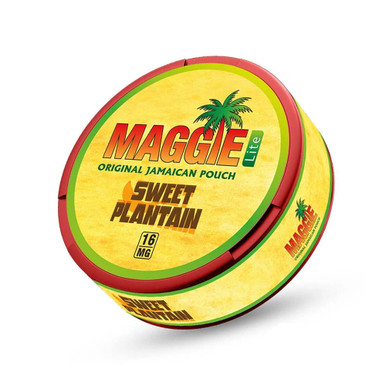
This page covers Maggie Original Jamaican Sweet Plantain Nicotine Pouches. Our catalogue gives the brand as Maggie, the product name as Original Jamaican Sweet Plantain, and the price as £39.90. There are two declared strengths against the listing, 16mg and 60mg, and both variants are £39.90. Stock showed as available when this was written, and we hold one image.
Say the obvious thing first, because this name makes it necessary. This is a nicotine pouch. It comes in a round can and it is used exactly as every other pouch on this site is used. It is not food, it is not a drink, nothing about it is eaten or swallowed, and no part of it is produce. Sweet Plantain is a flavour name printed on a lid — a label pointing at a taste, in the same way that a cherry name on another can points at a taste rather than at fruit in a tin.
The full guide to Maggie Original Jamaican Sweet Plantain Nicotine Pouches
4,953 words on how it eats, who it suits, how to serve it and what to put beside it.
Sweet Plantain: the record, in full
On the word Jamaican: it is part of the manufacturer's own product name and we have carried the title through unchanged. It is not a claim about where the product is made and we will not treat it as one. We hold no manufacturer record, no country and no production information for this listing, so there is no honest statement about origin available to us, and we would rather leave an obvious question unanswered than answer it out of thin air.
Two gaps in our data belong at the top. First, our flavour field for this listing is empty — no classification at all — which is why the can does not appear on any of our flavour shelves. Second, we hold no pouch count and no cans-per-pack figure. Both are genuine absences. Where the packaging carries a number, the packaging is the authority.
Sold to adults aged 18 or over who already use nicotine. Nicotine is an addictive substance. The full compliance wording closes the page.
Sweet plantain, considered purely as a flavour direction
Because our record carries no flavour tag, everything here is our own account of what the name points at. It describes a flavour family, not this can, and it says nothing about what is inside the pouch. We do not publish composition for anything we sell.
Sweet plantain is an unusual flavour name to find on a pouch shelf, and it is worth explaining what sort of taste the phrase conventionally indicates, because a lot of people will not have a reference point for it at all.
The defining characteristic is a sweetness that is soft and rounded rather than bright. Where a berry is sweet in a way that arrives quickly and carries a little acidity with it, this direction is sweet in a heavier, more mellow way, with very little sourness anywhere in it. The second characteristic is a starchy, almost bready underlay — a body to the flavour rather than a note on top of it, which is what makes the sweetness read as substantial rather than thin. The third, and the one that gives the name its interest, is a caramelised edge: the toasted, slightly burnt-sugar character that appears when something starchy and sweet meets heat.
Put together, that is a warm, low-acid, full-bodied direction with almost no sharpness to it. There is no cooling register implied by the name, no citrus lift and no bitter floor. It is the flattest-contoured flavour idea in the whole of this range, in the sense that there is not much of an arc to it — it arrives as itself and stays as itself rather than opening, peaking and falling away.
That has a practical consequence worth knowing. Flavours built on a single sustained register tend to fade from notice faster than flavours built on contrast, simply because the palate stops registering a signal that never changes. People who run a can like this alongside something sharp or cold usually say the pairing works better than either on its own, and that is a comment about attention rather than a claim about the products.
On aroma, a plantain-type name sits in the soft, sweet, slightly baked region rather than the fresh or fruity one. It has more in common with a banana-type flavour than with anything else on our shelves, though the two are not the same idea — a banana note is usually creamier and more perfumed, while a plantain direction is drier and carries the caramelised edge that a plain banana does not.
It is also worth being honest about how unusual this name is in the context of a pouch shelf. Most of the flavour names in this category cluster in a few well-worn families — mint, berry, citrus, a handful of dark sweet constructions — and a name like this one is doing something different by pointing at a direction that has no established convention behind it. That cuts both ways. There is no shared reference point, so nobody arrives with a fixed expectation to be disappointed against; equally, there is no shared reference point, so a description like the one above is doing more work than it would for a cherry or a mint, and carries correspondingly more uncertainty.
If you have never encountered this flavour direction in any form, the closest widely-known relative is the banana family, with the differences noted below. That is offered as a rough bearing rather than as an equivalence, and it is the best we can do from a catalogue record that holds no classification at all.
And the standing caveat: our record holds no classification for this can, so this is an account of a name rather than a description of a product, and taste transfers between people worse than anything else written on a shop page.
The can, and how the format works
A round, shallow tin with a lift-off lid. Unused pouches sit in a ring inside. Above them, under the lid, is a shallower separate compartment — the catch compartment — provided so that a used pouch has somewhere to go when there is no bin nearby. A pouch is used in one piece, removed, and thrown away; there is nothing to clean and nothing to empty except the catch compartment itself.
How long anyone keeps a pouch in varies from person to person, and we do not publish a figure for this listing because our record does not hold one. Manufacturers usually print their own guidance on the packaging and that is the correct place to read it. Used pouches belong in a bin, and nowhere else.
The catch compartment deserves one clarifying sentence, because it is the feature most often misunderstood by people coming to the format for the first time. It is not a second storage area for fresh pouches and it is not sealed off from the ring below it. It is a temporary holding space, designed around the reality that bins are not always within arm's reach, and treating it as anything more than that is what turns a perfectly good can into one you would rather not open.
The brand and the declared figure are printed on the lid face, which sounds like a detail and is not: once three cans are sitting face-up in a drawer, the lid is the only thing distinguishing them. Nothing about the mechanics of the format changes between manufacturers, which is why moving between brands requires no adjustment at all on the practical side.
What happens to a can over its life
The main thread of this page is condition — how a can behaves from the day it arrives to the day it is empty — because it is the part of ownership that product copy almost never covers and the part that most often explains why one can seemed better than the next.
Before it is opened
A sealed can is the most robust it will ever be, but it is not indifferent to where it waits. If you buy two or three at a time and keep the spares somewhere, that somewhere matters more than anything you do later. Cool, dry and dark is the whole specification: a cupboard, a drawer, a box on a shelf. Not a car, not a windowsill, not the top of a radiator or a boiler cupboard, and not a bathroom.
Heat is the variable that does real work here. It does not produce a dramatic failure; it produces the slow, unremarkable change that people later describe as a can not being as good as the last one. Because nothing visible happens, it is easy to blame the product rather than the shelf it spent August on.
The moment it is opened
Opening the can starts a clock that we cannot time for you. We do not hold a shelf life or an after-opening figure for this listing, and any date on the packaging outranks anything we could say. What is generally true of the format is that the first opening is when the lid's job begins, and from that point the single most useful habit is pressing the lid fully home every time rather than resting it on.
That sounds trivially obvious written down. In practice it is the most common thing people get wrong, because a lid that is nearly on looks exactly like a lid that is on.
The middle of a can's life
This is where the catch compartment earns its keep and also where it causes most of the trouble. It exists for convenience — somewhere to put a used pouch when there is no bin — and it is small and unsealed. Used pouches left in it for hours are what it is for. Used pouches left in it for days will make the can unpleasant to open and are sitting directly above the unused ones, which does those no favours either.
The other mid-life risk is mechanical. A can that has been sat on, crushed under a laptop in a bag, or dropped hard onto a tiled floor may no longer seat its lid flat. There is no fixing that. A can in that state should be used up rather than kept in reserve, because it will not hold its contents the way it did.
Dry and moister styles, and an honest gap
Pouches across this category are not all made to the same moisture level. Some are distinctly dry; others are noticeably moister to the touch. That difference changes how much a can has to lose in a warm or draughty place, and it is why storage guidance in this category is sometimes phrased differently from one product to another.
We do not hold that specification for this listing, so we are not going to state which style it is. The general advice above applies either way, and where the packaging carries specific storage instructions, follow those instead of this page.
The small habits that actually make the difference
None of what follows is clever and none of it costs anything, which is rather the point. Keep the can somewhere fixed at home rather than wherever it was last put down, because a can with a habitual place does not end up on a windowsill by accident. Carry one can rather than three, since two round tins in the same pocket is one too many and the spares are better off in the drawer. Press the lid until it seats, every time, including the times when you are in a hurry — those are the times it does not get done.
Empty the catch compartment when you empty your pockets, not when it is full. Do not keep a can in a coat that lives in a car. And if you have bought several, put the new ones behind the old ones rather than on top, which is the entire mechanism by which rotation happens without anyone having to think about it.
That is the whole list. There is no accessory that improves on a dark cupboard and a lid that is properly closed, and anyone selling you one is selling you something you do not need.
Near the end, and after
A can that has been open a long time is simply not the same as a newly opened one. Nothing alarming happens, but the difference is real enough that people who buy several at once and work through them in the order they arrived rarely complain about it, while people who leave one at the back of a drawer for months often do. Rotation costs nothing.
When a can is finished, empty the catch compartment into a bin before the can goes anywhere. Used pouches are waste and should be treated as waste — in a bin, not down a sink, not in a hedge, not out of a car window. And the empty tin should not be handed to a child as a toy, however harmless it looks once it is empty.
The part that is not optional
Cans live where children and animals cannot reach them. Full stop. The packaging is small, round, brightly printed and opens with one hand, and this is an adult nicotine product. A closed drawer or a high shelf, not a coffee table and not a bag left on the floor.
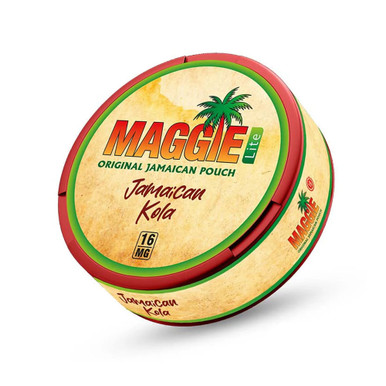
The Maggie shelf, and the six cans beside this one
The Maggie brand page holds seven listings. All seven sit at £39.90 and all seven carry the same two declared figures, 16mg and 60mg. There is no price ladder and no strength ladder inside the range, so moving between them is a decision about the name on the lid and nothing else — which is rarer across our catalogue than you might expect and makes this range genuinely easy to compare with itself.
None of the seven carries a flavour classification in our record, so the notes below describe what each name points at rather than what each can delivers.
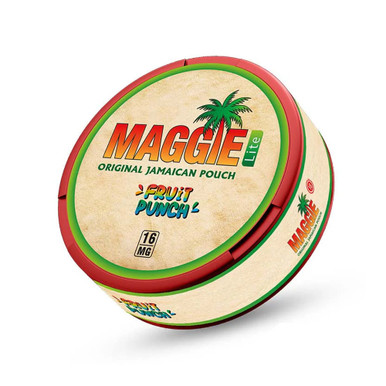
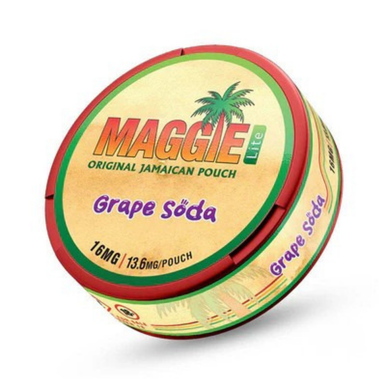
The closest relative to this page's can, in flavour architecture rather than in name, is probably Grape Soda — another low-acid, rounded, sweet direction, though perfumed where this one is baked. Summer Fruits goes the opposite way with a mixed-berry blend that is brighter, more acidic and more front-loaded. Fruit Punch is a broader multi-fruit name again, usually sweeter and more tropical in register than a berry mix.
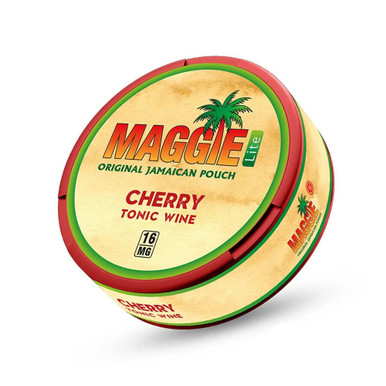
Cherry Tonic Wine is the most elaborate name of the seven, pointing at something dark and sweet with a bitter edge rather than a clean fruit. Kola abandons fruit entirely for a spiced construction with a dry bitter floor underneath it, and is the furthest in shape from this listing of anything on the shelf. And Mr Blue is the one name in the range that describes nothing at all — coined rather than descriptive, with an empty flavour field behind it, so we cannot tell you where it lands.
Within that set, the can on this page is the outlier. A starchy, caramelised, low-acid sweetness has very little company anywhere on our shelves, let alone within one brand's range, and that is the honest reason to pick it: not because it is better, but because there is not much else like it.
What people keep alongside something this soft
Running two cans at once is common, and with a flavour of this shape it is more useful than usual, for the reason given earlier — a sustained, low-contrast register fades from notice faster than a flavour with an arc to it. The sensible companion is something with sharpness, bitterness or a cold element, rather than another soft sweet one.
The nearest comparison we stock to this flavour direction is Cuba's Black Banana Hit at £39.90, which occupies the same soft, creamy, low-acid territory from a different angle. That makes it the best available reference point if you want to know what this shape of flavour is like, and simultaneously the worst possible companion to keep alongside it, since the two will blur into each other within a week.
For contrast, Black Cola at the same £39.90 brings spice and a deliberate bitter floor, which is the most complete structural opposite in that range. Black Apple Juice brings crisp orchard acidity, and Black Cherry brings a syrupy dark fruit with a sour lift. Black Blueberry is softer than either of those but still brighter and more acidic than a plantain direction. All four are £39.90.
Outside that range, Siberia Mini at £39.50 sits within pennies of this can on price and comes from an entirely different manufacturer, and Iceberg Arasaka at £39.90 is a further listing at this exact price whose name, like Mr Blue, is coined rather than descriptive — our pack entry for it supplies a title and a price and nothing else, so we will not describe its taste from this page. At the far end of the price range, Pablo Exclusive Banana Ice is £3.85, which is about a tenth of what this listing costs.
On that gap, the honest position: we hold no cans-per-pack figure against any of the listings named in this section, so we cannot tell you what a £39.90 listing is buying you in units compared with a £3.85 one. Comparing the two on price alone is comparing numbers rather than products, and the packaging is where a quantity is properly read.
Two declared figures, and the limits of a number
The second thread of this page is the strength information, which on this listing consists of two figures and nothing else.
| Declared strength | Price |
|---|---|
| 16mg | £39.90 |
| 60mg | £39.90 |
Both come straight from the product record. We publish them because they are declared on the product, and we publish nothing around them because we hold nothing around them. We do not know the basis on which either figure is expressed, we cannot convert one into the other, and we cannot compare either of them meaningfully with a figure printed by a different manufacturer. The can is where that information properly lives.
What the figures do here
They decide a shelf. The catalogue is split into three bands so that people who navigate by number can do so: medium at the lower end with 135 listings, strong in the middle, and extra strong with 98 listings, where this product is filed on the basis of its higher figure. That is a filing rule and a navigation aid. It is not an evaluation of anything.
What we are not going to do with them
We are not going to describe 60mg as a step up from 16mg, or 16mg as a starting point below 60mg. Both framings turn a specification into a progression, and there is no progression here — there are two variants of one product at one price. We are not going to call either figure suitable, appropriate, sensible, gentle or serious, because every one of those words is advice wearing a description's clothing.
And plainly: we cannot advise you on which strength suits you. Nobody at a shop can. It is not information we hold, it is not a judgement we are qualified to make, and it is not something a product page should be attempting for anyone. If you already use nicotine, you have your own reference. If you do not, nothing on this page is addressed to you.
Why the number travels badly between brands
There is one more thing worth explaining, because it stops people wasting effort on comparisons that cannot be made. A declared figure is published by whoever makes the product, and manufacturers do not all express the same quantity in the same terms. Two cans from two makers printing the same number are not therefore equivalent, and two cans printing different numbers are not reliably separated by the difference between them.
We hold no record of the basis of declaration for any listing on this site, which means we cannot normalise the figures and will not pretend to. The consequence is straightforward: a milligram figure is at its most useful as a comparison inside one manufacturer's range and at its least useful as a comparison across a catalogue of this size. Within the Maggie range that comparison barely arises at all, since every listing carries the same pair. Across our shelves generally, a table of numbers from different makers looks far more informative than it actually is.
This is not a complaint about manufacturers. It is a limitation of the information available to a retailer, and the honest thing is to say so on the page rather than to present a tidy ranking built on figures that do not share a basis.
The one genuinely useful thing about the pricing
Because both variants are £39.90, the decision between them carries no financial weight at all. That is unusual — on most listings that offer more than one figure, price moves with the number — and it means nobody is paying extra for a larger figure or saving money by taking a smaller one. Whatever else is involved in the choice, arithmetic is not.
Buying it, and the age check
Everything on this site is an 18+ purchase. Age verification is part of checkout, we may ask for proof of age at the point of sale, and the courier may ask for ID on the doorstep. Those checks are not waived because an order looks routine, and an order that cannot be verified is not handed over.
One thing worth knowing about how variants behave at checkout: the two figures are variants of a single product rather than two separate products, so they share this page, this image and this description, but they can move independently in stock terms. It is entirely possible for one variant to be available while the other is not. The availability shown against the variant you have actually selected is the one that governs, not the general state of the listing.
The price quoted on this page is what our record held at the time of writing — £39.90 for either variant — and the stock statement is dated the same way. If this text and the live listing ever disagree, the listing is correct. Delivery, payment and returns are set out in the site's policy pages rather than restated here.
Where to go from this page
If this is not the can, the quickest routes are by brand or by number. The seven Maggie listings share a price and a pair of figures, so that shelf is a pure flavour comparison. The Cuba brand page and the Pablo brand page are two of the larger brand shelves we keep and cover a far wider spread of prices and declared figures between them. By number, the three bands are the tool, with the extra strong shelf holding this listing.
And if you would rather see the lot, everything we stock is on a single page. Remember that this listing will not appear under any flavour shelf, for the reason given at the top of the page.
Questions we get about this can
Is this food, or flavoured with actual plantain?
It is a nicotine pouch, not food, and nothing about it is eaten. Whether any produce is involved in the flavour is a composition question, and we do not publish composition for any product on this site — nor do we hold it. The name is a flavour label. If that distinction sounds pedantic, it is the most important sentence on the page, because the name reads like something from a greengrocer.
What does it actually taste like?
Our flavour field for this listing is empty, so we hold no classification and cannot give you a specification. The description higher up the page is our own account of what the phrase "sweet plantain" conventionally points at as a flavour direction: soft, low-acid, starchy-sweet, with a caramelised edge. It is labelled as description because that is what it is, and the can itself remains the authority.
Does the name mean it is made in Jamaica?
No. It is part of the manufacturer's own product name, nothing more. We hold no origin, manufacturer or production data for this listing, so we cannot tell you where it is made. We are not going to derive a country from a word in a title, because that would be manufacturing a fact rather than reporting one.
How should I keep a can?
Cool, dry, out of direct sunlight, lid pressed fully home, away from heat sources, and not in a car. Empty the catch compartment regularly rather than letting used pouches sit in it. If you have several, work through them in the order you bought them. Where the packaging carries its own storage instructions, those take precedence over this page. And keep them well away from children and animals.
Does a can go off?
We do not hold a shelf life or an after-opening figure for this listing, so we cannot give you a period. Any date printed on the packaging is the authoritative one. What we can say is that an opened can left for months is not in the same condition as a fresh one — not dangerous, just noticeably different — and that heat accelerates that more than time alone does.
How many pouches are in a can?
We do not know. The pouch count and the cans-per-pack field are both empty in our record for this listing, and we will not estimate from what is typical in the category, because an estimate published here would be treated as a fact within a day. The packaging carries the declared number.
Why do both strengths cost £39.90?
Because that is what our record holds against each variant. We do not set the pricing and we have no explanation to offer beyond reporting it accurately. The practical effect is that choosing between the two figures involves no money, which removes the one part of the decision a shop could legitimately help with.
Which of the two figures should I pick?
We cannot tell you, and we will not. We give no strength advice on any listing, to anyone, and we do not describe any figure as suitable for a person or a circumstance. The two numbers are label information about a product. That answer is the same on every page of this site and it is not going to change.
Is it similar to a banana flavour?
They are relatives rather than twins, as flavour ideas. A banana direction is generally creamier and more perfumed; a plantain direction is drier, more starchy in body and carries a caramelised edge that a plain banana note does not. Since we hold no classification for this listing, that comparison is between two flavour families and not between two specified products.
Is it in stock?
Both variants showed as available at the time of writing, and the live listing is the real answer — this text does not update itself when a shelf empties. The brand page shows availability across all seven Maggie cans in one view, which is quicker than checking them individually.
Can I use it in a pub, an office or on a flight?
That is for the venue, the employer or the operator to say, not for us. Policies differ between organisations and change over time, and we have no standing to interpret anybody else's rules. Ask whoever is responsible for the place you are in, and treat the absence of a sign as an absence of information rather than as permission. If you are flying or crossing a border, the carrier and the destination country set their own rules and we do not track them.
Why does this one not show up when I browse by flavour?
Because our flavour field for it is empty, and the flavour shelves are built from that field. A listing with no classification has nothing to file it under, so it is reachable through the brand shelf, the strength band and the main catalogue page, but not through a flavour category. If the record later gains a classification, the listing would start appearing on the relevant shelf. We would rather leave the gap visible than assign a tag by guesswork, because a wrong tag is worse than no tag.
Is this can different from the others in the range in any way I can see?
Not on anything we hold. All seven listings share a price, a pair of declared figures, and an absence of pouch counts and flavour classifications in our record. On our data the name on the lid is the only variable between them. If the packaging differs in some respect we have not recorded — a different can size, a different pouch format — the packaging is where that would show, and it would outrank this page.
Do you carry ratings or customer feedback?
No. We do not publish ratings, review scores or customer comments on product pages, so there is nothing of that sort for this can. Everything factual on this page comes from our own catalogue record, and where that record is empty — the flavour classification, the pouch count, the storage specification — the page says so rather than filling the space.
Compliance
This product is sold only to adults aged 18 or over who already use nicotine. We do not sell to under-18s. ID may be requested at the point of purchase, and the courier may request it again on delivery.
Nicotine is an addictive substance.
This is not a licensed stop-smoking medicine and it is not intended for non-smokers, for anyone who does not already use nicotine, for under-18s, or for anyone who is pregnant or breastfeeding. Nothing on this page is medical advice, and nothing on it is a recommendation about what strength any person should use. We make no claim about what this product does.
Keep out of reach of children and animals. Used pouches go in a bin.
Last word
Maggie Original Jamaican Sweet Plantain is a nicotine pouch listed at £39.90, with two declared figures against it — 16mg and 60mg — at the same price either way. The name points at a soft, low-acid, caramelised sweet direction that has almost no company on our shelves, and since our flavour field is empty, that description is our account of the name rather than a specification. Jamaican is the manufacturer's naming and not a statement about origin, and we hold no pouch count. The rest of the range, the strength bands and the full catalogue are all linked above.
More from Maggie
More extra strong pouches
More maggie pouches
Where this sits
Maggie Original Jamaican Sweet Plantain Nicotine Pouches appears in these categories. Browse them, or jump to something close.
You might also like