Home / Extra Strong / Maggie Original Jamaican Mr Blue Nicotine Pouches
Maggie · 16mg–60mg
Read the full guide
Maggie Original Jamaican Mr Blue Nicotine Pouches
£39.90
✔ In stock — ready to ship
100% tobacco-free
Free over £20
Same-day dispatch
Secure checkout
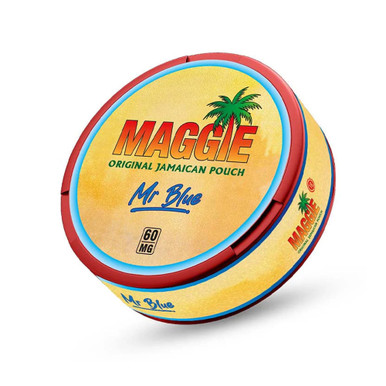
This page is for Maggie Original Jamaican Mr Blue Nicotine Pouches. Brand: Maggie. Product name as we hold it: Original Jamaican Mr Blue. Price: £39.90. Two declared strengths are recorded against the product, 16mg and 60mg, and both are listed at the same £39.90. Stock shows as available at the time of writing, and we hold a single product image.
So that there is no confusion caused by the name: this is a nicotine pouch. A dry pouch in a round can, used the way the rest of the pouches on this site are used. It is not a drink and it is not food, nothing about it is consumed as a liquid, and the words on the lid are a product name rather than a description of anything you would find on a shelf elsewhere. The point is worth labouring because this range in particular carries names that pull the imagination somewhere it should not go.
The full guide to Maggie Original Jamaican Mr Blue Nicotine Pouches
4,930 words on how it eats, who it suits, how to serve it and what to put beside it.
Mr Blue: what is on the listing and what is not
The word Jamaican is part of the manufacturer's own naming. We have carried the title into our catalogue exactly as we received it, and that is all the word signifies here. It is not a claim about where the product is made, and we will not turn a brand's naming into a geography lesson. We hold no manufacturer details, no country and no production information against this listing, so there is nothing we could say on that subject that would be true rather than invented.
Two blanks in our data are relevant before you read any further. The flavour field for this listing is empty — we hold no flavour classification for it at all, which matters more here than on most pages, because the name itself does not describe a taste either. And we hold no pouch count and no cans-per-pack figure. Where the packaging carries numbers, the packaging is right and this page is silent.
Sold to over-18s who already use nicotine. Nicotine is an addictive substance. Full wording at the foot of the page.
The format, in practical terms
Before the flavour question, the mechanics, because they are the same on this can as on almost everything else we list and they are what a first-time buyer of this particular brand actually needs.
The can is a round, shallow tin that closes with a lift-off lid. Inside, unused pouches sit in a ring. Under the lid, above that ring, there is a separate shallow compartment — the catch compartment — which exists so a used pouch has somewhere to go when a bin is not within reach. That compartment is a convenience, not a storage solution: it is small, it is not sealed, and leaving used pouches sitting in it for days rather than hours will make the whole can unpleasant and does the unused pouches underneath no favours. Empty it regularly, and put used pouches in a bin rather than anywhere else.
A pouch itself is small and soft and is used in one piece. How long anyone keeps one in varies from person to person and we do not publish a figure for this listing, because our record does not hold one. Manufacturers generally print their own guidance on the packaging and that is the place to read it. What is consistent across the format is that a pouch goes in, is used for a while, and then comes out and is thrown away — there is no residue to deal with, nothing to empty, nothing to clean.
The can's shape is the reason the format travels the way it does. It goes in a coat pocket, a bag, a drawer, a glovebox. It does not do well crushed, and it does not do well left somewhere hot, which has its own section further down. That is about the whole of the mechanical story, and it does not change between brands, which is why the brand you buy is a decision about flavour, figure and price rather than about how anything works.
How a flavour gets built into a dry pouch — and what "Mr Blue" tells us
This page runs on the question of flavour construction, and it is the right page for it, because the name on this can is the one name in the range that describes nothing at all.
The honest problem with this listing
Start with the admission. Mr Blue is a coined name. It is not cherry, it is not mint, it is not cola. It does not name a fruit, a spice, a plant or a temperature. And our record carries no flavour classification for the product, so there is no second source on our side that fills the gap. That means we cannot tell you what this can tastes of. Not "we would rather not" — we do not hold it.
We know what people usually assume, because blue as a colour word turns up across this whole category and tends to be attached to berry-shaped flavours somewhere in the raspberry, blueberry and mixed-berry region. That is a pattern across a market, though, not a fact about this product, and an assumption printed on a shop page becomes a fact in about a week. So we are leaving it as an assumption and labelling it as one. The printed can, and the manufacturer, are where a definitive answer lives. If knowing the flavour before you open it matters to you, this is a listing to be cautious about, and we would rather say that than sell you a guess.
What flavour construction in this format actually has to do
What we can write about usefully is the general problem any flavour faces in a dry pouch, because it is a genuinely constrained piece of design and it explains a lot about why a can can taste different from the thing its name points at.
A flavour delivered this way has three tools and only three. It has taste — the sweet, sour, bitter and salt registers. It has aroma, which is most of what people actually mean when they say "flavour", and which in this format arrives from the pouch itself rather than from anything in the air. And it has whatever cooling or warming register the maker builds in, which is a sensation rather than a taste and which behaves almost like a separate ingredient in how a can reads.
What it does not have is everything else that normally carries a flavour. There is no temperature to speak of. There is no texture in the usual sense — no crunch, no softness, no melt. There is no carbonation, which matters enormously for any flavour name borrowed from something fizzy, because the prickle people associate with those flavours is a physical sensation and cannot be reproduced. And there is no volume: a pouch delivers a small, steady signal over a period rather than a large one all at once.
Why this makes some flavour families translate better than others
The families that survive the translation best are the ones whose identity lives mostly in aroma and in a simple sweet-sour balance. Berry flavours translate well for exactly that reason — a berry is aromatic, sweet, mildly sour, and does not depend on texture or fizz to be recognisable. Mint families translate well because the cooling register is something the format can actually build rather than imitate.
The families that struggle are the ones built on things the format cannot supply. Anything defined by fizz loses its bite and has to rebuild it out of citrus and spice. Anything defined by richness or creaminess has no body to work with and comes out as sweetness plus aroma, which is thinner than the memory of it. Anything defined by texture loses the argument before it starts.
You can see the whole of that spectrum on our own shelves without changing brand more than once. Cuba's Black Cola at £39.90 is a case of a fizz-dependent name rebuilding its bite out of citrus and spice. Black Banana Hit, same price, is a case of a creamy, low-acid family being rendered almost entirely as sweetness and aroma. Black Blueberry is an example of a family that translates almost intact. And Iceberg Arasaka at £39.90 is a reminder that this page's listing is not the only coined name on our shelves — our own pack entry for that one hands us a title and a price and nothing else, so we are in exactly the same position with it as we are here.
Coined names, and why manufacturers use them
It is worth saying that a coined name is not a mistake or an oversight. Manufacturers use them deliberately, and there are ordinary commercial reasons for it: a name that does not tie a can to a single fruit can be reformulated without becoming a lie, it travels across markets where a fruit name might not, and it gives a range something to build an identity around beyond a list of produce. None of that is sinister. It is, however, inconvenient for a retailer trying to describe the thing accurately, and inconvenient for a customer who wants to know before buying rather than after.
Our position on it is simple and it does not change from page to page. Where a name describes something, we will describe what it describes. Where a name describes nothing and our record adds nothing, we say so and stop. The alternative — writing three confident paragraphs about a berry flavour we have no evidence for — would read better and be worth less than nothing, because the one thing a product page has to be is right.
Where that leaves the can on this page
It leaves it as a can with a name that does not commit to a family, from a range whose other names mostly do. If the assumption about blue-named flavours holds, it will land in the aromatic, sweet, mildly sour territory that this format handles best. If it does not hold, we have not told you anything untrue, because we have not told you anything. That is the most honest version of this section we can write.
The two declared figures on this line
Our record holds two strengths against this product, and the same price against both.
| Variant | Declared strength | Price |
|---|---|---|
| Lower figure | 16mg | £39.90 |
| Higher figure | 60mg | £39.90 |
Both figures come from the product record and both are simply label information. 60mg is a large number on the scale our catalogue uses and 16mg is not, and the distance between them on one listing is unusual. We do not hold the basis on which either is expressed and we are not going to guess at it; the printed can is where that is read properly.
What the figures do on this site is decide filing. We split the catalogue into three bands and this listing sits on the extra strong shelf, currently 98 listings, on the basis of the higher of its two figures. That is a navigation decision and nothing more.
What the figures are not is a scale of achievement. We do not present the 60mg variant as a step up, a progression, a stronger option worth reaching for, or anything else of that shape, and we will not tell you which of the two suits you — we cannot advise anyone on that and it would be wrong of a shop to try. The price is identical either way, so nothing in the decision is financial.
Discretion, setting, and whose rules are whose
The second thread on this page is about where and how the format is used, and it needs handling carefully, because it is the area where product copy most often drifts into saying things a shop has no business saying.
What the format is like to carry
Practically speaking, this is a small round tin and a small pouch. It makes no noise, produces nothing in the air, needs no equipment and requires no preparation. There is nothing to charge, nothing to refill and nothing to dispose of except the used pouch itself. That is a straightforward description of a format, and it is the main reason people who use it tend to describe it in terms of convenience rather than in terms of experience.
The tin is the only thing anyone else is likely to see. It is roughly the footprint of a small jar lid, it sits flat, and it is quiet in a pocket unless it is sharing that pocket with keys. People who run two or three flavours at once usually keep one can on them and the rest at home, because two tins in one pocket is noticeably more awkward than one.
Whose rules apply, and why we will not summarise them
Now the part that matters more. Where you may and may not use a product like this is not determined by us and it is not determined by the product. Venues set their own policies. Employers set their own policies, and many set them in writing in a staff handbook rather than on a sign. Airlines, rail operators, bus companies, hospitals, schools, gyms, hotels and landlords all set their own, and those policies differ from one another and change over time.
We are a shop. We do not speak for any of those organisations, we have no standing to interpret their rules, and a summary written on a product page would be out of date somewhere the moment it was published. So we do not publish one. If you want to know whether something is permitted somewhere, ask whoever runs the place — that is not us deflecting, it is the only source that is actually authoritative.
The thing discretion should not be used for
It follows from all of the above that the low profile of the format is not a reason to disregard a rule that exists. If a policy says no, the fact that nobody would notice is not a counter-argument, and we are not going to pitch it as one. Equally, the format's discretion is not a selling point we will dress up as anything more than it is. It is a description of a physical object: small, quiet, self-contained. Nothing in that description is a claim about the product, about the person using it, or about how anyone will be perceived.
Travelling with a can
One more practical note in the same territory. Rules on carrying and using nicotine products across borders vary by country and we do not track them. If you are travelling, check the rules for your destination and for your carrier before you pack, rather than after. Again, we have no useful information to add and would be guessing if we tried.
Where this can sits in the Maggie range
The Maggie shelf runs to seven listings. All seven are priced at £39.90 and all seven carry the same pair of declared figures, 16mg and 60mg. That uniformity is genuinely useful: there is no price ladder and no strength ladder inside this range, so moving from one can to another changes the name on the lid and nothing else.
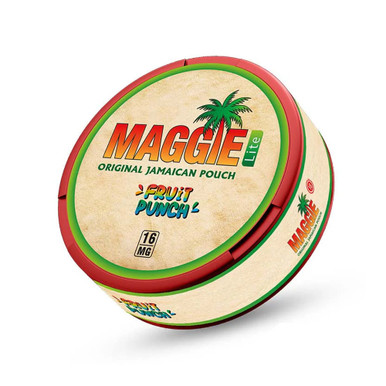
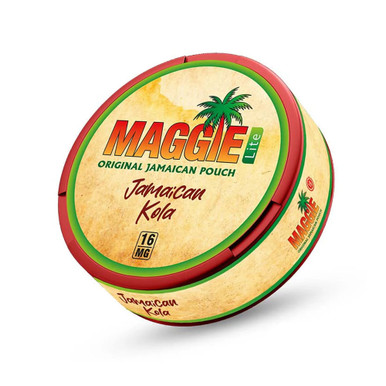
Six of the seven carry names that at least point somewhere. Kola is the one built on spice with a dry bitter edge underneath rather than on fruit — the furthest in shape from a berry direction. Summer Fruits names a mixed-berry blend where no single fruit leads. Fruit Punch names a wider multi-fruit mix, usually sweeter and more tropical in register than a berry one.
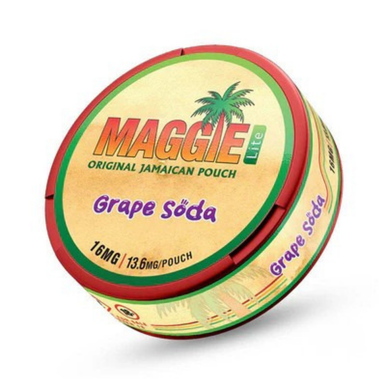
Grape Soda points at a round, perfumed, low-acid grape direction. Cherry Tonic Wine is the most complicated name of the seven and points at something dark and sweet with a bitter edge rather than at a clean fruit. Sweet Plantain names a soft, starchy-sweet, very low-acid direction that has almost no company on our shelves at all.
The can on this page is the seventh, and it is the only one whose name commits to nothing. That is either an annoyance or the reason to buy it, depending on temperament. As with all of them, our record holds no flavour classification, so those descriptions are accounts of what the names point at rather than statements about what the cans deliver.
What £39.90 does and does not tell you
The price on this listing is the same as the price on every other listing in this range, and it is also the same as the price on a considerable number of listings from other manufacturers that we stock. That is the sort of coincidence that invites an explanation, and the honest answer is that we do not have one to give.
Here is what we can state from our own record. This can is £39.90. So is Cuba's Black Cherry, and so is Black Apple Juice. Siberia Mini comes in at £39.50, forty pence below. Pablo Exclusive Banana Ice is £3.85, which is roughly a tenth of the figure at the top of this paragraph.
What we cannot state is what accounts for that spread, because the field that would explain most of it — how many cans a listing represents — is empty on every one of them in our record. A price of £39.90 against a price of £3.85 could reflect a difference in quantity, a difference in the product, a difference in how the manufacturer prices, or some combination we cannot see from here. We are not going to pick one of those and present it as the reason. Where the packaging states a quantity, the packaging is the source, and comparing two listings on price alone without that figure is comparing two numbers rather than two products.
We mention this on every page where the spread comes up because it is the single most common source of confusion on a catalogue this wide, and because the temptation for a shop is to smooth it over with a plausible story rather than admit to a gap in its own data.
Keeping something else in rotation
People who use this format regularly tend to keep more than one can going, and the usual reason is simply that a single flavour stops registering as anything when nothing else is ever in the rotation. Within this brand, the sensible companion to an unspecified name is a specific one, so you at least know what the other half of the pairing is.
Outside the brand, the same-price comparisons are the easiest to make. Black Cherry at £39.90 is syrupy and aromatic with a sour lift. Black Apple Juice, also £39.90, is the crisper, lighter orchard-fruit direction. Both are recognisable flavours with nothing ambiguous about the naming, which makes them a reasonable counterweight to a can whose name tells you nothing.
If you want to move away from fruit entirely, Siberia Mini at £39.50 is close to this listing on price and a long way from it in intent, and the cold-named cans mentioned earlier go in the same direction. And if the exercise is about price rather than flavour, Pablo Exclusive Banana Ice at £3.85 is the cheapest listing referenced anywhere on this page by a wide margin — though, as always, we hold no cans-per-pack figure for any of these, so we cannot tell you what accounts for the gap and will not speculate.
Storage, and what actually degrades a can
Heat is the enemy and everything else is a footnote. A can left in a car on a warm day, on a sunny windowsill, or next to a radiator will not be in the same condition as one kept in a cupboard. Cool, dry and dark is the entire recommendation, and a kitchen drawer satisfies it perfectly well.
The lid is the other half. Press it home rather than resting it on top, particularly if the can is going into a bag where it will be jostled. A can whose lid has been bent or whose seat has been damaged by being sat on will not hold its contents as it should, and is a can to finish sooner rather than to keep at the back of a shelf. Keep the catch compartment empty between uses rather than letting it fill.
If you buy several at once, work through them in the order you bought them. There is nothing dramatic about an older can, but an opened one that has sat for months is not the same as a new one, and rotation costs nothing. Cold storage is unnecessary; a fridge introduces condensation risk when the can comes back out, and that is the one thing a dry pouch has no use for.
Keep cans where children and animals cannot get to them. The packaging is small, round and easy to open, and this is an adult nicotine product.
Deciding between the two variants
The flavour is fixed on this page — one name, with the honest caveat that the name does not describe a taste and we hold no classification for it. So the only decision left is between the 16mg variant and the 60mg variant, and on that we have a position we hold on every page of this site: we will publish both figures, and we will not advise you.
We cannot tell you which strength suits you. We will not describe either figure as appropriate for a person, a situation or a level of experience, and we do not frame the higher number as a destination. Both are £39.90, both show in stock, and that is genuinely the whole of what we know that is relevant to the choice.
If you want to compare how figures are spread across the site instead, the three bands are the fastest way to see it: medium at the lower end, strong in the middle, and the extra strong shelf at the top where this listing is filed.
Ordering, delivery and age verification
You must be 18 or over to buy anything on this site, and age verification is built into the process. We may ask for proof of age when the order is placed, and the courier may ask for ID when it arrives. That is not a formality we waive on request, and an order that cannot be verified is not completed.
The price on this page is the price our record held at the time of writing — £39.90, either variant. Stock is stated as at the time of writing too, and the live listing is the authority if the two ever disagree. Delivery options, payment and returns are set out in the site's policy pages rather than paraphrased here, because a paraphrase on a product page is how a shop ends up contradicting itself.
Routes out of this page
If this is not the can, there are three obvious directions. Stay with the brand and look at the other Maggie listings, all at the same price and the same pair of figures. Move by number and use the strength bands, with extra strong being the shelf this one sits on. Or move by manufacturer: the Cuba shelf and the Pablo shelf are two of the larger ones we keep and between them cover a very wide spread of prices.
Failing all of that, everything we stock is on one page and can be narrowed from there. Note that this listing will not appear under any flavour shelf, because we hold no flavour classification for it.
Questions people ask about this listing
What does Mr Blue taste of?
We do not know, and we are not going to invent an answer. The name is coined rather than descriptive and our flavour field for this listing is empty. Blue as a colour word is commonly attached to berry-type flavours across this category, but that is a pattern in a market rather than information about this product. The printed can is the authoritative source. If the flavour matters to you before purchase, treat this listing with appropriate caution.
Does the name point at a flavour family the way the other Maggie names do?
The name does not indicate that or anything else. Some names in this range do point at recognisable flavour families and this one does not point anywhere. More importantly, whatever the name, the product itself is a nicotine pouch — nothing in this range is a liquid or a food, and the names are flavour labels only.
Does the word Jamaican tell me where it is made?
No. It is part of the manufacturer's own product name and we treat it as a name. We do not hold origin, manufacturer or production data for this listing, so we cannot tell you where it is made. Anything we said on that subject would be speculation dressed as a fact, which is not something we are prepared to publish.
How many pouches are in the can?
Our record does not hold a pouch count, and it does not hold a cans-per-pack figure either. That means we cannot answer, and we will not put an estimate on a product page. Whatever the packaging states is correct. It is a real gap in our data rather than a refusal.
Why do 16mg and 60mg cost the same?
Because that is how the product is priced in our record — £39.90 against each variant. We do not set that pricing and we have no explanation for it beyond reporting it accurately. The useful consequence is that choosing between the two figures involves no money at all.
Which figure should I choose?
We cannot say. We do not give strength advice to anyone, on any listing, and we do not describe any figure as suitable for a person. The two numbers are label information about the product and nothing more. If you already use nicotine you will have your own reference point; a shop page is not a substitute for one.
Can I use this at work or on a train?
That depends entirely on the policy of your employer or the operator, and those are theirs to set and state, not ours. Rules differ between organisations and change over time, so any summary we wrote here would be wrong somewhere. Ask whoever is responsible for the place you are in. The fact that the format is quiet and self-contained is not a reason to work around a rule that exists.
Is the can resealable?
The lid lifts off and presses back down, which is how the format works everywhere in this category. It is not a screw fitting and it is not airtight, and a lid that has been damaged will not seat properly. Pressing it fully home each time, and keeping the can out of heat, does more for the condition of what is inside than anything else you can do.
What do I do with a used pouch?
It goes in a bin. The catch compartment under the lid is there for when a bin is not immediately available, not as a place to store them — empty it out when you can, because used pouches left in a can for days will make the can unpleasant and will not do the unused ones underneath any good either.
Is this one in stock?
Both variants showed as available when this page was written. Stock moves and this text does not, so the live listing governs. The brand shelf is the quickest way to see which of the seven Maggie cans are currently available at a glance.
If I do not like it, is there anything I can do?
Returns on an age-restricted consumable are governed by the site's own returns policy rather than by anything written on a product page, so that is the place to check before you order. What we can say is that a single can at a stated price is a small commitment by the standards of most retail, and that nothing about buying from one manufacturer ties you to them afterwards. There is no device, no subscription and no compatibility to worry about — a can is a can.
Will you update this page if you get the flavour information?
If our catalogue record gains a flavour classification for this listing, the page will reflect it, and the listing would then also start appearing on the relevant flavour shelf. Until that happens the description above stays as it is, which is an explanation of why we cannot describe it rather than a description. We would rather leave an obvious gap visible than close it with something we made up.
Do you publish reviews or star ratings?
No. We do not carry ratings, review scores or customer comments on product pages, so there is nothing of that sort for this can. Everything factual here comes from our own catalogue record, and everything descriptive is written as description and flagged as such — which is why the flavour section on this page is mostly an explanation of why we cannot describe it.
Compliance and the legal position
This product is sold only to adults aged 18 or over who already use nicotine. We do not sell to under-18s. ID may be requested at the point of purchase and may also be requested by the courier on delivery.
Nicotine is an addictive substance.
This is not a licensed stop-smoking medicine and it is not intended for non-smokers, for anyone who does not currently use nicotine, for under-18s, or for anyone who is pregnant or breastfeeding. Nothing on this page constitutes medical advice, and nothing on it is a recommendation about what strength any individual should use. We make no claim about what this product does.
Store out of reach of children and animals. Put used pouches in a bin.
Summing up
Maggie Original Jamaican Mr Blue is a nicotine pouch listed at £39.90 with two declared figures against it, 16mg and 60mg, priced identically. The distinguishing feature of this listing is a negative one: the name does not describe a flavour and our flavour field is empty, so we cannot tell you what it tastes of and have not pretended to. The word Jamaican is the manufacturer's naming rather than a statement of origin. Everything else — the six other cans on the brand shelf, the strength bands, the wider catalogue — is linked from this page.
More from Maggie
More extra strong pouches
More maggie pouches
Where this sits
Maggie Original Jamaican Mr Blue Nicotine Pouches appears in these categories. Browse them, or jump to something close.
You might also like