Home / Extra Strong / Maggie Original Jamaican Summer Fruits Nicotine Pouches
Maggie · 16mg–60mg
Read the full guide
Maggie Original Jamaican Summer Fruits Nicotine Pouches
£39.90
✔ In stock — ready to ship
100% tobacco-free
Free over £20
Same-day dispatch
Secure checkout
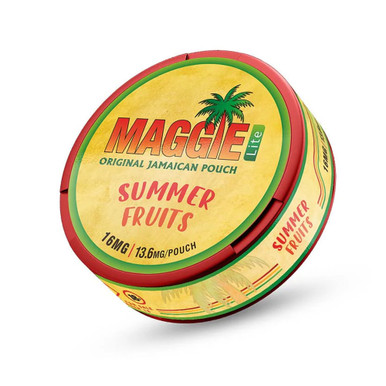
This is the page for Maggie Original Jamaican Summer Fruits Nicotine Pouches. Our record gives the brand as Maggie, the product name as Original Jamaican Summer Fruits, and the price as £39.90. Two declared strengths are held against it — 16mg and 60mg — and both variants carry that same £39.90. The listing showed in stock when this page was written, and there is one product image on file.
The first thing to be clear about is what the product is, because the naming across this whole range invites the wrong assumption. This is a nicotine pouch: a small dry pouch supplied in a round can, used the same way as everything else in this part of the catalogue. It is not food and it is not a drink. Nothing about it is consumed as a liquid and nothing about it is chewed or swallowed. Summer Fruits is a flavour name printed on a lid, in the same sense that a flavour name on any other can is a label rather than a promise of produce.
The full guide to Maggie Original Jamaican Summer Fruits Nicotine Pouches
4,927 words on how it eats, who it suits, how to serve it and what to put beside it.
The listing in front of you
The word Jamaican sits inside the manufacturer's own product name and has been carried into our catalogue title untouched. We do not read it as an origin statement and neither should anyone else. Our record holds no manufacturer, no country and no production detail for this listing, so we could not make an origin claim honestly even if we thought it was a good idea, and we do not.
Two things are missing from our data and are worth knowing now rather than at the end. The flavour field for this listing is empty — there is no flavour classification recorded against it, which is why it does not appear on any of our flavour shelves despite having an unambiguously flavour-shaped name. And there is no pouch count and no cans-per-pack number. Where the printed packaging carries figures, the packaging is right and this page is quiet.
Sold to adults aged 18 or over who already use nicotine. Nicotine is an addictive substance. The full wording is at the foot of the page.
The numbers on this can, and what a number can actually tell you
This page is written mainly around the strength figures, because this listing is an unusually clear illustration of how little a milligram figure does on its own and how easily people are encouraged to read more into one than it holds.
What we hold
| Variant | Declared strength | Price | Stock at time of writing |
|---|---|---|---|
| Lower | 16mg | £39.90 | In stock |
| Higher | 60mg | £39.90 | In stock |
Two figures, one price, one flavour name. That is the entirety of what our record says on the subject. We do not hold the basis on which either figure is expressed and we are not going to infer it, because an inference published on a product page becomes a fact in the reader's memory within a paragraph. The can itself carries whatever the manufacturer has declared and in what terms, and reading it there is the only reliable way to know.
What the figure does on this website
Its practical job here is filing. We divide the catalogue into three bands so that people who navigate by number rather than by name can do so. The medium band holds 135 listings at the lower end of the range. The strong band sits in the middle. The extra strong shelf carries 98 listings, and this product is filed there on the strength of the higher of its two declared figures.
That filing decision is a piece of website architecture. It helps you find a can. It is not an assessment of the product, it is not a quality ranking, and it carries no implication about who any listing is for.
Why a milligram figure compares badly across brands
Here is the part that is genuinely worth understanding, because it saves people a lot of wasted comparison. A declared figure is published by a manufacturer, and different manufacturers do not all express the same quantity in the same terms. Two cans from two makers carrying the same printed number are not therefore two equivalent products, and two cans carrying different numbers are not reliably a step apart in the way arithmetic would suggest.
We do not hold, for any listing on this site, the basis of the declaration — so we cannot normalise the figures for you, and we would be making it up if we tried. What that means in practice is that the number is most useful as a comparison within one manufacturer's range and least useful as a comparison across the catalogue as a whole. Inside this range, for instance, the comparison is easy, because all seven listings carry the same pair of figures. Across the site it is much less meaningful than a table of numbers makes it look.
The gap between 16 and 60, and what we will not say about it
The distance between the two figures on this listing is large — larger than on most products we carry, where the variants tend to sit closer together. It is the kind of gap that invites a shop to write something about progression, and we are not going to.
We will not describe the 60mg variant as an upgrade, a next step, a stronger option worth working towards, or a marker of anything about the person buying it. It is a specification. A larger printed number is a different product, not a superior one, and there is no ladder here to be climbed. We also will not describe the 16mg variant as an entry point, a starting place or a gentler option, because those framings do the same job from the other end.
Most importantly: we cannot advise anyone on which strength suits them. Not by experience, not by circumstance, not by any other measure. We are a shop with a catalogue record, we are not qualified to give that advice, and no product page on this site will give it. If you already use nicotine you will have your own frame of reference. If you do not, this is not a page that should be helping you form one.
How the two variants behave as listings
A small practical point that people ask about often enough to deserve its own note. The two figures are variants of a single product rather than two separate products, which is why they share one page, one image and one description. They can move independently in stock terms — it is perfectly possible for one to be available while the other is not — so the availability shown against the variant you have selected is the one that matters, not the availability of the listing in the abstract.
Because the price is identical, the variant selector is not doing any of the work a price comparison usually does. It is a specification choice and nothing else, and switching between the two on the page changes nothing except the number recorded against the order.
One thing the numbers genuinely do settle
They settle nothing about money, which is unusual. On most listings where two figures exist, the price moves with them. Here it does not: £39.90 either way. So whatever else the decision involves, it does not involve a calculation about value, and nobody is paying more for the larger number.
Summer Fruits, described as a taste
With no flavour classification on our record, what follows is our own account of what the name points at. It is a description of a flavour family, not a specification of this can, and it is not a statement about what is inside the pouch — we do not publish composition for anything we sell.
Summer fruits, as a flavour name, is a deliberately plural idea. Where a single-fruit name commits to one thing, this one commits to a blend, and the blend is conventionally built around soft red and dark berries: strawberry and raspberry doing most of the work at the front, with blackberry, blackcurrant or blueberry adding depth behind them. The intention of the name is that no single fruit should dominate; if one obviously does, the blend has not quite done its job.
As a taste, that puts it in the sweet-and-slightly-sour region rather than the sharp one. The strawberry element brings a soft, rounded, jammy sweetness. The raspberry brings the perfume and a light acidity, and it is usually the fruit that makes a mixed-berry flavour smell like anything at all. The darker berries sit underneath and supply body — a slightly deeper, less bright sweetness with a faint tannic dryness at the very end that stops the whole thing reading as sugar.
The shape of it over time, if you pay attention, is front-loaded. Mixed-berry flavours generally arrive quickly, sit at their fullest early, and then thin toward the finish, with the darker fruits being the last thing still identifiable. That is the opposite shape from, say, a spiced construction, which builds rather than arrives. Neither is better; they are just different profiles, and knowing which you prefer explains a good deal about which cans you end up keeping.
There is no cooling register implied by the name. A summer fruits construction is a warm flavour in the sense that it does not build any menthol-type sensation over the top. If a can does carry one, that is something the maker has added on top of the flavour family rather than something the name implies, and the other cans in this range are the same in that respect.
And the usual caveat, which matters more on a mixed-berry name than almost anywhere else: blends differ enormously between manufacturers. One maker's summer fruits leads with strawberry and another's leads with blackcurrant, and the two can be barely recognisable as the same idea. Since our record holds no classification for this listing, we cannot tell you which way this one leans. Taste is also the least transferable thing on any product page — two people describing the same can rarely produce the same sentence.
One further note on the name, since it is the sort of thing that trips people up when they are comparing across a catalogue. A blend name and a single-fruit name are not really the same kind of claim. A single-fruit name sets a target that can be missed — a cherry that does not taste of cherry has failed on its own terms. A blend name sets a direction instead, and there is a good deal of latitude in it. That makes blends harder to compare fairly between manufacturers and harder to describe usefully on a page like this one, which is part of why the paragraphs above are hedged as carefully as they are.
It also means that if you have used a mixed-berry can from another maker and liked or disliked it, that experience transfers less reliably than it would with a single-fruit name. The family is the same; the execution may not be close at all.
The format, briefly, for anyone new to this brand
The can is a round shallow tin with a lift-off lid. Unused pouches sit inside in a ring. Under the lid there is a second, shallower compartment — the catch compartment — intended as somewhere to put a used pouch when a bin is not to hand. It is a convenience and not a storage system: it is small, it is not sealed, and pouches left in it for days rather than hours will make the can unpleasant to open and will not help the unused ones sitting below.
A pouch is used in one piece and then removed and thrown away. How long anyone keeps one in varies, and we do not publish a figure for this listing because we do not hold one; the manufacturer generally prints its own guidance on the packaging, which is the thing to read. Used pouches go in a bin — not down a sink, not out of a car window.
None of this changes between brands, which is worth saying because it means moving from one manufacturer to another involves no learning at all on the mechanical side. The variables are flavour, declared figure and price. Everything else is the same object.
Storage: heat, lids, and the condition of a can over time
The second thread of this page is the least glamorous and the most likely to change your actual experience of a can, because most complaints about a product "not being as good as last time" turn out on inspection to be complaints about where the can has been living.
Dry and moist styles, and why we cannot tell you which this is
Pouches across this category are not all made to the same moisture level. Some are distinctly dry to the touch; others are noticeably moister. The distinction matters for storage, because a moister pouch has more to lose in a warm, ventilated place, while a dry one is more tolerant of an ordinary drawer but still not indifferent.
Our record does not state which style this listing uses, so we are not going to tell you. What follows therefore covers the format in general rather than being tailored to this can, and where the packaging gives storage instructions, the packaging outranks this page without argument.
Heat is the one that actually matters
Everything else on this list is a footnote next to temperature. The worst place a can can spend a day is a parked car. The second worst is a sunny windowsill, and the third is the top of anything that produces heat — a radiator, a boiler cupboard, the back of a kitchen appliance. Warmth works on a can slowly and invisibly, and the result is usually described afterwards as the flavour having gone flat or the pouches feeling different, rather than as anything dramatic.
The counter-measure is dull and effective: keep cans somewhere cool, dry and out of direct light. A drawer does it. A cupboard away from the cooker does it. A bag that does not live in a vehicle does it. There is nothing clever to buy and no accessory that improves on a dark cupboard.
Cold, damp and the fridge question
People ask about refrigerating cans fairly often and the answer is that there is nothing to gain from it. Cold is less damaging than heat, certainly, but a can that moves repeatedly between a cold fridge and a warm room will collect condensation under the lid, and moisture arriving from outside is not something any pouch benefits from. Room temperature, out of the sun, is the whole of it.
Damp is worth a separate mention because bathrooms are a surprisingly common place for a can to end up. A steamy room is a poor home for anything kept in a tin with a press-on lid. The same applies to a wet coat pocket in winter.
The lid, and mechanical damage
A press-on lid does its job only when it is pressed on. Resting it in place because you are in a hurry is the single most common way a can dries out or picks up an odour from wherever it is stored. If the can is going into a bag with other objects, it is worth a second's attention.
Physical damage is the other half. A can that has been sat on, crushed at the bottom of a rucksack or dropped hard may no longer seat its lid flat, and once that happens it will not hold its contents in the same condition. There is no repair for it. A can in that state is one to use sooner rather than to keep in reserve.
Rotation, and how long an opened can keeps
We do not publish a shelf life for this listing because we do not hold one, and any date printed on the packaging is the authority. What we can say as a matter of common sense is that an opened can that has sat at the back of a drawer for several months is not in the same state as a freshly opened one, and that people who buy several at a time and use them in the order they arrived rarely have this problem at all.
Keeping the catch compartment empty belongs in the same category of small habits. A can carrying four used pouches under its lid is not storing the unused ones well.
Travelling with a can
A round tin travels perfectly well in a bag or a coat pocket, and the only two things worth watching are the ones already covered: heat and crushing. A glovebox in summer combines both badly. A can zipped into a side pocket of a rucksack, away from anything heavy and out of the sun, will arrive in the condition it left in. If you are crossing a border, the rules on carrying nicotine products vary by country and by carrier and we do not track them — check before you pack rather than after, because we have nothing useful to add on that and would only be guessing.
The non-negotiable part
Cans go somewhere children and animals cannot reach. The packaging is small, round, brightly printed and easy to open, and this is an adult nicotine product. A high shelf or a closed drawer, not a coffee table.
The Maggie range as we list it
There are seven listings on the Maggie shelf, this one included. The range is unusually flat: every can is £39.90 and every can carries the same 16mg and 60mg pair. There is no price ladder and no strength ladder inside it, which means choosing between them is purely a matter of the name on the lid.
Since none of the seven carries a flavour classification in our record, the notes below describe what each name points at rather than what each can delivers.
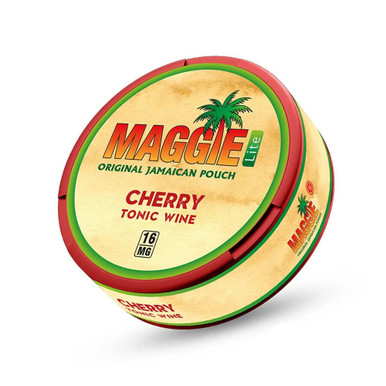
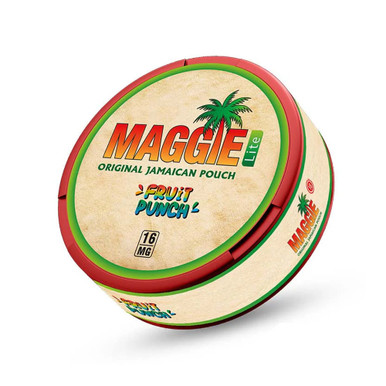
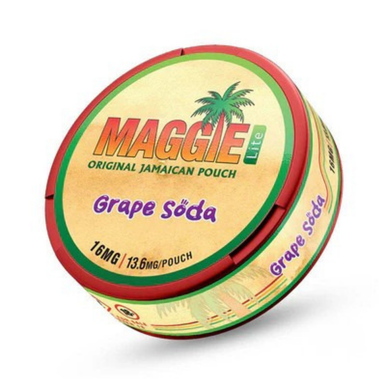
Fruit Punch is the nearest relative to this one — another multi-fruit name, but pointing at a wider and generally more tropical mix rather than a berry-centred one, which usually makes it the sweeter and less tart of the two ideas. Grape Soda narrows to a single fruit and a perfumed, rounded, low-acid shape that is quite unlike a berry blend.
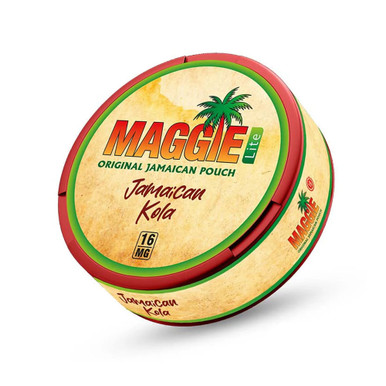
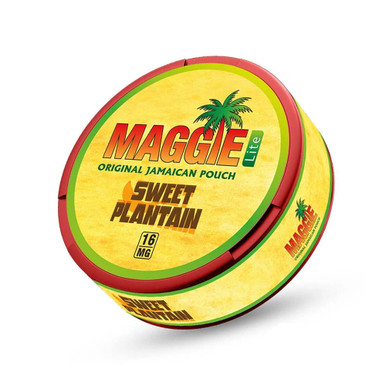
Cherry Tonic Wine is the most elaborate name of the seven and points somewhere dark and sweet with a bitter edge rather than at a clean fruit. Kola leaves fruit behind altogether for a spiced construction with a dry bitter floor underneath. Sweet Plantain is the strangest name in the range and points at something soft, starchy-sweet and almost without acidity, with very little company anywhere on our shelves.
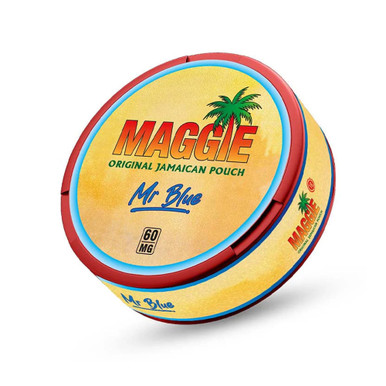
And Mr Blue is the one name in the seven that describes nothing at all. It is coined rather than descriptive, and because our flavour field is empty for it too, we genuinely cannot say what it tastes of — which we mention here so that nobody assumes it is a near neighbour of this can just because both sit in the same range.
Cans people keep alongside a berry blend
The usual reason for running two cans is that one flavour on its own stops registering after a while. The pairing that tends to work is something structurally different rather than a close relative, since two mixed-berry cans in rotation will simply blur.
Staying at the same price, Cuba's Black Cola at £39.90 is about as far from a berry blend as the catalogue goes at that figure — spiced, dark, with a bitter element rather than a tart one. Black Banana Hit, also £39.90, goes the creamy, low-acid route and has almost no sharp edge anywhere in it.
If you would rather stay in fruit but change its shape, Black Apple Juice is the crisp orchard-fruit direction with a cleaner acidity than a berry mix, and Black Cherry takes a single dark fruit and makes it syrupy and aromatic. Both are £39.90. Black Blueberry is the closest of the four to this listing's territory, which is precisely why it is the least useful as a contrast, though it is a fair comparison if you want to know how one manufacturer handles a berry against another.
A point worth making about pairing generally: the useful contrast is structural rather than nominal. Two cans with different fruit names can still occupy the same shape — both sweet at the front, both thinning at the finish, both with the same kind of acidity — in which case rotating between them achieves very little. Two cans with genuinely different architecture will stay distinct from each other for far longer, which is why the cola and banana suggestions above are more useful as companions to a berry blend than another berry would be, even though on paper another berry sounds like the safer choice.
Further afield, Siberia Mini at £39.50 sits within pennies of this can on price and comes from a different manufacturer entirely, and Iceberg Arasaka is another £39.90 listing whose name is coined rather than descriptive — our pack entry supplies a title and a price for it and nothing more, so we will not characterise its taste from here. At the other extreme of the price range, Pablo Exclusive Banana Ice is listed at £3.85. We hold no cans-per-pack figure against any of these, so we cannot explain the spread between £3.85 and £39.90 and will not invent a reason for it.
Picking a variant
The flavour on this page is fixed. That leaves the choice between 16mg and 60mg, and our position on it is set out at length above: both figures are published because both are declared, both cost £39.90, and we will not tell anyone which to buy or describe either as suitable for any person. That is not caution for its own sake — it is the only defensible position for a retailer to take on a question that is not a retailer's to answer.
If what you actually want is to see how the rest of the catalogue is distributed by number, the band pages do that better than any paragraph: the medium shelf, the strong shelf and the extra strong shelf where this listing is filed.
Ordering, delivery and proof of age
This is an 18+ purchase. Age verification forms part of the checkout process, we may request proof of age at the point of sale, and the courier may ask for ID at the door. Neither check is waived because an order looks ordinary, and an order that cannot be verified does not get completed or handed over.
The prices quoted throughout this page — £39.90 for either variant — are the figures our record held at the time of writing, and the stock statement is dated in the same way. The live listing governs if the two ever disagree. Payment, delivery options and returns live in the site's policy pages, which is where they belong; a product page that paraphrases a policy ends up contradicting it eventually.
Getting somewhere else from here
Three routes. By manufacturer: the Maggie listings are all at one price and one pair of figures, and the Cuba shelf and the Pablo shelf are two of the bigger brand pages we keep, spanning a far wider range of prices. By number: the three strength bands, with extra strong being where this can lives. Or by nothing at all — the whole catalogue sits on one page and can be narrowed from there.
One navigational quirk to repeat: despite the name, this listing will not turn up on a flavour shelf, because our flavour field for it is empty.
Things people ask
Is this a food product?
No. It is a nicotine pouch. It is not eaten, it is not a sweet and it is not a drink, and the name on the lid is a flavour label rather than a description of contents. We spell this out because a name like Summer Fruits reads like a food name, and because the whole range this can belongs to is named in a style that encourages the confusion.
What exactly is in the blend?
We cannot tell you. Our flavour field for this listing is empty, so we have no classification to publish, and we do not publish composition for any product on this site. The description of the summer fruits family higher up this page is our own account of what that name conventionally points at, written as description and labelled as such. The packaging and the manufacturer are the sources for anything more specific.
Does Jamaican mean anything about where it comes from?
No. It is part of the manufacturer's chosen product name and nothing else. We hold no origin, manufacturer or production data for this listing, so we cannot tell you where it is made, and we are not going to derive an answer from a word in a title. That would be inventing a fact, which is the one thing a catalogue page must never do.
Why are the two strengths so far apart?
That is how the product is specified and it is not our decision. Our record holds 16mg and 60mg against this listing and we publish both because both are declared. We do not hold the basis on which either is expressed, we cannot convert between them, and we do not present the larger figure as being any kind of destination.
Which variant is right for me?
We cannot say, and we will not guess. We give no strength advice to anybody on any listing, and we do not describe any figure as appropriate for a person or a situation. Both figures are label information about a product. Since both variants are the same £39.90, the decision at least carries no financial consequence, which is the only genuinely useful thing we can contribute to it.
How many pouches come in a can?
Our record has no pouch count and no cans-per-pack figure for this listing, so we cannot answer. We will not print an estimate based on what is common in the category, because an estimate on a product page stops being read as an estimate almost immediately. The packaging carries the declared number.
How should I store it?
Cool, dry, dark, lid pressed fully home, away from heat and out of direct sun. That is the general position for the format and the storage section above goes into it properly. Where the packaging carries its own storage instructions, follow those instead of us. And keep cans well out of reach of children and animals.
Can I put a can in the freezer to make it last?
We would not, and we do not publish it as a method. Repeated movement between very cold and room temperature invites condensation inside the lid, and moisture from outside is not useful to a pouch. There is no benefit we are aware of and we hold no manufacturer guidance suggesting it. Somewhere cool and dark is sufficient and requires no equipment.
Is it available right now?
Both variants showed as in stock at the time this page was written, and the listing itself is the live answer. Text on a page does not update itself when a shelf empties, so where this paragraph and the listing disagree, the listing is correct. The brand shelf shows availability across all seven Maggie cans at once.
Can I use this wherever I like?
No, and that is not a question a shop can answer for you. Venues, employers, transport operators and other organisations set their own rules about what may be used on their premises, those rules differ, and they change. We have no standing to interpret any of them. Ask whoever runs the place you are in, and do not treat the absence of a sign as permission.
Will it taste the same as the other Maggie fruit names?
Not necessarily, and we cannot promise either way. Fruit Punch is the nearest relative on the shelf and points at a wider, more tropical mix; Grape Soda narrows to one perfumed fruit; Cherry Tonic Wine goes darker and adds a bitter edge. Those are descriptions of what the names point at. With no flavour classification recorded against any of the seven, we cannot tell you how close any two of them actually land.
Is there any difference between the cans other than the flavour name?
Not in anything we hold. All seven listings on the brand shelf carry the same £39.90 price and the same pair of declared figures, and we hold no pouch count, no can dimension and no format note that distinguishes one from another. On our data, the name on the lid is the only variable. If the packaging itself differs in some way we have not recorded, the packaging is the place that would show it.
Do you show ratings or customer reviews?
No. There are no ratings, scores or customer comments on our product pages, so there is nothing of that kind for this can. Everything factual here comes out of our own catalogue record for the listing, and where the record is empty — the flavour field, the pouch count — the page says so rather than filling the gap.
Compliance
This product is sold only to adults aged 18 or over who already use nicotine. We do not sell to under-18s. ID may be requested when the order is placed and may be requested again by the courier on delivery.
Nicotine is an addictive substance.
This is not a licensed stop-smoking medicine and it is not intended for non-smokers, for anyone who does not already use nicotine, for under-18s, or for anyone who is pregnant or breastfeeding. Nothing here is medical advice and nothing here is a recommendation about strength for any individual. We make no claim about what this product does.
Keep out of reach of children and animals. Used pouches go in a bin.
To close
Maggie Original Jamaican Summer Fruits is a nicotine pouch at £39.90, listed with two declared figures, 16mg and 60mg, priced identically. The name points at a mixed-berry flavour family; our flavour field is empty, so the description on this page is our account of that family rather than a specification of this can. Jamaican is the manufacturer's naming and not a statement of origin, and we hold no pouch count. The rest of the range, the strength bands and the wider catalogue are all a link away.
More from Maggie
More extra strong pouches
More maggie pouches
Where this sits
Maggie Original Jamaican Summer Fruits Nicotine Pouches appears in these categories. Browse them, or jump to something close.
You might also like