Killa · 16.5mg
Read the full guide
Killa Exclusive Blue Mint Nicotine Pouches
£33.50
✔ In stock — ready to ship
100% tobacco-free
Free over £20
Same-day dispatch
Secure checkout
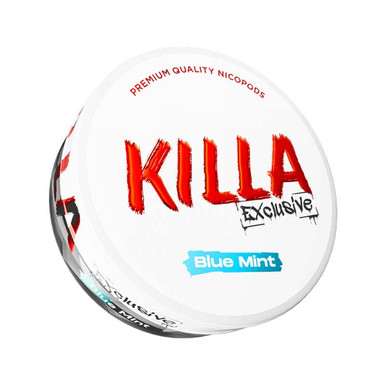
Killa Exclusive Blue Mint Nicotine Pouches are listed here at £33.50, with one declared strength on the label: 16.5mg. There is a single variant, not a spread of options, so the price and the figure belong together and there is nothing further to choose between. The listing shows as available at the time of writing, and we hold one photograph of it.
That is the complete set of facts we hold, and the rest of this page is built on them rather than around them. Where we do not know something — and there is one sizeable gap on this listing, covered below — the page says so instead of filling the space with a confident guess.
The full guide to Killa Exclusive Blue Mint Nicotine Pouches
5,085 words on how it eats, who it suits, how to serve it and what to put beside it.
What is actually on this listing
Two pieces of the name need setting straight before anything else, because both are manufacturer naming and neither is a description of the product.
"Killa" is a brand name. It is the word the manufacturer has chosen to put on its cans, and it belongs in the same category as any other trade name printed on any other product we stock. It is not a description of what the can does, it is not an instruction, and nothing on this page treats it as one. We file it as a brand, alongside every other brand, on the Killa shelf.
"Exclusive" is a line name. It marks a range within the brand's catalogue, in the way that manufacturers across this category name sub-ranges. We hold no information about what the manufacturer intends the word to designate — whether it refers to a packaging run, a set of flavours, or nothing more than a label — so we are not going to explain it. It is on the can, so it is in the title here. That is the whole of it.
The figure on the label, and what it is
The label figure for this can is 16.5mg. That is the number the manufacturer declares, and it is reproduced here exactly as we hold it. It is label information, nothing more.
It is worth being precise about what a number like that is and is not, because the mg figure is the thing people scan for first and the thing most often over-read. It is a declared figure attached to a product by the company that makes it. It is a specification, printed on packaging, in the same way that a size is printed on a garment. It is not a rating, it is not a score, and it is not a measure of anything about the person holding the can.
We publish the figure because it is printed on the can and because leaving it off a listing would be unhelpful. We do not interpret it, we do not translate it into what anyone should expect, and we do not tell anyone what figure is right for them. That last point is not a hedge or a legal formality, and it is worth stating in the plainest available words: we cannot advise which strength suits any individual, and we will not try. We are a shop with a catalogue. We do not know who is reading, and no shop is in a position to make that call for anyone.
There is a related point about comparison. Declared figures are set by manufacturers, and different manufacturers arrive at their figures in their own ways. Two cans from different brands carrying similar numbers are not, for that reason alone, interchangeable, and a number from one company's range does not map neatly onto another's. If you are used to reading these figures across brands, you will already know this. If you are treating the number as a universal unit, it is not one.
The can itself — lid, catch compartment and what it does in a pocket
This section is about the container rather than its contents, because the can is the part of the product you handle most often and the part that determines whether a product is a nuisance to carry or not.
Cans in this category share a common shape: a short cylinder, roughly the diameter of a large coin and not much taller than it is wide, with a lid that comes off the top. The proportions are set by what is inside — pouches sit flat in a ring around the inside wall, or stacked, depending on the maker — and the result is a container that sits flat in a pocket rather than digging into it. It is closer to a tin of lip balm in footprint than to anything you would notice carrying.
The lid is the part worth understanding. On most cans in this format, the lid is not just a seal. It contains a shallow second compartment, separated from the main chamber, and that compartment exists for used pouches. You unscrew or lift the lid, the compartment is in it, and a used pouch goes there rather than into a pocket, a glass, a bin you cannot reach, or a drain. It is a small piece of design and it is the single most practical feature of the format.
The reason it matters is disposal. A used pouch has to go somewhere, and the catch compartment gives it somewhere to go in the interval between finishing with it and reaching a bin. That interval is often long — a train journey, a walk home, the middle of a shift — and without the compartment, the alternatives are all worse. When the compartment fills, it is emptied into a household bin. Not a sink, not a toilet, not out of a window. Pouches should not go down drains, and the compartment is what makes a bin realistic.
Some cans in this category have a lid that screws on, others a lid that clicks. The difference is not trivial if you carry a can loose: a screw lid is harder to pop open under pressure in a bag. We do not hold a note of which closure this particular can uses, and rather than guess from a photograph we will say that the can in your hand is where to check. It will be obvious the first time you open it.
The portion count is the gap in our data. We do not hold a figure for how many pouches this can contains. Cans in this category commonly carry a count printed on the label, and that printed figure is the reliable one. We would rather point you at it than publish a number we have inferred from the price or from what a neighbouring product does.
That gap connects to a second one. Our data holds no pack count for this listing either — the field is empty. At £33.50, that is a material unknown, because on this site that sort of figure sometimes buys a single can and sometimes buys a sleeve of several. Without a count we cannot tell you which, and we cannot work out a per-can figure to compare against anything else. The product listing itself, and the basket at checkout, are where that resolves. It is an unsatisfying thing to have to write on a product page, and it is still better than a made-up number.
Blue Mint as a taste
Our flavour classification for this can holds one term: mint. That is why it appears on our mint flavour shelf, which is the largest flavour shelf on the site at 148 products.
Mint is the oldest and broadest flavour family in this category, and "mint" on a shelf label covers a considerable spread. At one end there is spearmint, which is rounder, sweeter and greener, with a soft herbal edge. At the other there is peppermint, sharper and more astringent, with a cooling sensation that arrives quickly and reads as clean rather than sweet. Between and around them sit wintergreen, which has a distinct medicinal-sweet character quite unlike either, and the various "ice" and "frost" constructions that lean hard on cooling and lightly on the herb itself.
"Blue Mint" as a name does not tell you which of those this is, and we are not going to pretend that it does. "Blue" in this category is almost always a colourway rather than a flavour statement — it names the can's livery and its place in a range, the way a car manufacturer names a paint. Occasionally the word travels with a berry note, as in the blue raspberry convention used in confectionery. Our classification holds no berry term for this can, only mint, so on the information we have this reads as a mint through and through, with "Blue" doing the work of a range marker.
What you can reasonably expect from a mint of this kind, described strictly as taste and aroma: a cool, clean flavour that presents early and settles; a sweetness that is present but not confectionery-heavy; and an aromatic character that carries slightly upward, which is the thing people mean when they describe a mint as "bright". Mint is unusual in this category in that the cooling sensation is part of the flavour rather than an addition to it, which is why mints are the family people most often return to after a run of fruit.
Against the other mints we stock, this one is placed by its classification rather than by any note we hold. Clew Cool Mint at £39.90 and Denssi Cold Mint at the same price both sit in the cool-forward part of the family by name. Klint Avalanche Mint at £36.90 names itself even more emphatically. Fumi Fiery Mint at £27.90 is the odd one in that group, since "fiery" suggests a warm note alongside the cool one, which is a genuinely different construction. Edge Mint at £14.95 is the plainest name on the mint shelf and the lowest price among these, and Nordic Spirit Max Frosty Mint at £4.49 is the cheapest mint listing in this group by a wide margin.
Those descriptions come from the names and the prices, which is all we hold. We do not publish tasting notes written by us, because we would be inventing them.
The format in use
A pouch is a small soft sachet, white, roughly the size of a small stick of chewing gum folded over. It goes between the lip and the gum, usually the upper lip, and it stays there. That is the whole of the mechanics.
Formats vary in size. "Slim" pouches are long and narrow and sit along the gum line. "Mini" pouches are shorter and thicker and take up less lateral room. "Regular" or standard portions sit between the two. The difference matters more than it sounds: a slim pouch is less noticeable to the wearer along the lip, while a mini takes up a smaller total footprint. We do not hold a format designation for this can, so the can is where to check.
How long people keep one in varies widely, and we are not going to publish a figure dressed up as guidance. What is fair to say is that the interval is a personal habit rather than a rule, that people generally stop when the flavour has gone flat rather than by a clock, and that the pouch is removed by hand and put in the lid compartment when they are done. There is no ceremony to it.
Two practical notes that come up often enough to belong on a product page. First, a pouch is not swallowed and is not chewed; it stays where it is put. Second, pouches are used one at a time. Neither of those is advice about consumption — they are descriptions of how the format is designed to work, in the same way that describing a teabag as steeped rather than eaten is a description of a format.
Where the 16.5mg figure sits among the shelves we run
This is the second place the strength ladder needs discussing, and it is worth separating from the first. Earlier the point was what the number is. Here the point is how our own site files it, which is a different thing entirely and one we control.
We sort products into strength bands so that the catalogue can be browsed. This can is filed on our Strong shelf. Above it sits the Extra Strong shelf, below it the Medium Strength shelf. Three bands, each a bucket of declared figures, each with a name that is a filing label.
The ladder is a filing system, not a ranking of merit. We want to be unambiguous about this because the words invite the wrong reading. "Strong" is above "Medium" in the list because the numbers are larger, and for no other reason. A can on the Extra Strong shelf is not better made, better value or more desirable than one on the Medium shelf. It carries a bigger declared figure. That is the entire difference the shelf name is reporting.
Nothing on this site is arranged as a progression, and we would ask readers not to treat it as one. There is no sequence to work along, nothing to graduate from, nothing that a larger number represents an achievement in reaching. A shelf is a way of narrowing 385 listings down to a browsable number when you already know roughly what you are looking for. It is the equivalent of sorting by size in a shoe shop.
The full catalogue of everything we stock can be browsed without any strength filter at all, which is often the more useful way in if you are looking by flavour or by brand rather than by number.
One more thing the shelf does not tell you: how any individual finds a given can. Two people using the same product report it differently, and there is no version of a shelf label that resolves that. We publish the manufacturer's figure and our own filing, and we stop there, because past that point we would be making claims about people we have never met.
Killa's range as we hold it
We list 31 products under this brand. Within that, the Exclusive line accounts for several cans, of which this is one, and the rest of the brand's shelf covers a broad flavour spread.
All the Killa cans we hold alongside this one are listed at £33.50, the same as this one, which makes the brand unusually flat in pricing on our shelves. That flatness is useful: within this brand, moving between cans is a flavour decision rather than a price one.
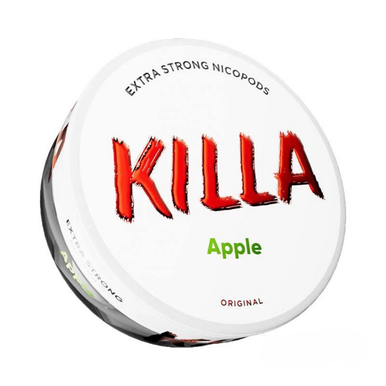
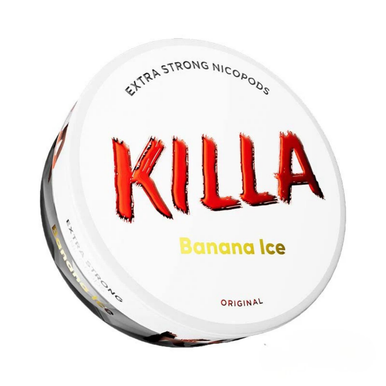
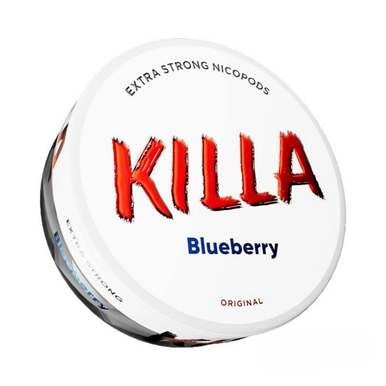
On the fruit side there is Killa Apple at £33.50, which sits in the orchard-fruit family, and Killa Blueberry at the same price in the berry family. Killa Banana Ice pairs a soft, rounded fruit with a cooling element, which is a very different construction from either.
On the confectionery side, Killa Bubblegum at £33.50 is the sweetest name in the brand's range as we hold it, and Killa Cola is the brand's take on the cola note — spiced, slightly sharp, recognisable. Off on its own is Killa Cappuccino, the only coffee-family can we hold from this brand, and the one furthest in character from the can on this page.
Each of those has its own listing carrying its own declared figures, and those pages are the place to read them. We are not going to state another product's label figure from memory on this page.
What people keep alongside a mint
People who keep more than one can open tend to keep cans that are unlike each other, which is the opposite of what you might assume. The logic is straightforward: a second can that tastes nearly the same as the first is a duplicate, not a variation.
If this mint is the regular, the obvious contrast is a fruit. 77 VB Edition Mini Arctic Berry at £39.90 is a berry with a cool element, so it keeps some of the cool character while changing the fruit entirely. Pablo Gold Edition Blueberry Peach Ice at £19.95 goes further, layering two fruits, and is a good deal cheaper on our listing.
If the contrast you want is within the cool family rather than away from it, Cuba Ninja Ice Cool at £39.90 and Elf Bar Cool Storm at £29.90 are both cool-forward names from brands other than this one, which is often a bigger change than switching flavour within a single brand. Different makers build the same flavour family differently, and that difference is more noticeable than the difference between two fruits from the same house.
Brand shelves are the efficient way to browse this: the Pablo shelf and our Cuba shelf both hold ranges wide enough to find a contrast within.
The mint neighbours, lined up by price
The cans named further up this page appear there one at a time, in the middle of sentences about flavour. Set out in a single column they make a different point, so here they are with the figures we hold against them.
| Listing | Price we hold |
|---|---|
| Nordic Spirit's Max Frosty Mint | £4.49 |
| the Edge mint listing | £14.95 |
| Fumi's fiery take on mint | £27.90 |
| Cool Storm from Elf Bar | £29.90 |
| Killa Exclusive Blue Mint (this page) | £33.50 |
| Klint's Avalanche Mint | £36.90 |
| the Clew cool mint can | £39.90 |
| Cuba's Ninja Ice Cool | £39.90 |
| Denssi's cold mint | £39.90 |
Now the warning that has to travel with the table. We hold no pack size for any entry in it, this listing included. Every figure in the right-hand column is a listing price attached to an unrecorded quantity, so the order of the rows is the order of the headline numbers and nothing beyond that. A £4.49 entry and a £39.90 entry are not necessarily nine times apart in anything you would care about, and they may not even be describing the same kind of unit.
Two further things that column does not encode. It does not encode the declared figure printed on any of those cans: we do not hold the label figures for other listings, and in our data price and milligrams are unrelated in any case. Nor does it encode how cold any of them is, despite most of the names gesturing at temperature. A cooling word is printing on a lid, not a measurement we carry.
What the table is genuinely good for is building a shortlist. Nine cans in one register, each with a figure attached and each a single click away, is a faster route to deciding where to look next than nine separate paragraphs of description.
Keeping a can in usable condition
Storage is not complicated but it is worth getting right, because the failure mode is a can that has gone dry and flat rather than one that has gone obviously wrong.
Keep the lid on. The lid is the seal, and a can left open on a worktop overnight loses moisture and with it much of what made the flavour present. This is the single most common way a can is spoiled, and it is entirely avoidable.
Keep it cool and out of direct sunlight. A windowsill in summer, a dashboard, a bag left in a hot room — all of these put a can through heat cycles it was not designed for, and heat is what drives moisture out of a sealed container faster than anything else. A drawer, a cupboard or a bag pocket away from a heat source is all that is required.
Some people keep cans refrigerated, particularly in warm weather. We hold no manufacturer guidance on whether that is intended for this product, so we present it as a thing people do rather than as an instruction. Any storage instruction printed on the can itself takes precedence over anything on this page.
Keep cans out of reach of children and away from anyone they are not intended for. That is a storage instruction, and it is the most important one on this list. The catch compartment in the lid is part of this too: empty it into a bin rather than leaving used pouches sitting in a can that gets left around.
On shelf life: cans carry date markings from the manufacturer, and those markings are the reference. We do not hold date information at the listing level and cannot tell you how long a given can has left. Buying at a rate that matches use, rather than stockpiling far ahead, is the practical answer to that.
Choosing, when there is only one option to choose
On this particular listing the choice is unusually simple, because there is nothing to configure. One declared strength, 16.5mg. One price, £33.50. One variant. No size options, no multipack toggle. You are either buying this can or you are not.
That simplicity has a downside, which is that it removes the usual way of adjusting within a product. On listings with several variants, a reader can stay with a flavour and move along the declared figures. Here there is no such move available: the only adjustment is to a different product.
If a different declared figure is what you are after, the strength shelves are the route — the Medium Strength listings and the Extra Strong listings each collect cans by band, and each product page carries its own figure. We are not going to suggest a direction of travel along those shelves, in either direction, for the reasons set out above.
On pack size, we are back to the gap in our data. Without a pack count on this listing, the comparison people usually want — cost per can, cost per pouch — cannot be done from this page. If that comparison matters to you, the listing and the basket are where the count becomes visible, and it is worth checking before ordering rather than after.
Ordering, delivery and the age check
This is an age-restricted product and the buying process reflects that at more than one point.
The listing price is £33.50. Ordering is the ordinary sequence: add to basket, check the basket, complete the checkout. Delivery options, costs and timescales are shown at checkout, which is the accurate place for them since they depend on the order and the address.
Age verification applies. Sales are to adults aged 18 or over only. Checks may be applied at the point of order, and ID may be requested on delivery. A courier can decline to hand over a parcel where age cannot be confirmed, and that is a normal outcome rather than a problem with the order. Ordering on behalf of anyone under 18 is not something we will supply.
On stock: this listing shows as available at the time of writing, but a product page written in advance is not a live stock feed. The listing itself is authoritative. If it shows as unavailable when you reach it, that is the current position regardless of what this paragraph says.
Finding your way back to this page
A short note on navigation, because product pages are often arrived at sideways from a search engine with no sense of where they sit.
This can appears on three shelves. It is on its brand's own shelf, which is the fastest route to the rest of the range. It is filed among the 132 cans in the Strong band, which is the route if you are browsing by declared figure. And it sits on the mint shelf, the largest flavour grouping we run.
Above all of those sits the full listing of everything in the catalogue, which is the right starting point when you do not yet know which axis you want to browse along. Brand shelves such as the Cuba range work the same way as this one's brand shelf, so once you know the pattern the whole catalogue is navigable from any product page.
Questions we are asked about this listing
How many pouches are in the can?
We do not hold that figure. It is not in our data for this listing, and we are not going to estimate it from the price or from what similar cans contain. Cans in this category normally carry a portion count printed on the label, and that printed figure is the one to go by. If the count is a deciding factor for you, it is worth checking the can or the listing before ordering rather than working from an assumption.
Does £33.50 buy one can or several?
We cannot tell you from the data we hold — the pack count field is empty for this listing. That is a genuine gap rather than an evasion. On this site, prices in that region sometimes cover a single can and sometimes a sleeve, so the figure alone does not settle it. The basket at checkout will show exactly what quantity is being bought, and that is the place to confirm it.
What does 16.5mg mean?
It is the strength figure the manufacturer declares for this product, printed on the label and reproduced on this listing. That is the full extent of what we can tell you about it. We do not interpret the number, we do not translate it into what anyone should expect from the can, and we do not compare it against figures from other manufacturers, because different makers arrive at their declared figures in their own ways.
Is 16.5mg a lot?
We file this can on our Strong shelf, which places it in the upper of our three bands. That is a statement about our filing, not a verdict on the product and not an answer to a question about any particular person. We cannot advise which strength suits anyone, and we would be overstepping badly if we tried. Anyone with a question about their own use should raise it with someone qualified to answer it, not with a shop.
Is this the same as other Killa cans?
It shares a brand and a price with the rest of the Killa range we stock — every can of theirs on our shelves is listed at £33.50. What differs is flavour, and the declared figures on the other listings are printed on those pages rather than this one. If you want to compare within the brand, the brand shelf puts all 31 of them in one place, and each product page carries its own facts.
What does "Exclusive" mean on the can?
It is the manufacturer's line name. We hold no information about what the company intends it to designate, and we are not going to invent a meaning for it. It may mark a particular range, a packaging run or nothing more than a label choice. The honest answer is that it is a word on a can and we do not know the reasoning behind it.
Is "Blue" a flavour?
Not as far as our data goes. The only flavour term we hold for this can is mint, which is why it is filed on the mint shelf and nowhere else. In this category "blue" is most often a colourway — a name for the can's livery and its position in a range. It occasionally travels with a berry note elsewhere in confectionery naming, but we hold no berry classification for this product and are not going to assert one.
What is the compartment in the lid for?
Used pouches. Cans in this format typically have a shallow second chamber built into the lid, separate from where the unused pouches sit, and it exists so that a finished pouch has somewhere to go until you reach a bin. It is emptied into a household bin — not a sink or a drain. It is a small feature but it is the one that makes the format practical away from home.
How long is a pouch kept in?
That varies from person to person and we are not going to publish a figure that would read as guidance. In practice people stop when the flavour has faded rather than by any clock, and the interval differs between individuals and between products. The pouch is then taken out by hand and put in the lid compartment. There is no fixed duration and nothing on the can that sets one.
How should the can be stored?
Lid closed, somewhere cool and out of direct sunlight, and out of reach of children. Heat and an open lid are the two things that dry a can out, and between them they account for most cans that go flat before they are finished. Any storage instruction printed on the can takes precedence over this page. We do not hold shelf-life or date information at the listing level.
Is it in stock right now?
It shows as available in the data behind this page, but this page is written ahead of time and is not a live feed. The listing itself reflects current availability, so if there is a difference between the two, the listing is right and this paragraph is out of date. Availability in this category moves around, particularly on single-variant listings where there is no alternative size to fall back on.
Can you tell me where it is made or who makes it?
No. We hold no origin or manufacturing information for this product, and we are not going to infer any from the brand name, the line name or the packaging. Anything you read elsewhere attributing an origin to this can on the basis of its name is reading something into it that is not there. The can and the manufacturer are the only reliable sources for that.
Legal and compliance information
This product is for adults aged 18 or over who already use nicotine. We do not sell it to anyone under 18, and we will not knowingly supply anyone buying on behalf of someone under 18. Age checks may be applied when you order, and ID may be requested on delivery before a parcel is handed over.
Nicotine is an addictive substance.
This product is not a licensed stop-smoking medicine and makes no medicinal claim of any kind. It is not intended for non-smokers, for anyone who does not already use nicotine, for under-18s, or for anyone who is pregnant or breastfeeding. Nothing on this page is medical advice, and nothing on it should be read as a recommendation to use nicotine or to use any particular strength. If you have questions about your own nicotine use, speak to a qualified healthcare professional rather than to a retailer.
Keep this product out of reach of children and away from animals.
In short
Killa Exclusive Blue Mint is a single-variant listing at £33.50 carrying a declared figure of 16.5mg, classified by us as a mint and filed on the Strong band of our shelves. We do not hold a portion count or a pack count for it, and we have said so rather than guessing. The brand and line names are the manufacturer's own words and we have not treated them as descriptions of anything. Everything else worth knowing is on the can.
More from Killa
More strong pouches
More mint pouches
Where this sits
Killa Exclusive Blue Mint Nicotine Pouches appears in these categories. Browse them, or jump to something close.
You might also like