Killa · 16.5mg
Read the full guide
Killa Cold X Mint Nicotine Pouches
£33.50
✔ In stock — ready to ship
100% tobacco-free
Free over £20
Same-day dispatch
Secure checkout
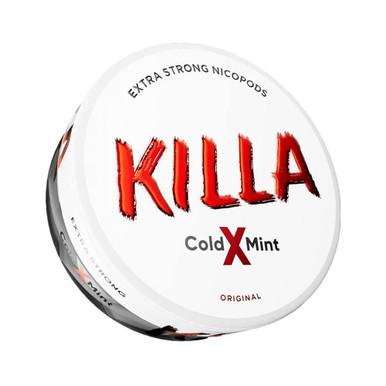
The listing here is Killa Cold X Mint Nicotine Pouches. Brand: Killa. Product name as we hold it: Cold X Mint. Price shown: £33.50. One declared strength, 16.5mg, which makes it both the upper and lower bound of what we carry for this product. Flavour field: a single tag reading mint. Stock: available at the time of writing. Images on file: one. Pack quantity: blank, and we will deal with that blank properly rather than writing around it.
Start with the obvious question. What does the X in the middle of the name mean? We do not know. It arrived with the product as part of the manufacturer's naming and our record carries no explanation of it. It is not a figure we hold, it does not correspond to anything in our data, and we are not going to reverse-engineer a meaning from the way it looks. Plenty of retailers would happily tell you it signals an extra measure of something. We cannot verify that and so we are not saying it. What we can verify is the declared strength, which is 16.5mg — the same figure carried by the rest of the Killa range we stock, including the listings without an X in the name.
The full guide to Killa Cold X Mint Nicotine Pouches
4,925 words on how it eats, who it suits, how to serve it and what to put beside it.
Killa Cold X Mint, and the letter in the middle of it
That is worth dwelling on for a moment, because it is the clearest possible illustration of how naming works in this category. A letter dropped into a product name looks like information. Here it is not attached to anything measurable in our record, whereas the milligram figure is. If you want to compare cans on something solid, compare the figures.
Everything on this page is built from the fields listed above, from comparison with other cans on our own shelves, or from saying plainly that we do not know. We do not reproduce ingredient panels, we do not describe what a pouch does once it is in place, and we make no statements about anyone's wellbeing in any direction. The page is written for adults aged 18 or over who already use nicotine, and the full wording sits in its own section below.
What the flavour is like: aroma first, then taste
Off the open tin the aroma is cold rather than botanical. That sounds like an odd thing to say about a mint, and it is the most accurate way to put it: the first impression is of the chill rather than of the leaf. There is a mint character in there, thin and clean and high, but it sits behind the cold impression rather than leading it. Compared with a can whose name puts the herb first, this one smells more austere and less green.
In the mouth the same ordering holds and becomes more pronounced. The cooling is the dominant element throughout, and the mint runs as a narrow line underneath it rather than spreading out. There is very little sweetness, no fruit and nothing creamy. The overall impression is direct and rather stripped back — this is not a flavour with layers to unpick, and it does not try to be.
The finish is long and it is mostly cold. Mint-family flavours generally outlast fruit ones in this format, and where the cooling element is the leading character, the tail end of a pouch is almost entirely that sensation with the taste itself mostly gone. So the shape of it is: cold aroma, cold-led taste, a narrow mint line, and a long cool finish.
Two caveats, both important. This is a description written by a retailer, not a manufacturer specification — our record holds the single word mint and nothing more granular. And the vocabulary in this category is not standardised, so our use of words like cold, clean and narrow is our own and may not map onto the words in your head. If precision matters, the can is the authority and this page is one shop's account.
Carrying one, using one, and whose rules apply
This is the section that most product pages in this category get wrong, usually by being reassuring where they have no standing to reassure. We will try to be useful instead.
What the format is actually like to carry
A tin is a small rigid cylinder. It goes in a jeans pocket, a jacket pocket, the front pouch of a bag, a glovebox, a desk drawer. Being rigid it protects its contents, which is more than most packaging this size manages, and being round it rolls off any flat surface in a moving vehicle and migrates to the far corner of any open bag. People who carry one daily tend to settle on a fixed pocket for it within a week.
The lid is a push fit, so it opens fast and one-handed, and that same push fit means side pressure in a crammed bag can occasionally lever it open. There is no window in the tin, so the only way to know how full it is without opening it is weight and rattle — quiet and heavy when full, louder and looser as it empties.
Hands-free and quiet, but not invisible
Once a pouch is in place there is nothing to hold, nothing to put down, nothing to switch off, no ash, no noise and no cloud. That is the whole design brief of the format and it is the honest reason people describe it as discreet. Most users stop noticing the physical object within a couple of minutes.
What it is not is invisible. Someone looking at you directly at the wrong moment may notice a slight fullness, and taking one out is a visible action unless you are somewhere private. Anyone telling you the format is undetectable is overselling it. It is quiet and hands-free; those are the accurate words.
Venues, employers and transport set their own rules
Here is the part we will not blur. Whether you may use one of these in a particular place is not a question this shop can answer, and any retailer that tells you otherwise is guessing on your behalf about premises they have never seen.
Employers set workplace policies. Some address this format explicitly, some fold it into a broader policy, some have not considered it and will decide the first time it comes up. Venues — pubs, restaurants, cinemas, stadiums, gyms — set their own house rules and are entitled to. Transport operators set conditions of carriage, and those vary by operator and by route. Schools, hospitals and other institutions have their own positions. Airlines and border rules are another matter again, and both the carrier and the destination country will have something to say that has nothing to do with us.
None of those rules are ours to interpret, summarise or reassure you about. They change, they differ between sites within the same organisation, and the consequence of us getting one wrong lands on you rather than on us. The correct source is the operator, the employer or the venue, and the correct time to ask is before rather than after.
Why we will not write the reassuring version
It would be easy to write a paragraph implying this format slips past rules that other things do not. It would also be untrue as a general statement, and it would amount to advising people how to use a nicotine product in places that have not agreed to it. We are a shop. We sell the can, we tell you accurately what is on it, and we leave questions of where and when to the people who actually set those rules and to your own judgement as an adult.
The one thing we will say firmly, because it is a matter of basic courtesy rather than policy: a used pouch goes in a bin. Not under a table, not in a plant pot, not out of a car window. It is the single most common complaint made about this format anywhere it is used, and it is entirely avoidable.
How a flavour reads in a dry pouch
The second thing worth spending real space on here is why pouch flavours behave the way they do, because it explains a lot of the disappointment people report when a name promises something the format cannot deliver.
The aroma at the lid is not the taste
Open any tin and the smell arrives before anything else, and it is almost always the most vivid version of the flavour you will encounter. That is an ordinary property of a sealed container full of aromatic material — the air inside concentrates. The taste that follows is a quieter, flatter relative of that first impression. People who judge a can by the smell at the lid are consistently surprised, and the surprise runs in the same direction every time.
Three stages, in every flavour family
Broadly, a pouch flavour arrives in three stages. There is a front, which is the most defined and most name-like part and which lands in the first stretch. There is a middle, which is where whatever the flavour is actually built around holds steady for a while. And there is a tail, where the definition drops away and what remains is a faint impression plus whatever sensation the flavour carried with it. In a mint-family can like this one, the tail is dominated by the cooling rather than by the taste, which is why mints seem to last longer than fruit cans even when they do not.
Why mint names are the easiest to deliver
Of all the flavour names in this catalogue, mints are the ones that translate most successfully into a dry pouch, and there is a reasonable explanation for it. A mint is not really being asked to imitate an object. Nobody has a precise reference for what a mint should taste like in the way they have a precise reference for an apple or a cup of coffee, so the name has more room to be right. A mint also comes with a physical sensation attached, and a sensation survives the format intact in a way a delicate taste does not. That is why the mint shelf is by far our largest at 148 listings — not because of any preference on our part, but because it is the family that works most reliably.
Fruit and coffee names are impressions, not reproductions
By contrast, a fruit name is being measured against something everyone has actually eaten, and a dry format cannot deliver the juice, acidity and texture that make a real fruit recognisable. So what it delivers is a top note plus a sweetness, and your brain does the rest. That is not a failure; it is the honest ceiling of the format, and cans in those families are best judged as impressions rather than as reproductions. The same goes double for coffee-named cans, where the roast note carries the recognition and nothing else about a cup of coffee can survive the trip.
What we will not tell you about how it is done
We do not publish what is used to achieve any of this. Composition is the manufacturer's information, it is printed on the packaging, and paraphrasing it from memory or from a competitor's page would be worse than saying nothing at all. Everything in this section is about perception — what the flavour does as you experience it — and deliberately not about what is inside the pouch. If you need the latter before you buy, read the can.
16.5mg, and the two labels on this product
The declared figure is 16.5mg, single, with no second variant of this flavour in our catalogue. It is a manufacturer's statement of strength per pouch, printed on the can, reproduced by us exactly and used by us for sorting. It is not a grade, a rank or a measure of quality, and there is no sequence in this catalogue to work through.
The web address of this page contains extra strong. That phrase comes from the manufacturer's naming of its line. Our own filing, which follows the declared figure, puts the can on the Strong shelf alongside 132 others. We run a separate Extra Strong shelf and this can is not on it. Two naming systems, one product, and they disagree. We publish both rather than quietly adopting whichever reads better, because the alternative is hiding a discrepancy from the person it affects.
And the sentence this page will not soften: we cannot advise which strength suits anyone. Not the reader, not somebody being bought for, not in general. We have no way of knowing what a person already uses, and telling a customer which nicotine product to put in their mouth is not a thing a retailer should be doing. If you want to see how the declared figures spread across the catalogue, the Medium Strength shelf and the two shelves above it are the picture.
What our record contains, and the shape of its gaps
It is worth setting out what a retailer's product record actually is, because a lot of the frustration people have with pages like this one comes from assuming it is richer than it is.
Our system holds a small set of fields per listing: a title, a brand, a product name, a price, a declared strength, a flavour tag, a stock flag, a count of attached images and a pack quantity. That is essentially it. There is no field for portion size, none for the number of pouches in a tin, none for cooling intensity, none for ingredients, none for country of origin and none for a manufacturer's own description. Where those things exist, they exist on the packaging rather than in our database.
Two of those fields are doing more work than they look. The flavour tag is a broad family label, not a flavour description — every mint-named can in the catalogue carries the same one, which is why it can tell you where a product is filed but nothing about how it tastes. And the pack quantity is, on this listing and on a great many others, simply empty. That single blank is responsible for most of the things this page cannot tell you: how many pouches you get, what the price is per can, and whether a cheaper listing elsewhere is genuinely cheaper or just a different unit.
We could fill those gaps by copying other retailers, and we do not, because a figure copied from a competitor's page is a figure nobody has verified. We could fill them by estimating, and we do not, because an estimate written in a product description becomes a fact within a fortnight. So the gaps stay visible. It makes for a less satisfying page than the ones that answer everything, and it means that when we do state something — a price, a declared figure, a stock position — you can take it as read that it came from our own record rather than from somebody's marketing copy.
The tin, the lid and the well inside it
The container is the standard slim cylinder that nearly every brand in this category uses: a body holding the portions and a push-on lid whose underside is a shallow well. The well is there so a used pouch has somewhere to go when a bin is not within reach. It is a temporary holder, not storage, and it holds a handful at most — fill it and the lid stops seating flush, which is when a tin decides to open itself in a coat pocket.
Empty it daily. With a cold, sharp flavour the transfer of smell from the well to the fresh portions is noticeable within a day, and it is entirely preventable. The uniformity of the design across brands is genuinely convenient, incidentally: a can you have never bought before behaves exactly like the last one, which is not something you can say about most categories.
The mint-named listings under this label
This brand does not sell one mint with variations. It sells several separate lines, each with its own name, and the names imply relationships between them that we are not in a position to quantify. A can named for the cold, a can named for coolness and a can with a letter inserted into the middle of the name are, on the face of it, meant to be understood as distinct products rather than as the same thing packaged three ways. That is the manufacturer's intent as far as anyone can read it from naming alone.
What our data shows is that they are indistinguishable on every field we hold. Same brand, same £33.50, same declared 16.5mg, same single flavour tag reading mint, same shelf. If you were hoping the catalogue would settle the difference for you, it will not, and it would be dishonest of us to imply otherwise by writing three confident and subtly different descriptions as though we had measured something.
What we will give you is our own impression, labelled as exactly that. This can leads with the cold and keeps the mint character narrow behind it. A can named simply for cold mint, in our experience of the range, lets rather more of the peppermint through before the chill takes over. A can named for coolness tends to read softer and greener again, with more sweetness and less edge. Those are three descriptions of three tastes, written by a shop, based on nothing more authoritative than having opened the tins. They are not measurements, there is no scale behind them, and anyone who wants certainty will get it faster from owning the cans than from reading us.
One structural note, since it affects what you can reach from this page. Our related-products list for this listing does not surface the other Killa mints — it reaches for other brands in the same flavour family instead. That is how the list is generated rather than a judgement about which products belong together, and it means the quickest route to the rest of the mint-named cans under this label is the Killa brand page rather than anything in the neighbour section further down.
The wider Killa range
We carry 31 Killa listings in total, and the range is unusually consistent: the cans we hold are overwhelmingly 16.5mg at £33.50, so flavour is effectively the only variable across the whole brand. That makes comparing within it simpler than comparing across brands, because you are never weighing a taste you want against a figure you do not.
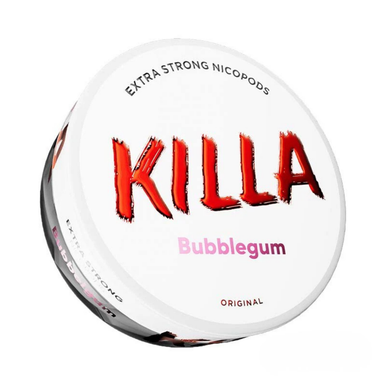
Away from the mints, the fruit end holds Killa Apple and Killa Blueberry, both plain fruit names, with Killa Banana Ice putting a cooling element behind a fruit and so sitting closer to this can than the other two do. The sweet and drink-derived listings are Killa Bubblegum and Killa Cola. Killa Cappuccino is the roast-flavoured one and about as far from a cold mint as this brand travels. Every one of them is £33.50.
A word on the naming, since this range invites comment. The brand name is loud and the line naming is louder, and we treat both as trademarks rather than as descriptions. A manufacturer chooses its own words for its own commercial reasons and those words carry no information beyond identifying the product. We reproduce them accurately, because accurate reproduction is how you find what you came for, and we decline to write in their register.
What else sits near this can on the shelves
The mint shelf is long and the neighbours our system surfaces for this listing spread across a wide price range. At the low end, Nordic Spirit Max Frosty Mint is listed at £4.49 and Edge Mint at £14.95. In the middle sit Pablo Gold Edition Blueberry Peach Ice at £19.95, which pairs fruit with a cooling element rather than going straight mint, Fumi Fiery Mint at £27.90 and Elf Cool Storm at £29.90. Above this can's £33.50 you have Klint Avalanche Mint at £36.90 and then a £39.90 group: Clew Cool Mint, Denssi Cold Mint, Cuba Ninja Ice Cool and 77 VB Edition Mini Arctic Berry, the last of which is a reduced-format berry rather than a mint at all.
Before anybody reads that price ladder as a quality ladder: we cannot tell you what any of those prices buys, because the pack-quantity field is blank across most of our catalogue including this listing. A £4.49 line and a £39.90 line may be a single can and a box respectively. Comparing headline prices without the unit is how people reach confident wrong conclusions, and we would rather point at the hole than let you walk into it. The broader ranges behind two of those neighbours are on the Pablo brand page and the Cuba brand page.
Keeping a can in condition
Lid on when you are not taking one out. That is most of it. An open tin dries, and a dried pouch is a diminished version of what you paid for — flavour first, texture after. Leaving a can open on a desk all afternoon is the commonest way people spoil one.
Keep tins out of heat and direct sun. A dashboard in summer is the worst place in an ordinary day for a sealed tin; a radiator shelf is the winter equivalent. A drawer, cupboard or bag pocket is fine. Cold appears to do no harm and some people keep spares refrigerated; we hold no manufacturer instruction on that, so treat it as something people do rather than something we advise.
Empty the lid well daily, and keep tins out of reach of children and animals. That last point is not really storage advice — it is a condition of keeping any nicotine product in a household, and it applies to every listing we carry without exception.
What is actually available to choose between
On this listing, one thing: whether to buy it. A single variant at 16.5mg and £33.50, no second strength, no alternative pack size in our record and no multipack line. Where a page offers genuine options we set them out; here there are none, and manufacturing a comparison would be a waste of your time.
The choosing happens between listings. If the flavour is right and the figure is not, the strength shelves either side of this one are where to look. If the figure is right and the taste is not, the Killa page is effectively a flavour menu with the number already fixed. And if you would rather see the whole catalogue in one place, everything we stock is that page.
Ordering, identification and delivery
Ordering works the same way across the site: the listing goes into the basket, the basket carries the displayed price, checkout confirms the total. Our record marks this can in stock as written, though a description is a slower-moving thing than a warehouse and the cart is the live position.
Age verification is required and is not a formality. This is an 18+ product; age is confirmed as part of the order, and an order that cannot be verified does not ship. Separately, a courier may ask for identification at the door and may refuse to release a parcel where age cannot be established, in which case it comes back to us. Have something to hand if a delivery is due.
We do not print delivery times, cut-offs or postage costs in product descriptions, because those change more often than the copy does and a stale figure is worse than none. Checkout carries the current position.
Finding your way onward
Three shelves carry this can. The mint listing at 148 products is comprehensive rather than quick. The 132 cans we file as Strong group by declared figure. The Killa page at 31 listings is the fastest of the three to read from top to bottom.
Above those sit the hubs: the whole catalogue unfiltered, three strength hubs cutting it by declared figure including the Extra Strong listing, and the brand hubs cutting it by manufacturer. Most people get where they are going faster by starting from a flavour or a brand and checking the strength shelf second.
Questions people ask about this one
What does the X stand for?
We do not know and we are not going to guess. It came to us as part of the manufacturer's product name and our record holds no explanation of it, no figure behind it and nothing that would let us interpret it. It is not a strength indicator as far as our data is concerned: the declared strength is 16.5mg, which is what the rest of the Killa range we stock declares as well. If the letter means something specific, the manufacturer is the one who can tell you.
How many pouches are in the tin?
We do not hold that number. The pack-quantity field for this listing is empty and there is no portion count in our record, so anything printed here would be invented. The figure is on the can and the cart shows what the £33.50 covers. We would rather carry a visible gap than a plausible fabrication.
Why does the address say extra strong when you file it under Strong?
Two systems, one can. Extra strong is part of the manufacturer's naming of its line and arrived attached to the product. Strong is our shelf label, derived from the declared milligram figure. We operate an Extra Strong shelf separately and this can is not on it. Rather than pick one and hide the other, we show both and say where each came from.
How is this different from the Cold Mint in the same range?
In our record, not at all — same brand, same £33.50, same declared 16.5mg, same single flavour tag. In the mouth, our own impression is that this one leads harder on the cold and keeps the mint narrower, while the other lets more of the peppermint character through. That is a description and not a measurement, and we hold nothing that would let us put it more precisely than that.
Am I allowed to use this at work or on a train?
Not a question we can answer, and we would be guessing about premises we have never seen. Employers set workplace policy, venues set house rules and transport operators set conditions of carriage, and all three vary and change. Ask the operator, the employer or the venue. What we will say is that a used pouch belongs in a bin wherever you are, which is a matter of courtesy rather than policy.
Which strength should I choose?
We cannot tell you, and pretending otherwise would be doing you a disservice. We have no way of knowing what anybody already uses and a shop answering that question has stepped outside its role. What we do instead is publish every declared figure accurately and keep the shelves consistent so you can compare them yourself.
Is the cooling in this stronger than in your other mints?
We cannot rank them. Every mint-named can in our catalogue carries the same broad flavour tag and we hold no measurement of cooling intensity for any of them, so a ranking from us would be invention dressed as data. We can tell you what each is called and what it costs. Placing two cans against each other in practice requires having used both.
How long does one last?
It varies between people and we will not publish an average we have not measured. What is generally true is that flavour is clearest early and thins steadily, and with a cold-led can the cooling outlasts the taste, so a pouch feels finished later than it tastes finished. Most people go by that rather than by a clock, and your own established pattern is a better guide than anything here.
Do you publish reviews or star ratings?
No. We do not carry ratings, testimonials or popularity claims on our listings, and we are not going to imply a consensus we have never collected. What you get instead is the price, the declared figure, the flavour tag, the stock position, one image and an explicit account of what our record does not contain.
Is the availability shown here up to date?
It was right when the page was written, which is all a static description can honestly claim. Stock moves and we do not rewrite product copy every time it does. The cart is the test: if the listing adds to your basket it is there, and if it does not, this page has simply aged.
Can I order it for someone else?
Only where that person is 18 or over and already uses nicotine. Verification applies to the order whoever the can is for, and a courier may still ask for identification at the door regardless of who placed it. We will not knowingly supply an age-restricted product intended for anyone under 18.
Legal and compliance information
Please read this section before ordering.
- Over-18s only. This product is sold only to adults aged 18 or over, and only to adults who already use nicotine. Age is verified as part of the order process.
- Nicotine is an addictive substance. This product contains nicotine at a declared strength of 16.5mg.
- This is not a licensed stop-smoking medicine. It holds no medicinal authorisation, and it is not intended for non-smokers, for anyone who does not already use nicotine, for under-18s, or for anyone who is pregnant or breastfeeding.
- Identification may be requested on delivery. Couriers may ask for proof of age at the door and may decline to hand over a parcel where age cannot be established.
- Keep out of the reach of children and animals. Used pouches go in a bin, never down a drain.
Closing
The full position on this can: Killa Cold X Mint Nicotine Pouches, £33.50, one declared strength of 16.5mg, one flavour tag reading mint, in stock as written, one image on file, no pack quantity in our record, and a letter in the product name that we cannot explain because nobody has told us what it means.
If a cold-led mint is what you are after and this brand is the one you buy, the listing above is the place to go. If you are still comparing, the mint shelf and the Killa page will do more for you than further prose from us. And where the real question is which declared figure to pick, the answer is unchanged and will stay unchanged: that is not something a shop can tell you, and we are not going to act as though it were.
More from Killa
More strong pouches
More mint pouches
Where this sits
Killa Cold X Mint Nicotine Pouches appears in these categories. Browse them, or jump to something close.
You might also like