
Home / Medium Strength / White Fox Mint Nicotine Pouches
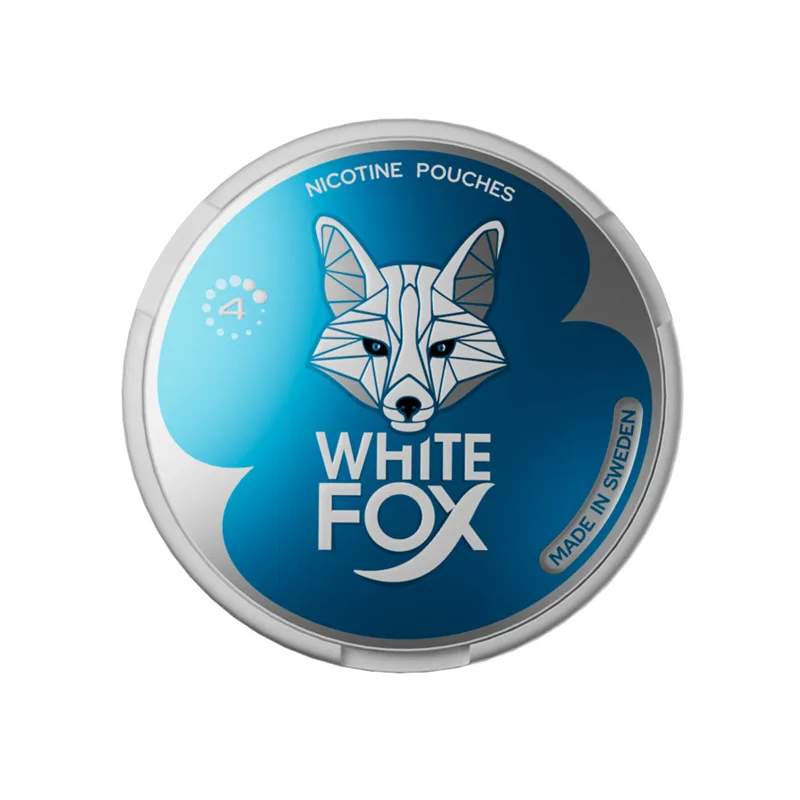
White Fox · 3mg–9mg · 10-can pack
Read the full guide
White Fox Mint Nicotine Pouches
£34.90
✔ In stock — ready to ship
100% tobacco-free
Free over £20
Same-day dispatch
Secure checkout
White Fox Mint is the listing with no qualifier attached. Not double, not peppered, not spear, not black — just Mint. We sell it as a box of ten cans at £34.90, in three declared strengths: 3mg, 6mg and 9mg. Each of those three costs the same £34.90, so the figure you pick has no effect on what you pay. It is in stock on our shelf as this page is written.
An unmodified name is an odd thing to sell, because it tells you both the most and the least. The most, in that nobody could misread what family this belongs to. The least, in that every other can in the brand's mint group tells you something extra about itself in its name and this one declines to. Whether that is a virtue depends entirely on what you want from a product name, and this page tries to be useful about that rather than clever.
The full guide to White Fox Mint Nicotine Pouches
5,002 words on how it eats, who it suits, how to serve it and what to put beside it.
The plainest-named can in the line
Three shelves carry it on our site. It appears under our mint listings, of which there are 148, under the medium-strength band of 135 products, and on the brand page holding all six White Fox cans we carry. Between those three you can see most of what there is to see about where this sits, and the remainder of this page fills in the practical detail.
How a portion behaves once it is in
This is the section that matters most to people who already use the format, and it is also the section where nothing needs dressing up, because the facts are ordinary and verifiable.
The portion is the slim type. Slim means narrow and long — a thin rectangle with softened ends rather than a broad cushion. It has some give to it when you press it, holds the shape you give it, and weighs almost nothing. Against the wider portions some houses use, the difference in bulk is immediate and is usually the first thing anyone notices when changing brands, ahead of anything to do with taste.
Placement is the same as any other slim portion: between the upper lip and the front of the mouth, lying flat along the lip line. Centred or to one side is a matter of preference, and people tend to settle into one and stay there. Within twenty or thirty seconds most people stop registering the physical presence of it entirely and are only aware of the flavour. A portion that keeps announcing itself has usually gone in folded or been pushed too far towards the corner of the mouth; straightening it out and reseating it flat resolves nearly every case.
Duration is the question with the least satisfying answer. What people describe runs from about twenty minutes at the short end to something approaching an hour at the long end, clustering in the middle. The taste is at its most defined early — the first five to ten minutes carry most of it — and then declines gradually, so the last stretch is faint. Some people go the full hour out of routine rather than because much is still happening. Others take one out well before the half hour because they have had what they wanted from it. Neither approach is correct. We are not going to suggest a duration, because it is not a thing a shop can sensibly have an opinion about.
Moisture is the other characteristic regular users tend to ask about. These sit on the drier end of the range we carry. A drier portion opens more gradually than a very wet one, feels lighter in the mouth over a long sitting, and is less inclined to make itself felt as a physical weight. If your last box was a wet one, expect the opening minute here to be more restrained. That is the design of the format rather than a shortfall in the can, and it catches people out often enough to be worth flagging before you judge a first portion thirty seconds in.
Practicalities during use: it stays put while you talk, and it stays put while you drink, though a hot drink will move things along faster than a cold one. Taking one out is a matter of hooking it with a fingertip; it lifts in one piece rather than breaking up, which is the whole point of how these are constructed.
Mint as a taste — and what our records will not tell you
Described honestly, what is here is mint in its cool, sweet-leaning form. The aroma on opening a can is clean and confectionery-like rather than green or herbal. The taste that follows reads as mint without a second character alongside it, which is more or less what the unqualified name suggests. It is not fruit, not spice, not liquorice and not a dark register of anything.
Now the limitation, which we would rather put in the middle of the page than bury at the bottom. Our catalogue records exactly one flavour tag for this product: mint. It records exactly one flavour tag for White Fox Double Mint as well: mint. Likewise for White Fox Peppered Mint and for White Fox Spearmint. Four cans, four different names on the lids, one identical tag behind all four in our data.
We are not going to pretend otherwise by writing four different sets of tasting notes and presenting them as fact. Our flavour data cannot separate these cans, full stop. What can separate them, in ordinary English, is the names themselves: a can labelled Spearmint is signalling the softer, sweeter mint character that word normally carries; a can labelled Peppered Mint is signalling something sharper alongside the mint; a can labelled Double Mint is signalling two mint characters layered together; and this can, labelled simply Mint, is signalling none of those qualifications and is presumably the brand's baseline version of the family.
Read that paragraph as what it is — an interpretation of four product names, offered as an interpretation. It is not a measurement, it is not a tasting panel, and we are not going to upgrade it into one by writing it more confidently. If you want a real answer about how these four differ in the mouth, the only route is to try them and form your own view, and a great many people with a shelf of White Fox cans have done exactly that.
One more thing worth being straight about: our mint shelf holds 148 listings from every brand we carry, and that single tag is doing the same flattening job across all of them. A shelf that broad is a starting point for browsing, not a statement that everything on it tastes alike.
Against the other cans at the same end of the shelf
The comparison most people actually want is not this can against the idea of a mint can. It is this can against the specific things sitting near it, using only the information we can substantiate.
Price is the one dimension where our records are exact, so start there. This box is £34.90. Among the listings nearest to it you will find SYX Cool Mint at £29.90, Klint Arctic Mint at £36.90, the 77 apple-and-mint can at £39.90, XQS Arctic Freeze at £39.90, Edge Spearmint at £14.95 and Velo Bright Spearmint at £4.19. All were available at the time of writing.
Those figures look incoherent side by side, and there is a simple reason. They are not all pricing the same quantity. Our file records this listing as ten cans and says so explicitly. For the neighbours it records a price and a stock position and nothing about how many cans that price covers. So we will not turn any of them into a cost per can, because that would mean inventing the denominator. The practical instruction is short: before you compare two prices anywhere in this shop, open both pages and read what each price actually includes. People who skip that step reliably mislead themselves, and the £4.19-to-£39.90 spread above is exactly the trap.
Flavour family is the second comparable dimension. Several of those are mint-family listings, so a shopper browsing the mint shelf might reasonably have all of them open at once. Others on the same neighbour list are deliberately nothing like a mint: Fumi Dark Spice at £27.90 sits in a spiced register, UBBS Cola Ice at £19.95 in the cola family, the Pablo Silver Edition blueberry and peach can and the Nordic Spirit berry listing at £4.49 in fruit. They appear alongside this one because plenty of people want one can of mint and one can of something that is emphatically not mint.
Format is the third. Portion width, depth and moisture vary noticeably between houses, and that variation is often what people actually feel when they switch, even when they attribute it to flavour. Our records do not carry portion dimensions for each brand, so that observation is offered as a general property of the category rather than as a specific claim about any can linked above.
And the fourth dimension people want — which is best — is the one we will not supply. We hold nothing that would let us rank any of those cans against each other, so a ranking from us would be either invention or one person's preference wearing a shop's name. You will find prices, pack sizes, flavour families and stock flags on this site, and you will not find a scoreboard.
What is worth saying on the other side is how much stays identical across that whole list. Every can there has a screw lid and a disposal compartment. Every one is placed and removed in the same way. Every one is stored the same way, disposed of in the same bin, and sold under the same age rules. The real choice is narrower than the shelf makes it look, and it comes down to flavour family, portion format, the declared figure, the pack size and the price.
Three figures on the label and what a figure is worth
This listing carries 3mg, 6mg and 9mg. There is no 12mg version of the plain Mint can on our shelf, which is a documented difference from two of its siblings and one we will come back to.
| Declared figure | Box price | Cans in the box |
|---|---|---|
| 3mg | £34.90 | 10 |
| 6mg | £34.90 | 10 |
| 9mg | £34.90 | 10 |
A printed figure is a declaration by the manufacturer about that product. That is the whole of what it is. It does not translate across brands — two cans from different houses printed with the same number are not thereby equivalent, because there is no single convention forcing them to be. And it says nothing whatever about any particular person, because a number on a can cannot know anything about the person holding it.
Our strength shelves exist because 385 listings need sorting somehow, and the printed figures are the only consistent thing available to sort them by. This can sits in the medium band with 135 others; the Strong shelf and the Extra Strong shelf hold listings whose printed figures fall higher. Those shelves are filing, not a staircase. We do not present movement between them as a direction of travel, and we would rather link them as plain navigation than as a suggestion.
We cannot tell you which of these three figures suits you. We hold no information about you, and a strength recommendation made from that position would be worthless. The three numbers are published so you can read them. What you do next is yours.
The can, the lid and getting rid of a used portion
The container is the standard circular can with a lid that comes off in a short twist, and the lid has a shallow compartment set into its top with a small cover of its own. That compartment is where used portions go until a bin turns up.
It fills faster than people expect — a few used portions and it is done — and a packed compartment is the ordinary reason a lid stops closing properly. If a can has started to feel like the thread is going, check the lid before you blame the can. Emptying it into general waste is the answer. Used portions are not recycling, they must not go down a sink or a drain, and they need keeping away from children and from animals just as firmly after use as before it.
Our records give the pack size as ten cans and do not record how many portions sit inside each can, so we are not going to print a portion count. The can's own label carries that number; we would only be guessing, and a guess on a product page reads like a fact.
A single can travels easily — jacket, jeans, bag pocket, no bulk to speak of. Ten cans is drawer territory rather than pocket territory. Most box buyers carry one and store nine, which is worth planning for on the day the box arrives rather than a fortnight later.
Using a shelf of 148 mint listings without losing an afternoon
Our mint shelf is the largest flavour shelf on the site by a distance. One hundred and forty-eight listings is more than anybody is going to read through, so here is how the filing actually works and how to cut it down.
The tag is coarse. As already admitted, four cans from this one brand share it, and the same coarseness applies across every other brand on that shelf. Anything a manufacturer has presented as a mint of any description ends up there — spearmint names, peppermint names, arctic and frost names, and cans like this one with no qualifier at all. The shelf answers the question "is this in the mint family" and nothing finer than that.
The productive way to use it is to cross it with a second shelf rather than to read it end to end. Combining it with the medium band cuts it to the listings whose printed figures fall where this can's do. Combining it with a brand page — White Fox, or one of the bigger ranges like Pablo — cuts it to one house's interpretation of the family. Either of those gets you to a shortlist in a couple of clicks, which no amount of scrolling will.
What the shelf cannot do is rank. There is no ordering on it that means "most minty" or "best mint", because we hold no data that would produce one and we are not going to fabricate the ordering to make browsing feel more decisive. The shelf is a filter. The comparison is still yours to make from the individual listings, which is why the prices, pack sizes and declared figures are set out plainly on each one.
What a product name can and cannot carry
It is worth pausing on naming, because this particular can raises the question more sharply than most and because it affects how you should read every flavour description in our shop, not just this one.
A name printed on a lid is a decision made by a manufacturer for commercial reasons. It is not a specification, it is not regulated in the way a declared figure is, and there is no body ensuring that two products sharing a word share a character. When a can says Spearmint and another says Peppered Mint, the difference in those two words is real as a naming difference and only presumptively real as a difference in the mouth.
The unqualified name on this can is an interesting case of exactly that. Read one way, it says: this is the house baseline, the version with nothing added to the description. Read another way, it says nothing at all beyond the family. Both readings are available, and our records cannot adjudicate between them, because our records contain one word about this can's flavour and that word is the family name.
The reason we labour this is practical rather than philosophical. People arrive at pages like this one expecting the description to settle a decision, and on a shelf of four same-brand cans with one shared tag, no honest description can. The best a shop can do is be clear about the shape of its own ignorance and let you decide with that in view — which is a less comfortable page to read, and a more accurate one.
Opening the first can out of a new box
Ten cans arrive sealed. The first one has a thin protective membrane sitting under the lid, and it comes away in one piece if you lift it from the rim rather than the middle. Started from the centre, it tends to tear and leave fragments to pick out — a minor annoyance rather than a problem, but easily avoided.
Portions sit packed in a ring inside. The first is snug and the rest come away easily, and any portion that arrives slightly compressed can be rolled once between finger and thumb to even it out before placing. That small habit makes the difference between a portion that lies flat and one that sits oddly.
On a box of ten, there is one extra consideration that a single can does not raise: order of use. There is no reason to rotate cans and no meaningful difference between the first and the last, provided the box has been kept somewhere cool and dark. The only thing that changes a can is mistreatment, not age on a sensible shelf. Open them in whatever order you like and store the rest properly.
Where the plain Mint can sits among the six White Fox listings
Six products from this brand are on our shelves, and comparing them properly takes about a paragraph once the marketing is stripped out.
Four of the six carry mint-family names — this one, the Double Mint box, the Peppered Mint box and the Spearmint box. A fifth, White Fox Black Mint, is the darker-named member of the group. The sixth, White Fox Full Charge, carries no flavour word in its name and, in our catalogue, no flavour tag either — we hold nothing at all about how that one tastes, and we say so on its page too.
Every one of the six is £34.90 for ten cans, and every one was in stock as this was written, so price and availability tell you nothing about which to choose. The genuine differences are in the declared figures. This can offers 3mg, 6mg and 9mg. Double Mint and Peppered Mint each add a 12mg to that spread. Spearmint takes the unusual route of offering 6mg and 12mg only, skipping the figures in between. Full Charge is a single 16mg, which is why it files under Strong rather than medium.
If you already know which printed figure you are after, that paragraph narrows six cans down faster than anything else on this page — and notably faster than any amount of prose about flavour, given that four of the six share one tag between them.
Cans people keep in the drawer next to this one
Ten cans of one thing is a substantial run of the same flavour, and most people who buy boxes keep something unlike it within reach.
Within the brand, the easy pairings are the siblings, all at the same £34.90 in the same ten-can format: the Black Mint listing for the one whose name points somewhere else, or Spearmint if you want a different mint name at identical cost. Whether those two taste meaningfully different from this one is, as established, not something our data can settle.
Outside the brand, contrast is the usual motive. The UBBS cola can and the Fumi spiced listing are both a decisive break from mint. The Pablo blueberry-and-peach can at £39.90 and the Nordic Spirit berry option take the fruit route. The 77 apple and mint can sits in between, being a mint with a fruit alongside it.
If you would rather stay in mint but sample how another house builds one, the SYX cool mint listing, the Klint arctic can, the Edge spearmint option and the XQS freeze can are the closest four on our shelves. All were in stock at the time of writing, and all, once again, need checking for what their prices actually cover.
Looking after a box of ten
Everything sensible about storage follows from one fact: these are moist products in sealed containers, and what ruins them is drying out.
Heat and light are the enemies, so cool and dark is the rule. A drawer, a cupboard, a shelf out of the sun — all fine. A car in summer is the worst place available to you, and a sunny windowsill runs it close over a longer period. The damage is invisible until you open a can and find the portions stiff and the taste short, at which point nothing can be done about it.
Lids go back on and get screwed down between uses. An open can deteriorates faster than a closed one and an open can in a bag redistributes itself across the bag. Refrigerating spare cans is something some people do; it is a preference, not a requirement, and unopened cans in a dark drawer at room temperature keep perfectly well. Stability beats cold — repeated warming and cooling does more harm than simply leaving a can alone somewhere ordinary.
The last point is about household safety rather than product quality. Ten cans is a real quantity of an age-restricted product to have in a home. Decide where it lives — out of reach of children and pets — before the box gets put down on a kitchen counter and forgotten.
Choosing between 3mg, 6mg and 9mg, and whether a box is right at all
Two questions face you, and only one has an answer we can give.
On the figure, we have said it and we will repeat it because it is the single most important sentence on this page: we cannot advise which declared figure suits anyone. We know nothing about you, we never will, and a shop that offers strength advice from that position is simply guessing in public. What we can tell you is that the three figures cost exactly the same here, so nothing about the decision is financial. That is not universally true across our catalogue, and it is worth checking on other listings rather than assuming.
On format, the answer is factual and short. This product is sold as a ten-can box and in no other quantity. We have no single can of it. If ten cans of one flavour is more commitment than you want — particularly given that we have just spent several hundred words explaining that our data cannot distinguish this flavour from three of its siblings — then this listing is not the right entry point, and everything we stock includes plenty of listings sold in smaller amounts. Saying so costs us a sale and is still the right thing to put on the page.
Placing an order, and what happens at the door
Checkout is ordinary: pick the figure, add the box, pay. The parts that differ from unrestricted shopping are the age parts.
Buyers must be 18 or over. Age verification applies at purchase, and ID may be requested on delivery. The courier who asks and does not get acceptable proof will not hand the parcel over and has no room to make an exception. If the address is a workplace or a shared household where someone else is likely to take deliveries, plan around that, because a parcel that cannot be handed over comes back rather than being left.
Picking runs against the same stock the listing displays, so a box shown as available is a box on the shelf at that moment. If something sells out between your order and the pick, we will get in touch rather than substitute. We will not send a different declared figure or a different flavour in place of what was ordered — that decision is not ours to make on a customer's behalf.
Moving on from this page
If you are still deciding, the shelves do the work faster than more prose will. The White Fox range page puts all six cans in one view, which is the quickest way to compare the declared figures. The mint shelf is the wide view across every brand we carry. The medium-strength shelf gathers the 135 listings in this printed band.
For the adjacent bands, the Strong listings and the Extra Strong listings are linked here purely as navigation. Two of our bigger brand ranges, the Pablo shelf and the Cuba shelf, show how other houses organise a flavour line, and the full catalogue is the unsorted lot.
Questions this can gets asked
What is the difference between this and White Fox Double Mint?
Two documented things. The names, and the declared figures. This can comes in 3mg, 6mg and 9mg; the Double Mint box adds a 12mg. On taste, our catalogue tags both with the same single word, mint, and draws no distinction between them at all. We will not invent one to make this answer more satisfying than the facts allow.
Is the plain Mint milder than the others?
We do not know and we are not going to say. Nothing in our records supports ranking the four mint-named cans against each other on intensity of flavour, and the unqualified name is a naming decision by the manufacturer rather than a statement about intensity. Anyone telling you confidently which is mildest is telling you their own impression.
Why is there no 12mg?
Because this product is not offered in one on our shelf. The listing runs 3mg, 6mg and 9mg only. Two of its siblings do carry a 12mg version, so if that particular figure is what you are after, the brand does offer it — just not on this flavour name.
How many cans, and can I buy one?
Ten cans for £34.90, and no, there is no single-can version of this listing with us. Ten is the number of cans, not portions; we do not record how many portions each can holds, so we do not print that figure anywhere on the page.
How long should I keep one in?
There is no should. People describe anything from about twenty minutes to an hour, with the taste strongest in the early minutes and fading steadily after. We are not going to put a recommended duration on the page, because it is a matter of preference and a shop has no standing to direct it.
Is it a slim portion?
Yes — the narrow rectangular format that lies flat along the lip rather than the broader kind. Coming from a wider portion, the drop in bulk is normally the first thing people register about the change, before anything about flavour.
What do I do with a used one?
Put it in the compartment in the lid until you reach a bin, then general waste. Not recycling, not a sink, not a drain. Keep used ones away from children and pets — a used portion left on a surface is exactly what a curious animal goes for.
Do the different strengths cost different amounts?
Not here. All three figures are £34.90 for the ten-can box, so the choice carries no price consequence on this listing. Worth checking on other products, where that is not always the case.
Where is it made?
We do not hold that information and we are not going to guess at it. Our file covers name, brand, price, pack size, declared figures and stock, and country of origin is not among them. The packaging will tell you whatever the manufacturer chooses to print.
Is it in stock?
It was when this page was written, along with every can linked from it. Stock across a catalogue this size genuinely changes, so the availability line on the listing is the only thing worth trusting at the moment you read it. If the listing says unavailable, believe the listing.
Does a can go off?
Not in a way we can put a date on, but a can left warm, open or in sunlight dries out and the taste goes flat and short. Kept closed somewhere cool and dark, the last portion in a can is much like the first. With nine spare cans sitting at home, that matters more on a box purchase than on a single.
Can I mix strengths in one box?
No. A box is ten cans of one declared figure. Two figures means two boxes. Since every White Fox listing we hold is the same price for the same quantity, at least the sums are straightforward.
Why do four of your White Fox cans share one flavour tag?
Because that is all our catalogue holds. The tag records the family, not the variation within it, so Mint, Double Mint, Peppered Mint and Spearmint all come back as mint and nothing more. We would rather show you that limit than hide it behind four sets of invented tasting notes. The names on the lids are the manufacturer's own and reading them as ordinary English is as far as we can honestly go.
Can I take a can abroad?
Rules on carrying nicotine products differ from country to country and we do not hold a reliable list, so we are not going to tell you what is allowed where. Check the rules for your destination before travelling rather than relying on a product page. Physically, the cans travel without trouble as long as the lids are screwed down and they are not left somewhere hot.
The notices we are required to give, put plainly
- Sold only to adults aged 18 or over who already use nicotine.
- Nicotine is an addictive substance.
- This is not a licensed stop-smoking medicine and is not intended for non-smokers, anyone not already using nicotine, under-18s, or anyone pregnant or breastfeeding.
- ID may be requested on delivery, and the parcel will not be released without it.
- Keep cans, and used portions, out of reach of children and animals.
In summary
Ten cans at £34.90, three declared figures all priced the same, a slim dry-leaning portion, a lid with a disposal compartment, and a flavour tag that our catalogue applies identically to this can and three of its siblings. We have told you what the name suggests and labelled that as a reading of the name. We have told you what the figures are and refused to tell you which to pick. Where our records run out, the page says so instead of filling the gap with something that sounds better.
More from White Fox

More medium strength pouches
More mint pouches
Where this sits
White Fox Mint Nicotine Pouches appears in these categories. Browse them, or jump to something close.
You might also like